
What is a sinking fund? In simple terms, a sinking fund is a savings account created for a specific, predictable expense. It's a way to save up for a known future cost by putting aside small, regular amounts of money over time.
Think of it as giving your money a specific job with a deadline. Instead of being hit with a large bill that disrupts your budget, you prepare for it in advance. This turns a potentially stressful expense—like annual car insurance, holiday gifts, or a planned vacation—into a manageable, non-event.
Why Planned Savings is a Game-Changer
Have you ever felt a jolt of panic when a big, predictable bill arrives? Maybe it's the holiday season approaching, a large annual subscription renewal, or the cost of new tires you knew you'd need eventually. A sinking fund is your tool to eliminate that stress.
It’s about shifting from reacting to your finances to proactively managing them.
For example, imagine you want to take a vacation next year that will cost $2,400. Without a plan, you might be tempted to put it on a credit card and worry about the high-interest debt later. With a sinking fund, you can plan ahead. By setting aside $200 a month for twelve months, you’ll have the cash ready. No debt, no stress—just the vacation you planned for.
Sinking Funds vs. Emergency Funds vs. General Savings
It's easy to confuse different types of savings, but each has a specific job in your financial plan. An emergency fund is for true, unexpected crises, like a sudden job loss or an urgent medical bill. General savings is often for vague, long-term goals without a set timeline.
A sinking fund is different because it's for expenses you know are coming.
A sinking fund gives every dollar a specific job and a firm deadline. This simple shift turns saving from a passive hope into an active strategy, putting you in control of your expenses instead of letting them control you.
The key difference is the purpose. Sinking funds are for planned expenses. Here’s a simple breakdown of how these accounts compare.
| Category | Sinking Fund | Emergency Fund | General Savings |
|---|---|---|---|
| Primary Goal | Save for a specific, planned expense | Cover unexpected, urgent crises | Save for undefined, long-term goals |
| Timeline | Short to medium-term (usually < 5 years) | Immediate, unpredictable | Long-term, often flexible |
| Examples | New car, home repairs, vacation, holiday gifts | Job loss, medical emergency, urgent car breakdown | Down payment (far future), retirement top-up, "someday" goals |
| Funding Style | Regular, calculated contributions | Build to 3-6 months of expenses, then maintain | Contribute when you can, often without a set schedule |
| Withdrawal Trigger | The planned expense occurs | A true, unforeseen emergency happens | You decide to fund a long-term goal or opportunity |
Understanding these roles is the first step toward building a resilient financial plan. When you know what each account is for, you can make smarter decisions with your money.
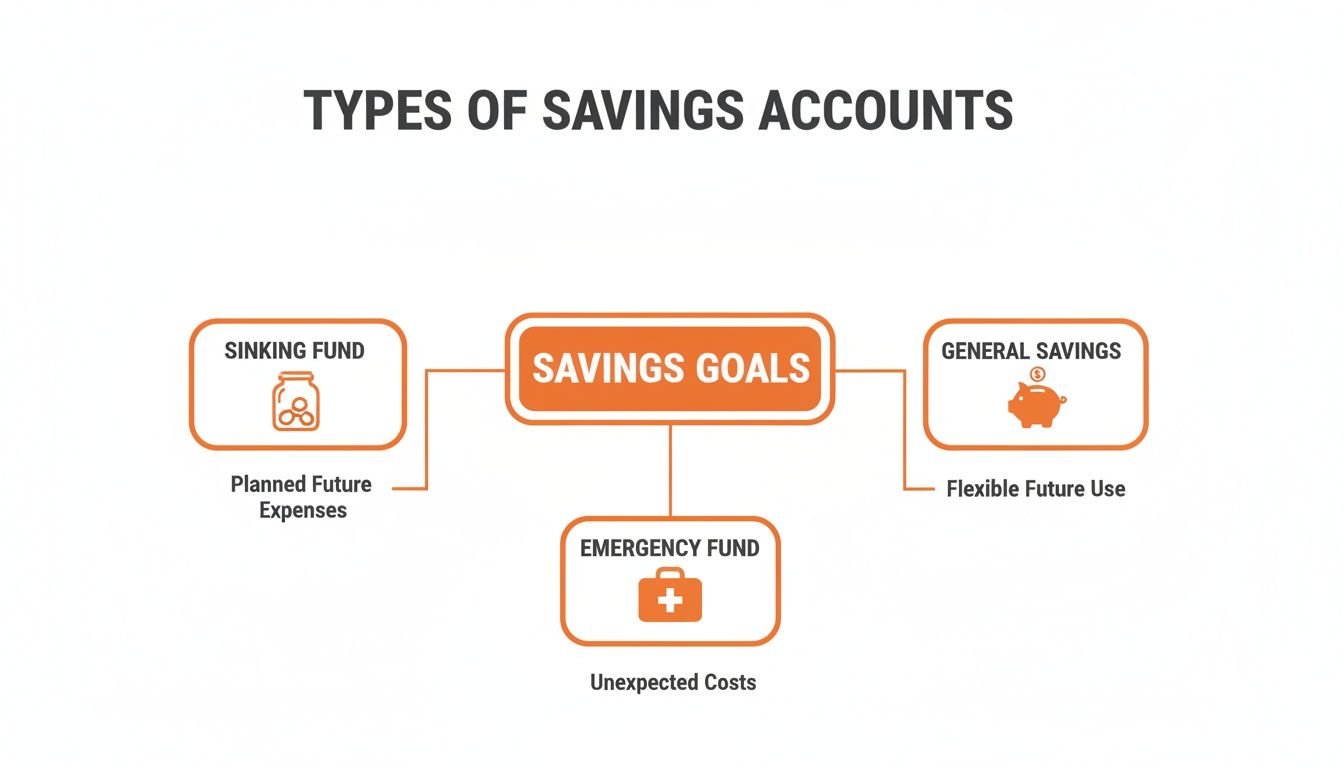
As you can see, each savings bucket has a unique job. Getting this structure right is fundamental. To see how you can organize these different savings goals within your overall financial picture, check out these powerful budget planning tools that help bring it all together.
Why Sinking Funds Are Your Best Defence Against Debt
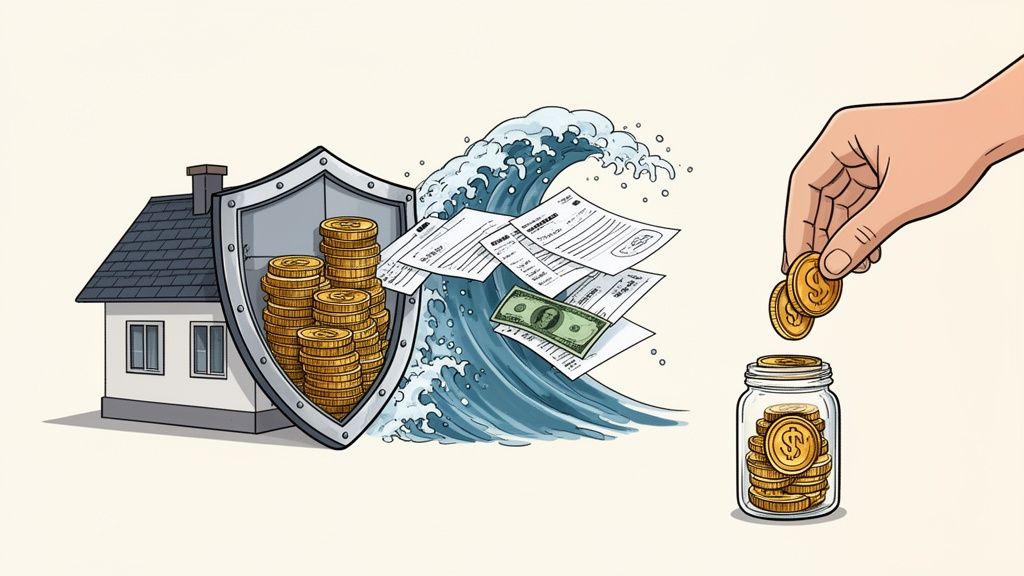
A sinking fund is more than just another savings account. It's your financial shield against future debt—a dedicated pool of money you build intentionally for large, predictable costs. This simple habit prevents you from reaching for a credit card or taking out a loan when those expenses arise.
Every dollar you put into a sinking fund is a vote for financial control. You’re making a deliberate choice to pay for a future goal with money you already have, not money you have to borrow. It’s a powerful shift that can turn money anxiety into genuine confidence.
The Real Cost of Being Unprepared
We’ve all been there: that sinking feeling in your stomach when a huge, unplanned bill arrives. It's a feeling of being overwhelmed by a cost you didn't prepare for.
Interestingly, in some places, the idea of "sinking" is more than a metaphor—it has staggering financial consequences.
For instance, in California's Central Valley, the ground is literally sinking due to excessive groundwater pumping. A study from UC Riverside revealed this land subsidence has crushed property values, causing homes in affected areas to lose between 2.4% and 5.8% of their sale price. This has resulted in an estimated $1.87 billion in lost housing value. It’s a powerful, real-world lesson in how a lack of foresight can lead to massive, unavoidable costs. You can read more about this on Stanford's news site.
Just as managing water resources can prevent the ground from collapsing, managing your money with a sinking fund keeps your budget from collapsing under pressure. Those small, consistent contributions strengthen your financial foundation, making it resilient enough to handle what’s next.
Building Your Financial Peace of Mind
At its core, a sinking fund is a tool to break the cycle of debt. Instead of reacting to large expenses with high-interest credit cards, you plan for them with low-stress savings. This one change can have a massive positive impact on your overall well-being.
A sinking fund empowers you to spend on your goals without guilt or fear. It turns large, intimidating expenses into manageable, bite-sized savings targets, putting you firmly in control of your financial future.
Knowing you have money set aside for life’s big moments—a new car, a wedding, or even a new laptop—creates a profound sense of security. It’s the difference between hoping you can afford something and knowing you can. That's what true financial peace of mind feels like.
Real-World Sinking Fund Examples You Can Use
Let's move from theory to practice and look at how sinking funds work in everyday life. The best part about this strategy is its flexibility—you can create a sinking fund for nearly any planned expense, turning a future financial headache into a simple, achievable goal.
Here are a few common scenarios where a sinking fund can be a game-changer. By breaking down these costs, you’ll see how you can plan for them with confidence and zero stress.
Car Costs
Your car is a collection of predictable expenses. You know you'll need new tires, and regular maintenance isn't optional. A sinking fund helps you get ahead of these costs instead of letting them disrupt your budget.
- New Tires: A good set of tires can easily cost $800 or more. Instead of a sudden hit to your bank account, what if you saved just $67 a month for a year? When your tread wears thin, you’ll have the cash ready.
- Annual Maintenance: Oil changes, inspections, and tune-ups add up. If you set aside $40 a month, you'll have a $480 buffer to cover routine care without touching your daily spending money.
- Next Car Down Payment: Eyeing a newer model? If you want to put $6,000 down in two years, you can get there by tucking away $250 per month. That simple habit could mean a smaller loan and lower monthly payments.
Home Upkeep and Annual Bills
Owning a home or even renting comes with a calendar of large, recurring bills. Property taxes, insurance premiums, and HOA fees are perfect candidates for a sinking fund. This approach ensures you’re never caught scrambling.
A sinking fund turns your biggest annual bills from a source of anxiety into just another line item in your monthly budget. You pay for them bit by bit, all year long, so writing the final cheque feels surprisingly easy.
Take your annual home insurance premium of $1,200. By saving $100 every month, the bill is completely covered when it arrives. The same logic works for many other expenses:
- Appliance Replacement: Your refrigerator has a limited lifespan. Saving $50 a month builds a healthy fund for the day a major appliance gives out.
- Property Taxes: A $3,600 property tax bill feels much less intimidating when you’ve been putting aside $300 a month for it.
- Membership Renewals: That $240 professional membership or streaming bundle is easily handled by saving $20 a month.
Planning for Life Events
This is where sinking funds become truly powerful. They provide a clear, actionable roadmap for life's best moments, letting you enjoy them without going into debt.
Imagine a family planning their annual holiday with a budget of $1,500 for gifts, food, and travel. Using a tool like Fintrack, they can create a "Holiday Fund" and set up an automatic transfer of $125 a month starting in January. By December, the money is there, waiting to be spent.
They enjoy a stress-free celebration and, even better, start the new year with no holiday-related credit card debt. It’s a simple strategy that makes a huge difference.
Your Four-Step Guide to Starting a Sinking Fund
We’ve covered the "what" and "why." Now for the practical part: setting up your first sinking fund. It's a straightforward process that marks the moment you shift from thinking about your goals to actively building toward them.
These four steps will turn a large financial goal from a vague idea into a real, achievable plan.

Step 1: Pinpoint Your Goal
First, decide exactly what you're saving for. A vague goal like "save more money" lacks direction and makes it easy to lose focus.
Be specific. Are you saving $3,000 for a down payment on a car? $1,500 for a family holiday? Or $600 to cover your annual car insurance premium? Give your fund a name and a target number. This isn't just about labeling; giving your goal a clear purpose is what keeps you motivated.
Step 2: Do the Math
With a clear goal, it's time for some simple math. All you need is your target amount and your timeline.
Let's say you want to save $2,400 for a new laptop in 12 months. The calculation is simple:
Total Goal ÷ Number of Months = Monthly Contribution $2,400 ÷ 12 = $200 per month
Breaking it down into a manageable monthly target makes the goal feel much less intimidating. You now have a clear path forward and know exactly what you need to do each month to succeed.
This kind of proactive planning is a powerful buffer against both personal and larger economic factors. For instance, some homeowners in California's Central Valley have seen property values fall by up to 5.8% due to land subsidence, an issue linked to groundwater depletion that has caused billions in damage. A sinking fund helps you prepare for both personal expenses and these larger, regional shifts. You can see the full findings in this research on sinking home prices from UC Riverside.
Step 3: Automate Your Savings
This is the key to consistency. If you rely on remembering to move the money yourself each month, life will eventually get in the way. The most effective way to build your fund is to automate it.
Set up an automatic transfer from your checking account to your savings account for every payday. This "pay yourself first" strategy works because the money for your goal is saved before you even have a chance to spend it.
Step 4: Watch It Grow
Finally, track your progress. Seeing the balance increase is a powerful motivator. It’s tangible proof that your small, consistent efforts are paying off.
Apps like Fintrack are designed for this. You can create and name specific goals within the app, linking your savings account to get a clear visual of how close you are to your target. Seeing everything in one dashboard keeps you focused.
Moreover, Fintrack can help you reach your goals faster by identifying extra cash in your budget, like forgotten subscriptions you can cancel. When you explore savings strategies and goals within Fintrack, you’re not just saving—you’re building a system that celebrates every small win along the way.
Common Sinking Fund Mistakes to Avoid
Starting a sinking fund is a significant step toward financial control. However, a few common mistakes can derail your progress. Knowing these pitfalls ahead of time makes it easier to stick with your plan and achieve your goals.
One of the most frequent mistakes is setting vague goals. A fund labeled “Future Stuff” lacks the focus needed to stay motivated. Without a clear target, it’s too easy to dip into that account for an impulse purchase, undermining the purpose of saving.
The Temptation to Borrow
Another common error is treating your sinking fund like a backup checking account. You might tell yourself you’ll just “borrow” from your vacation fund for a dinner out, promising to pay it back later. This habit creates small financial leaks that will slowly drain your savings.
This is why keeping your funds separate is crucial.
To avoid raiding your savings, you need to create a psychological barrier. Open a dedicated, named high-yield savings account—like ‘2027 Car Down Payment’—and the money immediately feels off-limits for anything else.
That mental separation is a powerful tool for building discipline. When your money has a specific job, you’re far less likely to use it for anything else.
Forgetting to Automate and Track
Perhaps the biggest mistake is failing to automate your contributions. Relying on willpower to move money each month is a recipe for inconsistency. Life gets busy, and it's easy to forget or decide you’ll “do it next month.”
Here’s how to sidestep these common errors:
- Get Specific: Instead of a generic “Car Fund,” name it “New Tires Fund - $800 Goal.” A clear, measurable target gives you something concrete to work toward.
- Set It and Forget It: Always automate your transfers. Schedule a recurring deposit right after every payday so your fund grows without you having to think about it.
- Keep It Separate: Use a different savings account for each major sinking fund. This simple trick prevents you from accidentally spending money meant for other goals.
- Watch It Grow: Check your balance regularly. Seeing the number climb is a fantastic motivator that reinforces your good habits.
Using an app like Fintrack can help you avoid these mistakes. By creating visually separate goals within the app, you can easily track each fund’s progress, building the discipline needed to stay focused. It keeps your goal money mentally separate from your everyday spending cash, making it easier to succeed.
Achieving Financial Peace of Mind with Sinking Funds
Let's reframe how we think about sinking funds. They are not about restriction; they are about freedom. It’s a method to give yourself permission to spend on your goals—without guilt or anxiety—because the money is already there, waiting.
This isn’t a niche financial trick; it’s a strategy used at the highest levels. The government of California, for example, uses a massive sinking fund called the Budget Stabilization Account (BSA) to manage the state's financial fluctuations. Facing leaner years, the state planned to draw approximately $12.2 billion from its reserves over the last two fiscal years to maintain essential services. You can see the full breakdown in the official 2026-27 budget summary.
The real power of a sinking fund is the quiet confidence it gives you. When you know you’re prepared for what’s coming, a huge source of financial stress just melts away.
That same logic works for your personal finances. By consistently setting money aside for specific goals, you build your own buffer against both planned expenses and life's curveballs. It’s about creating a solid financial front for your family, and you can explore how Fintrack simplifies planning for multiple goals to get everyone on the same page.
Getting started is simpler than you might think. You don’t need a perfect, all-encompassing system from day one.
Your First Step to Financial Freedom
Ready to trade financial worry for confident action? Start small.
Think of one goal you want to achieve this year. It could be anything. Now, open a separate high-yield savings account just for that, give it an inspiring name, and set up your first automatic transfer. That’s it.
You can even let an app like Fintrack handle the work of tracking that first sinking fund for you. By taking this one small step, you're doing more than just saving money—you're investing in your peace of mind, one planned purchase at a time.
Sinking Fund FAQs: Your Top Questions Answered
Understanding what a sinking fund is is one thing, but putting it into practice can bring up more questions. Let's answer some common ones so you can start saving with confidence.
How Many Sinking Funds Can I Juggle at Once?
The number of sinking funds you can manage depends on your personal preference. A good starting point is one or two of your most important goals. This keeps things manageable and helps you build the habit without feeling overwhelmed.
Once you're comfortable, you can add more. A good budgeting app can be very helpful here, allowing you to create digital "jars" for each goal so you can see exactly where your money for the new car, the holiday, and property taxes is going.
Where’s the Best Place to Keep My Sinking Fund Money?
You should keep this money separate from your daily checking account. The best place is a separate high-yield savings account (HYSA).
This approach has two main benefits. First, it keeps the money "out of sight, out of mind," reducing the temptation to spend it impulsively. Second, an HYSA pays you interest, giving your savings a small but steady boost and helping you reach your goal a little faster.
You can then link that HYSA to a tool to watch all your funds grow in one place.
Should I Focus on a Sinking Fund or Paying Off Debt First?
This is a common financial dilemma. If you have high-interest debt, like a credit card balance, paying it down should be your priority. The interest you're paying on that debt is almost certainly higher than any interest you could earn in a savings account.
But you don't always have to choose one over the other. You can do both.
Consider a balanced approach. Continue making aggressive payments on your debt, but also set up a small sinking fund for a critical expense you know is coming up. This will prevent you from having to use a credit card again when that planned expense arrives, which is key to breaking the debt cycle for good.
Ready to stop juggling messy spreadsheets and start seeing real progress? Fintrack organizes all your accounts into one simple dashboard and makes tracking every single sinking fund effortless. Start building your financial peace of mind with Fintrack today.