
A Health Savings Account (HSA) is a personal savings account for healthcare expenses, but it comes with some seriously powerful tax benefits. Imagine a savings account that also works like an investment account, all while giving you three different tax breaks.
Think of it like this: your friend pays for a doctor's visit with after-tax money from their checking account. You pay for the same visit with your HSA, using money you didn't pay taxes on. This simple difference can save you hundreds or thousands of dollars over time.
Understanding the Health Savings Account
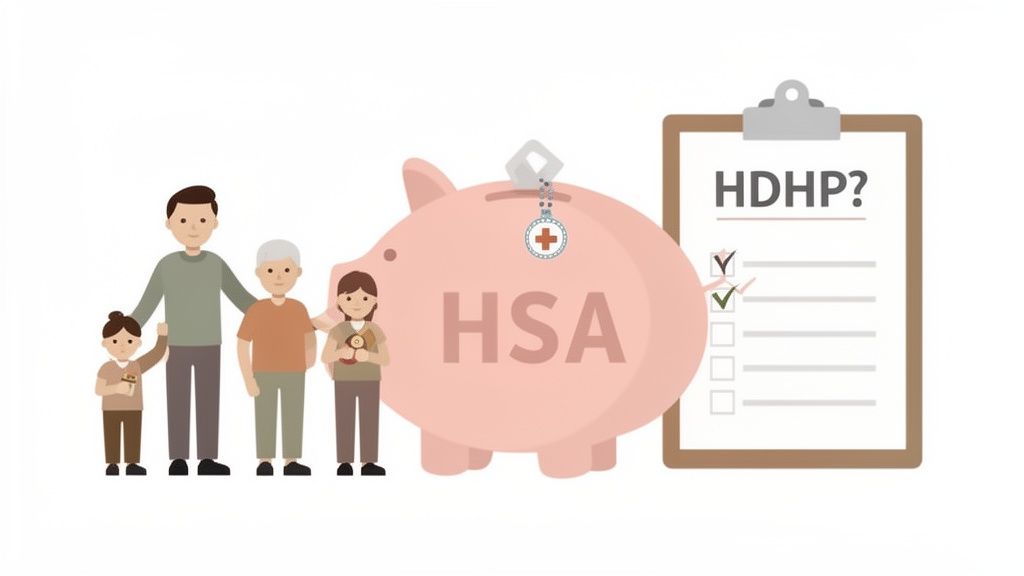
So, what exactly is a Health Savings Account (HSA)? It’s a tax-advantaged account you can use to pay for qualified medical costs. To open one, you must be enrolled in a specific type of insurance called a high-deductible health plan (HDHP).
An HDHP usually means you pay lower monthly insurance premiums. In exchange, you cover more of your healthcare costs out-of-pocket before your insurance starts paying. The HSA is designed to help you pay for that higher deductible and other medical bills with tax-free money.
But here’s where it gets really interesting: an HSA isn't just a spending account. The money you contribute is yours forever. Your balance rolls over every single year, and you can even invest the funds, making it one of the most powerful savings tools available.
Are You Eligible for an HSA?
Not everyone can open a Health Savings Account. You have to meet a few specific rules from the government.
Use this simple checklist to see if you qualify to open and contribute to an HSA in 2026.
HSA Eligibility Checklist for 2026
| Requirement | Yes / No |
|---|---|
| I am covered under a high-deductible health plan (HDHP). | |
| I have no other disqualifying health coverage. | |
| I am not enrolled in Medicare. | |
| I cannot be claimed as a dependent on someone else's tax return. |
If you can check "Yes" for all of these, you're likely eligible to start saving.
The Triple Tax Advantage of an HSA
The real magic of an HSA is its triple tax advantage, a combination of benefits you won’t find in almost any other account. Understanding these three perks is the key to turning your HSA from a simple healthcare fund into a serious financial tool.
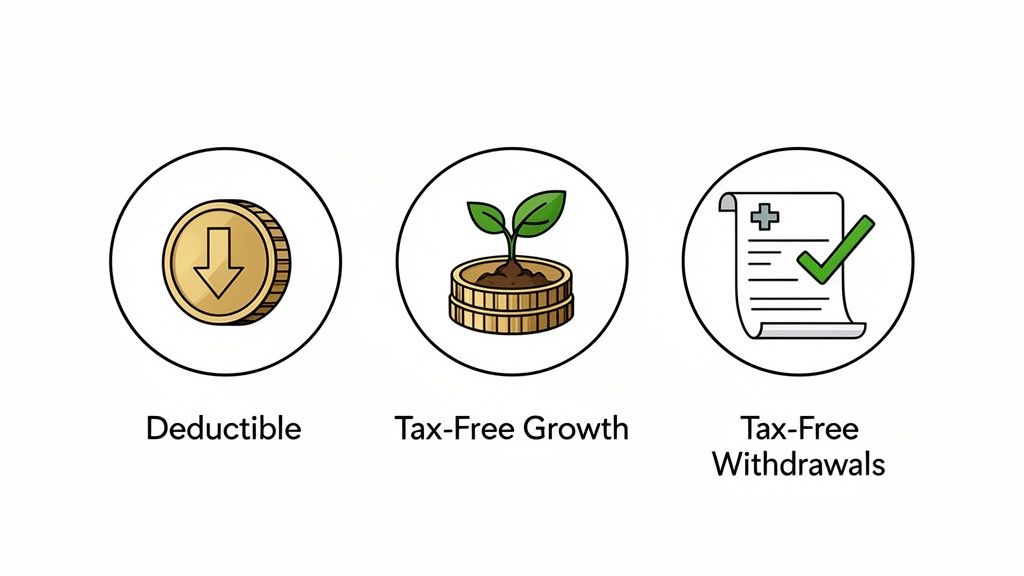
Here's what makes it so special:
- Benefit 1: Contributions are tax-deductible. Every dollar you put into your HSA lowers your taxable income for the year. This could mean you owe less in taxes or get a bigger refund.
- Benefit 2: Your money grows tax-free. Most HSA providers let you invest your funds in things like mutual funds. Any interest or investment gains your money earns are completely tax-free.
- Benefit 3: Withdrawals are tax-free. When you need to pay for a qualified medical expense—from a prescription to a dental filling—you can pull money out of your HSA without paying taxes.
This combination is what makes an HSA so powerful. Most retirement accounts, like a 401(k), give you a tax break now or tax-free withdrawals later, but not both. An HSA gives you the best of both worlds, plus tax-free growth.
Most people don't realize their HSA is a triple-tax-advantaged investment vehicle, not just a medical spending card. Many track HSA contributions as a regular expense and miss that it's one of the most powerful savings tools available—especially if you can afford to pay medical costs out of pocket and let the HSA grow.
How to Fund and Use Your HSA in 2026
Okay, you’re eligible and ready to open an HSA. Now for the practical part: getting money in and using it wisely. The government sets annual limits on how much you can contribute.
For 2026, the contribution limit is $4,300 for an individual and $8,550 for a family. If you’re 55 or older, you can contribute an extra $1,000 "catch-up" contribution.
Getting Money Into Your Account
You have a couple of easy options for funding your HSA.
- Payroll Deductions: The most common method is through your employer. You decide how much to contribute from each paycheck, and the money is moved automatically before taxes are calculated.
- Direct Contributions: You can also transfer money directly from your bank account. If you do this, you’ll claim the tax deduction for your contributions when you file your annual tax return.
What Can You Spend HSA Money On?
You can use your funds, completely tax-free, for a massive list of qualified medical, dental, and vision expenses. The list is long, but some common examples include:
- Doctor’s visits and co-pays
- Prescriptions
- Dental work like cleanings, fillings, and braces
- Eye exams, glasses, and contact lenses
- Chiropractic care and physical therapy
- Medical equipment like crutches or blood sugar monitors
Actionable Step: Maximize Your 2026 Contribution
Treat your HSA contribution like any other important financial goal. Here’s how you can do it in a tool like Fintrack:
- Set a Goal: A user recently created a goal in Fintrack's Strategies & Goals feature called "Max HSA 2026" with the $4,300 annual limit as the target. This helps them visualize their progress.
- Track Your Contributions: They also set up a recurring HSA contribution as a monthly transaction. By creating a spending cap for their "Health & Insurance" category in the Budget Planning & Tracking tool, they can ensure they’re consistently working toward their goal.
Comparing an HSA to an FSA and IRA
You’ll often see other acronyms like FSA and IRA. It's easy to get them confused, but they serve very different purposes.
HSA vs. FSA
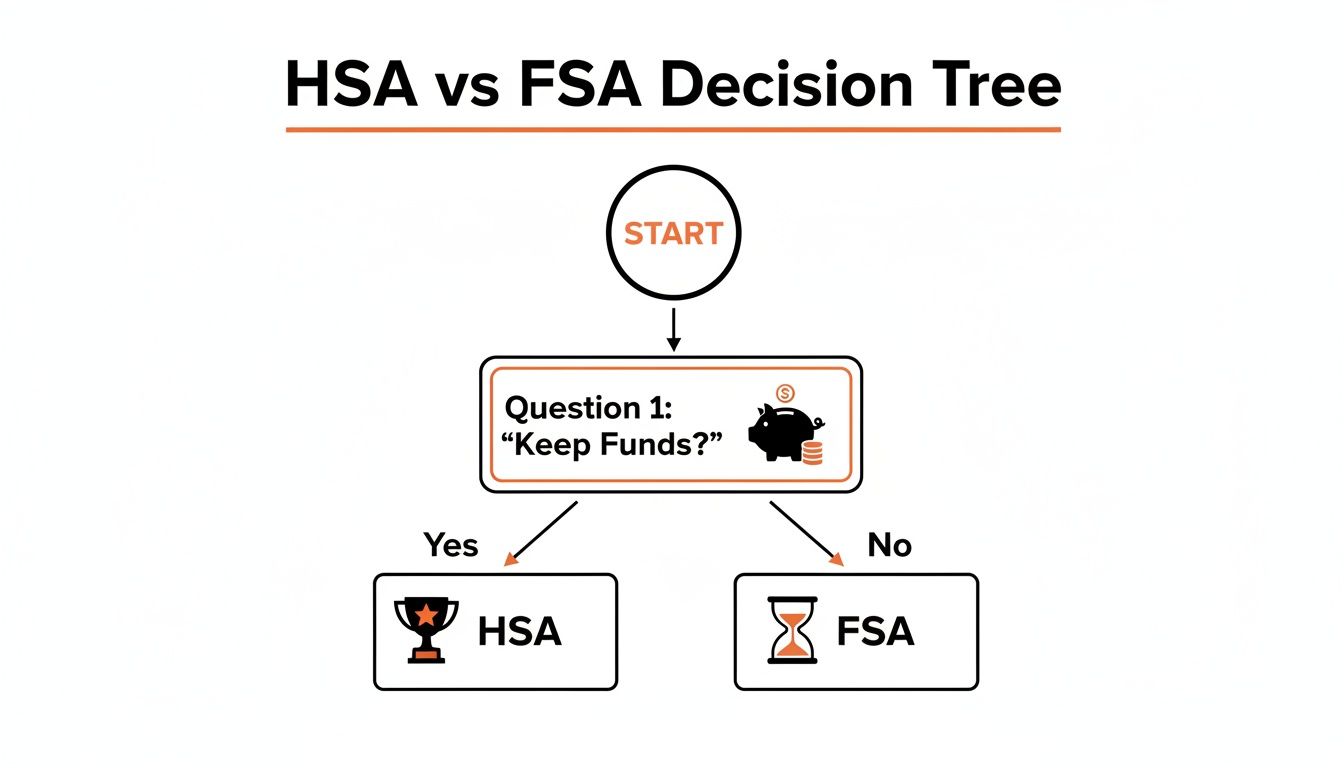
A Flexible Spending Account (FSA) also lets you use pre-tax money for medical costs. The biggest difference is ownership.
With an HSA, the account is 100% yours. The money is yours to keep forever. It rolls over year after year and goes with you if you change jobs.
An FSA, on the other hand, is owned by your employer. The funds are usually "use-it-or-lose-it." If you don't spend the money by the end of the year, you often forfeit it.
HSA vs. Traditional IRA
An HSA can also function like a retirement account, similar to a Traditional IRA. You get a tax deduction for contributions to both, and the money can be invested to grow over time.
The game-changing difference is how you take the money out. When you withdraw from a Traditional IRA in retirement, you pay income tax. With an HSA, withdrawals are completely tax-free at any age, as long as you use the funds for qualified medical expenses.
HSA vs. FSA vs. Traditional IRA Comparison
| Feature | HSA (Health Savings Account) | FSA (Flexible Spending Account) | Traditional IRA |
|---|---|---|---|
| Who Owns It? | You (the individual) | Your Employer | You (the individual) |
| Do Funds Roll Over? | Yes, indefinitely | No (typically use-it-or-lose-it) | Yes, indefinitely |
| Can It Be Invested? | Yes | No | Yes |
| Contribution Tax Benefit? | Yes (tax-deductible) | Yes (pre-tax) | Yes (tax-deductible) |
| Withdrawal Tax Benefit? | Tax-free for medical expenses | Tax-free for medical expenses | Taxed as income |
An HSA is a unique hybrid that connects your immediate healthcare needs with your long-term retirement goals.
Turning Your HSA Into an Investment Account
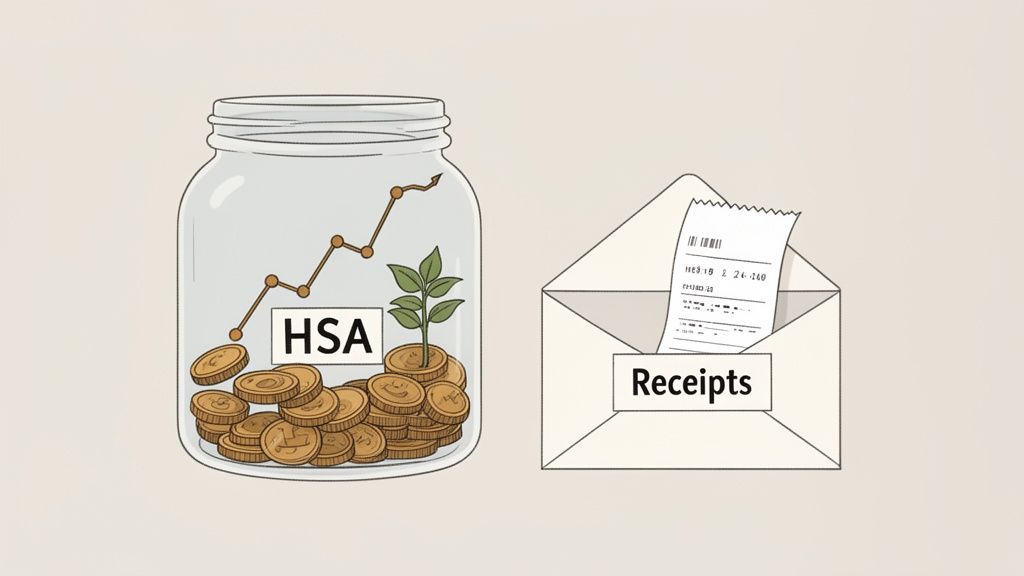
If you only use your HSA as a debit card for doctor visits, you’re missing its most powerful secret: it’s one of the best retirement accounts available. The strategy is simple: if your budget allows, pay for your current medical bills out-of-pocket instead of using your HSA.
This leaves your HSA funds untouched and ready to be invested. Most HSA providers offer investment options like mutual funds, allowing your money to grow tax-free.
The "Receipt Banking" Strategy
Ready for a more advanced technique? "Receipt banking" maximizes your HSA's long-term power. The idea is to pay for qualified medical expenses today with your own money, but—and this is the key part—save every single receipt.
Years or even decades later, you can reimburse yourself from your HSA for those old expenses, completely tax-free. This turns your HSA into a flexible, tax-free cash source for retirement.
Here’s how to put this strategy into action:
- Pay Out-of-Pocket: When you have a medical expense, use your own cash or credit card.
- Save the Proof: Keep a digital copy of every receipt and Explanation of Benefits (EOB).
- Track Your Expenses: Some Fintrack users track these unreimbursed medical expenses using a special tag or note on each transaction. This gives them a running tally of how much they can withdraw tax-free later.
- Withdraw Later: Whenever you need the cash in the future, you can pull money from your HSA tax-free, up to the total amount of the expenses you've "banked."
By using your HSA this way, it becomes one of the most versatile and tax-efficient accounts in your financial toolkit. You can explore different strategies and goals for your financial future that incorporate this technique.
How to Track and Maximize Your HSA
To unlock all its benefits, you need to actively manage your HSA. The easiest way is to integrate it into your overall financial picture.
By linking your HSA to a financial tool like Fintrack, your contributions and spending are automatically categorized. This gives you a clear, at-a-glance view of how your HSA fits with the rest of your money.
A common question Fintrack's AI Assistant, Finny, gets is, "How much have I contributed to my HSA this year?" Users ask this to check if they're on pace to max out their annual limit. Finny pulls their HSA-related transactions, sums them up, and tells them how much room is left before hitting the IRS cap—so they can adjust contributions before year-end.
This simple tracking transforms your HSA from a passive account into a core part of your wealth-building plan. While you're at it, you can check for other perks in your Benefits Wallet to ensure you’re not leaving any money on the table. Properly organizing deductible expenses is also a smart habit for tax time.
Frequently Asked Questions About HSAs
Let's tackle some common questions about Health Savings Accounts.
What Happens to My HSA if I Change Jobs?
The account is 100% yours to keep. Your HSA is not tied to your employer, so if you switch jobs, the money goes with you.
If your new job doesn't offer an HSA-eligible health plan, you won't be able to add new money to the account. But you can continue to use the existing funds tax-free for any qualified medical expenses.
What Are the Penalties for Non-Medical Withdrawals?
It’s important to use your HSA only for health expenses, at least until you're older. If you use the money for anything other than qualified medical costs before you turn 65, you’ll pay your normal income tax on that amount, plus a 20% penalty.
How Does an HSA Work After I Turn 65?
This is where the HSA becomes an amazing retirement tool. Once you enroll in Medicare (usually at age 65), you can no longer contribute to your HSA.
However, you can still pull money out tax-free for medical costs. Even better, the 20% penalty for non-medical withdrawals disappears. If you use the money for anything else, you just pay regular income tax on it, exactly like a traditional IRA withdrawal.