
Figuring out a realistic food budget can feel like guessing. So, let’s start with a solid baseline. In 2026, the average grocery cost for 1 person per month in the US falls somewhere between $300 on a thrifty plan and $570 on a more liberal one.
Of course, that’s just a starting point. Your personal spending will swing based on your diet, where you shop, and your lifestyle. Let's look at what that means for you.
Your 2026 Grocery Budget Benchmark
Let's dive right into the numbers. Knowing the national average gives you a great reference point to see how your own grocery bills stack up. The goal isn't to hit these numbers exactly, but to understand where you land.
For example, the USDA provides a few different budget levels to help you see the range. Think of them as guideposts for your spending.
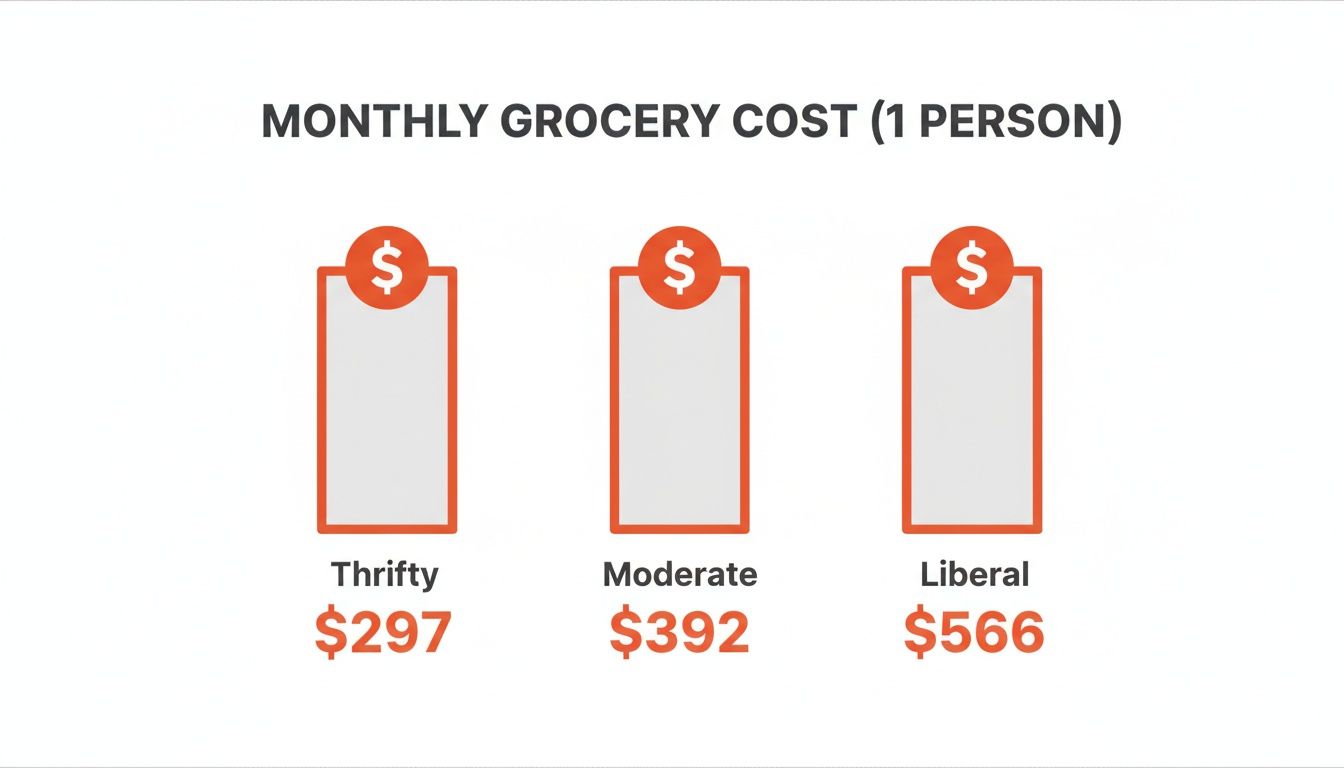
What's the big takeaway? Shifting from a liberal to a thrifty plan could put over $260 back in your pocket every single month. That’s a significant amount of cash you could redirect toward other financial goals.
Location plays a huge role, too. Someone in a high-cost urban area might spend over $600 monthly, while those in more affordable regions could be closer to the $444 mark. For a deeper look, you can find the official numbers in the USDA's official food cost reports.
If you use a tool like Fintrack, this is where the magic happens. You can compare your automatically categorized grocery spending against these benchmarks to quickly see where you stand and find opportunities to save.
What Really Shapes Your Grocery Bill
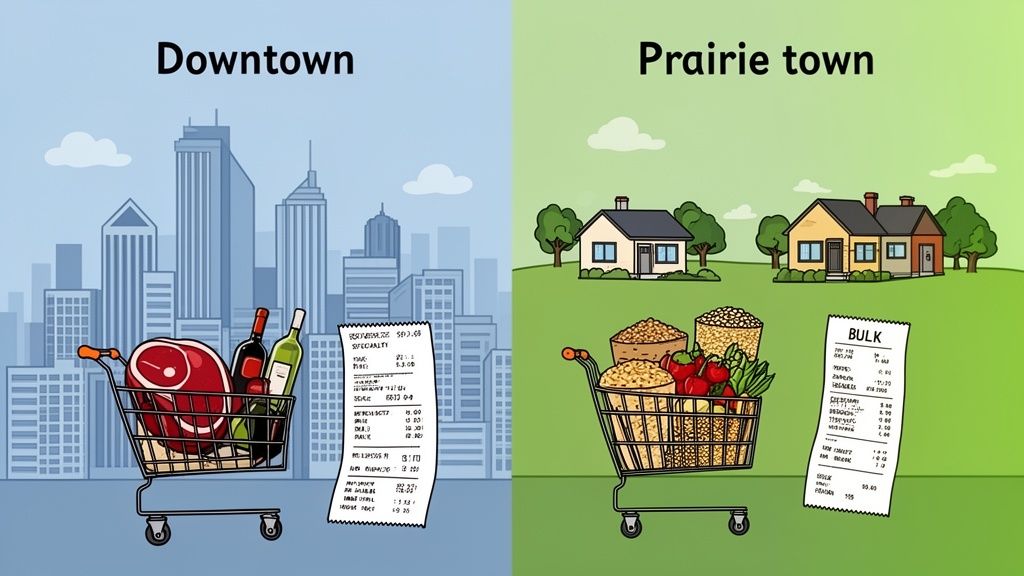
Ever compare grocery receipts with a friend and wonder why your totals are miles apart? Getting a handle on the key factors is the first step toward mastering your food budget. Your final bill is really a story told by your location, your diet, and your shopping habits.
Where You Live Matters
Your zip code has a bigger say in your food costs than you might think. Living in a major city like New York or San Francisco almost guarantees you'll pay more for staples like milk and eggs compared to someone in a small town.
Think about the difference between artisanal bread from a boutique city grocer and a standard loaf from a suburban supermarket—the price can easily be double. People in the suburbs often have better access to bulk stores like Costco, an advantage not always available to city dwellers.
Your Diet and Food Choices
What you put in your cart is probably the single biggest driver of your grocery total. Your personal tastes and dietary needs directly shape how much you spend.
For example, someone who enjoys steak dinners will have a much higher average grocery cost for 1 person per month than someone who builds meals around beans and rice. Here are a few common trade-offs:
- Plant-Based vs. Meat-Eater: A diet built on affordable plant-based proteins like lentils and tofu is almost always lighter on the wallet than one featuring fresh meat and fish every day.
- Organic and Specialty Foods: If you lean toward organic produce or specialty items like gluten-free bread, you can expect to add 10-30% to your bill.
- Convenience Items: Pre-chopped veggies and frozen dinners are fantastic time-savers, but that convenience comes at a premium compared to making things from scratch.
Your Shopping Habits and Behaviours
How you shop is just as important as what you buy. Two people with the same grocery list can walk out with very different receipts. Are you a meticulous planner, or an impulse buyer tempted by end-of-aisle displays?
If you use a budgeting app, you can see these habits in action. For example, Fintrack's AI assistant, Finny, can show you your spending trends. Just ask, "What are my top 3 grocery stores by spending?" You might be surprised by the answer.
Groceries are a major part of your variable expenses. To see how they fit into your overall financial picture, check out this guide on understanding variable expenses.
How to Find Your True Grocery Spending Average
Those national averages are a decent starting point, but they don't tell you your story. To actually make a dent in your grocery bill, you need to know what you're spending right now. Think of it like a "you are here" pin on a map.
The good news? Finding your starting point is pretty straightforward. You can do it the old-fashioned way or use an app to get an instant answer.
The Manual Method: A Step-by-Step Guide
If you don't mind a little hands-on detective work, you can calculate your average the old-fashioned way. This approach forces you to look closely at your habits.
Here’s how to do it in three simple steps:
- Gather Your Data: Pull together your bank and credit card statements from the last three months. If you pay with cash, hopefully you've been stashing those receipts.
- Isolate Your Grocery Spending: Go through your statements and highlight every transaction from a grocery store. Exclude non-food items like cleaning supplies if you can.
- Calculate Your Average: Add up the grocery totals for each month. Then, divide that sum by the number of months. For example, if you spent $450, $510, and $480, your total is $1,440. Divide by three, and your average grocery cost for 1 person per month is $480.
Once you have your average, you can drill down even further. A free cost of recipe calculator can show you how much your favorite meals are actually setting you back.
The Automated Approach: Get an Instant Answer
If sifting through receipts sounds like a chore, there's a much faster way. Modern budgeting apps are designed to do this heavy lifting for you. An app can save you time and remove the guesswork.
Fintrack, for example, can find this number for you in seconds. Once you connect your bank accounts, the Transactions with AI feature automatically categorizes your purchases.
You can then ask the AI assistant, Finny, a direct question like, "What was my average grocery cost over the last three months?" It gives you an immediate, accurate answer, so you can spend less time crunching numbers and more time saving money.
Real-World Grocery Budgets for Different Lifestyles
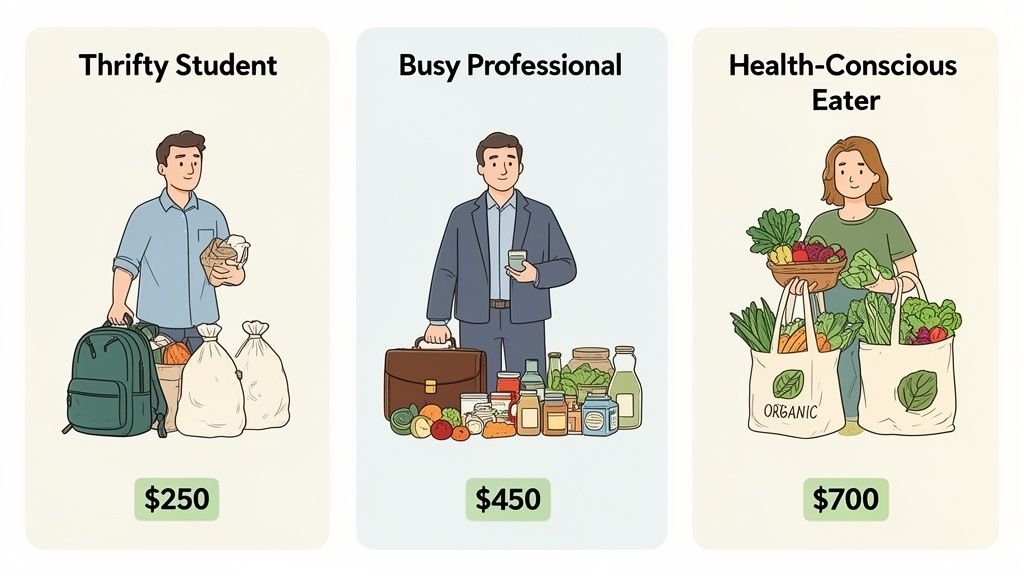
National averages don't tell the whole story. Your actual grocery bill is shaped by your lifestyle and priorities. To bring the average grocery cost for 1 person per month to life, let’s walk through a few real-world scenarios.
You'll probably see a bit of yourself in one of these examples, which can help you set a realistic budget from the get-go.
The Thrifty Student: Alex
Meet Alex. As a university student, Alex’s main goal is to keep costs down without surviving solely on instant noodles. Every dollar has a job.
- Monthly Budget: Around $250–$325
- Typical Shopping List: Bulk-bin rice, seasonal veggies from a discount grocer, store-brand pasta, eggs, and canned tuna.
- Key Strategy: Alex plans meals around weekly sales flyers and batch-cooks huge pots of chili to freeze for busy weeks. Food waste is the enemy.
The Busy Professional: Maya
Now let’s look at Maya, a professional whose biggest shortage isn't money—it's time. Her grocery spending is a mix of convenience for hectic weeknights and quality ingredients for the weekend.
- Monthly Budget: Typically lands between $400–$550
- Typical Shopping List: Pre-chopped vegetables, good-quality jarred sauces, and rotisserie chickens. She might even use a meal-kit service a few times a month.
- Key Strategy: Maya uses Fintrack's Budget Planning & Tracking to set a weekly grocery cap. This gives her the freedom to pay for convenience without letting impulse buys take over.
These different approaches highlight the massive spending range. A detailed food cost analysis shows that a single person’s monthly bill can fall anywhere from $297 to $566. That $269 difference adds up to over $3,200 a year.
The Health-Conscious Eater: Liam
Finally, we have Liam. For him, health and wellness are non-negotiable, and his grocery spending reflects that. He prioritizes organic produce and specialty foods.
- Monthly Budget: Often $600 or more
- Typical Shopping List: Organic fruits from the farmers' market, grass-fed beef, wild-caught salmon, and gluten-free bread.
- Key Strategy: Liam uses Fintrack's Transactions with AI feature to see exactly how much goes toward "Organic Produce" versus "Supplements," ensuring his money is funding his health goals.
7 Actionable Ways to Lower Your Grocery Bill
Knowing your average is the first step, but the real win is figuring out how to shrink that number. With food prices feeling higher than they were a few years ago, we're all looking for ways to save.
Here are seven strategies you can put into practice this week to get your grocery spending under control.
1. Plan Your Meals Around the Sales Flyers
Instead of deciding what to eat and then hunting down ingredients, let the weekly sales flyers be your guide. Build your menu around whatever proteins, produce, and pantry staples are on sale. This one change can easily shave 15-20% off your bill.
2. Become a Pro at Reading Unit Prices
The biggest box isn't always the best value. Look for the unit price on the shelf tag, which breaks down the cost per ounce or per item. This gives you an apples-to-apples comparison to spot the true bargain.
3. Embrace Your Freezer and Batch Cooking
Cooking in bulk is a game-changer for saving time and money. Set aside a few hours on a Sunday to make big batches of chili, soup, or lasagna. Freeze the rest in single-serving containers for an instant meal on a busy night.
4. Shop Seasonally and Locally
When produce is in season, there's more of it, which means it’s cheaper and tastes better. Berries are a steal in the summer, while squash and apples are more affordable in the fall. Hitting up a local farmers' market can also be a great way to find fresh, seasonal produce.
5. Create a "Use It Up" Shelf in Your Kitchen
Pick a spot in your fridge or pantry and name it the "Use It Up" shelf. Anything nearing its expiration date goes here. This visual cue reminds you to use that half-full container of salsa before it's too late. A significant portion of the average grocery cost for 1 person per month comes from food waste.
6. Track Your Spending in Real Time
It’s easier to stick to a budget when you know where you stand. Using an app like Fintrack lets you set a spending limit in the Budget Planning & Tracking feature and sends you alerts before you go over. The Benefits Wallet can also help you organize cashback offers so no discount gets missed.
7. Make One Smart Swap Per Trip
You don't need to change everything at once. Challenge yourself to make one smarter swap every time you shop. It could be grabbing the store-brand yogurt or picking a cheaper cut of meat. If you want to stay motivated, try a fun saving money challenge.
Using Smart Tech to Master Your Grocery Budget
Let's be honest, tracking every dollar you spend on food can be a chore. Smart budgeting tools give you a crystal-clear picture in real-time, helping you make smarter choices without the guesswork.
The best place to start is simple: create a dedicated ‘Groceries’ category in your budgeting app. An app like Fintrack does the heavy lifting by automatically sorting your purchases, so you can see your habits laid out clearly.
Get Instant Insights with an AI Assistant
Ever wonder how your grocery spending is looking mid-month? Instead of digging through receipts, modern tools let you just ask. With an AI assistant like Fintrack’s Finny, you can have a quick conversation to get the answers you need.
For example, you could ask things like:
- "Where did I spend the most on groceries last month?"
- "How am I tracking against my grocery budget?"
- "Show me my average grocery spend over the last quarter."
This turns budgeting from a daunting task into a simple check-in. It gives you the information you need to adjust your spending right away. You can learn more about detailed budget planning.
Connect Savings to Your Bigger Goals
Saving money on groceries feels more rewarding when you know what you’re saving for. This is where connecting your budget to your goals becomes powerful. You're no longer just cutting costs; you're actively building toward something that matters.
With Fintrack’s Strategies & Goals feature, you can create that direct link. Set up a goal—say, "Save $500 for a weekend trip"—and watch how the money you save at the supermarket contributes to it. Seeing that progress provides serious motivation.
A Few Common Questions
As you start dialing in your grocery budget, a few common questions always seem to pop up. Let's walk through some quick answers.
How Much Extra Should I Budget for Dietary Restrictions?
If you're managing a specific diet—like gluten-free or vegan—plan for higher costs. A good starting point is to add an extra 10-30% to your baseline grocery budget. To get an accurate number, track your spending for a month to see how much of a buffer you truly need.
Are Meal Kit Services Cheaper Than Buying Groceries?
While meal kits are convenient, they are almost never cheaper than buying the ingredients yourself. You're paying a premium for pre-portioned ingredients and curated recipes. That said, they can be a money-saver if your alternative is ordering expensive takeout multiple times a week.
What’s the Best Way to Stick to a Budget When Prices Rise?
When you feel the squeeze of rising food prices, get strategic. Focus on the habits that give you the biggest bang for your buck. Plan meals around sales, make friends with store brands, and cook in larger batches. Even small shifts can have a surprisingly big impact on your average grocery cost for 1 person per month.
Ready to stop guessing and finally see where every dollar is going? With Fintrack, you can automatically track your purchases, set spending alerts, and get instant insights from our AI assistant, Finny. Start your journey to financial clarity today.