
We've all heard the advice: "Spend less, save more." While simple in theory, putting it into practice can feel overwhelming. A saving money challenge offers a structured, motivating way to turn that advice into real results.
The key is finding the right challenge for your goals and spending habits. For some, the motivation comes from seeing a streak continue, like someone building an emergency fund through small, weekly deposits. For others, it’s the thrill of "finding" money by cancelling forgotten subscriptions and reallocating those funds.
This guide will break down 10 popular saving challenges with step-by-step instructions. You'll learn how to use tools like Fintrack to automate your progress, turning a "someday" goal into a funded reality.
1. 52-Week Money Challenge
The 52-Week Money Challenge is a year-long challenge that builds momentum gradually. You start by saving $1 in the first week, $2 in the second, and so on. By the final week, you'll save $52, for a total of $1,378 for the year.
This method gamifies saving by breaking a large goal into small steps. It’s perfect for beginners who feel overwhelmed by large savings targets.
How to Implement the 52-Week Challenge
Automation and visual progress are your best friends for this challenge. Instead of manually remembering each deposit, you can use a tool to keep you on track.
- Set Up a Goal in Fintrack: In the Fintrack app, create a new savings goal under Strategies & Goals. Title it "52-Week Challenge" with a target of $1,378. The progress ring will fill up with each deposit, providing visual motivation.
- Use Recurring Commitments: Instead of setting 52 separate reminders, set a weekly funding commitment in Fintrack. This keeps your goal visible and tracks your deposit streak, reinforcing the positive habit.
- Try the Reverse Method: If your finances are tighter near the end of the year, flip the challenge. Start by saving $52 in week one and decrease the amount by $1 each week.
- Link to a Sinking Fund: The money you save should go into a separate account to avoid spending it. You can learn more about setting up a sinking fund here.
2. No-Spend Challenge
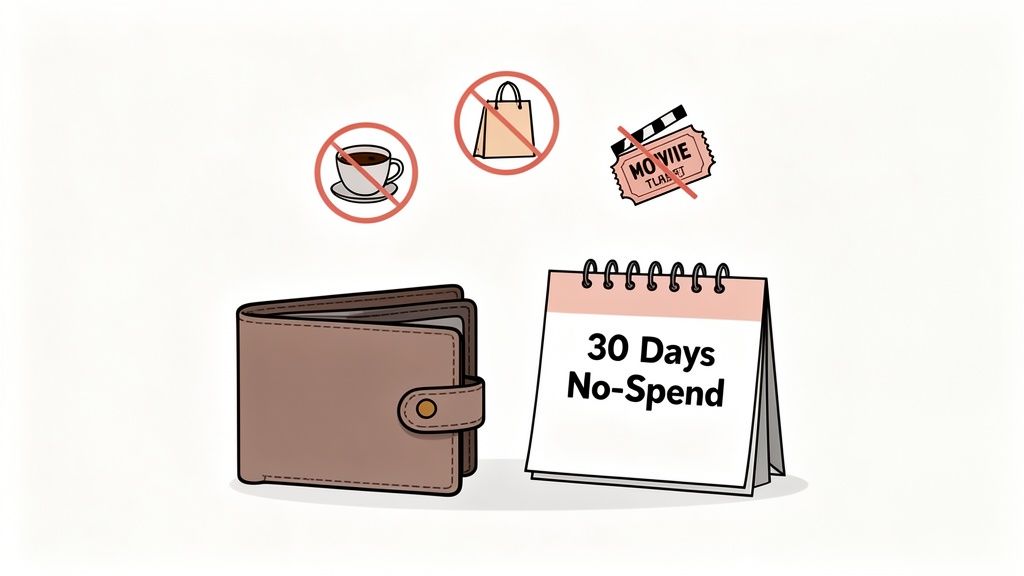
The No-Spend Challenge is a financial reset where you stop spending on non-essential items for a set period, like a week or a month. This typically means cutting out discretionary categories like dining out, shopping, and entertainment.
This challenge helps you understand your needs versus your wants. People are often surprised how much they were spending on impulse buys. The money you save can then be redirected to pay down debt or accelerate a savings goal.
How to Implement the No-Spend Challenge
A successful no-spend challenge requires clear rules. A tool like Fintrack can help you define your boundaries and monitor your progress.
- Define Your Rules: Before you start, review your past expenses in Fintrack’s Transactions view to identify non-essential categories. Your "no-spend" list might include restaurants and clothing, while essentials like groceries and rent are allowed.
- Track Your Progress: At the end of the challenge, compare your spending to a typical month. The difference is what you've saved. You can then make a one-time transfer of that amount directly into your savings goal within Fintrack.
- Plan for Free Alternatives: A no-spend month doesn't have to be boring. Look for free activities like visiting parks, borrowing from the library, or cooking new recipes.
- Learn More About Spending: If you want to dive deeper, you can explore how to manage your variable expenses to find more long-term savings opportunities.
3. Round-Up Savings Challenge
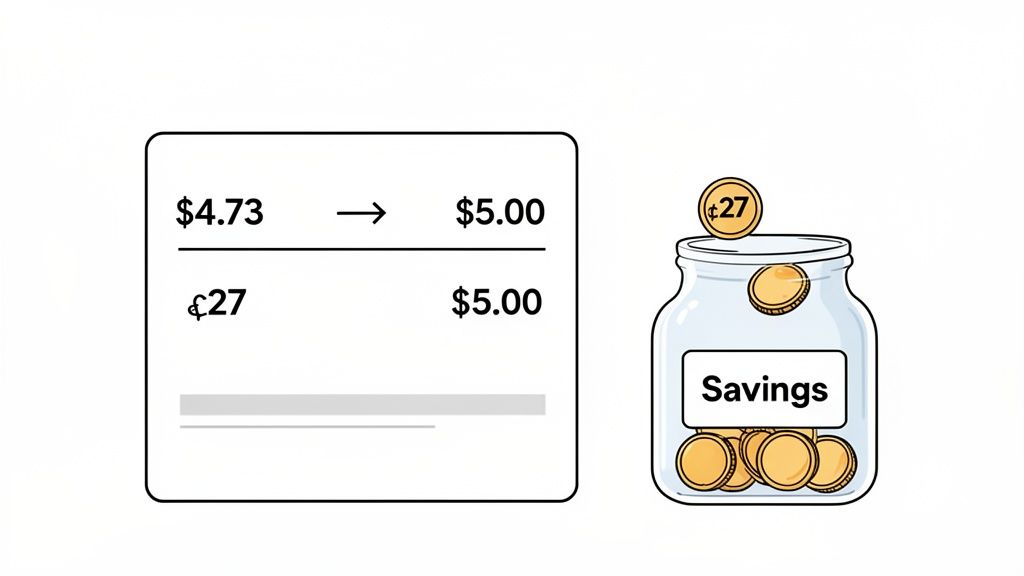
The Round-Up Savings Challenge is a passive method that turns your daily spending into savings. Every purchase you make is rounded up to the nearest dollar, and the spare change is automatically moved into a savings account. For example, a $4.73 coffee rounds up to $5.00, and $0.27 is saved.
This "set it and forget it" approach makes saving effortless. It’s ideal for people who find it difficult to put aside larger sums of money at once. Users often report saving hundreds of dollars annually just by letting their digital spare change accumulate.
How to Implement the Round-Up Challenge
Automating the process is key to making this challenge successful. Connecting your accounts and setting a clear purpose for the funds can turn small change into a significant savings pool.
- Set a Clear Goal: In Fintrack, create a specific savings goal under Strategies & Goals, like "Vacation Fund." This gives your round-ups a purpose.
- Track Your Accumulations: Connect your bank accounts to Fintrack to see your round-up savings as they happen. Fintrack’s Transactions with AI can help categorize everything automatically so you can see where round-ups are coming from.
- Identify High-Impact Spending: Use Fintrack's spending analytics to see which purchase categories generate the most round-ups. Your daily coffee or frequent grocery trips might be your biggest savings generators.
- Combine with Rewards: Amplify your savings by linking your round-up account to your rewards cards. You can track both cashback and round-up savings together in Fintrack’s Benefits Wallet, essentially saving money twice on every purchase.
4. 30-Day Spending Freeze
The 30-Day Spending Freeze is an intensive challenge designed to reset your financial habits. For one month, you spend money only on absolute essentials like housing, utilities, and groceries. All discretionary spending is off-limits.
This challenge forces you to distinguish between your needs and wants, often leading to significant savings in a single month. Many people use a spending freeze after a period of overspending, like the holidays, or when preparing for a major financial goal.
How to Implement the 30-Day Spending Freeze
Success with this challenge depends on careful preparation and real-time accountability. Using a tool to monitor your spending is critical to staying on track.
- Analyze Past Spending: Before you begin, use Fintrack's Transactions with AI to analyze your last 30 days. This gives you a clear baseline for your true essential costs.
- Set Strict Category Limits: In Fintrack’s Budget Planning & Tracking tool, create strict spending caps for each essential category (e.g., groceries, fuel). Enable alerts to notify you when you’re approaching your limit.
- Plan Your "Free" Time: Proactively schedule free activities like park visits, library trips, or at-home movie nights to avoid last-minute, budget-breaking entertainment choices.
- Track Daily Progress: Use Fintrack to monitor your spending daily. Seeing your savings add up provides powerful motivation and helps you celebrate the small wins.
5. Cashback Challenge
The Cashback Challenge reframes saving by focusing on earning "free money" from your spending. You strategically use credit cards and cashback apps to maximize rewards, then commit to saving 100% of those earnings.
This method makes you more mindful of your payment choices. By actively seeking out and saving these earnings, you can accumulate a significant sum without changing your budget.
How to Implement the Cashback Challenge
Organization and a central tracking hub are key to making this challenge work. You need a place to see all your potential and earned rewards so nothing slips through.
- Track Rewards with Fintrack: Use Fintrack’s Benefits Wallet to see all available cashback offers and credits across your connected accounts. This feature can uncover rewards you might not even know you have.
- Set Up a Dedicated Savings Goal: Create a new goal in Fintrack called "Cashback Savings." Watching the progress ring fill up with money you "found" provides excellent motivation.
- Automate Your Savings: Each month, once your cashback is credited, set up a transfer to move that exact amount into a separate savings account. This creates a clear separation and prevents accidental spending.
- Combine with Other Tools: To maximize your returns, exploring the best cashback apps can provide additional savings on your everyday purchases.
6. Subscription Audit & Cancellation Challenge
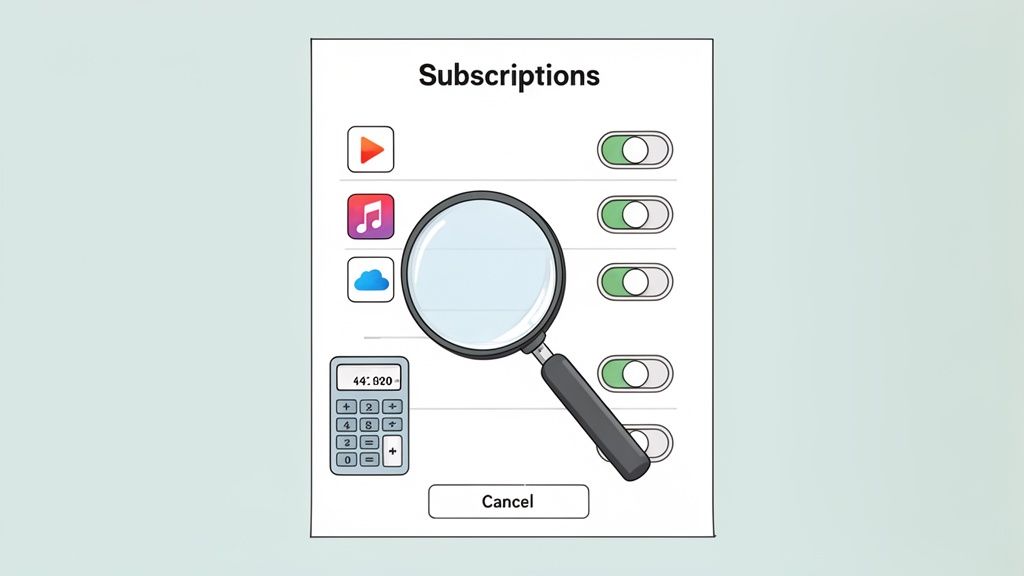
This challenge is focused on finding and eliminating recurring charges for services you no longer use. Since many people waste money on forgotten subscriptions, this audit can uncover significant savings quickly.
The challenge is perfect for anyone feeling like their money is disappearing without a clear destination. It combines discovery with direct action, helping you plug leaks in your budget.
How to Implement the Subscription Audit Challenge
Success comes from using tools to identify every recurring charge automatically, rather than digging through bank statements manually.
- Automatically Detect Subscriptions: Ask Finny, the Fintrack AI Assistant, to "find all my subscriptions." This will generate a complete list of your recurring charges so nothing slips through the cracks.
- Prioritize by Cost: Sort your subscriptions by cost. This helps you focus on the most expensive ones first, where cancellation will have the biggest impact.
- Calculate the Annual Cost: For each subscription, calculate its annual cost. A $15 monthly fee might seem small, but seeing it as a $180 annual expense provides a powerful perspective.
- Set a Savings Goal: To see the real-time impact, create a new savings goal in Fintrack titled "Subscription Savings." Transfer the money you save from each cancellation directly into this goal.
7. Envelope/Category Budget Challenge
This challenge applies the principles of traditional cash envelope budgeting to your digital finances. You assign specific spending limits to your expense categories (like groceries or entertainment) within a budgeting app. The challenge is to stay within these limits for 30 to 90 days.
This method forces you to be mindful of every dollar you spend. It shines a spotlight on where your money is going, helping you identify and plug budget leaks.
How to Implement the Envelope/Category Budget Challenge
Success comes from setting realistic limits and tracking your progress in real-time. Using a tool that automates this tracking is key.
- Set Up Your Category Budgets: Use Fintrack’s Budget Planning & Tracking. To set realistic starting points, look at your spending history from the past three months. Fintrack's AI can analyze this data to recommend initial budget amounts.
- Enable Real-Time Alerts: Turn on Fintrack’s spending alerts. You can set them to notify you when you’ve used 75% or 90% of a category's budget, giving you a chance to adjust.
- Conduct Weekly Reviews: Check in on your Fintrack dashboard weekly to see which categories are on track and which are approaching their limits.
- Share with Your Household: If you budget with a partner, use a Fintrack Household Plan. This creates transparency and shared accountability, making it easier for everyone to stick to the plan. You can discover how Fintrack simplifies this process.
8. Debt Snowball/Savings Snowball Challenge
The Debt Snowball/Savings Snowball Challenge combines debt elimination with accelerated savings. You tackle your smallest debts first for quick wins, then roll the payment amount from each paid-off debt into the next one, creating a "snowball" of funds.
Once your debts are gone, that entire accumulated monthly payment is channeled directly into savings. This transforms a debt-reduction plan into an impressive saving money challenge, causing your savings to grow quickly.
How to Implement the Debt/Savings Snowball Challenge
Visualizing your progress and automating the process are key to keeping the snowball rolling. A financial tool can help you manage the moving parts.
- List and Track Your Debts: Start by listing all your debts from smallest to largest in Fintrack. Note the total balance and minimum payment for each one.
- Create Paired Savings Goals: Set up two distinct goals in Fintrack’s Strategies & Goals section: one for "Debt Elimination" and another for "Snowball Savings Fund."
- Redirect Freed-Up Money: As you pay off each debt, adjust your budget to redirect the freed-up payment amount to the next debt on your list. Fintrack's budget tracking can help you visualize this as a new source of funds.
- Celebrate Milestones: Set up alerts in Fintrack to celebrate each time a debt is paid off. This provides a crucial psychological boost that keeps your momentum high.
9. Hourly Rate Challenge
The Hourly Rate Challenge is a psychological tool designed to change your perception of spending. You calculate your after-tax hourly wage and use it to measure the true cost of your purchases. A $50 meal isn't just fifty dollars; it's two hours of your life's work if you earn $25 per hour.
This mental shift makes the opportunity cost of spending personal. It's especially effective for curbing impulse buys by prompting you to ask, "Is this purchase really worth the time I spent earning the money for it?"
How to Implement the Hourly Rate Challenge
This challenge is about building a new decision-making habit. A tool like Fintrack can help you keep your hourly rate top-of-mind.
- Calculate Your True Hourly Rate: First, determine your net hourly wage (after taxes). For example, if your bi-weekly take-home pay is $2,000 for 80 hours of work, your rate is $25/hour.
- Frame Budgets in Hours: When setting category budgets in Fintrack, add a note translating the dollar amount into work hours. A $400 monthly dining budget becomes "16 hours of work."
- Pause Before You Purchase: Before making a non-essential purchase, do the quick math. Is that $100 pair of shoes worth four hours of your time? This simple act is often enough to differentiate a want from a need.
- Review Spending in "Work Hours": At the end of the week, review your spending categories in Fintrack and convert the total spent into hours. Seeing you spent 10 hours of work on takeout can be a powerful motivator.
10. Daily Spending Limit Challenge
This challenge promotes mindful spending by capping your daily discretionary purchases. You set a fixed amount, such as $40, that you can spend each day on non-essential items like coffee or lunch out.
This method is effective for anyone transitioning from a no-spend period back to regular budgeting. It offers structure without total restriction.
How to Implement the Daily Spending Limit Challenge
Daily tracking is the key to making this challenge work. Use a tool to monitor your spending in real time and keep your limit top-of-mind.
- Set a Realistic Limit: Use Fintrack to analyze your last 30 days of discretionary spending and calculate a reasonable daily average. Set your limit slightly below that.
- Enable Real-Time Alerts: In Fintrack, set up spending alerts for your discretionary categories to prevent you from accidentally going over.
- Track Your Progress: Ask Finny, the Fintrack AI Assistant, "How much did I spend on non-essentials today?" to check your progress against your limit.
- Check Before You Spend: Before making a purchase, open Fintrack's daily spending view to see exactly where you stand. This small step creates a crucial pause, allowing you to make a more intentional decision.
- Allow for Rollovers: For flexibility, allow one or two "rollover" days per week. If you spend only $20 on Monday against a $40 limit, you can roll that unused $20 over to a higher-spend day later in the week.
Top 10 Savings Challenges Comparison
| Challenge | Implementation complexity | Resource requirements | Expected outcomes | Ideal use cases | Key advantages |
|---|---|---|---|---|---|
| 52-Week Money Challenge | Low — simple weekly increments to implement | Regular weekly deposits, basic tracking tool | ~$1,378/year; builds consistent saving habit | Beginners, emergency/vacation fund builders, habit formation | Structured progression, easy visual tracking, steady momentum |
| No-Spend Challenge | Low–Medium — set rules and timeframe, requires planning | Willpower, tracking discretionary categories, possible social adjustments | $300–$1,000+ monthly savings; increased spending awareness | Short-term resets, breaking impulse spending, quick cash flow boost | Rapid reduction in discretionary spend, reveals true spending patterns |
| Round-Up Savings Challenge | Low — automated after initial setup | Linked card/account or app integration; frequent transactions helpful | $50–$150+ monthly aggregate; passive accumulation over time | Passive savers, frequent small-purchase consumers | Automatic, painless saving; minimal behavior change required |
| 30-Day Spending Freeze | Medium–High — strict rules and preplanning needed | Rigid discipline, essentials planning, tracking tools | $500–$2,000+ in a month; fast habit reset and prioritization | Post-overspend recovery, short-term aggressive saving goals | Clear binary rules, dramatic short-term results and motivation |
| Cashback Challenge | Medium — requires managing cards and offers | Multiple cards/accounts, reward apps, tracking to optimize | $50–$300+ monthly depending on spend; “found money” accumulation | Regular spenders wanting to optimize rewards | Leverages existing spend, scalable, compounds multiple reward streams |
| Subscription Audit & Cancellation Challenge | Low–Medium — discovery plus manual cancellations | Time to audit accounts; tools for recurring charge detection | $100–$300+ monthly immediate savings | Users with many recurring charges or forgotten trials | Immediate impact, high ROI, largely one-time effort with periodic repeats |
| Envelope/Category Budget Challenge | Medium — set up category limits and monitor | Ongoing monitoring, realistic historical spending data | Typical 10–30% spending reduction | Households or individuals seeking sustained budget control | Real-time feedback, measurable category goals, sustainable long-term |
| Debt Snowball / Savings Snowball Challenge | Medium–High — payment sequencing and reallocation | Consistent payments, debt tracking, multiple account coordination | Debt reduction leading to accelerated savings once debts cleared | Those with multiple debts seeking momentum and combined goals | Strong psychological wins, visible progress, multiplies payments into savings |
| Hourly Rate Challenge | Low — mindset shift and simple calculations | Time to calculate true hourly rate and apply before purchases | ~20–40% discretionary reduction for many users; behavioral change | People needing perspective on spending opportunity cost | Free, personalized decision framework that changes spending habits |
| Daily Spending Limit Challenge | Medium — daily engagement and monitoring required | Daily tracking, alerts, rollover management | 15–35% discretionary spending reduction; daily measurable wins | Users who prefer daily structure and short feedback loops | Immediate feedback, flexible rollover, builds daily discipline |
From Challenge to Habit: Making Your Savings Stick
Completing a saving money challenge is a fantastic achievement. But the real victory is transforming that short-term discipline into a lasting habit. The finish line of one challenge should be the starting line for a sustainable savings system.
The transition from a temporary challenge to a permanent habit is where many people stumble. The secret to making it stick lies in automation and consistency, which is how an app like Fintrack is designed to help. Lasting financial change comes from building a system where saving is the default, not the exception.
Your Action Plan for Lasting Savings
How do you make sure the progress you’ve made doesn’t evaporate? Here’s an actionable plan to lock in your new habits using Fintrack.
- Automate Your Core Savings: The single most effective action you can take is to automate your savings. Within Fintrack, this means setting up a recurring funding commitment for a goal. Start with a small, manageable weekly deposit, like $25 or $50.
- Connect Savings to Your Budget: Your budget and savings shouldn't live in separate worlds. At the end of each month, if you come in under budget, Fintrack can prompt you to transfer that surplus directly into a savings goal. This reinforces the connection between mindful spending and faster goal achievement.
- Use AI for Ongoing Optimization: Your spending patterns change. Get into the habit of asking Finny, the Fintrack AI assistant, simple questions like, "Where did I overspend this month?" or "Find subscriptions I can cut." This turns financial review from a chore into a quick conversation.
- Track Your Streaks: Motivation is a powerful tool. Instead of only focusing on the total amount saved, pay attention to your consistency. Fintrack’s streak tracking for goal contributions provides a psychological boost. Watching that streak grow builds the muscle memory needed for long-term success.
The value of mastering a saving money challenge extends far beyond your bank account. It builds confidence and reduces financial stress. You've already taken the hardest step by starting. Now, it's time to build a system that makes saving an automatic part of who you are.
Ready to turn your challenge success into a lifelong habit? Fintrack helps you build a sustainable savings system with automated goal contributions, budget-to-savings transfers, and AI-powered insights. Start building your financial future, one small, consistent step at a time, by downloading Fintrack today.