You've found a place, paid the application fee, and saved what you thought was enough for first and last month's rent. Then the move starts costing money: a truck, boxes, utility connections, tenant insurance, basic furniture, and meals on the road. By the time the keys are in your hand, your bank balance is uncomfortably close to zero.
A realistic budget for moving out needs more than a rent estimate. You need three separate targets: move-in cash, a monthly survival budget, and a post-move emergency reserve. Keep those targets separate, and you'll know whether you can afford the move, not just whether you can sign the lease.
Why Rent Is Only One Piece of the Moving-Out Bill
A first-time renter often treats moving as a one-day transaction. They calculate rent, add a deposit, book transport, and assume the expensive part is finished when the boxes arrive. That approach misses the costs that appear in clusters, especially during the first weeks.
The move-in bill can include packing materials, movers or a truck, cleaning, utility and internet setup, tenant insurance, furnishings, parking, application fees, and food while your kitchen is still in boxes. Some costs are predictable. Others are small enough to ignore individually but large enough to drain the cash you intended to use for groceries or an unexpected bill.
A useful overview of planning your moving budget also highlights why removal costs are only one part of the total. Your own budget should make those additional expenses visible before you commit to a move.
Use three cash targets
Target one, move-in cash: Money available before the keys are handed over. This covers the first rent payment, applicable deposit, moving transport, setup charges, and immediate essentials.
Target two, monthly survival: The amount needed to live in the new place each month. Rent is only one line. Add utilities, food, transport, insurance, phone, debt payments, subscriptions, and irregular costs.
Target three, post-move reserve: Cash left untouched after moving. This protects you from an income interruption, medical bill, repair, delayed deposit refund, or replacement purchase.
That separation matters because a person can reach the first target and still be unable to sustain the home. A low rent number doesn't make a move affordable if the commute consumes the savings or the setup costs leave no reserve.
Before choosing a rent ceiling, compare the full housing line with how much you should spend on rent. Then build the move around cash flow, not around the maximum amount a landlord is willing to accept.
Calculate the Move-In Cash You Actually Need
For most California rentals, the starting point changed on July 1, 2024, when Assembly Bill 12 generally limited residential security deposits to no more than one month's rent for furnished and unfurnished units. The California Department of Real Estate explains the current deposit standard, including the exception that can affect your calculation.
Start with the amount you'll need before moving day:
- First month's rent
- Applicable security deposit
- Transport, packing, cleaning, and labour
- Utility and internet setup
- Tenant insurance
- Basic furnishings and household supplies
- A small amount for application fees and immediate surprises
For a unit renting at $2,000 per month, the usual post-AB 12 baseline is $4,000, made up of $2,000 for the first month and $2,000 for the deposit. Under the former maximum for an unfurnished unit, the same renter could have needed up to $6,000 upfront. A furnished unit could have required up to $8,000.
| Cost line | AB 12, post-July 2024 | Pre-AB 12 unfurnished | Pre-AB 12 furnished |
|---|---|---|---|
| First month's rent | $2,000 | $2,000 | $2,000 |
| Security deposit | $2,000 | Up to $4,000 | Up to $6,000 |
| Baseline before other costs | $4,000 | Up to $6,000 | Up to $8,000 |
The law includes a small-landlord exception. A qualifying natural person or certain LLCs that own no more than two properties with no more than four total rental units may still charge up to two months' rent. Verify the landlord's status before treating one month's rent as your final deposit requirement.
Run your own rent example
If monthly rent is $2,201, the generally permitted deposit is also $2,201, producing a baseline of $4,402 before transport, utilities, furnishings, or insurance. This is the minimum cash calculation, not the complete moving budget.
The deposit also isn't instant spending money after you leave. California landlords generally must return it, or provide an itemized deduction statement, within 21 days after move-out. The California Department of Justice describes permitted deductions such as unpaid rent, tenant-caused damage beyond ordinary wear, qualifying cleaning, and authorised property replacement.
Photograph the unit at move-in and move-out. Keep receipts, document cleaning, and compare the final statement with the permitted categories. If you're deciding whether to buy a bed, desk, or storage space, it can help to review a complete list of expenses rather than treating furnishings as an afterthought.
Storage can also change the first-month total when your move-in date and move-out date don't line up. If you're comparing options in another market, a guide to compare UK storage unit prices shows why storage deserves its own line instead of being buried inside “moving costs.”
Build a Monthly Survival Budget That Actually Lasts
The move-in target gets you through the door. The monthly survival budget tells you whether staying there is realistic.
California commonly uses 30% of gross household income as a housing-cost affordability benchmark. In 2022, 40.9% of California households spent more than 30% of income on housing, according to the state's housing cost burden guidance. Renters face greater pressure. Among renters earning less than $75,000 annually, 83% were cost-burdened, compared with 59% of homeowners in the same broad income group. Among households earning under $35,000, 92% of renters were cost-burdened, compared with 72% of homeowners.
A California earner making $60,000 annually has gross monthly income of $5,000. Thirty percent implies about $1,500 per month for housing costs, including relevant utilities. If rent alone is close to $1,500, electricity, heat, water, internet, and other setup costs can push the household beyond that benchmark.
Use a complete monthly template
Write the recurring budget before signing:
- Housing: Rent, electricity, heating, water where applicable, internet, parking, and tenant insurance
- Transport: Fuel, public transit, vehicle maintenance, insurance, parking, and commuting costs
- Essentials: Groceries, phone, medical costs, and minimum debt payments
- Flexible spending: Subscriptions, eating out, clothing, and personal purchases
- Irregular costs: Repairs, annual fees, gifts, travel, and household replacement items
- Savings: Emergency reserve contributions and other planned goals
The 2025 California Housing Partnership report says median rent has risen 40% since 2000, while median renter income rose 9% after inflation. It also reports that average asking rent increased 3.5% year over year, and renters need to earn 2.8 times the state minimum wage to afford it. These figures explain why saving enough for the move doesn't guarantee positive monthly cash flow.
Canadian renters need to use the advertised rent for the specific unit, especially when pursuing a newly leased turnover unit. The Canada Mortgage and Housing Corporation's 2025 Rental Market Report lists October 2025 two-bedroom turnover rents of $2,696 in Vancouver, $2,547 in Toronto, $2,155 in Ottawa, $1,836 in Calgary, $1,644 in Montréal, and $1,600 in Edmonton.
Those are turnover rents, not a universal Canadian threshold. The report also gives a national average of $1,914 for a two-bedroom purpose-built rental apartment and $2,030 for a two-bedroom condominium apartment. Your budget should use the actual listing you're pursuing, then add the non-rent housing lines.
For a practical worksheet, use monthly budget planning to separate one-time move costs from recurring commitments. That distinction prevents a cheap-looking first month from hiding a monthly budget that fails immediately.
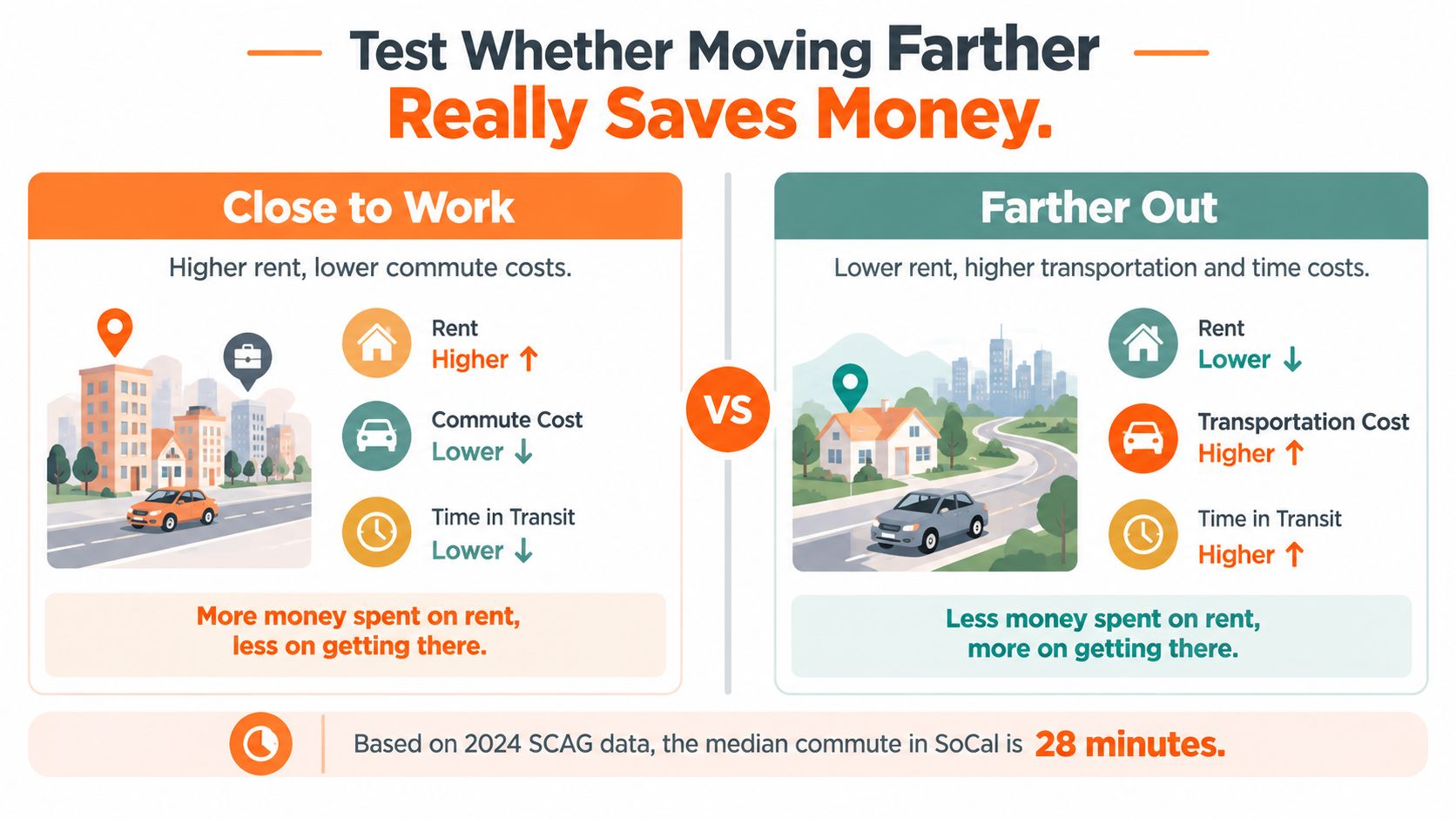
Test Whether Moving Farther Really Saves Money
A lower rent farther from work isn't automatically cheaper. Compare the entire relocation scenario over six to twelve months, not just the advertised monthly rent.
In the Southern California Association of Governments region, median rent reached $2,151 in 2024, while 43.6% of households were housing-cost burdened, according to 2024 SCAG data. The same source lists California's rate as 39.1% and the U.S. rate as 32.0%. Those regional differences are why a single statewide rent rule is too blunt for relocation decisions.
Compare the two addresses
For each option, write down:
| Cost category | Close-to-work unit | Farther-out unit |
|---|---|---|
| Rent | Higher or lower advertised rent | Higher or lower advertised rent |
| Utilities | Actual expected services | Actual expected services |
| Transport | Fuel, transit, insurance, parking | Fuel, transit, insurance, parking |
| Vehicle use | Maintenance and wear | Maintenance and wear |
| Time | Daily travel time | Daily travel time |
| Transition | Deposit, movers, setup, duplicate rent | Deposit, movers, setup, duplicate rent |
A higher-rent unit near work can win when it reduces fuel, parking, vehicle maintenance, insurance exposure, and unpaid travel time. A lower-rent unit may still be the right choice, but only if the savings survive the transition period and the commute doesn't create a second unaffordable bill.
Calculate a break-even month. Add the extra rent for the closer home, subtract the monthly commuting savings, and include one-time relocation costs. If the farther option costs less only after a long period, ask whether you can carry the upfront cash risk.
Cash-at-risk rule: Don't choose the cheaper monthly option if the move would consume the money needed for food, transport, and emergencies before the savings arrive.
Set a maximum cash-at-risk number before you apply. Include duplicate rent, delayed deposit recovery, application fees, utility setup, furnishings, and any income lost while moving. The right choice isn't the lowest rent. It's the scenario that leaves you solvent while delivering a sustainable monthly cost.
Stack an Emergency Reserve on Top
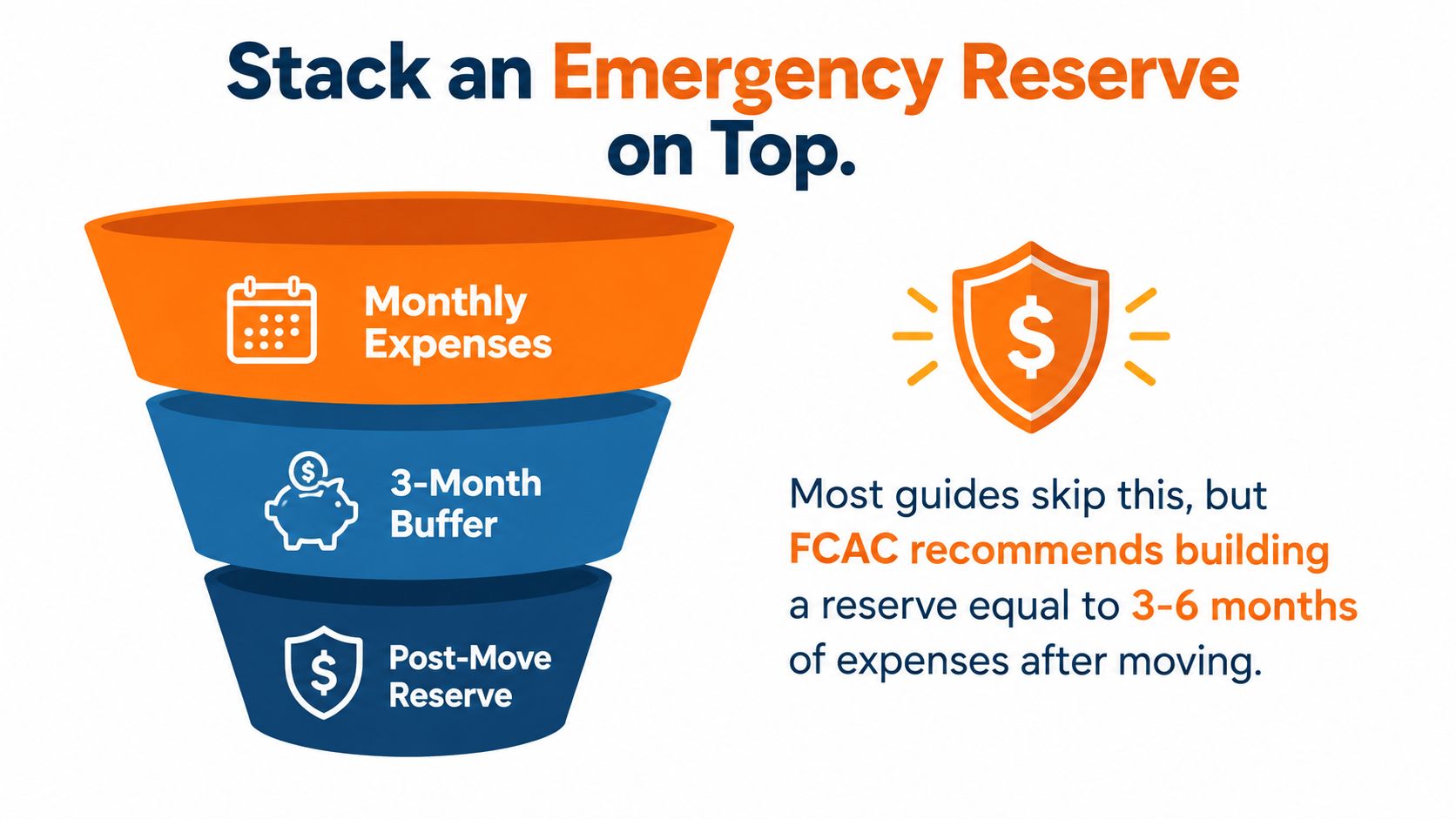
Your emergency reserve belongs above the move-in target, not inside it. Do not use it for a sofa, television, or rushed furniture purchase. Its job is to keep a manageable setback from turning into missed rent or a housing crisis.
The Financial Consumer Agency of Canada's emergency-fund guidance recommends building three to six months of regular expenses or income, using whichever measure fits your situation. The emergency-fund guidance illustrates the dollar amounts:
- $3,000 in essential monthly expenses: A three-month reserve is $9,000, while a six-month reserve is $18,000.
- $4,000 in essential monthly expenses: A three-month reserve is $12,000, while a six-month reserve is $24,000.
This reserve covers income interruption, medical bills, repairs, replacement expenses, and a security deposit that comes back late. Moving concentrates predictable setup costs and surprise bills in the same period, so arriving with no cash buffer is a poor plan.
Build it in stages if necessary
If the move works without borrowing, build the reserve progressively. For the full methodology, follow this guide on how to build an emergency fund.
- Save the required move-in cash.
- Set aside one month of essential expenses in a separate account.
- Move only when the monthly budget works without credit.
- Build the reserve toward three months of essentials.
- Continue toward six months if your income is volatile or your household has little flexibility.
Count rent, groceries, utilities, insurance, transport, phone costs, and minimum debt payments as essential categories. Keep subscriptions, dining out, and other flexible spending outside the target unless you cannot cut them during a disruption.
Keep the post-move reserve separate from your everyday spending account. Otherwise, a large balance can give false confidence while every dollar is already committed to rent, transport, or setup. A relocation plan should therefore include three cash targets: move-in money, a sustainable monthly budget, and a reserve that protects the following months. A cheaper move that leaves no reserve can cost more within the first year.
Plan the Moving-Out Timeline Without Missing Steps
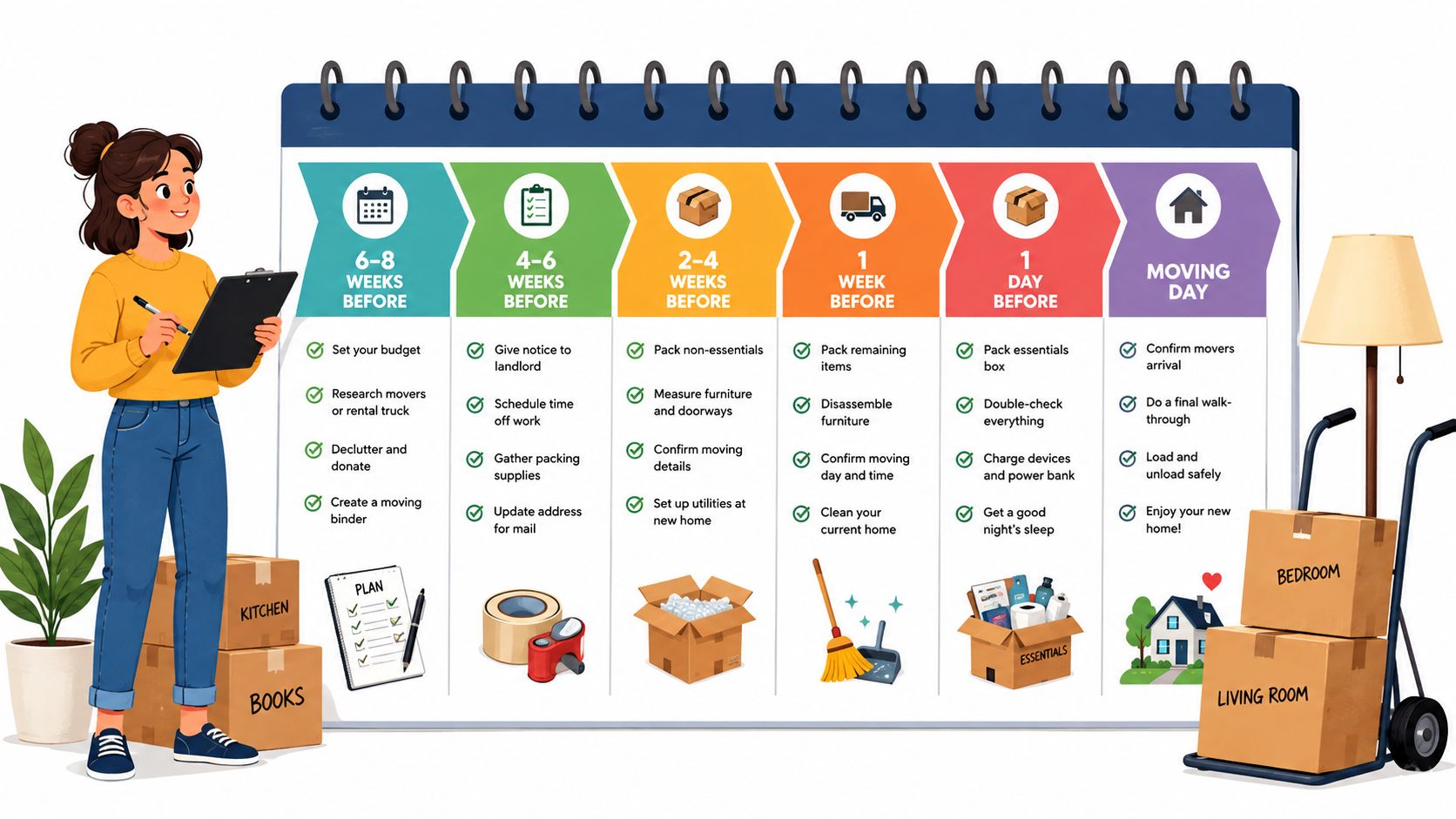
A good moving calendar turns the three targets into actions. It also gives you time to catch costs before they become urgent.
Before moving day
Start by confirming the actual rent, deposit, landlord exception, lease dates, and required insurance. Get transport quotes, price packing supplies, check storage needs, and list each utility separately. Ask which services are included in rent and which you'll pay directly.
Tenant insurance doesn't have one national price. The quote depends on the address, deductible, coverage limits, claims history, building characteristics, and optional coverage. Get a quote for the specific unit instead of using a generic allowance.
Use this period to photograph the current home, organise receipts, sell or donate items you won't move, and build the move-in cash target. If the budget only works by spending the emergency reserve, postpone the move or reduce the scope.
During move week
Keep the money for rent and the deposit untouched. Confirm the mover or truck, arrange key collection, activate electricity and heat where applicable, set up internet, purchase tenant insurance, and keep receipts for every payment.
Take timestamped photographs of the new unit before unpacking. Record existing marks, damaged fixtures, appliance condition, floors, walls, and cleanliness. This evidence gives you a clear record when the tenancy ends.
After you move
Enter every recurring bill into the monthly budget. Don't group electricity, heating, water, internet, and mobile service into one vague “utilities” estimate, because separate lines show which cost is changing.
In California, landlords generally must return the deposit or provide an itemised deduction statement within 21 days after move-out. Keep your photographs, lease, correspondence, cleaning records, and receipts together until the statement arrives and you've checked it against permitted deductions.
Your Move-Out Budget Checklist and Next Step
Use this checklist before committing to the move:
- Move-in cash: First month's rent, applicable deposit, movers or truck, packing, cleaning, utilities, internet, insurance, furnishings, and setup costs
- Monthly survival budget: Rent, utilities, transport, food, insurance, phone, debt payments, subscriptions, irregular costs, and savings
- Emergency reserve: A staged target that begins with one month of essentials and builds toward three to six months
- Relocation comparison: Total rent, utilities, commuting, parking, vehicle costs, travel time, and transition expenses over six to twelve months
- Cash-at-risk limit: The amount you can spend without using money needed for essentials or emergencies
- Move timeline: Lease checks, quotes, utility setup, insurance, photographs, receipts, and deposit follow-up
Avoid the three mistakes that cause the most damage: spending every available dollar on move-in, treating the deposit as immediately refundable, and assuming a low-rent home farther from work will save money without calculating the commute.
For a practical calendar and handoff sequence, this stress-free relocation timeline can complement your financial checklist. Then use a monthly budget template to keep one-time costs and recurring costs visible after the move.
Fintrack lets you organise rent, deposits, utilities, transport, moving costs, and savings goals in one budget, with manual entry available when you don't want to connect a bank account. Visit Fintrack to track the three cash targets and see whether your moving-out plan still works after the first month.