
Meta description: Get a free monthly budget template, learn how to fill it in, and see when to move from spreadsheets to a simpler budgeting system.
You sit down near the end of the month, open your banking app, glance at a credit card balance, and think the same thing again. Where did the money go?
That feeling is usually what sends people searching for a monthly budget template. Not because they want a perfect spreadsheet. They want a shortcut to feeling organised, less stressed, and more in control when bills hit.
A good template helps because it turns a vague money problem into a simple list. Income goes in. Bills go in. Spending categories go in. What's left gets assigned on purpose instead of disappearing.
Ready to Finally Tame Your Monthly Spending?
A love for spreadsheets isn't typically why budgeting begins. Instead, it starts because the month consistently ends in surprises. Groceries run higher than expected. A few small taps pile up. A subscription renews that nobody remembers approving.
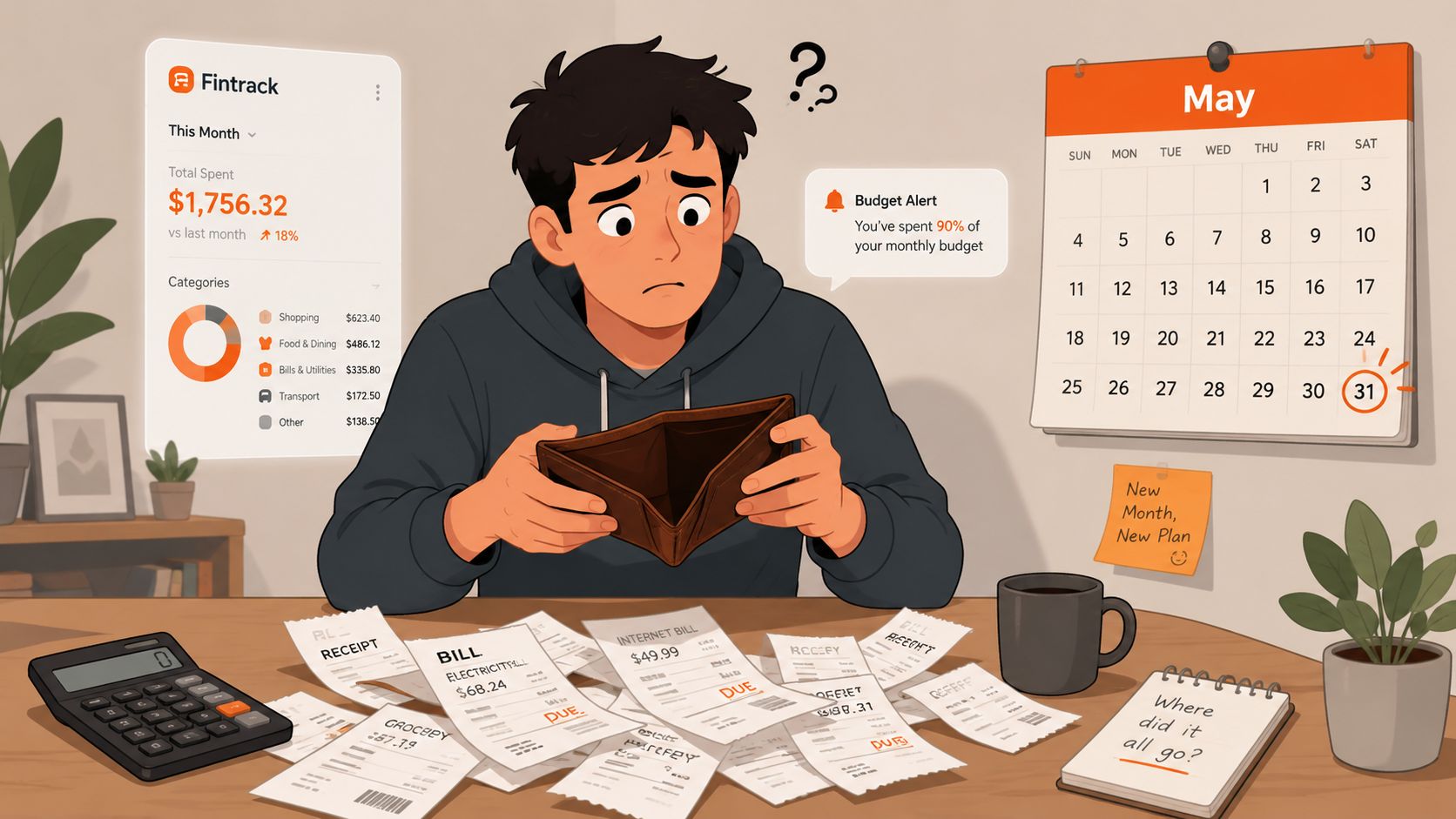
A monthly budget template gives you one job for today. Get everything visible in one place. That alone lowers the mental noise.
If you want to start right away, use whichever format fits how you already work:
- Excel version: best if you like offline editing and basic formulas
- Google Sheets version: best if you want access from phone and laptop
- CSV version: best if you want something simple you can import or customise
The format matters less than the habit. Pick one and begin.
What this tool actually fixes
A template won't make spending decisions for you. It will show you the decisions you're already making.
That's why even a basic worksheet can help you spot things like:
- Recurring charges you forgot about
- Spending drift in dining out, shopping, or convenience purchases
- Mismatch problems where your fixed bills are taking too much of your pay
- Leftover money leaks where unassigned cash gets spent without much thought
Practical rule: Your first budget doesn't need to be smart. It needs to be honest.
There's also an emotional side to this. When money feels messy, people often avoid it. That avoidance makes the problem feel bigger than it is. Practical, judgement-free money habits matter, which is why Action Accountants' financial guidance is a useful read if your stress around money has started affecting your decisions.
Keep the first version boring
Don't try to build a master finance system on day one. A clean monthly budget template should only answer a few questions:
- What came in
- What had to go out
- What usually changes month to month
- What you want to save or pay down
If it does that, it's working.
How to Set Up Your New Budget Template
The easiest way to fail at budgeting is to make setup too complicated. Open your template and fill it in with the numbers you can verify today. You can refine it later.
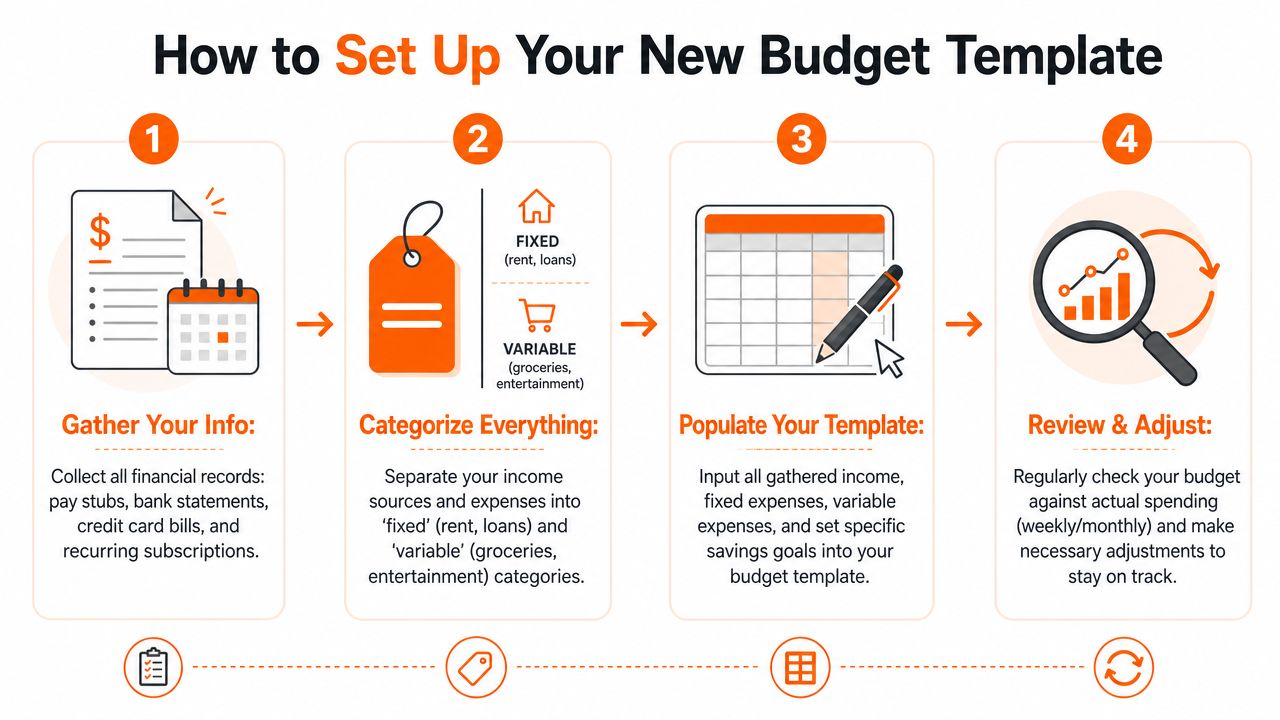
Gather your numbers first
Before typing anything, collect the documents that tell the truth:
- Income records: pay stubs, invoices, benefit deposits
- Account activity: bank statements and credit card statements
- Regular bills: rent, mortgage, insurance, phone, internet, loan payments
- Small recurring costs: streaming, apps, memberships, software, meal plans
If you're not sure what belongs in a budget, this list of common monthly expenses can help you build categories without missing the boring but important stuff.
Add all income, not just your paycheque
Start with the money available for the month. For salaried workers, that's straightforward. For anyone with uneven income, this part needs a bit more care.
For Canadian budgeters with fluctuating income, such as contract work, a common recommendation is to average earnings over the past six to twelve months, and include benefits like the Canada Child Benefit and GST/HST credit so your plan reflects total cash flow, as explained in Questrade's budgeting guide for Canadians.
That approach works because it smooths out the emotional swings of one strong month or one weak month. You're budgeting from a realistic baseline, not from hope.
Split expenses into fixed and variable
A monthly budget template becomes usable instead of cluttered.
Fixed expenses
These are the bills that are usually predictable:
- Housing: rent or mortgage
- Utilities: if they stay fairly stable
- Debt payments: required minimums
- Insurance: home, tenant, car, health
- Phone and internet
- Child care or tuition
- Subscriptions you intend to keep
Variable expenses
These move around and need active attention:
- Groceries
- Dining out
- Transport fuel or transit
- Medical and pharmacy costs
- Household supplies
- Gifts
- Entertainment
- Personal spending
The categories that wreck budgets usually aren't dramatic. They're the ones people call “just little things”.
Give savings a row in the template
A lot of people treat savings as whatever survives the month. That usually means it gets crowded out.
Create separate lines for the goals that matter right now, such as:
- Emergency fund
- Debt payoff beyond minimums
- Annual bills
- Travel
- Home or car repairs
- Holiday spending
You don't need ten goals. Two or three is enough to start.
Check the balance and adjust
Once income and expenses are entered, your template should show one of three outcomes:
| Result | What it means | What to do next |
|---|---|---|
| Money left over | Your plan has breathing room | assign it to savings or debt |
| Exactly balanced | Every dollar has a job | track closely through the month |
| Negative balance | Spending is higher than available income | cut categories, delay extras, or revise assumptions |
If the number is negative, don't scrap the whole budget. That's useful information. It tells you the current version of your month doesn't work on paper, which is much better than discovering it after the money is gone.
Putting Your Budget to Work in Real Life
A template only becomes useful when it matches real life. Different households need different setups, even if the structure is the same.
One person trying to save and pay down debt
A single renter in a city often has a simple budget on paper and a messy one in practice. The fixed bills are clear enough. Rent, transit, phone, student loan, utilities. The trouble usually shows up in convenience spending. Coffee, takeout, app purchases, weekend plans.
In this case, the template works best when the variable categories stay tight and obvious. Not detailed to the point of exhaustion, just clear enough to catch patterns. “Food” is too broad for many people. Splitting it into groceries and dining out usually tells a more honest story.
A monthly budget template also helps this person protect progress. If they want to save and make extra debt payments, those need their own lines before the month starts.
A couple merging finances for the first time
Many spreadsheets become less about maths and more about friction. One person thinks holidays deserve their own category. The other person sees that as unnecessary. One wants a larger grocery buffer. The other wants a bigger home fund.
The template helps because it gives both people the same page to react to. Not memory. Not assumptions. An actual list.
A strong setup for couples usually includes:
- Shared essentials such as housing, groceries, utilities, transport
- Joint goals such as travel, emergency fund, debt reduction
- Personal spending lines so every purchase doesn't turn into a discussion
For recurring bills, a dedicated monthly bill tracker can make it easier to see who pays what and when each charge lands.
Couples don't need identical money habits. They need a system both people will keep using.
A Canadian family balancing high housing costs
For a family in Canada, the pressure points often look different. Housing, food, transport, school-related costs, insurance, and seasonal spending can all compete for space.
The useful part here is having a benchmark. According to the Credit Counselling Society, Canadian households should allocate 35% of net income to housing, including mortgage or rent, property taxes, home insurance, and hydro, with food at 10–20% and transportation at 15–20%, as outlined in these Canadian budgeting guidelines.
That doesn't mean every family will land neatly inside those ranges. It does mean the template can flag pressure quickly. If housing is pushing everything else out, the issue may not be overspending on small items. It may be that the biggest fixed cost is dominating the month.
That's why budgets work best when they reveal the trade-off. Sometimes the answer is reducing discretionary spending. Sometimes it's changing a larger bill, restructuring debt, or planning around irregular costs more carefully.
Simple Rules to Make Budgeting Easier
Many don't need a complicated budgeting philosophy. They need a rule that helps them decide where money should go when everything feels important.
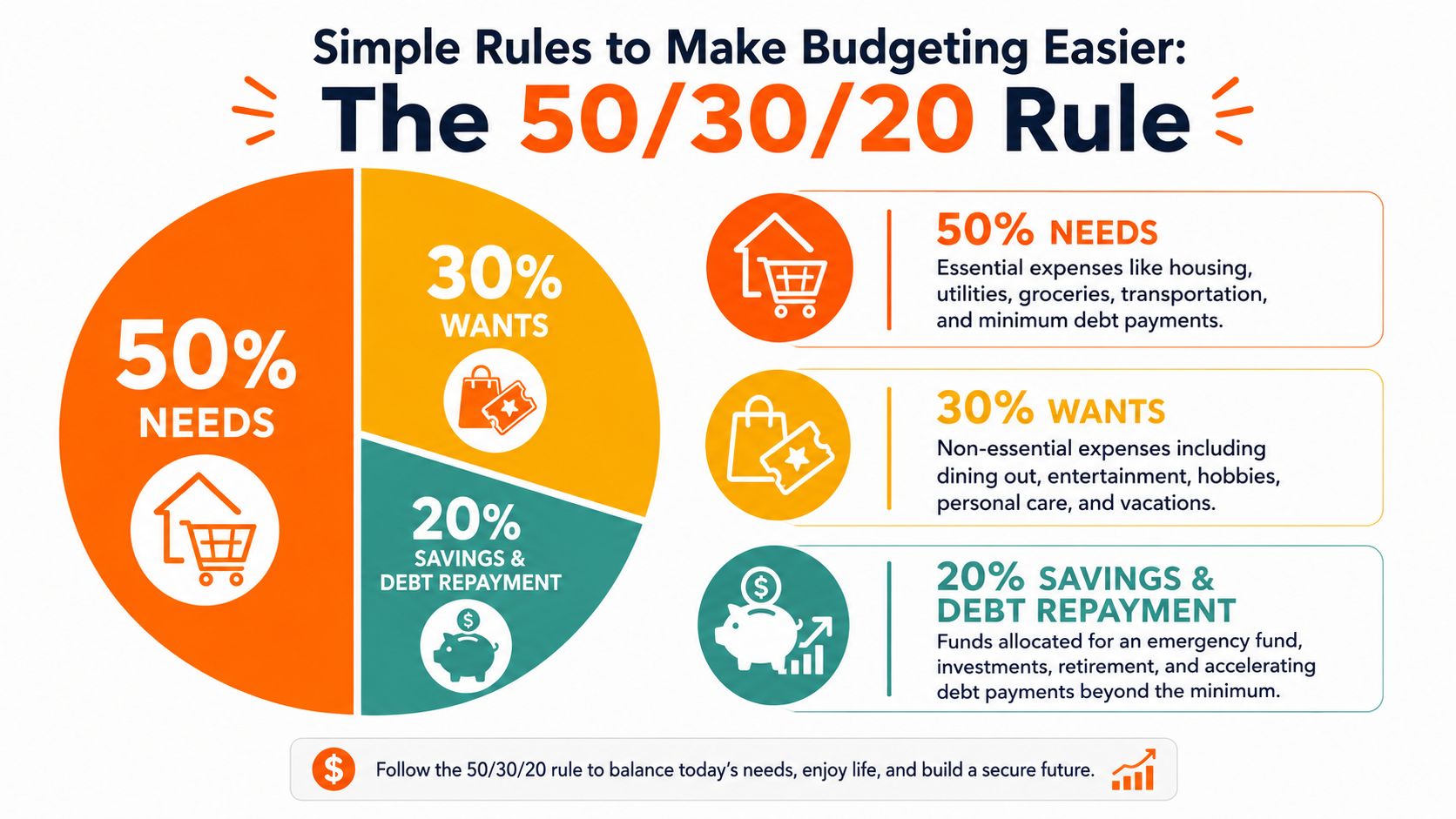
One of the simplest is the 50/30/20 rule.
Use 50 30 20 as a guide, not a test
According to the 50/30/20 budget framework promoted by resources including the Federal Trade Commission and Ally Bank, a structured monthly budget template allocates 50% of income to needs, 30% to wants, and 20% to savings and debt repayment, as summarised in NerdWallet's budget template guide.
This framework is helpful because it simplifies a messy month into three decision buckets.
| Bucket | What goes there | Why it helps |
|---|---|---|
| Needs | housing, groceries, utilities, transport, minimum debt payments | shows what must be covered first |
| Wants | dining out, shopping, hobbies, subscriptions, fun spending | keeps lifestyle spending visible |
| Savings and debt repayment | emergency fund, investing, extra debt payments | turns future goals into monthly action |
What works and what doesn't
What works is using the rule to spot imbalance. If wants keep creeping upward, you'll see it. If needs are so high that saving feels impossible, that becomes clear too.
What doesn't work is treating the percentages like a moral scorecard. In expensive cities, needs may run high. In a debt payoff season, the savings and repayment category may need more focus than the framework suggests.
Key takeaway: A budgeting rule should reduce decision fatigue. If it makes you feel defeated, simplify it.
Some people also do better by automating the saving part first. If that's your weak spot, the pay yourself first method can work well alongside a monthly budget template.
When You're Ready to Upgrade from Spreadsheets
Spreadsheets are useful. They're flexible, cheap, and familiar. For a first budget, they're often the right move.
But they also break down in predictable ways.
Where spreadsheets start to struggle
Manual budgeting usually fails for practical reasons, not because people are lazy.
- You forget to enter purchases
- Categories drift over time
- The sheet shows your plan, not your current reality
- Recurring charges hide in statement lines
- Reviewing everything takes longer than it should
In California, budgeting guidance also points to the value of structured tracking. The State Controller's Office says creating a budget is an essential first step, and related resources note that structured tracking helps people spot overspending like duplicate subscriptions or unnecessary dining costs, while average California households spend over $1,000 annually on unwanted recurring services, according to the California Budget and Policy resources.
That's the kind of problem spreadsheets can catch, but only if someone keeps them updated carefully.
What a better system changes
The next step is usually not “build a bigger spreadsheet”. It's moving to a system that keeps the same budgeting logic but removes more of the manual work.
A stronger setup should help you:
- Track spending as it happens
- See category totals without rebuilding formulas
- Spot duplicate charges and recurring subscriptions faster
- Ask simple questions about your money and get usable answers
- Keep budgeting even if you prefer manual entry over bank connections
That last point matters for many people in Canada and for anyone who values privacy or wants tighter control over their data entry. A tool that supports bank-free tracking is often easier to trust and easier to stick with.
The practical upgrade path
If your template is working, keep the category structure. That's the hard thinking part. Move those same categories into a tool that updates faster and surfaces patterns more clearly.
The benefit isn't novelty. It's consistency.
A spreadsheet asks you to remember to look. A dynamic system makes it easier to keep looking because the information is already organised. If you're comparing options, this guide to financial planning software for everyday budgeting is a sensible place to sort out what matters and what's just extra clutter.
Your First Month Is the Hardest but Most Important
Your first month with a monthly budget template will probably be a bit messy. That's normal. You're not just filling in boxes. You're learning what your month looks like.
A few categories will be off. Something irregular will show up. You may realise you forgot a bill or underestimated a spending habit. None of that means the budget failed. It means the budget did its job.
Keep the review process simple:
- Check once a week
- Adjust categories when reality says you need to
- Look for patterns, not perfection
- Stay with the same system long enough to learn from it
If money feels tight, it can also help to read practical advice on living paycheck to paycheck so you can stabilise cash flow while building the habit.
The win in month one isn't a flawless spreadsheet. It's replacing guesswork with visibility.
If you're ready to move beyond a static sheet, Fintrack is a practical next step. You can take the categories you just set up, turn them into a live budget, and keep tracking your spending in one place without relying on a more complicated spreadsheet.