
Meta description: Learn how to use an expense tracker for couples with a simple system for shared costs, split rules, monthly check-ins, and calmer money talks.
It usually starts with something small.
One person pays for dinner again. The other grabs groceries, covers the streaming bill, and assumes it all evens out. Then the credit card statement lands, and suddenly both of you are having a much bigger conversation than either of you expected.
That's why an expense tracker for couples matters. Not because couples can't do basic maths, but because shared money gets messy fast when nobody has agreed on what counts as shared, what feels fair, and how often you'll check in.
Why Managing Money as a Couple Is So Hard
A lot of couples think the problem is overspending. Often, the underlying problem is that there's no shared system.
One partner is tracking every transaction. The other is checking the bank balance and assuming things look fine. One person thinks takeaway is a normal weekly expense. The other sees it as a treat that should come from personal spending. Both can be reasonable. The friction comes from the gap between those assumptions.
In Canada, the average cost of a couple's monthly shared expenses, including groceries, rent, and utilities, is approximately $3,200, yet 38% of couples do not track their spending by category, relying instead on overall bank balances, according to the Financial Consumer Agency of Canada budget guidance. That's how duplicate charges, subscription drift, and “I thought you paid that” moments slip through.
The stress usually shows up in ordinary moments
It might be the pause after brunch when the bill arrives.
It might be a text that says, “Did we already pay the hydro bill?” It might be a review of the month where both of you realise the grocery number feels way higher than expected, but neither of you can explain why.
Practical rule: Money arguments rarely begin with the total. They begin with unclear expectations.
This is why a tool alone won't fix things. Honeydue, Parity, spreadsheets, and shared notes can all help, but they only work when the couple decides how they'll use them.
If you're also trying to organise the broader household side of life, resources like this guide to Vero Beach insurance bundling can be useful as an example of how couples often save money by reviewing recurring household costs together rather than handling them separately.
A simple category structure helps too. If you need a starting point, this list of household budget categories makes it easier to separate fixed bills, shared essentials, and personal spending before confusion builds.
Fairness matters as much as arithmetic
Couples don't usually want perfect accounting. They want a setup that feels fair, easy to maintain, and calm enough to stick with.
That's why the best expense tracker for couples is a framework. First, choose the system. Then define the rules. Then build a rhythm you can keep.
Before The App Agree on Your System
Before you compare features, notifications, or whether a tool supports manual entry, decide how your household money will work.
Most couples land in one of three models. None is universally best. The right choice depends on how you handle privacy, income differences, financial habits, and mental load.
Three Systems for Managing Money as a Couple
| System | How It Works | Best For |
|---|---|---|
| All-In | Both incomes and most expenses go into a fully shared system. Bills, goals, and day-to-day spending are managed together. | Couples who want maximum transparency and don't mind combining financial decision-making. |
| Yours, Mine, and Ours | Shared expenses come from a joint pool, while each partner keeps some separate money for personal spending. | Couples who want teamwork on household costs without losing individual autonomy. |
| Split Everything | Each person keeps finances largely separate and settles shared expenses based on an agreed rule. | Couples who strongly prefer financial independence or are blending finances gradually. |
The All-In model
This setup is clean. One system, one view, fewer reimbursements.
It tends to work well when both people are comfortable discussing money openly and neither feels controlled by the shared structure. The downside is obvious too. If one partner likes close tracking and the other values more spontaneous spending, every purchase can start to feel loaded.
The hybrid model most couples settle into
This is the most practical setup I see in real life. Shared bills and goals are shared, but each person still has room for their own choices.
You decide which categories belong to the household, contribute to those on a regular schedule, and keep personal spending from becoming a negotiation every time someone buys coffee, books, tools, skincare, or hobby gear. If you want a worksheet to talk this through, a budget template for couples is a good way to map out who pays what before transactions start piling up.
“A good system reduces the number of decisions you have to re-argue.”
The fully separate model
This can work, especially early in a relationship or when both partners have established habits they don't want to merge right away.
But it only works if the rules are explicit. Without that, one person usually becomes the household organiser while the other just sends money when asked. That creates the exact kind of resentment couples were trying to avoid by keeping things separate.
A quick way to choose
Ask these three questions together:
- How much visibility do we want? Full transparency feels secure for some couples and invasive for others.
- How different are our incomes? Large gaps often make rigid equal splits feel tense.
- How much admin are we willing to do? Separate systems usually need more reconciliation, not less.
If you can answer those truthfully, choosing the app gets much easier after that.
Defining Whats Shared and How to Split It
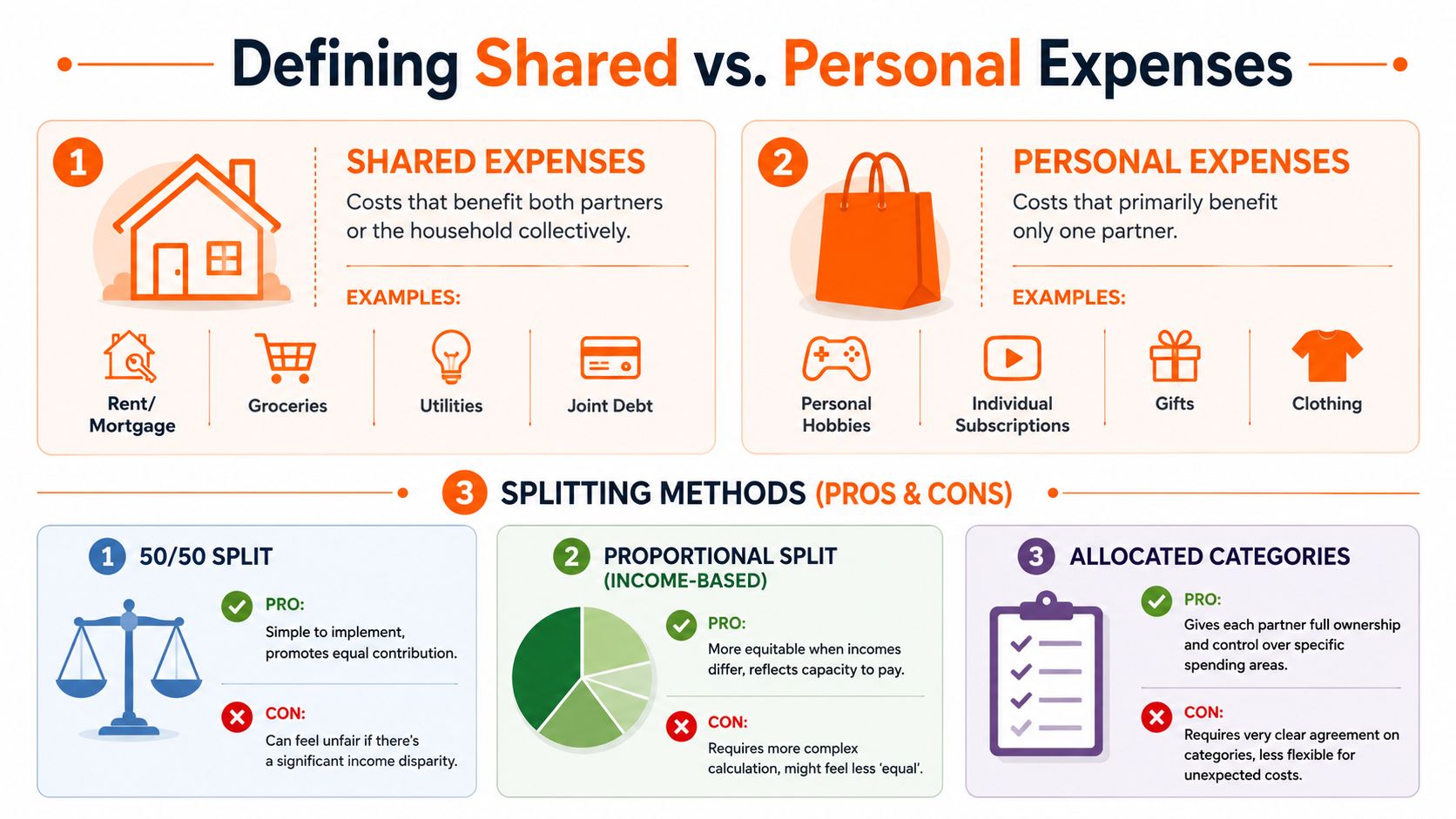
Most money tension doesn't come from rent or electricity. It comes from the blurry middle.
Groceries are shared, until one person adds supplements, protein bars, or lunch items for work. A streaming service is shared, until only one person uses it. A holiday is shared, but maybe one partner wants the upgraded hotel and the other doesn't.
Surveys indicate that 45% of couples struggle to agree on what counts as a necessary expense versus a discretionary one, especially when tracking shared accounts, and that confusion often leads to duplicate charges or missed budget targets, according to Budget Butterfly.
Start with a shared versus personal checklist
Write this down once. It saves a lot of repeated debate later.
Usually shared
- Housing costs: Rent, mortgage, strata or condo fees, tenant insurance, core utilities
- Food at home: Regular groceries, household staples, cleaning supplies
- Transport tied to the household: Fuel for shared use, parking for shared errands, transit passes if handled jointly
- Joint obligations: Shared debt payments, pet costs, childcare, planned travel booked together
Usually personal
- Individual habits: Lunch out alone, personal coffees, solo entertainment
- Hobbies and interests: Fitness classes, gaming, craft supplies, sports gear
- Personal care and style: Haircuts, cosmetics, clothing, skincare
- Gifts and surprises: Presents for friends, family, or each other
Needs a rule
- Groceries with personal add-ons: Specialty items, supplements, premium snacks
- Subscriptions: Shared if both use them regularly, personal if not
- Travel upgrades: Base cost shared, optional upgrades paid individually
- Dining out together: Shared if it's a planned couple expense, personal if one person insists on frequent extras
If grocery spending is one of your recurring friction points, a personalized grocery budgeting tool can help you estimate a realistic food budget before you decide how much belongs in the shared pool.
Pick one split method and stick to it
Here are the three most workable options.
The 50/50 split
This is the easiest to run. Shared bills get divided equally. It works best when incomes are similar and both people use household resources in roughly the same way.The proportional split
Each person contributes based on income. If one partner earns more, they cover a larger share of shared costs. This usually feels more equitable for couples with uneven income.The allocated-category split
One partner owns certain categories, and the other owns different ones. For example, one covers groceries and internet while the other handles rent and utilities. It can be simple, but only if you review category totals often enough to keep the overall balance fair.
Don't optimise for the fairest method on paper. Choose the one you'll both still follow in six months.
A master list of expenses is helpful here because couples often forget irregular categories until they hit. Annual fees, gifts, travel deposits, pet care, and home items are where “we'll just sort it out later” usually breaks down.
Put the agreement in writing
Not a legal contract. Just a shared note.
Include:
- Which expenses are shared
- Which are personal
- How you split shared costs
- What happens when one person pays upfront
- How often you reconcile
That one note becomes your reset point whenever memory and assumptions start drifting.
Your Monthly Rhythm for Tracking and Reconciliation
An expense tracker for couples only works if it fits normal life.
If the process depends on both of you remembering every receipt, opening a spreadsheet every night, and discussing every purchase in real time, it won't last. You need a rhythm that catches issues early without turning money into a full-time project.

Weekly tracking beats heroic catch-up
The best routine is usually short and boring. That's a compliment.
Try this:
- During the week: Enter shared purchases as they happen or review them in batches every few days.
- At week's end: Confirm categories, note anything unusual, and flag items that need reimbursement.
- At month's end: Reconcile, adjust, and make decisions for next month.
Manual entry matters more than some couples expect. Plenty of people prefer not to connect every bank account, and manual entry also forces a quick moment of awareness. You notice spending patterns sooner when you actively log them.
Use a simple reconciliation flow
A monthly money date works best when it follows the same order every time.
Review the transaction list
Check that shared purchases are in the right categories. Correct obvious mistakes first.Confirm recurring bills
Look for anything that was charged twice, renewed unexpectedly, or changed in amount.Settle reimbursements
Figure out who covered more and transfer only after the categories are clean.Scan for hidden value
Loyalty points, account credits, and unused contribution room get missed when nobody does a proper review.
For Canadian couples, the average TFSA contribution gap is $1,250 per household annually because 52% fail to manually reconcile loyalty points and unused credits against their shared budget, according to CPABC's budgeting app roundup for Canadians. That's a strong argument for a review process that includes more than just bills and reimbursements.
If you want a cleaner recurring-expense process, a monthly bill tracker helps separate one-off spending from the costs that repeat every month.
The point of reconciliation isn't to settle score. It's to make sure your system still matches real life.
Keep the meeting short and calm
A good money date doesn't need to be heavy. It should answer a few practical questions:
- Did we stay close to the plan?
- Did anything unusual happen this month?
- Do we need to adjust any categories?
- Is one person carrying more of the admin than the other?
If those questions get answered consistently, shared money feels lighter. Not because spending disappears, but because surprises do.
Communication Is the Best Financial Tool
Most apps can categorise transactions. They can't help two people interpret what those transactions mean.
That's the part couples underestimate. One partner sees a large payment and thinks, “We're falling behind.” The other thinks, “That was planned.” One person wants every extra dollar to attack debt. The other wants to keep investing steadily. The transaction list can show both positions. It can't resolve the values underneath them.
Current tools offer no built-in mediation frameworks or goal-alignment analytics, despite 58% of Canadian couples reporting financial value conflicts as a leading source of relationship stress, as noted by Stash's overview of budgeting apps for couples.
Better conversations need structure
Without structure, money talks drift toward blame.
Try using prompts like these during your check-in:
- “What felt tight this month?” This opens the door to pressure points without accusing anyone.
- “What expense felt worth it?” Useful when one partner values convenience and the other values savings.
- “What should stay personal so we stop debating it?” This reduces unnecessary friction.
- “What shared goal matters most right now?” Helpful when debt reduction, travel, investing, and emergency savings are competing for the same dollars.
Keep the discussion on decisions, not personalities
The phrase “you always spend too much” ends badly.
The phrase “our eating-out category ran hotter than expected, so do we want to raise it or cut back somewhere else?” gives you a decision to make together. That small shift matters because it keeps the focus on the system.
A useful reframe: Treat the budget as a draft, not a verdict.
That mindset makes it easier to adapt when life changes. New job, irregular pay, parental leave, rising rent, moving costs, debt payoff, or a shift in priorities. The strongest couples aren't the ones who never disagree about money. They're the ones who return to the conversation before resentment gets ahead of them.
A simple script for hard months
When spending went off plan, use this order:
- Name the category
- State the fact
- Ask what changed
- Choose one adjustment
- Set the next review date
Short, specific, and calm beats a long post-mortem every time.
A Central Hub for Your Household Finances
A strong couple money system has four parts. You agree on the model, define what's shared, keep a monthly rhythm, and talk openly when something feels off.
That's why the best setup isn't just an app with nice charts. It's a central place where both people can see the same household picture, follow the same rules, and review the same categories without rebuilding the process every month.
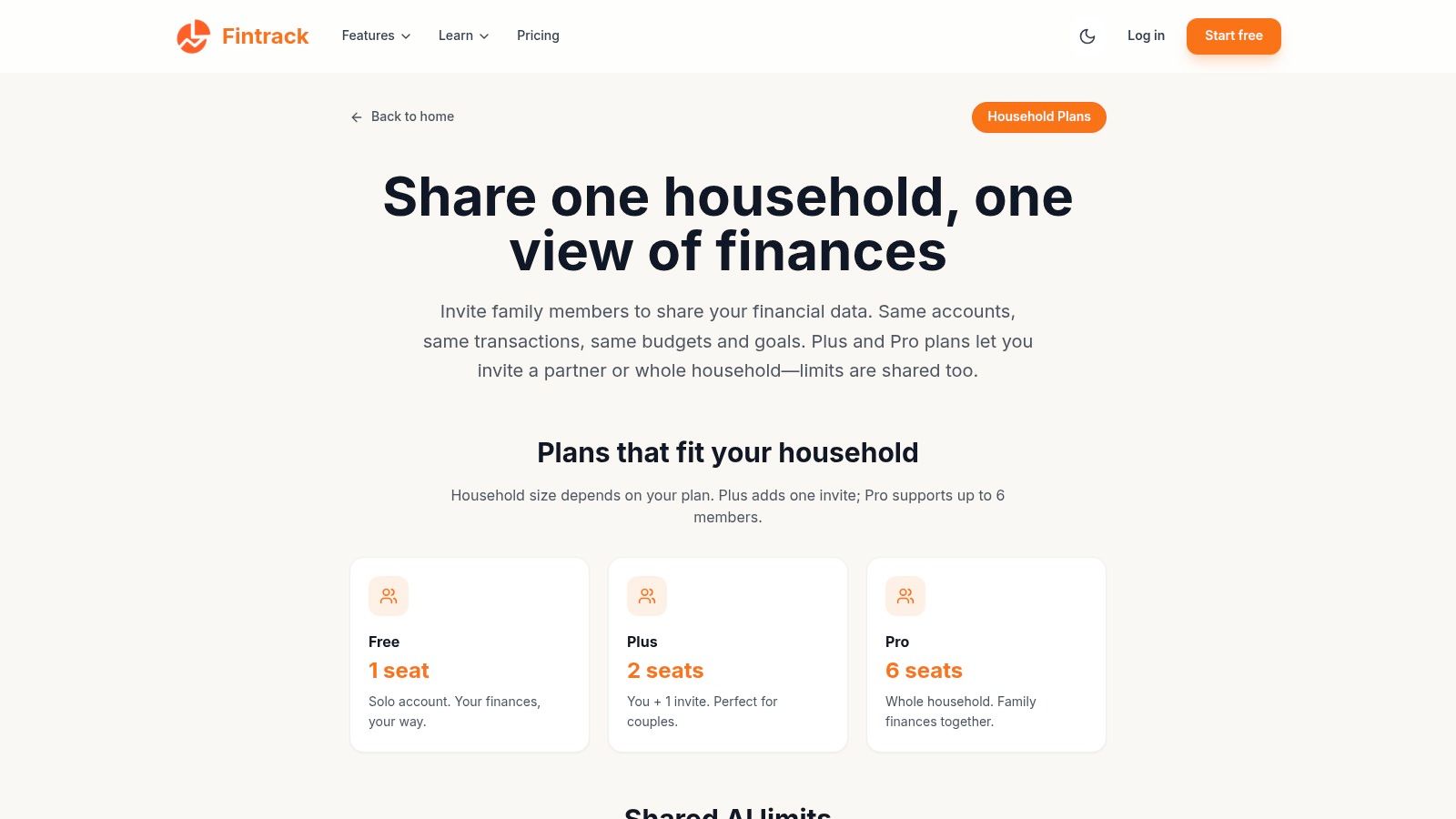
For couples who want that kind of shared view, tools built around household planning tend to work better than trying to patch together separate notes, reimbursement apps, and spreadsheets. If you also like habit-based systems, a couple's habit building solution can pair nicely with financial routines by helping both partners stick to regular check-ins.
For a wider view of how your spending, goals, and categories connect, this guide to a personal finance dashboard is a helpful next read.
If you want to put this system into practice, Fintrack is a practical next step. Its Household Plans feature gives couples one place to organise shared budgets, customise how expenses are handled, and keep track of household spending even if you prefer manual entry instead of linking bank accounts.