
You set a goal to build an emergency fund, pay down debt, or save for a home. Then a car repair, an irregular paycheque, or a higher grocery bill changes the month, and the amount you planned to save no longer fits. A financial goals calculator helps turn that vague intention into a timeline based on your target, income, expenses, contributions, and competing priorities.
The point isn't to produce a perfect prediction. It's to show what your current cash flow can support, where the pressure points are, and what needs to change before a goal becomes realistic.
Why Most Savings Goals Fail Before They Start
Many savings plans fail at the moment someone chooses a target without checking the route. “I want to save for a home” sounds motivating, but it doesn't answer how much to save, by when, or what happens when your monthly surplus disappears.
Suppose you decide to transfer a fixed amount after payday. The first month works. The next month includes an annual bill. After that, you use the savings to cover an unexpected expense, and the goal starts to feel like proof that you're bad at saving. In reality, the plan may have ignored your actual cash flow.
Canadian households show this intention-versus-execution gap clearly. In a 2024 BMO survey, 69% of Canadians said they had set financial goals, but only 33% said they had a financial plan and 59% said they didn't have a household budget for the year. The challenge isn't always knowing what matters. It's converting that decision into repeatable actions.
Practical rule: A goal becomes useful only when you can connect it to a date, a contribution pattern, and the money left after essential costs.
A guide to why goal-setting matters can help you choose the objective. The calculator handles the less comfortable questions: Is the deadline affordable? Does debt repayment need to come first? Can contributions vary across the year?
The calculator as a reality check
Canada's Financial Consumer Agency of Canada has long treated goal calculators as a practical bridge between budgeting and savings execution. Its materials describe a tool that helps Canadians manage debt and savings goals, while the agency's financial capability research connects structured planning with staying within a budget. In the 2019 Canadian Financial Capability Survey materials, FCAC notes that Canadians can use a calculator to set savings goals.
That makes the calculator a diagnostic tool, not a magic wand. It helps you see whether the problem is the target, the timeline, the contribution amount, or the lack of a plan for irregular expenses.
How a Financial Goals Calculator Actually Works
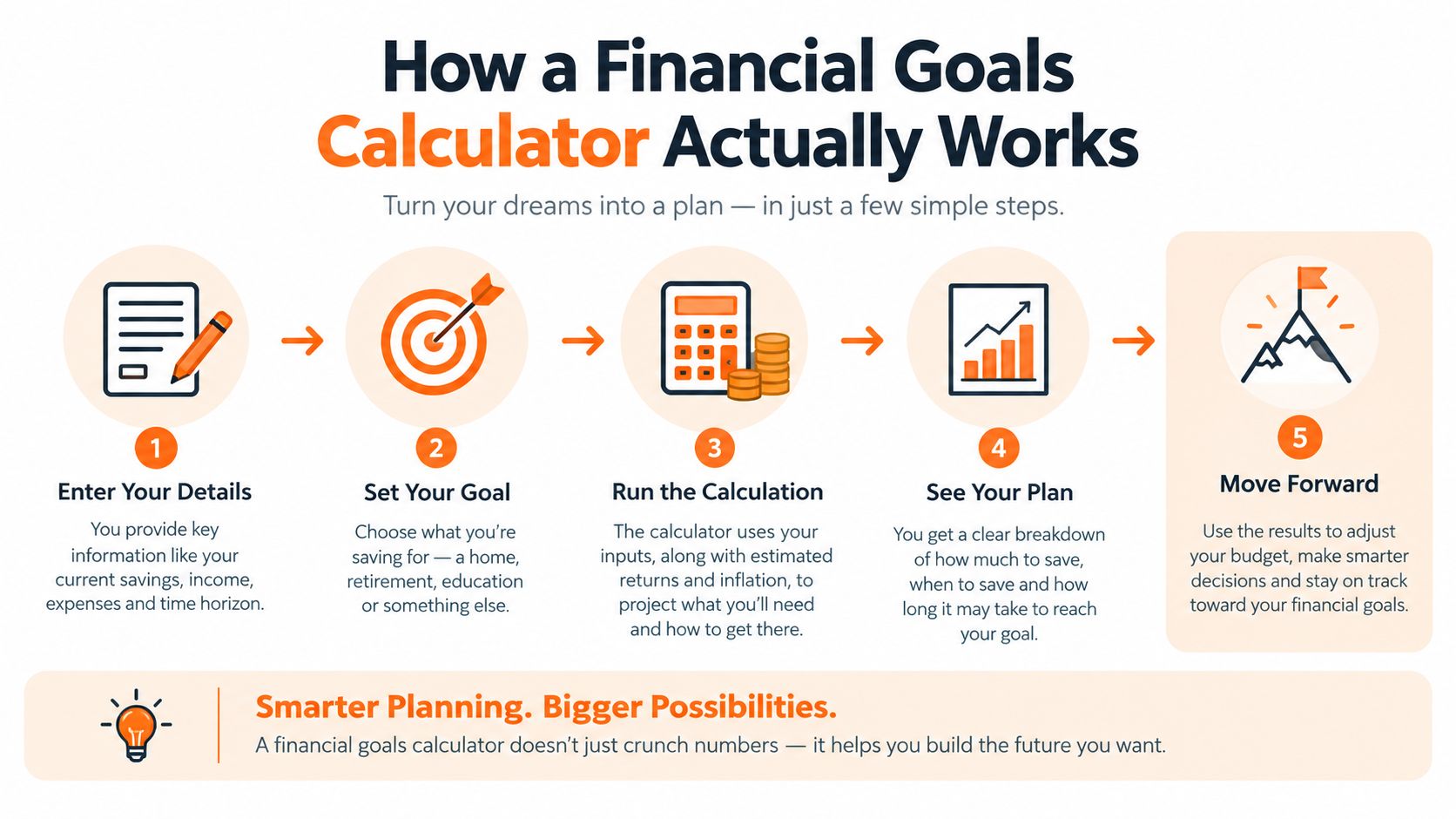
A basic calculator needs a few clear inputs, much like planning a road trip. The target is the destination, the timeline is the arrival date, your available surplus is the fuel budget, and contribution frequency tells you how often you can refuel.
Start with the inputs
Target amount: Define what you're trying to fund. Include a realistic estimate of the expense rather than choosing a round figure because it feels comfortable.
Time horizon: Set the date you want to reach the goal. A shorter deadline usually requires larger contributions, while a longer horizon may make the same target easier to fund.
Current savings: Enter what you've already set aside for that purpose. Keeping existing emergency savings separate from a holiday or home deposit prevents the plan from overstating your available resources.
Recurring contributions: Add the amount you can contribute and how often. If your income changes, use a conservative baseline and model larger deposits separately.
Growth assumptions: Some calculators allow an expected rate of return. Treat this as an estimate, not a guarantee, and avoid relying on investment growth to rescue an unaffordable contribution plan.
The calculator then compares income and expenses to identify a surplus or deficit and uses that result to estimate a timeline. Canada's official financial tools collection describes FCAC's calculator as using income, savings, and expenses to provide customized guidance for debt and savings goals.
A simple worksheet may show a contribution total. A more useful planner can also account for debt reduction, changing contributions, and the effect of time. For a plain-language explanation of the forecasting concept, see what financial forecasting means.
A result is only as reliable as the assumptions you enter. If your expense estimate is incomplete, the timeline will look more certain than your finances really are.
Real-World Examples for Different Financial Milestones
The same calculator can support different goals, but the inputs should reflect the risk and rules attached to each one. An emergency fund needs a household expense baseline. A registered account goal must also respect Canadian contribution limits and available room.
Example one, an emergency fund
FCAC says an ideal emergency-fund target is three to six months of regular expenses in its emergency-fund guidance. RBC's guidance expands the practical range to three to nine months, with six months especially relevant for homeowners, single-income households, families with children, and people with higher fixed expenses. It notes that nine or more months may suit self-employed workers, gig workers, commission-based earners, new immigrants, and people with irregular earnings or no EI eligibility.
Enter your regular expenses, choose the appropriate risk range, and compare the target with your current savings. If the required monthly contribution is too high, extend the deadline rather than pretending the shortfall doesn't exist. You can also split the goal into an initial cash buffer and a later expansion target.
Example two, registered savings in Canada
Canadian account rules can materially change a long-term plan. For 2026, the TFSA annual contribution limit is $7,000, and unused room carries forward. Canada.ca gives an example where $5,000 of unused room from the prior year combines with the new limit to create $12,000 of available room in 2026. The federal TFSA contribution guidance explains how current limits, unused room, and previous withdrawals affect available space.
The 2026 RRSP contribution limit is the lesser of 18% of the previous year's earned income or $33,810, according to ATB's 2026 RRSP and TFSA guidance. The same guidance shows that reaching the full ceiling requires 2025 earned income of at least $187,833. Contributions exceeding the deduction limit by more than $2,000 can also trigger a 1% monthly tax, as explained by Advisor.ca in the linked guidance.
Regional retirement targets
A generic retirement target can hide major location differences. A 2025 FP Canada survey reports that Canadians believe they need $1.7 million on average for a comfortable retirement, with regional estimates ranging from $2.201 million in British Columbia to $928,000 in Atlantic Canada.
| Region | Average Target | Key Cost Driver |
|---|---|---|
| British Columbia | $2.201 million | Housing and regional living costs |
| Canada overall | $1.7 million | Personal retirement lifestyle |
| Atlantic Canada | $928,000 | Regional cost assumptions |
Use regional figures as context, not as a personal prescription. Your housing situation, retirement age, income, and desired lifestyle still belong in the calculator. For near-term objectives, short-term savings goals can help you separate immediate needs from long-range planning.
Adjusting for Cash-Flow Volatility and Debt
A steady monthly contribution is convenient for a calculator, but many households don't earn or spend money that way. Freelancers, commission-based workers, gig workers, and people with seasonal income may have strong months followed by periods when saving must pause.
Canadian survey data points directly to this problem. In the FP Canada 2025 research, 41% of Canadians said they didn't have enough money left after expenses, 35% cited economic uncertainty, and 31% identified debt repayment as a main roadblock to reaching financial milestones.
Use ranges instead of one optimistic number
Enter a contribution amount you can maintain in an ordinary month, then test a lower month and a stronger month. This creates a range of possible completion dates instead of a brittle promise that collapses after one difficult pay period.
You can also model stop-start contributions:
- Stable months: Contribute the planned baseline.
- Tight months: Reduce or pause the contribution without treating the plan as abandoned.
- Strong months: Direct a defined share of extra income toward the highest-priority goal.
The calculator becomes more useful when you sequence goals instead of funding everything at once. A basic order might place essential cash reserves first, expensive debt next, and longer-term goals after the monthly cash flow can support them. The right sequence depends on interest rates, account rules, household risk, and the consequences of missing each obligation.
Recalculate after debt changes
Debt repayment competes with saving because both use the same surplus. If a debt payment falls, the freed-up amount can become a contribution. If a new balance appears, update the calculator rather than continuing with an outdated timeline.
The cash-flow management guide provides a useful framework for tracking money in and out. The practical habit is simple: review the plan after a meaningful income or expense change, not only at the end of the year.
Turning Calculator Results into Daily Budgeting Actions
A calculator can tell you that a goal requires a certain contribution pattern. It can't confirm whether your grocery spending, subscriptions, transport costs, and annual bills leave enough money to follow that pattern.
Track the categories that create the surplus. If your goal assumes money will come from dining out, recurring charges, or discretionary shopping, those categories need a visible limit. A savings line in the budget then works like a bill, because you can see whether the planned amount was available.
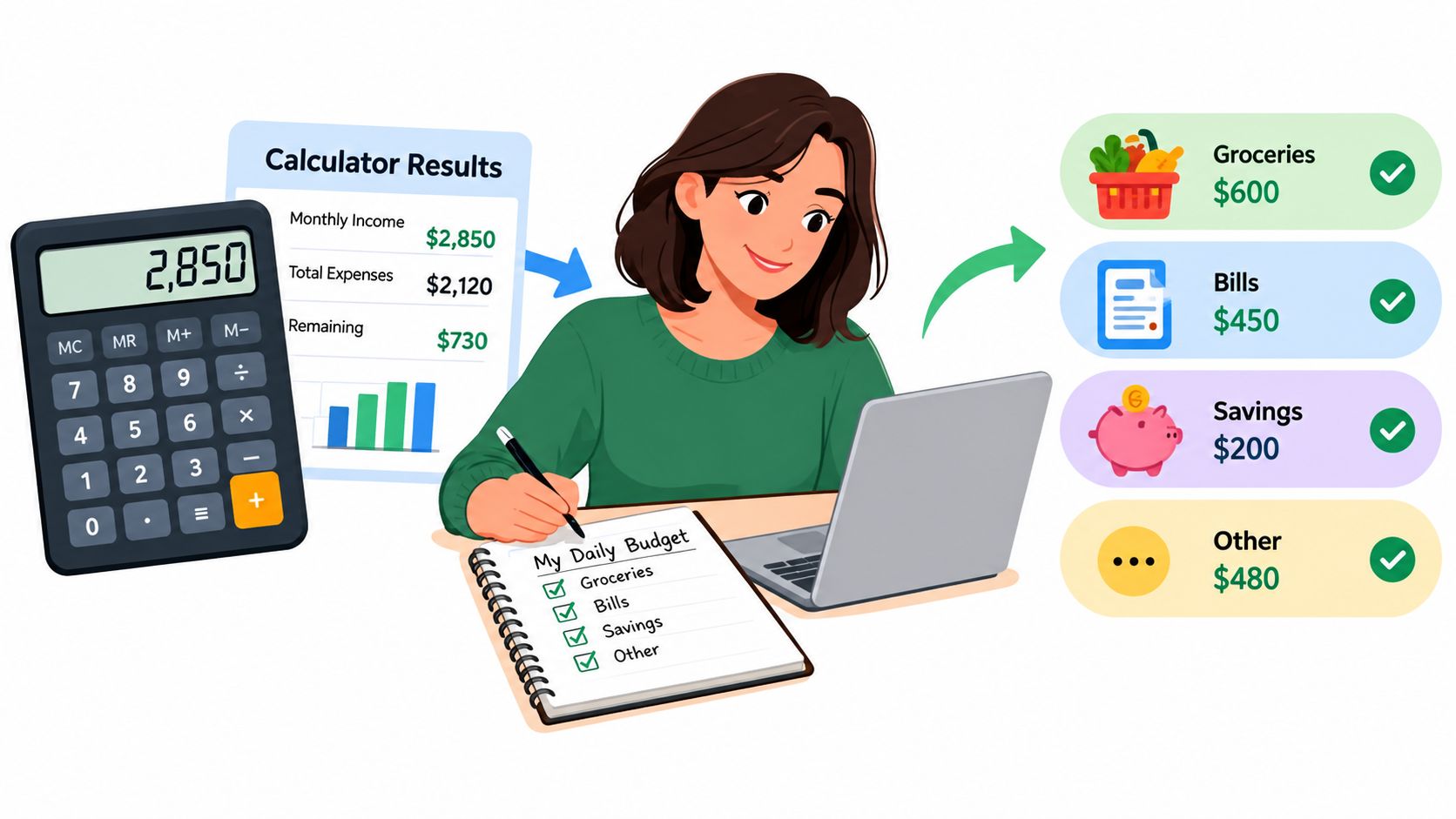
Some people prefer a printable system for category planning, and a digital meal and budget tracker can provide a structured place to record meals, spending, and household priorities.
Fintrack is one option for combining manual expense entry, transaction tracking, subscription monitoring, savings goals, and an AI assistant without requiring a bank connection. That bank-free approach can suit Canadian users who want to enter transactions themselves or keep accounts separate while still monitoring progress.
Use monthly budget planning to turn the calculator's result into a category-level decision. Then check the goal after each pay cycle and adjust the forecast when real spending differs from the estimate.
Your Step-by-Step Goal Tracking Checklist
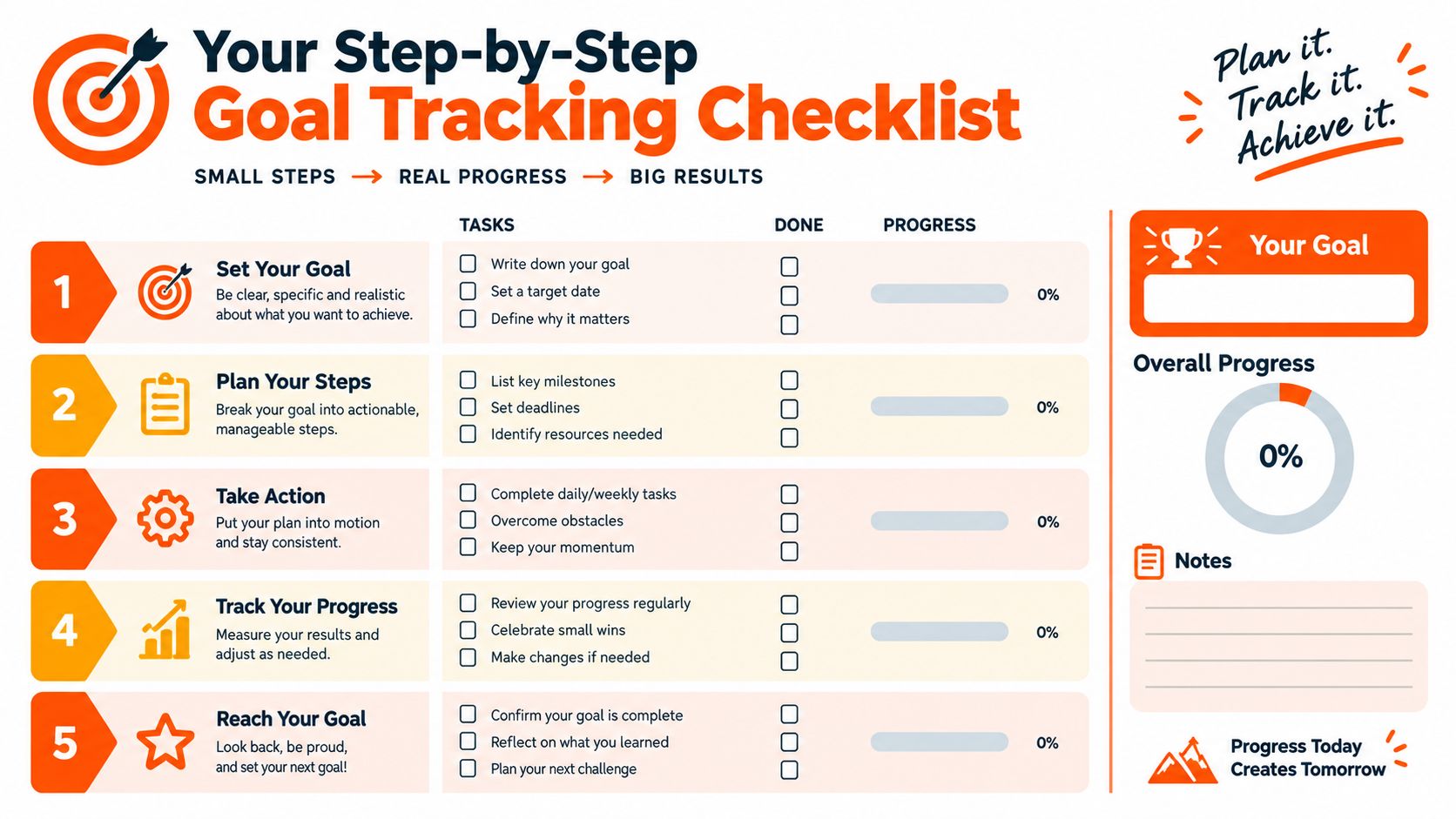
A goal needs a repeatable review routine. Use this checklist to connect the forecast with your day-to-day money decisions.
Define the destination: Write the target amount, purpose, and deadline. Separate emergency savings, debt repayment, retirement, and optional goals.
Enter real cash flow: Add income, regular expenses, current savings, and contribution capacity. Include irregular costs rather than treating them as surprises.
Choose the sequence: Decide which goal gets priority when the monthly surplus can't fund everything. Review account limits and debt obligations before increasing contributions.
Track the categories: Record spending and compare each budget category with the assumptions behind the calculator. Set alerts for unusual activity, duplicate charges, or recurring subscriptions that weaken the surplus.
Review on a schedule: Check progress after each pay cycle or at a consistent monthly review. Recalculate after a new job, a move, a change in household size, or any major debt or expense change.
Business owners and freelancers may also find a startup financial planning playbook useful for thinking about variable income, reserves, and forward planning. The same principle applies to personal finances: use a plan that can change without losing its purpose.
Fintrack lets you set savings goals with target amounts and deadlines, record spending manually, monitor progress, and review the cash-flow patterns behind your forecast. Visit Fintrack to connect your calculator results with practical daily tracking, without relying on a bank connection.