Goal setting matters because it turns a vague wish into a measurable threshold that can guide your budget, spending limits, and saving habits. In Canada, 69% of people say they have financial goals, but only 38% have a household budget and 31% have a written financial plan.
You may recognise the pattern. You check your account after rent, groceries, subscriptions, and a few purchases you barely remember. The balance looks uncomfortable, so you promise yourself that next month will be different. You'll spend less, save more, and finally get ahead.
That promise usually fades because it doesn't tell you what to do when the next bill arrives. A useful goal gives the promise a number, a timeframe, and a routine for checking whether your daily decisions still support it.
For a budgeting app or spreadsheet, that creates a practical bridge. The goal becomes a planned transfer, a category limit, and a visible progress line rather than another intention competing for attention.
The Gap Between Intending and Achieving
“I should save more money” sounds responsible, but it isn't a working financial plan. It has no target amount, no deadline, and no rule for deciding whether a purchase fits the month.
A client might start January determined to build savings. By the middle of the month, an unexpected expense appears, a few restaurant meals go on the credit card, and a subscription renews. Nothing feels dramatic in isolation. By month-end, however, the original promise has disappeared because there was no measurement system to bring it back into view.

Why intention loses momentum
An open-ended task asks you to make the same decision repeatedly. Should you transfer money today? Is this purchase acceptable? Can you spend normally and somehow still save more by the end of the month?
A defined goal closes part of that loop. “Build an emergency fund” becomes a target amount and a date. That target gives you a reference point when your motivation is low, your schedule is busy, or your account balance makes every choice feel urgent.
Short-term targets can be especially useful because they make progress easier to see. This guide to short-term financial goals can help you choose an outcome that feels close enough to influence your next pay period, not just a distant ideal.
Practical rule: If you can't state the amount, deadline, and next contribution, you have an intention, not yet a usable goal.
The point isn't to create a perfect plan on the first attempt. It's to replace “I'll do better” with an instruction your future self can follow. Once the instruction exists, tracking can show whether the problem is the target, the budget, or an expense pattern you haven't noticed.
What Goal Setting Actually Does for Your Money
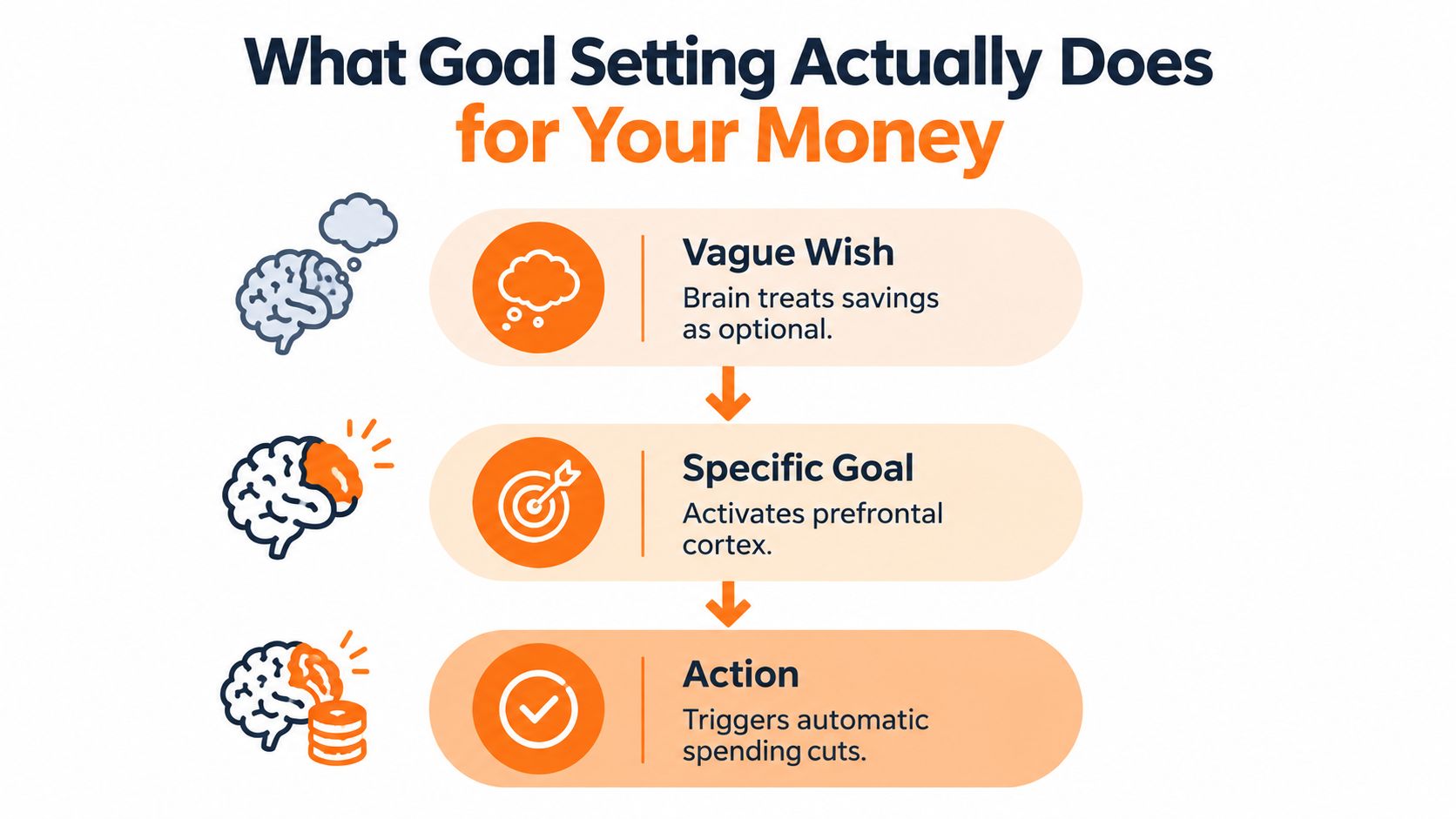
Goal setting changes the role of a financial target. Instead of sitting in the background as a hopeful outcome, the target becomes a decision filter for spending, saving, and reviewing cash flow.
Consider California's higher-education planning framework. The state adopted a 2030 target of 70% of working-age adults holding either a postsecondary award or a bachelor's degree, while statewide attainment stood at 56% in 2023, according to the Public Policy Institute of California's analysis.
The broad target matters, but it becomes manageable only when planners turn it into milestones. The framework aims to move from 56% in 2023 to 58% in 2024, 60% in 2025, and eventually 70% by 2030. The same report estimates that California would need 1,307,047 more educated adults to reach the target, including 1,848 additional graduates from two-year institutions and 765,200 from four-year institutions.
Personal finance follows the same logic. “Become financially secure” is too broad to direct a purchase today. “Save a defined amount by a defined date” lets you calculate a contribution, set a spending ceiling, and identify a shortfall before the deadline.
Goals create a decision filter
A goal doesn't eliminate trade-offs. It makes them visible.
- A purchase gets evaluated against the target. You can ask whether it fits inside the amount available after the planned contribution.
- A budget gets a purpose. Category limits stop being arbitrary restrictions and become support for a result you chose.
- A review produces a decision. If progress is behind schedule, you can reduce spending, adjust the date, or revise the target.
This is the practical value of systems thinking for procrastinators. A goal tells you where you want to go, while a repeatable system determines what happens on an ordinary Tuesday when nobody feels motivated.
California's example also shows why accountability improves when a gap has a measurement. A general ambition can sound successful even when progress is unclear. Annual milestones expose where the distance is greatest and give decision-makers something specific to correct.
Your budget needs the same visibility. A savings goal should answer three questions: how much is required, when it is needed, and which monthly behaviour will fund it. Without those answers, spending decisions remain vulnerable to mood and convenience.
Why Vague Savings Plans Fail
A paycheque arrives, fixed bills leave the account, and the remaining money disappears into ordinary choices. “Spend less” offers no instruction about whether to cut takeout, subscriptions, transport, shopping, or a bill that ran higher than expected. The plan feels flexible until the decision becomes urgent.
A specific goal creates a usable contrast:
| Vague intention | Usable financial goal |
|---|---|
| Save more | Save a stated amount by a stated date |
| Reduce debt | Direct a planned contribution toward a named balance |
| Spend less | Set a limit for a defined category |
| Prepare for emergencies | Build a reserve with a review schedule |
For recurring or irregular costs, what a sinking fund is shows how a named reserve can turn an intention into a defined category with money set aside before the expense arrives.
The Financial Consumer Agency of Canada's guidance on savings and investment goals recommends writing goals down with a dollar amount and timeframe. That detail lets you compare the desired result with available cash flow instead of relying on how motivated you feel.
The Government of Canada's Office of the Superintendent of Bankruptcy guidance on SMART financial goals presents the SMART framework as a practical way to make goals more achievable. Its value is not the acronym. The framework forces a clear definition of success and a way to recognise progress.
Goals without plans create false confidence
Canadian data exposes the execution gap. 69% of Canadians reported having financial goals, while 38% had a household budget and 31% had a written financial plan, according to Ipsos Canada's survey reporting.
A goal can therefore be sincere and still lack a mechanism for action. Without a monthly allocation, spending boundary, or review habit, the intended result competes with convenience every time money moves.
Use the next paycheque as a timing check. Decide when the money moves, where it goes, and what remains available afterward. That test examines the handoff from intention to behaviour rather than redefining the goal.
- Name the outcome: emergency savings, debt repayment, a car, or another priority.
- Set the amount and date: compare the target with real income and expenses.
- Choose the funding rule: transfer or reserve the amount before discretionary spending.
- Review the gap: adjust the plan when cash flow changes instead of abandoning it.
A goal can be modest and still useful. It must be concrete enough to stop your future self from improvising.
How Specific Goals Improve Savings Execution
A household can make progress on several priorities, but limited cash flow rarely supports equal progress on all of them. Spreading every available dollar across too many targets often produces activity without a visible result.
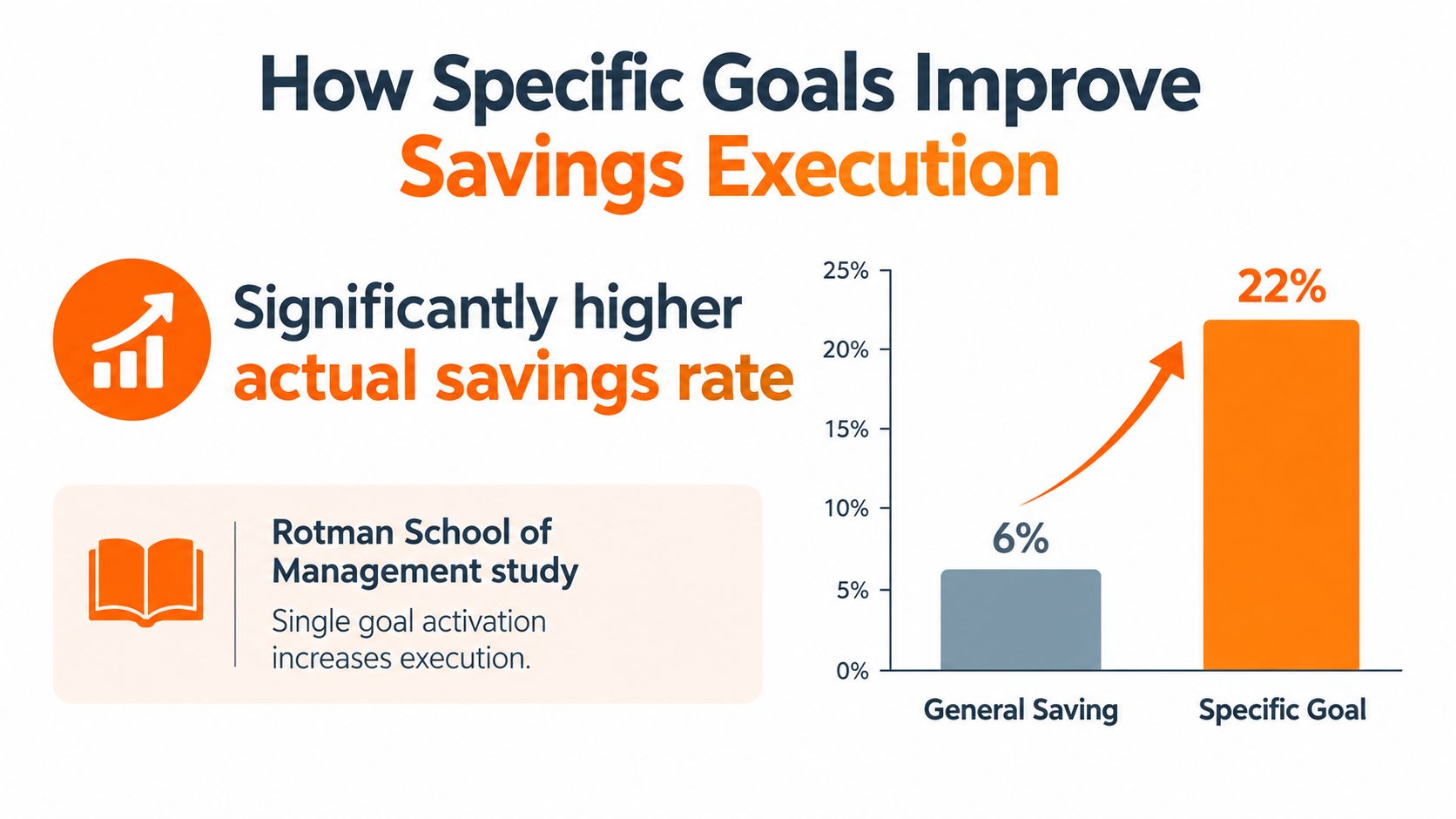
A Rotman School of Management study found that activating a single savings goal led to significantly higher actual savings over a six-month window than activating multiple goals, as described in the study on savings goal activation. The finding points to a design problem, not a character flaw. Fewer active goals reduce competing decisions and make the next financial action easier to identify.
Choose one priority before adding another
Suppose your household wants to build an emergency fund, repay debt, save money for a car, reduce subscriptions, and invest more. Each objective may be sensible, yet dividing discretionary income among all five can leave every account short of the amount needed to create meaningful momentum.
Rank the goals by what protects your current position or enables the next decision. Give the top priority a target and timeframe, then direct available budget capacity toward it before opening another active savings target. If the car is the priority, a defined monthly contribution makes the purchase plan visible and testable.
The Financial Consumer Agency of Canada's financial capability research identifies shorter-term goals as part of an effective financial plan and connects regular saving for unexpected expenses with greater financial resilience and overall financial well-being. A near-term milestone can serve as both an objective and a practical test of whether the saving routine is working.
The same agency says Canadians save less than 5% of income on average and suggests trying to save at least 10%, while recommending a specific amount and time period to motivate progress, according to its saving and investing video. Use that guidance as a reference, not as a rule that takes priority over rent, food, debt payments, or other essential costs.
Design for limited cash flow
FP Canada reports that 51% of Canadians are putting off at least one milestone because of financial concerns, while 41% cite not having enough money left after expenses as a barrier and 35% cite economic uncertainty, according to its financial stress survey reporting. These constraints make ranking priorities more important.
A tight budget may require a longer timeframe, a smaller contribution, or a narrower outcome. Changing the terms keeps the plan aligned with reality. Keeping an unrealistic target vague does the opposite, because the shortfall remains hidden until frustration replaces consistent action.
Turning Goals Into Budget Rules and Tracking Routines
A goal changes behaviour only when it reaches the budget. Use a simple workflow that turns the desired outcome into a recurring decision and then checks whether the decision is working.
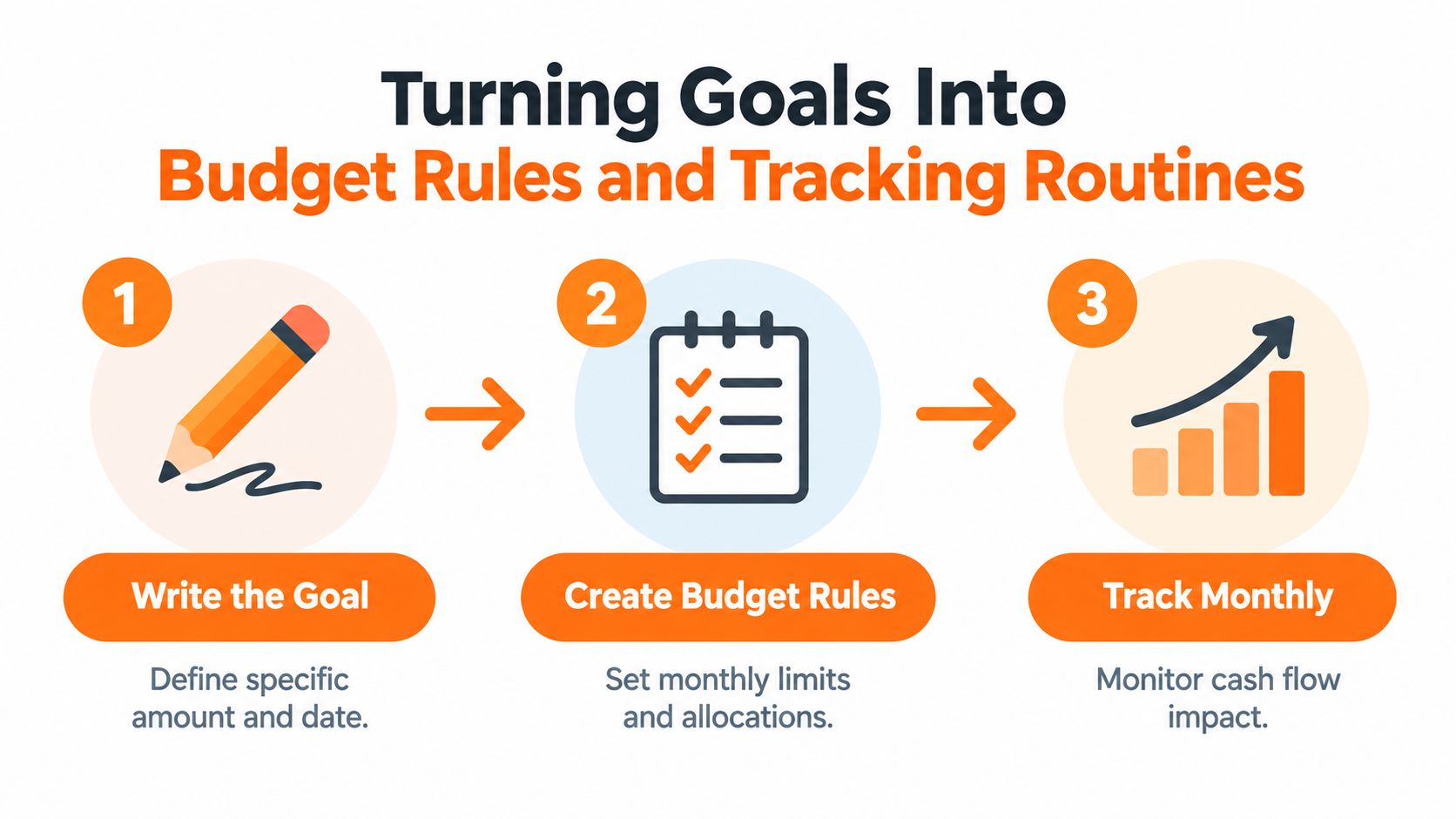
1. Write the goal
Start with a sentence that includes the target and deadline:
I want to save [amount] for [purpose] by [date].
Then check whether the goal fits your circumstances. If you have irregular income, use a conservative contribution and review it more often. If the goal competes with essential bills or high-cost borrowing, rank those obligations before treating the savings target as fixed.
The wording matters because “save more” cannot be audited. A written target can.
2. Create a budget rule
Translate the target into a recurring contribution. Divide the remaining amount by the number of contribution periods before the deadline, then compare that requirement with your actual cash flow.
Next, decide what happens before optional spending. You might reserve the contribution when income arrives, assign a category limit, or create a rule that directs a defined amount toward the priority goal. The specific method can vary. The essential feature is that the decision happens in advance.
A budget versus actual dashboard becomes useful. Comparing the plan with recorded spending helps you see whether the issue is an unrealistic allocation or repeated overspending in a category.
3. Track and review
Tracking isn't punishment. It is feedback.
Review the goal after each meaningful budget period. Check the amount contributed, the spending categories that affected it, and whether the deadline still makes sense. If the gap is growing, act while the correction is small. You may need to reduce a category, pause a lower-priority goal, increase income, or move the deadline.
The goal is not to predict every expense perfectly. It is to catch drift before the plan becomes invisible. With a clear target, your tracking routine can show exactly which choice needs attention.
Where to Start Without Overcomplicating Things
You don't need a complicated spreadsheet to learn why goal setting is important. You need one priority, a realistic target, and a way to compare your plan with what really happened.
Start with a goal that matters in the near term. An emergency fund, a necessary replacement purchase, or a specific debt balance can work well because the outcome is easy to name and the next contribution is clear.
Use a low-friction setup
Write down these four details:
- Purpose: What will this money do for you?
- Target: What amount would count as progress?
- Date: When do you want to reach it?
- Contribution: What recurring amount can your current cash flow support?
Don't set a contribution based on an ideal month. Use the month you can realistically repeat, then increase it when your expenses or income change. A smaller sustainable action is more useful than an aggressive target that forces you to restart.
For examples of time-bound objectives, the Lumas guide to medium-term goals offers a useful way to think about goals that sit between immediate bills and distant plans. Adapt the examples to your income, obligations, and priorities rather than copying someone else's timeline.
Make progress visible
Choose a tracking method you'll use. A spreadsheet works if you update it consistently. Manual entry can be preferable when you don't want to connect a bank account, particularly for Canadian users who prefer keeping their account details separate from their budgeting routine.
Fintrack can hold a target amount and deadline, record transactions through manual entry or connected accounts, and show progress through milestones and updates. Its value in this process is practical: it keeps the goal and the spending record in the same workflow instead of leaving you to reconcile separate notes.
If you're new to budgeting, these budgeting tips for beginners can help you establish the basic categories and review habit before adding more goals.
Start with one measurable target and review it regularly. Once that routine feels ordinary, add another goal only if your cash flow and attention can support it.
Fintrack combines goal planning with expense tracking so you can set a target, record transactions manually or through a bank connection, and monitor progress against your real spending. Visit Fintrack to turn one financial priority into a visible budget routine.