
Meta description: A realistic plan to stop living paycheck to paycheck with quick wins, a workable budget, and habits that create lasting breathing room.
The week before payday has a particular kind of stress.
You check your account. You subtract rent, groceries, fuel, and that bill you forgot was due earlier than usual. Then you start doing the mental gymnastics. Can this wait until Friday? Should I move money from savings? Is the card payment going to clear?
If that sounds familiar, you're not bad with money. You're dealing with a cash flow problem that can happen at almost any income level, especially when fixed costs keep climbing faster than your margin.
That Feeling When Payday Is Still a Week Away
A lot of people think living paycheck to paycheck means someone isn't earning enough, full stop. That's too simple. In a summary from Investopedia, a 2023 survey found that 45% of high-income earners also reported living paycheck to paycheck. That tells you something important. The issue often isn't just income. It's how much of that income is already spoken for before the month even begins.
I see this pattern in a few common forms. One person has a solid salary but a rent payment that eats up too much of it. Another is carrying debt from an older emergency and now every paycheque arrives with obligations attached. Someone else earns enough in theory, but irregular costs keep knocking them off balance because there's no buffer.
Living paycheck to paycheck often feels like a personal failure, but most of the time it's a system problem. Too many fixed bills, too little margin, and no room for ordinary life mistakes.
That pressure doesn't stay neatly inside your bank account. It spills into sleep, relationships, work, and mental health. If money stress is affecting your headspace, support matters. Some people find it helpful to talk through the emotional side with Interactive Counselling for online therapy, especially when financial anxiety starts shaping daily decisions.
There's also a practical side to reducing that stress. Start by getting brutally clear on what leaves your account every month. A simple monthly bill tracker can help you see recurring due dates, stop surprise withdrawals, and replace guesswork with facts.
The first shift isn't “spend less.” It's “see clearly.” Once you can spot the pattern, you can start changing it.
Diagnose Your Financial Pressure Points
Those living paycheck to paycheck don't have one problem. They have one main pressure point and a few smaller ones around it. If you don't identify the main one, you'll waste energy fixing the wrong thing.
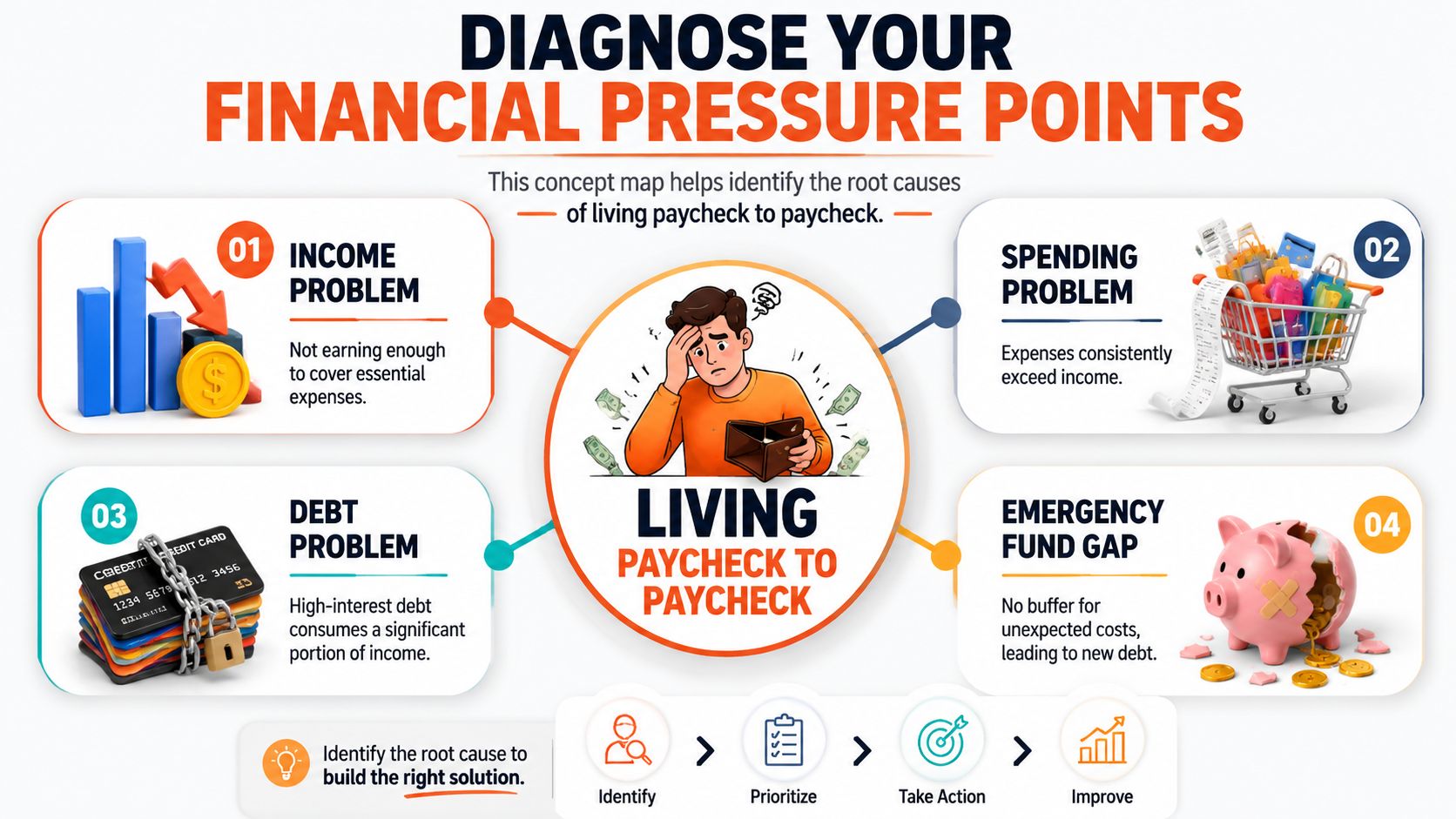
The four pressure points
There are four usual drivers:
| Pressure point | What it looks like | What usually helps |
|---|---|---|
| Income gap | Essentials take most of your pay before anything else | More income, cheaper fixed costs, or both |
| Spending drift | Small and medium discretionary spending keeps crowding out priorities | Tracking, limits, and clearer weekly decisions |
| Debt load | Payments for past spending consume today's cash flow | A debt plan and fewer new charges |
| Emergency fund gap | One unexpected cost forces borrowing or missed bills | A starter cash buffer |
A 2025 Bank of America Institute analysis noted that the rise in households living paycheck to paycheck is concentrated among lower-income Millennials and Gen X, which is one more reminder that this strain often sits right in the middle of working life. People aren't failing adulthood. They're trying to manage work, housing, family costs, and old obligations at the same time.
A fast self-check
Use the last month of bank and card activity. Don't optimise yet. Just sort.
List take-home income
Include wages, freelance income, support, benefits, and any regular transfers you rely on.Separate fixed from variable costs
Fixed costs include rent, car payments, insurance, minimum debt payments, phone plans, and childcare. Variable costs include groceries, fuel, takeout, household spending, and personal spending.Mark every debt payment
Minimums matter because they reduce your flexibility before the month starts.Identify the trigger category
Ask one question: If I solved only one issue first, what would relieve the most pressure?
A full list of expenses helps here because people usually underestimate the categories that don't arrive as one tidy monthly bill. School costs, pet care, pharmacy runs, birthday gifts, parking, and home supplies can unexpectedly wreck a fragile budget.
How to tell what's really going on
Practical rule: If your essentials and debt minimums leave almost nothing before discretionary spending starts, you don't have a discipline problem. You have a margin problem.
Look for these clues:
Income problem
You're careful already, but basics still feel tight. Cutting coffee won't fix housing, transport, or debt obligations that are too large.Spending problem
You aren't overspending in one dramatic way. Money just leaks through convenience spending, inconsistent grocery habits, online purchases, and “I'll deal with it later” decisions.Debt problem
You keep making progress and then lose it because interest and minimums keep pulling cash away.Emergency fund gap
The month works only if nothing goes wrong. Real life always proves otherwise.
Once you know the pressure point, you can stop treating every money issue like a character flaw and start treating it like a solvable operational problem.
Your First 30 Days to Create Breathing Room
The first month isn't about building the perfect budget. It's about stopping the bleeding and proving to yourself that change is possible.

Week 1 and 2
Start with a temporary reset, not a forever lifestyle.
Pause non-essential spending
For a short period, cut out purchases that are easy to delay. New clothes, impulse home buys, app upgrades, convenience extras, and hobby spending can wait while you stabilise.Keep a spending note on your phone
Every time you want to buy something, write it down instead. This creates a pause between the urge and the action.Review every recurring charge
Streaming services, memberships, software, add-ons, family plans, cloud storage, premium delivery, and annual renewals all deserve a second look.
One of the easiest places to recover cash is recurring spending you barely notice. A good subscription management app helps surface those charges so you can decide what stays and what goes.
Week 3
Now reduce only a few categories. Don't try to become a different person overnight.
Pick one food category, one convenience category, and one flexible category.
For example:
Food category
Reduce takeout frequency and decide in advance which days are simple meal days.Convenience category
Cut rush purchases that happen because planning broke down, like delivery fees, last-minute snacks, or duplicate household items.Flexible category
Cap social spending, shopping, or personal care extras for the rest of the month.
If you try to cut everything, you'll quit. If you cut the right few things, you'll feel relief fast enough to keep going.
Week 4
The last part of the month is about protecting any surplus, even if it feels small.
Do these three things:
Move the leftover money out of your main spending account
If it stays visible, it often gets spent.Plan the next bill cycle before payday lands
Assign your next paycheque on paper before it arrives.Write down what worked
Not what sounded smart. What worked.
Here's a simple 30-day triage checklist:
| Action | Why it matters |
|---|---|
| Freeze low-priority spending | Creates immediate breathing room |
| Cancel or pause unused subscriptions | Removes silent monthly leaks |
| Reduce only a few variable categories | Keeps the plan realistic |
| Set aside any small surplus | Starts your buffer |
| Pre-plan the next pay cycle | Prevents the same scramble from repeating |
This month is financial first aid. It won't solve every structural problem, but it can stop the constant feeling of being cornered. That matters more than people realise.
Build a Sustainable Budget That You Can Stick To
A budget only works if it reflects your real life. If the numbers look good on paper but collapse by the second week, the problem isn't motivation. The plan is too rigid.

Start with a simple frame
A common starting point is to divide money into needs, wants, and future goals. Use that as a draft, not a rule carved in stone. If housing or debt is heavy right now, your budget won't look balanced for a while, and that's fine.
Build your budget in this order:
Essentials first
Housing, groceries, transport, utilities, insurance, childcare, medications.Minimum obligations next
Debt payments, required subscriptions, and must-pay services.Short-term stability
Starter emergency savings and known upcoming costs.Flexible spending
Eating out, entertainment, shopping, hobbies, and personal extras.
A lot of households fail here because they skip category detail. Broad labels like “miscellaneous” hide bad decisions and normal life costs in the same bucket. More specific household budget categories make it easier to adjust the right thing instead of slashing everything.
Make the budget fit your pay cycle
If you're paid twice a month, weekly, or irregularly, a monthly budget still matters, but you also need a paycheque plan.
Try this approach:
- For each paycheque, assign the next few obligations
- Keep groceries and fuel in smaller weekly amounts
- Leave a category for irregular but expected spending
- Review once a week, not only at month end
That weekly check-in is where you regain control. You catch drift early, before it turns into another shortfall.
A workable budget doesn't ask whether you were perfect. It asks whether your plan still matches reality.
Use tools to reduce friction
Manual budgeting helps, but only if you'll keep using it. Many people need less spreadsheet work and more visibility. Tools that categorise spending, flag recurring charges, and show category progress can make the process easier to maintain.
This is also where a budgeting tool can help. Fintrack's budget planning feature lets you set category limits, track progress, and adjust based on what's happening instead of rebuilding your plan from scratch every week.
The best budget is boring in the right way. It should tell you what's safe to spend, what needs attention, and what can wait. If it does that consistently, it's doing its job.
Your Financial Roadmap for the Next Year
Escaping the cycle of living paycheck to paycheck usually happens in layers. First you stop the scramble. Then you stabilise. Then you build protection around your life so one bad week doesn't knock everything over.
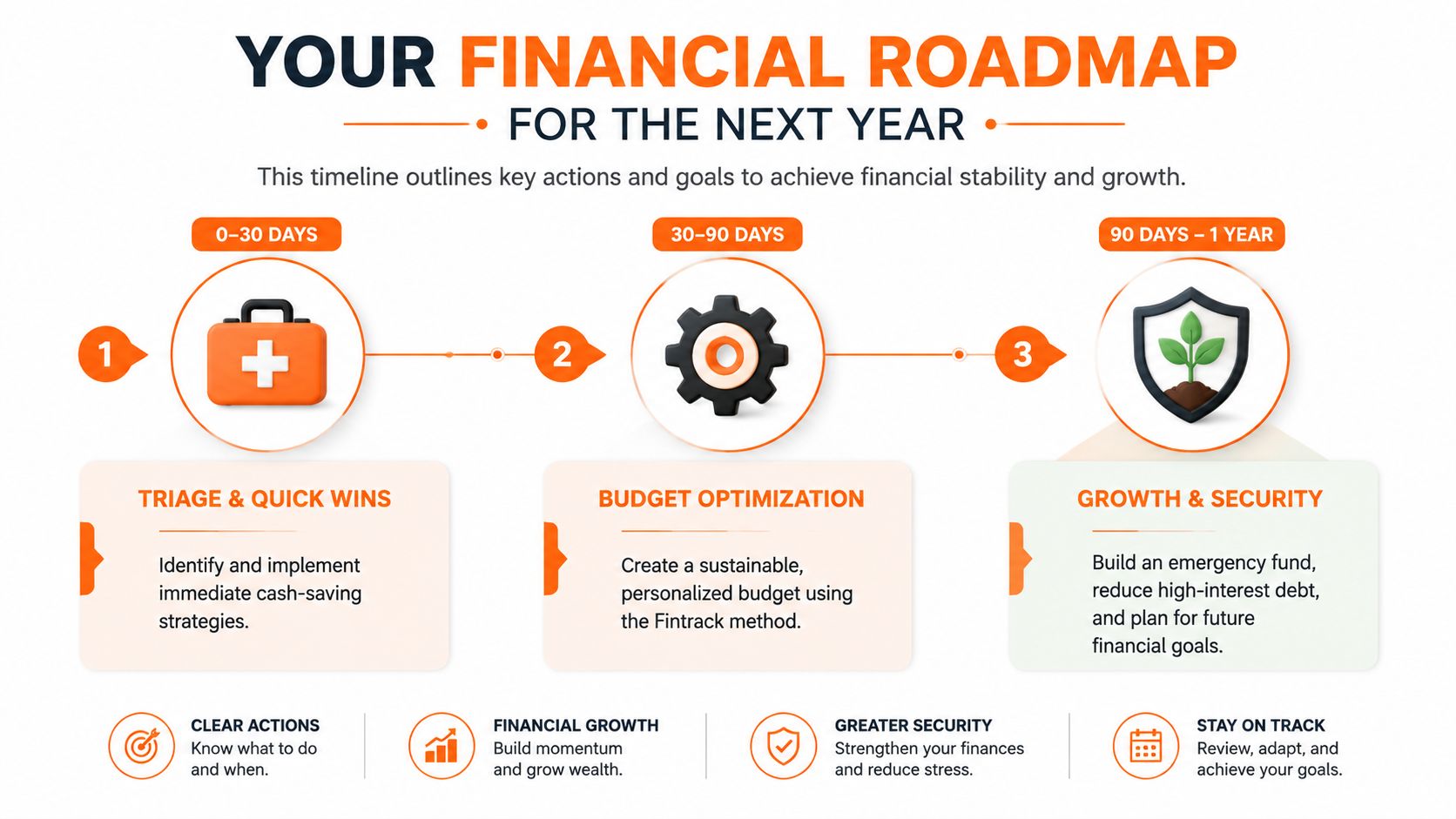
The next 90 days
Your first stretch is about consistency, not speed.
Focus on these milestones:
Keep bills current
Predictability matters more than perfection.Hold one small cash buffer
Even a modest buffer changes how you handle timing gaps and minor surprises.Choose one debt priority
Don't spread extra money across too many goals at once.Prepare for known costs
Annual fees, school expenses, holidays, car maintenance, and gifts shouldn't become emergencies just because they aren't monthly.
That last point matters a lot. A sinking fund is one of the most practical tools for anyone trying to stay out of the paycheck-to-paycheck trap. It turns predictable future expenses into manageable monthly planning.
The next 12 months
Think in terms of stability, capacity, and optionality.
| Time frame | Main focus | What success looks like |
|---|---|---|
| Months 1 to 3 | Stabilise cash flow | Fewer surprises, better bill timing |
| Months 4 to 6 | Build protection | A stronger emergency cushion and fewer new setbacks |
| Months 7 to 12 | Expand options | More room for debt payoff, saving, or career moves |
Career growth can become part of this plan too, especially if your diagnosis showed a real income gap. That might mean asking for more responsibility, applying for a better role, or tightening up your job search materials with an AI resume builder if earning power is the lever that will move your budget the most.
The longer-term aim isn't just “save more.” It's to create a life where a car repair, slower work month, or school expense doesn't instantly push you back into panic mode.
You know your finances are improving when one problem stays one problem. It doesn't automatically become five.
That's the shift from constant reaction to steady control.
Make Your New Habits Stick for Good
Most money plans don't fail because the math is wrong. They fail because the system depends on willpower every single day.
Willpower is unreliable. Habits and structure are much better.
Build defaults that help you
Good habits usually start with fewer decisions, not more.
Try these defaults:
Automate one transfer
Move a set amount to savings right after income arrives, even if it's modest.Use spending alerts
Real-time notifications make it harder to ignore drift until the end of the month.Check money on a schedule
Pick one day each week for a brief review. Same time, same routine.Keep one visible target
A small emergency fund, one debt balance, or one sinking fund is enough to stay engaged.
Plan for setbacks without drama
You will overspend in a category at some point. A bill will be higher than expected. Something will break. That doesn't mean the whole plan failed.
Use a reset process:
- Name what happened
- Adjust one or two categories
- Protect essentials
- Resume the plan at the next review
Don't turn one off-track week into a month of avoidance.
Missing the plan once is a moment. Stopping the plan entirely is what causes the real damage.
Watch your emotional spending patterns
Most overspending isn't random. It follows a pattern. Common triggers include stress, convenience, boredom, social comparison, and reward-seeking after a hard day.
A few questions help:
- What was I feeling right before I spent this?
- Was this planned, delayed, or reactive?
- What problem was I trying to solve?
- What would have helped instead?
Sometimes the answer is rest. Sometimes it's planning. Sometimes it's boundaries with other people. The money choice often sits on top of a non-money issue.
The households that make lasting progress usually do one thing very well. They make it easy to notice what's happening before it becomes expensive. One dashboard, one weekly review, and a few automated decisions are often more useful than a detailed spreadsheet you stop opening after two weeks.
From Surviving to Thriving
Breaking the pattern of living paycheck to paycheck rarely comes from one huge move. It usually comes from a series of smaller ones done consistently. See the pressure point clearly. Create a little breathing room. Build a budget that matches your actual life. Then protect your progress with habits that don't depend on motivation.
Over time, those ordinary actions compound into stability, confidence, and choices. If part of your longer-term plan includes building skills and earning power, this guide to making smart education investments is a useful reminder that some spending can strengthen your future instead of weakening your month.
If you want a simpler way to put this into practice, Fintrack can help you organise your budget, track spending, and see where your money is going so your next paycheque comes with a plan instead of a scramble.