
Some money stress is loud. A missed payment, an over-limit card, a tax surprise.
Most of it is quieter. It sounds like checking three apps to figure out whether you can afford a weekend away. It looks like a paycheque landing and disappearing too fast. It feels like knowing you should have a plan, but not knowing where to start.
That’s where planning personal finance helps. Not as a rigid set of rules, and not as a spreadsheet hobby. A good plan gives your money a job, shows you what matters most, and makes everyday decisions easier.
The people who do this well usually aren’t obsessing over every coffee purchase. They have a simple system. In Canada, households with well-developed financial plans show 2x higher savings efficacy and 78% emergency preparedness, compared with 53% for non-planners, while only 19% of households are dedicated planners, according to research on financial planning outcomes. That gap matters.
Your First Step Toward Financial Clarity
Financial clarity starts with one shift. Stop treating money as a set of disconnected tasks.
Many people manage money in fragments. Bills in one place. Savings in another. Credit cards on autopay. A vague idea of what’s left over. That setup works until life changes, a large expense hits, or a long-term goal starts feeling urgent.
What a plan does
A personal finance plan is a working system for five things:
- Seeing reality clearly so you know what’s coming in, what’s going out, and what you owe
- Choosing priorities instead of reacting to every expense
- Protecting yourself from shocks like emergencies or income changes
- Funding future goals such as travel, a home, retirement, or debt freedom
- Reviewing regularly so your plan adjusts when life does
That’s the practical version. It’s less about perfection and more about direction.
Practical rule: If your finances feel fuzzy, the answer usually isn’t more discipline. It’s better visibility.
Planning personal finance also reduces decision fatigue. When you already know how much goes to bills, saving, debt, and flexible spending, you make fewer panicked choices during the month.
Start with one central view
The first useful move is to create one place where your financial picture lives. That might be a spreadsheet, a notes app, or a dashboard that combines accounts and transactions. The format matters less than the habit.
For people who want that view without building it manually, a tool with a conversational overview can help. The personal finance assistant category is useful because it lets you ask plain-language questions about your money instead of digging through statements.
What doesn’t work is trying to “feel” your way through finances. Memory is unreliable. Bank balances can be misleading. A paycheque in your account doesn’t mean you’re ahead if rent, debt payments, and annual costs are still waiting.
A better mindset for the rest of this guide
Treat your plan like a map, not a moral test.
Some months will be messy. A plan still helps. It shows what changed, what needs adjusting, and what to ignore.
That’s how people make progress in practice. Not by being perfect every month, but by building a system they can return to quickly.
Get a Complete Picture of Your Finances
You can’t plan a route without knowing your starting point. Money works the same way.
A lot of people skip this part because it feels tedious. They’d rather jump straight to budgeting or saving goals. But if your numbers are scattered, every decision after that sits on shaky ground.

Gather the whole picture
Start with four categories:
Income Include salary, freelance income, side work, support payments, and any other regular deposits.
Spending Look at fixed costs first, then variable spending. Housing, utilities, insurance, groceries, transport, subscriptions, dining out, and irregular purchases all count.
Assets Cash, savings, investment accounts, and anything else you could reasonably count as part of your financial base.
Debts Credit cards, lines of credit, student loans, car loans, tax balances, and any personal borrowing.
If this sounds basic, that’s because it is. Good planning personal finance habits usually start with ordinary bookkeeping done consistently.
Focus on flow, not just balances
People often look at account balances and stop there. The more useful question is how money moves.
Two people can have the same income and very different outcomes. One has controlled fixed costs, low friction, and automatic saving. The other leaks money through irregular spending, duplicate subscriptions, and untracked card use.
That’s why I tell people to measure two things before making any big change:
- Net cash flow
- Spending patterns by category
Your net worth matters, but your monthly flow tells you whether the current system is sustainable.
Use categories that match real life
Overcomplicated categories make tracking harder, not better. Keep them broad enough to maintain and specific enough to be useful.
A simple setup might include:
| Category | What belongs there |
|---|---|
| Housing | Rent, mortgage, property costs, utilities |
| Transport | Fuel, transit, car payment, insurance |
| Food | Groceries, takeaway, restaurants |
| Debt | Minimums and extra debt payments |
| Lifestyle | Shopping, hobbies, entertainment |
| Savings | Emergency fund, sinking funds, investments |
If you’re doing this manually, review a few months of transactions and assign each one. If you want less admin, automatic expense categorisation can save a lot of time by sorting spending into usable groups.
The goal isn’t to create beautiful data. The goal is to make your money visible enough to act on.
Watch for the usual blind spots
Most financial snapshots miss the same trouble spots:
- Annual costs like insurance renewals or school fees
- Small recurring charges that no longer matter to you
- Shared household expenses that drift between accounts
- Irregular income months if you’re self-employed or paid on commission
- Debt minimums that leave little room for progress
This is also where AI-style transaction review can help. A searchable transaction history is far more useful than scrolling bank feeds. If you can ask, “What did I spend on eating out last month?” and get a clean answer, your plan gets easier to maintain.
What to keep after this step
By the end of this exercise, you want a short working summary:
- Your monthly take-home income
- Your essential monthly spending
- Your flexible monthly spending
- Your total debt and required payments
- Your current savings position
That single-page view becomes the foundation for every goal, budget, and review that follows.
Set Financial Goals You Can Reach
A plan without goals turns into maintenance. You pay bills, try to be sensible, and hope things improve.
Useful goals give your money direction. They also help you decide what to ignore. If you’re saving for a home deposit, that matters more than random spending tweaks that don’t move the bigger picture.
Break goals into time horizons
The easiest way to keep goals realistic is to separate them by timeline.
Short-term goals usually sit close enough to feel tangible. Think emergency savings, paying off a small balance, replacing a laptop, or building a travel fund.
Mid-term goals need more structure. A vehicle purchase, a down payment, career training, or major home costs fit here.
Long-term goals shape the whole plan. Retirement is the obvious one, but long-term care for family, financial independence, or a major lifestyle shift can belong here too.
Each goal needs a different funding method. Short-term money should stay stable and accessible. Longer-term money can tolerate more fluctuation.
Turn vague ideas into working targets
“Save more” isn’t a goal. It’s a wish.
A better goal sounds like this:
- Emergency fund for essential expenses
- Debt payoff with a clear end point
- Retirement contribution habit tied to each pay cycle
- Travel fund with a monthly saving amount and target date
The simplest filter is the classic S.M.A.R.T. idea. Specific, measurable, achievable, relevant, and time-bound. It works because it forces trade-offs into the open.
For example, “I want to retire early” is inspiring but too loose to act on. A more useful version is, “I want to increase my retirement contributions this year and review whether an earlier retirement date is realistic.” If that’s your focus, this practical financial guide to early retirement gives a grounded look at the kind of planning involved.
Retirement deserves a real line item
Long-term goals often get postponed because they feel far away. That’s risky.
According to data on retirement planning gaps, 32% of working-age U.S. adults have $0 saved for retirement, and only 39% of adults have attempted to create a retirement plan. The same source notes that 25% of women have no savings or less than $10,000, compared with 16% of men.
Those numbers don’t tell you what your retirement should look like. They do show that delay is common, and expensive.
A goal becomes real when it has a deadline, a funding source, and a place in your monthly plan.
Match each goal to an account or tracking system
One reason goals fail is that they live only in your head. If possible, give each one a visible home.
That can mean:
- A separate savings account for a near-term expense
- An automatic transfer tied to payday
- A debt tracker that shows progress
- A dedicated goal dashboard that updates as money moves
The goals and savings strategy tools approach is useful here because it turns a broad plan into trackable targets with progress attached. That makes it easier to stay engaged when a goal takes months or years.
Choose fewer goals, not more
Too many goals at once creates fake progress. You move tiny amounts in many directions and feel busy without gaining traction.
A stronger approach is to pick:
- One protection goal, such as emergency savings
- One pressure-relief goal, such as high-interest debt repayment
- One future goal, such as retirement or a down payment
That mix keeps your plan balanced. You protect the present, reduce stress, and still move toward something meaningful.
Choose a Budgeting Framework That Works for You
A budget isn’t a punishment. It’s the operating system for your plan.
The mistake isn’t budgeting. The mistake is forcing yourself into a method you hate and won’t maintain. Some people need structure. Others need a lighter framework with fewer moving parts.
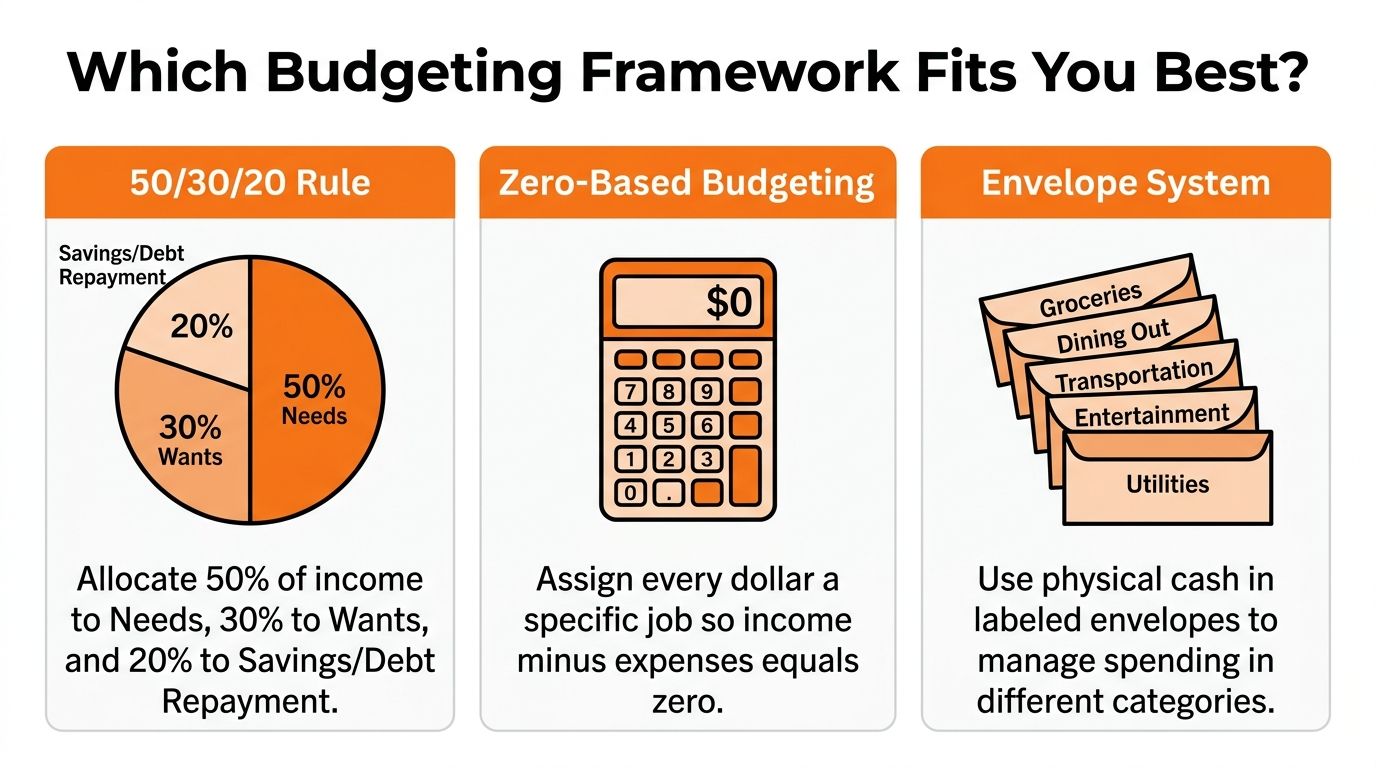
Three common approaches
Here’s a practical comparison of three popular systems.
| Framework | Best for | What it does well | Where it struggles |
|---|---|---|---|
| 50/30/20 rule | People who want simplicity | Gives broad spending guardrails | Can be too loose if spending is already messy |
| Zero-based budgeting | People who want control | Assigns every dollar a job | Takes more effort to maintain |
| Envelope system | People who overspend in a few categories | Creates hard spending limits | Less convenient in a digital-first life |
The 50 30 20 rule
This method divides income into needs, wants, and savings or debt repayment. It works well when you want quick structure without tracking every detail.
It’s a good fit if you:
- Need a reset after drifting without a plan
- Prefer broad targets over line-by-line budgeting
- Want flexibility while still protecting saving progress
It’s less useful if your fixed costs are already too high. In that case, broad percentages can hide a structural problem.
Zero-based budgeting
This method gives every dollar a purpose so income minus planned spending equals zero. You don’t spend every dollar. You assign every dollar.
That difference matters. Savings, debt payments, annual costs, and sinking funds all get planned before the month begins.
Zero-based budgeting is strong when:
- Income is stable and you want tighter control
- You’re paying down debt and need precision
- You tend to ask “where did it go?” at month-end
It can feel heavy if you dislike admin. The solution isn’t to abandon it. It’s to simplify the categories and automate as much as possible.
The best budget is the one you’ll still use after a busy month, a stressful week, and one unexpected bill.
The envelope system
This is old-school and still useful. You set cash limits for specific categories and stop spending when the envelope is empty.
Even if you don’t use physical cash, the principle works well for problem areas like dining out, personal spending, or entertainment. It gives you a clear stop point.
This method works best when behaviour is the problem, not knowledge. Many people already know they overspend in one or two categories. They need friction, not more education.
How to choose your framework
If you’re unsure, use this quick decision guide:
- Choose 50/30/20 if you want a simple starting point
- Choose zero-based if you want maximum visibility and tighter control
- Choose envelopes if a few categories regularly derail your month
You can also combine them. Many people use a broad framework for the full month, then apply envelope-style caps to risky categories.
What usually fails
Budgeting tends to break for predictable reasons:
- The categories are too detailed
- Irregular costs are ignored
- The plan is built once and never reviewed
- One bad week leads to giving up entirely
- Savings are treated as leftover money
A working budget needs enough structure to guide decisions, but not so much complexity that you avoid opening it.
If you want a digital version of any of these systems, budget planning tools can help you set category limits, compare plan versus actual spending, and spot problems before the month gets away from you.
Build Your Financial Safety Net
If your financial plan has no shock absorbers, even a good month can collapse fast.
This is the part people postpone because it isn’t glamorous. No one brags about holding cash for emergencies or steadily clearing debt. But these two habits protect everything else in your plan.
Emergency savings comes first
An emergency fund isn’t optional. It keeps a real-life problem from turning into a debt problem.
A practical target is 3 to 6 months of essential living expenses. Keep that money somewhere accessible and stable, not mixed into everyday spending.
The reason is simple. According to financial literacy and emergency savings data, 57% of Americans cannot cover a $1,000 emergency expense from savings, and 69% of U.S. households have less than $1,000 saved for emergencies.
That’s why even a modest starter fund matters. It buys time. It reduces panic. It protects your ability to stick with the rest of the plan.
Start smaller if needed
If building a full safety net feels impossible, use stages.
- Stage one is a starter emergency cushion
- Stage two is one month of essentials
- Stage three is the fuller target range
This approach works better than waiting until you can save a large amount. Momentum matters.
Debt needs a method, not just motivation
Debt repayment often stalls because people attack it emotionally instead of systematically.
Two common approaches work well:
| Method | How it works | Best use |
|---|---|---|
| Avalanche | Pay extra toward the highest-interest debt first | Best when you want the most efficient payoff |
| Snowball | Pay extra toward the smallest balance first | Best when quick wins keep you engaged |
Neither method is morally superior. Choose the one you’ll stick with.
If your debt is causing stress, the first goal is to stop adding to it. That might mean pausing some savings goals temporarily, tightening a few spending categories, or using a starter emergency fund to break the cycle of borrowing for surprises.
Protecting your plan means preparing for the boring setbacks, not just chasing the exciting goals.
Don’t ignore related protection gaps
A safety net isn’t only cash. It also includes the practical protections that keep one event from wiping out progress.
That can include:
- Adequate insurance
- Current beneficiary details
- A plan for major health costs
- A working list of due dates and minimum payments
For readers reviewing health-related savings tools, this guide on what an HSA account is can help clarify where that type of account may fit within a broader protection plan.
What works in real life
People tend to succeed here when they do three things:
- Automate the emergency transfer
- Pick one debt method and stop switching
- Track progress visibly
What doesn’t work is trying to build emergency savings, invest aggressively, pay down every debt, and maintain full lifestyle spending all at once. A safety net requires prioritising stability for a season.
That trade-off is worth it. Once the floor is stronger, every other financial decision gets easier.
Automate and Optimize Your Financial Life
A plan that depends on daily willpower won’t hold up for long. Busy weeks, travel, family demands, and plain old forgetfulness get in the way.
Automation solves the consistency problem. Optimisation improves what the system keeps doing in the background. Together, they make planning personal finance less fragile.
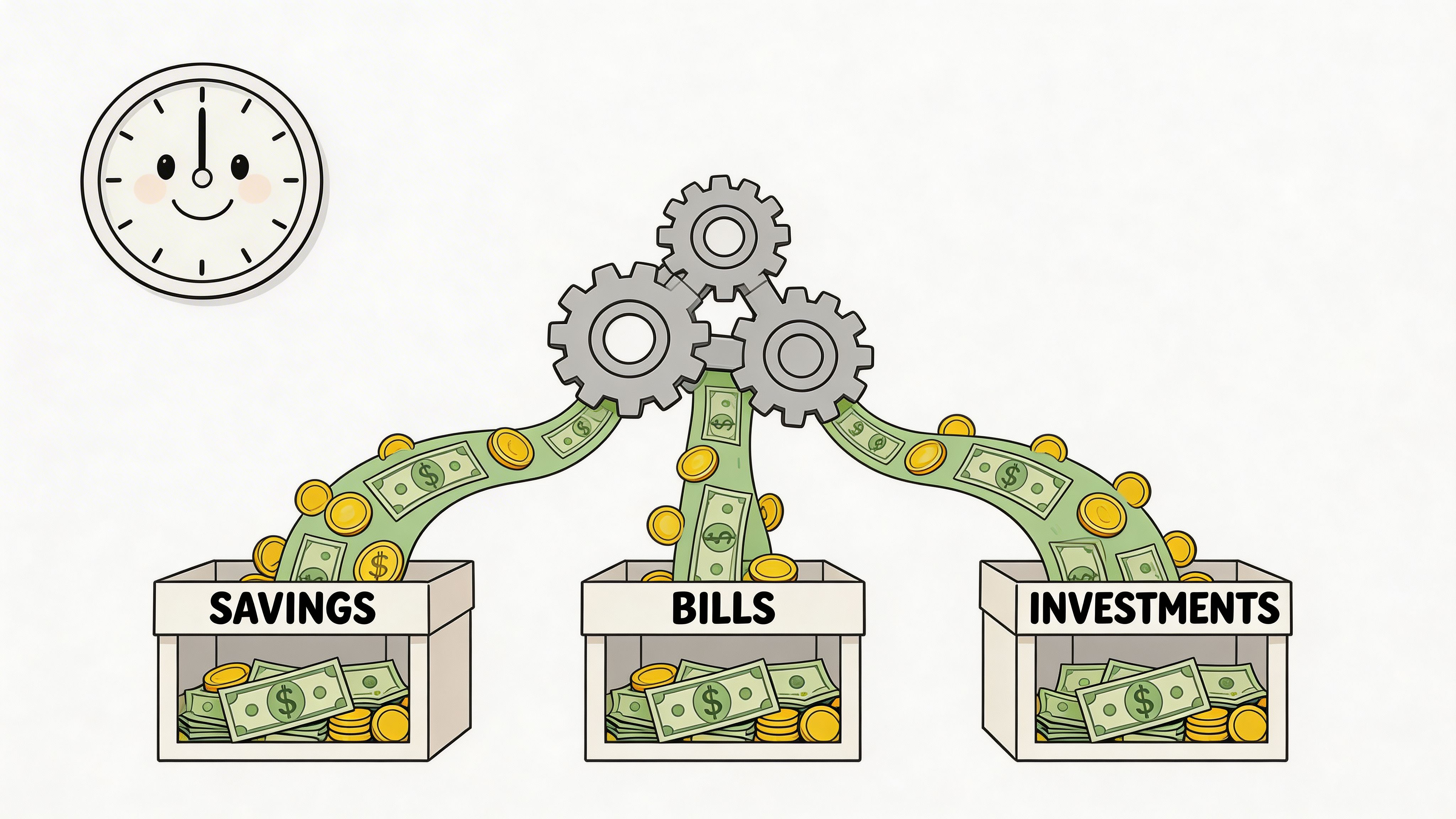
Automate the essentials first
Start with the tasks that should happen whether you’re paying attention or not:
- Savings transfers on payday
- Bill payments for fixed monthly obligations
- Debt payments above the minimum where possible
- Investment contributions if they’re part of your plan
This removes the monthly debate. You don’t have to decide again and again whether to save. The decision has already been made.
A lot of people try to optimise before they automate. That’s backward. A perfectly designed plan still fails if it relies on memory.
Then cut the waste you can’t easily see
Once the basics run automatically, look for friction and leakage.
The common culprits are recurring subscriptions, duplicate services, forgotten free trials that converted to paid plans, and loyalty benefits that expire unused. These items often look small in isolation and expensive in aggregate.
According to research on subscription waste and unredeemed rewards in Canada, 68% of recent immigrants overspend by $250 per month on unused subscriptions and unredeemed loyalty points, and an estimated $2.8 billion in major loyalty points is expected to expire in 2025.
Those figures speak to a wider household problem. Money is often lost through neglect, not bad intentions.
Optimisation is more than cutting back
People hear “optimise” and think deprivation. The better version is recovering value you already earned and reducing waste you no longer want.
That might include:
- Closing duplicate subscriptions
- Using card-linked perks before they lapse
- Redeeming loyalty balances intentionally
- Routing recurring spending through the most useful rewards setup
- Reviewing payroll and withholding choices with a qualified professional
If tax planning is part of your annual money review, this overview of advanced tax reduction strategies can help you prepare better questions for a professional adviser.
Use tools where they remove admin
This is one of the few places where software can make a genuine difference, because the task is repetitive and data-heavy. Fintrack, for example, can surface recurring charges, track spending patterns, and organise rewards and perks through its Benefits Wallet so households can spot unused value without checking multiple accounts manually.
That kind of support is useful because optimisation rarely fails from lack of knowledge. It fails because people don’t have time to inspect every transaction and expiry date.
A strong money system handles the routine automatically and saves your attention for the decisions that need you.
A simple order of operations
If you want one practical sequence, use this:
- Automate bills and core saving
- Create rules for debt and investment transfers
- Review recurring charges
- Check benefits, credits, and loyalty balances
- Repeat the review on a set schedule
That sequence keeps your plan lean. First, the money goes where it needs to go. Then you improve what’s left.
Stay on Track with Regular Financial Check-ins
A financial plan isn’t something you finish. It’s something you revisit.
That doesn’t mean constant tinkering. In fact, too much adjusting can be just as unhelpful as ignoring your finances entirely. The aim is a rhythm that catches problems early and keeps your plan aligned with real life.
Monthly check-ins
A monthly review doesn’t need to be long. It needs to be honest.
Use a simple checklist:
- Compare budgeted spending with actual spending
- Review progress on current savings and debt goals
- Check for unusual transactions or recurring charges
- Confirm bills were paid and transfers happened
- Adjust next month’s plan for anything irregular coming up
Many people regain control quickly with this approach. One short review can reveal that dining out drifted, a subscription restarted, or an annual cost is closer than expected.
Annual reviews
Your annual review is broader. It’s less about categories and more about structure.
Look at:
- Changes in income or household costs
- Goal timelines and whether they still fit
- Debt progress and interest-heavy balances
- Insurance coverage and account details
- Government benefits, credits, and eligibility changes
That last item gets missed often. A 2023 Statistics Canada report on underused household benefits indicated that 1.4 million Canadian households underutilised benefits such as the Canada Child Benefit and GST/HST credits, leaving more than $1.2 billion unclaimed annually.
If your income, work setup, or family situation changed, a review can uncover money you didn’t realise was available.
Keep the review light enough to repeat
The best check-in routine is one you won’t avoid.
A practical format looks like this:
| Review type | Focus |
|---|---|
| Monthly | Spending, transfers, short-term adjustments |
| Annual | Goals, protection, benefits, bigger structural updates |
If you share finances with a partner or family member, put the review on the calendar and keep it short. Open the accounts, note what changed, make two or three decisions, and move on.
Small, regular reviews prevent large, expensive surprises.
Planning personal finance works the same way good maintenance works. You don’t wait for something to break badly. You check the system often enough to keep it running well.
If you want an easier way to apply this without juggling spreadsheets and scattered accounts, Fintrack can help you review spending, goals, and recurring charges in one place so your financial check-ins take minutes instead of becoming another task you put off.