
Meta description: Learn what a homeowners association fee is, what it covers, how much it can cost, and how to budget for HOA dues and surprise assessments.
You've found a home that seems to fit. The listing price works. The location works. The photos make it easy to picture yourself living there.
Then you spot one more line in the monthly costs: HOA fee.
That's the moment many first-time buyers pause. Is it basically rent? Is it optional? Is it just for a pool you may never use? The central question: does it push the home out of your real budget?
An HOA fee is one of those housing costs that looks simple at first and gets more important the closer you get to buying. The monthly amount matters, but the bigger issue is that it can change over time. In some communities, the significant budget surprise isn't the standard dues. It's a fee increase, a reserve shortfall, or a special assessment that shows up later.
That Extra Fee on Your Dream Home Listing
A common first-time buyer scenario goes like this. You compare two homes with similar prices, and one looks like the obvious winner. Then you notice the cheaper-looking property has an HOA fee attached to it every month.
That fee changes the affordability picture right away. It sits beside your mortgage, property taxes, insurance, and utilities. If you ignore it during the shopping stage, you can end up approving yourself emotionally for a home that doesn't fit your monthly life.
For many buyers, the confusion comes from the way the fee appears in listings. It can look like a side note, even though it's a mandatory ownership cost. If the property is in an HOA-governed community, you don't get to opt out just because you'd rather mow your own lawn or skip the clubhouse.
A better way to think about it is this: the listed home price tells you what it costs to buy the property, but the HOA fee helps tell you what it costs to keep owning it.
That's why buyers saving for a down payment should also budget for ownership costs that begin after closing. If you're still building that full picture, this guide on how to save for a house is a useful companion.
Practical rule: Never judge a home's affordability by the listing price alone. Judge it by the total monthly housing cost.
The fee may be modest. It may also be large enough to change what loan payment feels comfortable. And even when the current amount seems manageable, the smarter question is whether the community's finances suggest stable dues or future surprises.
What an HOA Fee Actually Is
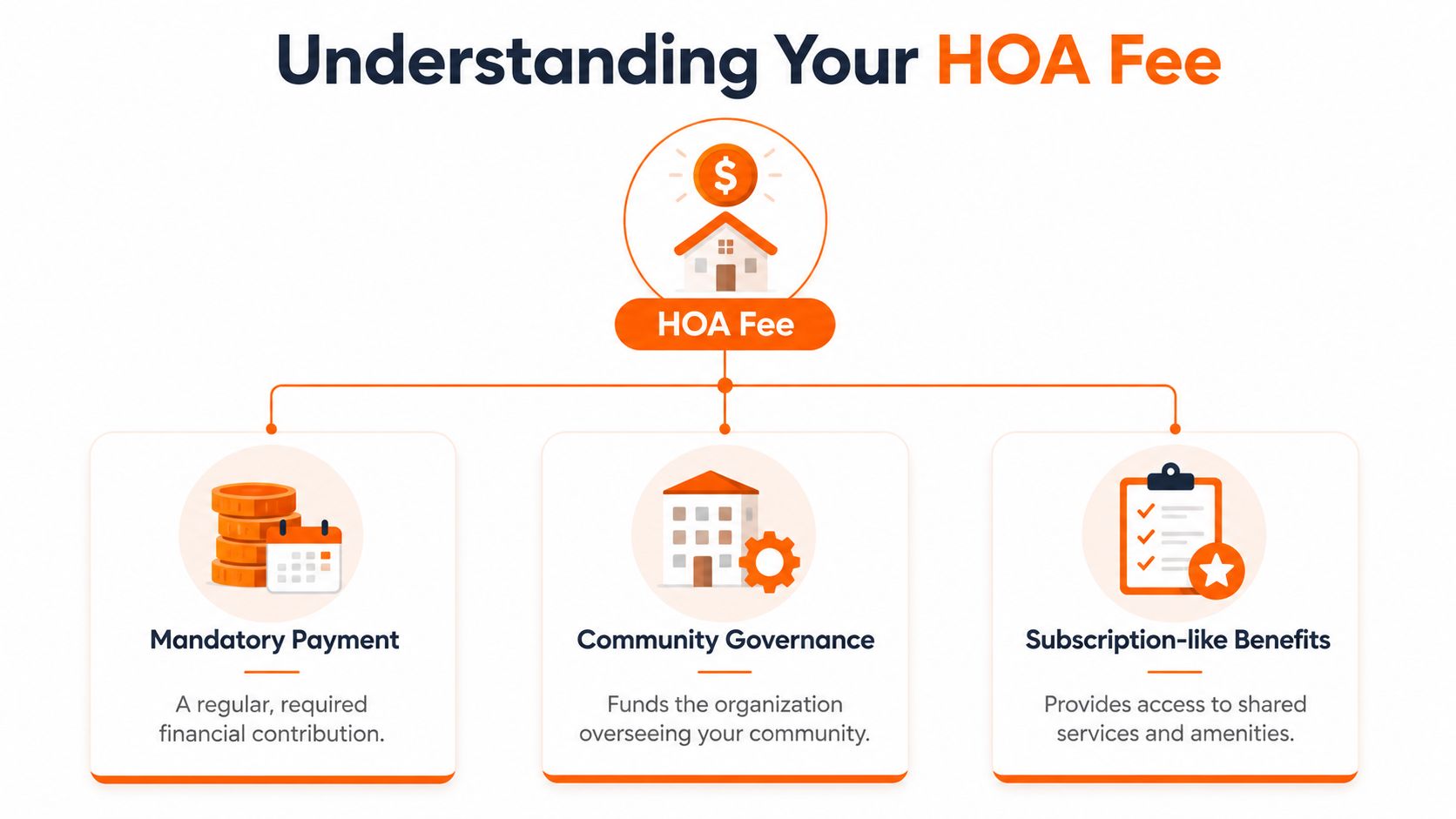
An HOA fee is a mandatory payment you make to the homeowners association that manages the shared parts of a community. If you buy into that community, membership usually comes with the property. You don't sign up later. You buy in and become part of it.
In plain terms, if you're asking what is a homeowners association fee, it's the recurring amount the association collects to run the community and pay shared expenses.
Think of it as a community operating payment
The easiest analogy is a neighbourhood subscription, but with legal teeth. You pay regularly, and in return the association maintains common property, oversees rules, and funds shared services.
The association itself is a formal governing body, usually run by a board. That board is responsible for setting dues from the annual budget and applying the community's governing documents. In California, this isn't a niche arrangement. The Foundation for Community Association Research estimates there are 50,000+ HOAs in the state, and about 14.07 million people live in HOA communities, meaning roughly 35.6% of Californians are in HOA-governed housing, according to California HOA statistics.
That scale matters because it tells you this fee isn't some unusual condo quirk. For a large share of owners, it's a normal part of homeownership.
It isn't the same as rent
Rent goes to a landlord for the use of a property you don't own. An HOA fee goes to the association for costs tied to a property you do own.
That distinction matters because people often assume ownership means complete control over all housing costs. In an HOA, you own your home, but some financial obligations are shared and governed collectively.
If you're in Canada, the closest parallel is often a strata setup. If that language is more familiar, the Royal LePage Brookside guide to strata properties gives a helpful overview of how shared ownership and community management work.
A recurring housing cost can still be fixed in your budget even when the amount may rise over time.
That's why it helps to treat HOA dues like any other recurring bill. This primer on a fixed expense is useful if you're building your monthly housing budget from scratch.
Where Your Money Goes What the Fee Covers
The short answer is that your money funds the association's budget. The less obvious answer is that the budget usually covers both today's operating costs and tomorrow's major repairs.

An HOA's board sets dues based on the annual budget, which is allocated across owners. Funds commonly pay for common-area maintenance, insurance, utilities, and reserve contributions, with payment schedules typically being monthly, quarterly, or annually, as explained in this overview of how HOA fees and finances work.
Day-to-day operating costs
Part of the fee pays for the ordinary work that keeps a community usable and presentable.
That often includes:
- Common-area upkeep: Landscaping, hallway cleaning, exterior lighting, rubbish area maintenance, and general repairs.
- Shared utilities: Water for common spaces, electricity for lighting, lift power in some buildings, or irrigation systems.
- Insurance: Coverage for shared structures or common elements that individual owners don't insure on their own.
- Amenity operations: Pools, gyms, clubhouses, gates, private roads, or shared outdoor spaces.
Some of those costs sound minor until you add up the number of systems involved. A gated community, for example, has equipment, maintenance, repairs, and access control to pay for. If you want to understand the kind of infrastructure communities manage, this look at modern gate management for properties gives useful context.
The reserve fund matters more than many buyers realise
This is the part buyers tend to overlook. A healthy association doesn't only pay today's bills. It also sets money aside for future replacement and major repair work.
That reserve fund may be used for things like:
| Expense type | Typical purpose |
|---|---|
| Roof or exterior work | Major repairs or replacement on shared structures |
| Private roads or paving | Resurfacing and repair of association-maintained surfaces |
| Building systems | Lifts, gates, pumps, or other shared equipment |
| Long-term capital work | Larger projects the community knows are coming |
If reserves are weak, owners may face a special assessment later. That means a separate bill outside normal dues.
Key watchpoint: Low monthly dues aren't always a bargain. Sometimes they mean the association isn't saving enough for large future repairs.
If the term sounds unfamiliar, a sinking fund is the closest personal-finance parallel. It's money set aside in advance for predictable but irregular big costs. HOAs need the same discipline.
How Much Are HOA Fees A Look at Averages and Variability
Buyers often want a clean answer, but the situation is messy. HOA fees can be modest, high, or shockingly high depending on the property and location.
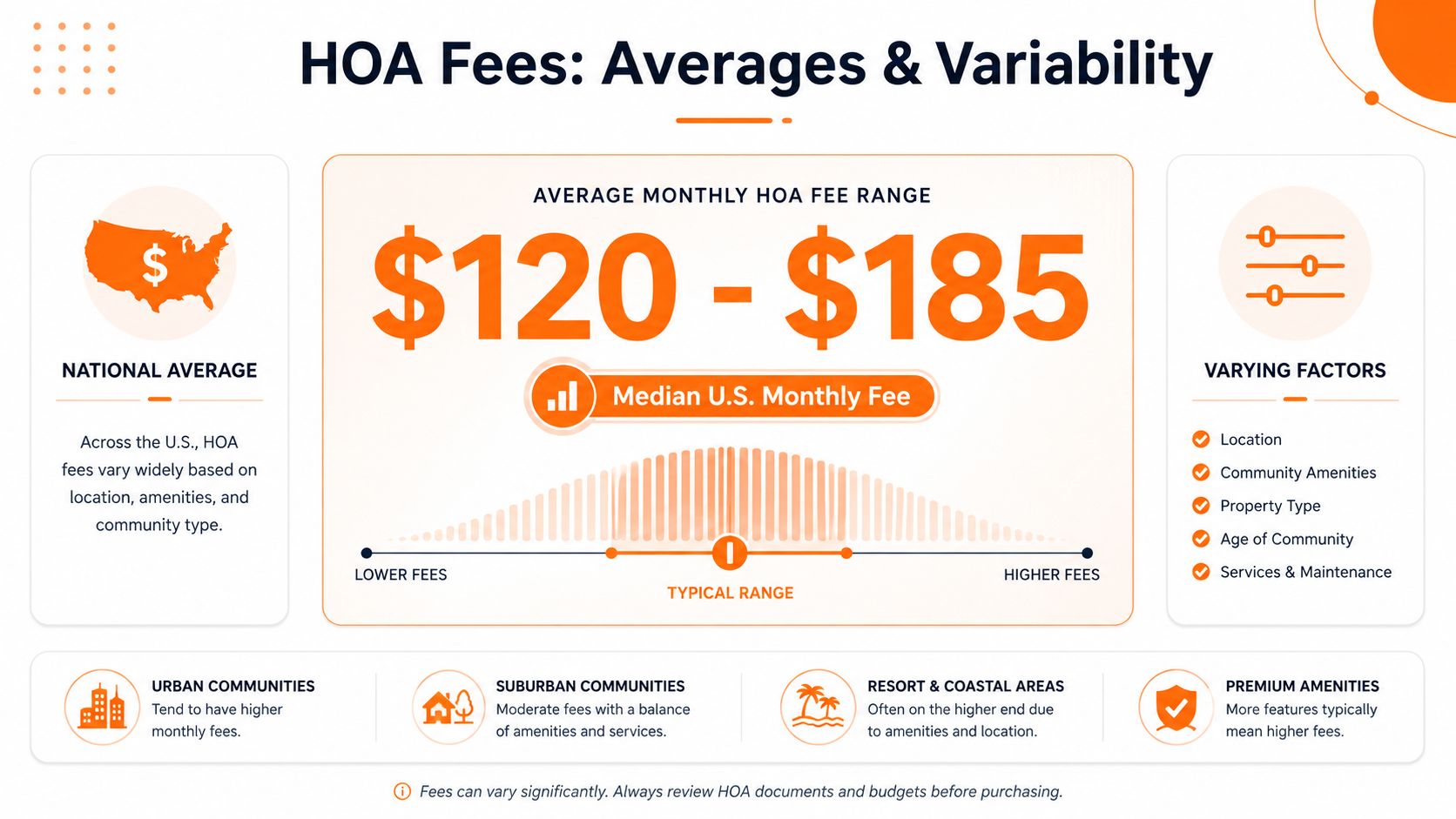
The U.S. Census Bureau reported that 21.6 million of 86.6 million owned households paid either condo or HOA fees in 2024, and the nationwide median monthly fee was $135, according to the Census Bureau's report on condo and HOA fees.
The national number hides a wide spread
A median tells you what's typical in the middle. It doesn't tell you how broad the range is.
The same Census Bureau data showed that households with a mortgage paid a median condo or HOA fee of $120 per month, while households without a mortgage paid $184 per month. It also found that about 5.6 million households (26%) paid less than $50 a month, while about 3 million households paid more than $500 a month.
That's why two listings with “HOA fee included” can mean very different things in practice.
Why one community is cheap and another is expensive
The fee usually rises when the association has more to maintain or more financial risk to cover.
Common drivers include:
- Property type: Condos often have more shared building systems than detached homes in planned communities.
- Amenities: Pools, lifts, gyms, gates, staffed entry, and private roads all cost money to operate and repair.
- Insurance pressure: Communities in higher-risk areas may need more expensive coverage.
- Reserve needs: Older buildings or communities with expensive shared assets need stronger long-term funding.
California shows why location matters. California's average HOA fee was $291.90 per month in U.S. Census data cited by Zillow's guide to HOA fees. Independent California consumer guidance also notes that monthly dues in some Bay Area markets can run around $400-$700, with luxury buildings exceeding $1,000 per month, according to this California-focused explainer on understanding HOA fees.
The real budget risk is volatility
A buyer can plan for a known monthly number. The harder part is planning for change.
In practice, the biggest surprises usually come from three places:
- Regular dues increases when operating costs rise
- Reserve shortfalls when the association hasn't saved enough
- Special assessments for emergency repairs or major projects
That last one matters because it falls outside the normal monthly bill. In high-cost states, insurance pressure, wildfire-adjacent risk management, and expensive shared infrastructure can all push dues or assessments higher over time.
How to Budget for HOA Fees and Hidden Costs
Treat the HOA fee as part of your core housing payment from day one. Don't place it in the “miscellaneous” bucket and hope it behaves.
A simple budgeting approach works best.
Build the fee into your home affordability number
When you decide what monthly housing cost feels safe, include:
- Mortgage payment: Principal and interest
- Property taxes: Usually estimated monthly even if paid differently
- Home insurance: Your individual policy
- HOA dues: The current required amount
- A buffer: Space for dues increases or one-off community costs
That last line is where many buyers go wrong. They budget for the current dues but not for the possibility that the amount rises or that the association levies a special assessment.
If a home only works when every housing cost stays frozen, it probably doesn't fit your budget comfortably enough.
Make the fee visible every month
The more automatic the expense, the easier it is to stop noticing it. That's risky with HOA dues because they can crowd out savings if your budget is already tight.
Use a recurring bill review system so you can see:
- whether the dues changed
- whether a special assessment was added
- whether your total housing costs are drifting up
- what spending category will need to flex if that happens
A straightforward monthly bill tracker helps if you want one place to monitor recurring obligations without missing changes.
Use a two-layer plan
Think of HOA budgeting in two layers:
| Layer | What it covers |
|---|---|
| Monthly plan | Current dues as a regular housing expense |
| Backup plan | Cash reserve for fee increases or special assessments |
This approach keeps a known cost from turning into a cash-flow problem. It also helps you evaluate properties more realistically before you buy. A home with a lower sticker price but unstable community finances can become more expensive than a home with higher but better-managed dues.
Essential HOA Questions for Buyers and Owners
Buyers usually don't need more theory at this point. They need practical answers.
Are HOA fees tax-deductible
Usually, no. TaxAct states that homeowners' association assessments are not deductible because the HOA is not a state or local government, as noted in its guidance on homeowners association fees.
There can be more nuanced situations involving rental or business use, but most owners shouldn't assume the fee creates a personal tax break.
What should I review before buying
Ask for the association's recent budget, reserve information, fee history, and any notice of planned special assessments. You want to know whether the current dues seem sustainable, not just whether this month's amount looks affordable.
Also review the rules. If you may rent the property later, rental restrictions matter. For a practical overview of that issue, Can You Rent Condos? is a helpful starting point.
What happens if you don't pay
These fees are generally mandatory. Because the association is a formal governing entity, unpaid dues can lead to penalties and enforcement action under the community's rules and applicable law.
What's the biggest mistake owners make
They focus only on the monthly number and ignore the association's financial health. Cheap dues can be fine. Cheap dues with weak reserves are a different story.
If you own in an HOA community already, the safest move is to keep a dedicated cash cushion for housing surprises. This guide on how to build an emergency fund can help you set that up.
If you want a simple way to keep HOA dues, mortgage costs, and other recurring housing bills visible in one place, Fintrack is a practical next step. It helps you organise your budget, track changing monthly expenses, and spot when housing costs are starting to creep higher.