
A lot of people meet their annual gross income for the first time in a job offer, not in a budgeting app or a tax form.
You scroll to the salary line, see a number that looks exciting, and immediately start doing life math. Can I afford a better flat? Should I finally replace my car? Is this enough to save for a down payment? Then your first paycheque lands, and the amount in your bank account is clearly smaller than the number you were picturing.
That gap is where confusion starts.
If you've ever wondered what is annual gross income, the short answer is simple: it's the total income you earn in a year before taxes and other deductions come off. But the practical answer matters more. In Canada, this number affects your mortgage application, your tax return, your rental search, and the way you should build a realistic budget.
This guide keeps it plain. No jargon for the sake of sounding smart. Just what the number means, how to calculate it, where people get tripped up, and how to use it to make better money decisions today.
Your Paycheque's Starting Line
A job offer might say you earn a salary of $70,000 a year. That number is not your take-home pay. It's your annual gross income, which is the starting line for your money, not the finish line.

In plain language, annual gross income is the full amount you earn over a year before income tax, CPP contributions, EI premiums, or workplace deductions come off. If you're an employee, it's the big number attached to your compensation. If you're self-employed, it's the revenue you bring in before eligible business expenses and tax adjustments change the picture.
Why this number matters first
This is the number banks, landlords, and the CRA often look at first.
It gives them a standard way to assess your earning power before your personal deductions make your situation more customised. That's why gross income shows up again and again in financial paperwork.
Practical rule: Gross income tells you what you earn. Net pay tells you what you can spend.
There's also a useful reality check in knowing where your income sits compared with broader Canadian benchmarks. In Canada, the median total income for tax filers was CAD 41,800 in recent years, while busy professionals in their prime earning years often exceed CAD 92,000, according to Statistics Canada. That doesn't tell you whether you're doing "well" or "poorly," but it does help you judge your own budget, goals, and expectations more clearly.
A simple way to think about it
Think of annual gross income like the full jug of water at the top of the counter.
Before you drink from it, some water gets poured into other glasses. Taxes. CPP. EI. Benefits deductions. What's left in your glass is what you use month to month.
If you want a cleaner overview of how your income, spending, and balances fit together, a tool like Finny, Fintrack's personal finance assistant can help you ask straightforward questions about your money without digging through statements manually.
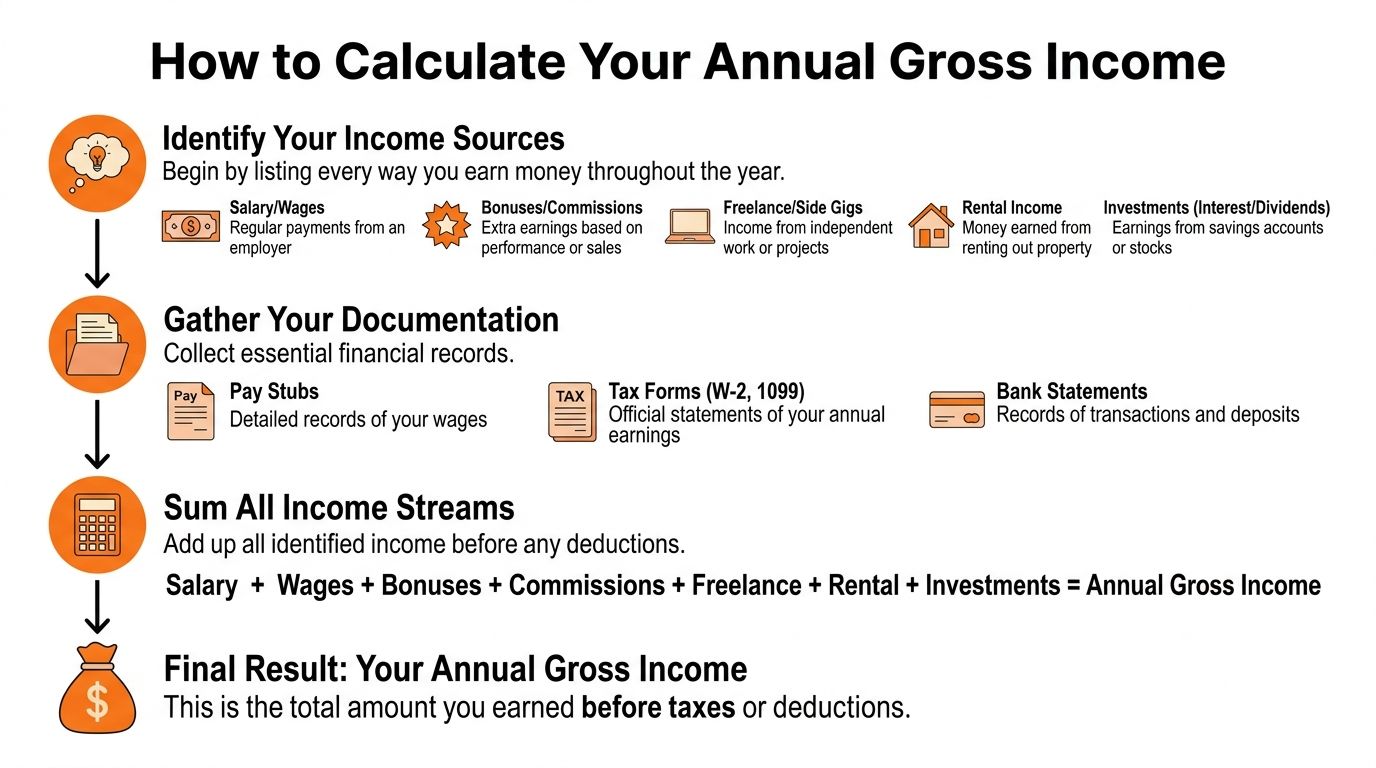
How to Calculate Your Annual Gross Income
Fortunately, many individuals can calculate this number in a few minutes.
The method depends on how you earn. Salary is the easiest. Hourly work takes one extra step. Self-employment needs a bit more care because you may have several income streams and less tidy paperwork.
If you're a salaried employee
This is the simplest version.
If your employment agreement says you earn a set salary each year, your annual gross income is usually that salary amount, plus any bonuses, commissions, or taxable extras you expect to receive.
Use this checklist:
- Start with your base salary
- Add bonuses if they're part of your compensation
- Add commissions if you earn them regularly
- Include taxable income from side work if you want a full annual picture
If your contract says $80,000 a year and you also receive a bonus, your gross income is your salary plus that bonus.
If you're paid by the hour
Hourly workers need to turn weekly or biweekly earnings into a yearly total.
A practical formula is:
Hourly wage × hours worked in a year = annual gross income
If your schedule is steady, many people estimate annual hours based on a full work year. If your shifts change often, use your recent pay stubs to build a more realistic estimate instead of guessing.
Helpful documents include:
- Pay stubs that show regular earnings
- T4 slips from your employer
- A year-to-date income total if your payroll system provides one
If you're self-employed or freelance
Self-employed individuals often undercount or overcount their income.
Your gross income is the total business income you bring in before business expenses are deducted. If you invoice clients, sell services, run a side business, or do contract work, you need to add all of that income together first.
For self-employed Canadians, gross income is reported on the T2125 form, and the CRA can levy penalties of up to 10% on unreported income, according to the CRA T2125 guidance. That makes careful tracking important, especially if your income arrives from multiple sources.
A practical self-employed method
Try this simple process:
- List each income source. Client work, consulting, platform payouts, rental income, interest, and dividends all need their own line.
- Pull the records. Use invoices, bank deposits, payment processor summaries, and slips.
- Add the gross amounts before expenses. Don't subtract software, travel, supplies, or office costs at this stage.
- Check your tax forms. Your T2125 helps structure business income properly.
When your income comes from several places, the hardest part usually isn't the maths. It's collecting every deposit in one place.
If you want a simpler way to review totals and patterns after your transactions are imported, an AI assistant for personal finance questions can make it easier to spot missing income or inconsistent deposits.
If your income changes from month to month
Commission workers, freelancers, and seasonal earners need a different approach.
Instead of relying on one strong month, use a rolling annual view. Add your income from the last full year of records. If you're still building that history, use the most complete set of recent records you have and stay conservative.
A good rule is to treat irregular income like uneven weather. You don't pack for the hottest day of the year. You pack for the conditions you're likely to face most often.
Gross Pay vs Net Pay vs Net Income
These terms get mixed up constantly because they sound close and often appear on the same documents.
They're not the same thing.
The waterfall view
Think of your income as water flowing down a series of levels.
At the top is gross income. That's the full amount before deductions. After payroll deductions come off, you get net pay, which is the amount that lands in your bank account from each paycheque. Later, when you file taxes, your return works through more steps, including net income and taxable income.
That means one income figure can turn into several different numbers depending on the context.
Gross Income vs Key Financial Terms
| Term | What It Is | Where You See It |
|---|---|---|
| Gross income | Your total income before deductions | Job offer, pay records, lender paperwork, tax reporting |
| Gross pay | The gross amount on a specific paycheque before deductions | Pay stub |
| Net pay | What you receive after payroll deductions such as tax, CPP, and EI | Your bank account and pay stub |
| Net income | An income figure used on your tax return after certain deductions are applied | Tax return |
| Taxable income | The amount the CRA uses to calculate income tax after applicable deductions and adjustments | Tax return |
Where people get confused
The most common mistake is treating salary, paycheque amount, and tax return income as if they're interchangeable.
They're not. Salary may be your main gross income figure, but your paycheque is already reduced by deductions. Your tax return then applies a different set of rules again.
Here's a simple way to separate them in your head:
- Gross income answers, "What did I earn?"
- Net pay answers, "What did I receive?"
- Net income answers, "What income figure is the tax system using after certain deductions?"
Your budget lives on net pay. Your borrowing power often starts with gross income.
Why this matters in real life
If you budget using gross income, you'll probably overestimate what you can safely spend.
If you ignore gross income completely, you'll miss how lenders, landlords, and some financial rules evaluate your situation.
This is also why workplace benefits can feel confusing. For example, RRSP matching can improve your long-term financial picture even though the details don't always look intuitive on a pay stub. If that topic feels fuzzy, this explainer on what RRSP matching means and how it works is a useful next read.
A quick memory trick
Use this three-part test:
- Gross is the top-line number.
- Net pay is the spendable paycheque number.
- Net income is the tax-return number.
Once you sort those into separate buckets, most pay stub and tax form confusion gets easier to untangle.
Why This Number Is Your Financial Foundation
Annual gross income isn't just a definition you memorise for tax season.
It shapes what you can rent, what you can borrow, and how realistic your plans are.

Lenders use it to size your housing costs
When you apply for a mortgage, lenders don't start by asking what you feel comfortable spending. They start with your income and debt obligations.
In Canada, most major lenders require monthly housing costs to be no more than 32% of monthly gross income. For someone earning $80,000 gross annually, that works out to about $6,667 per month in gross income and a housing payment cap of around $2,133, according to the Financial Consumer Agency of Canada.
That single rule shows why gross income matters so much. Even if you personally feel comfortable stretching further, the lender may not.
Landlords and rental applications rely on it too
Landlords want to know whether your income can support the rent consistently.
They may ask for pay stubs, employment letters, or tax documents because gross income gives them a standard way to compare applicants. It's not a perfect measure of affordability, but it's one of the fastest filters they use.
Your tax return starts here
Your annual gross income is also the launch point for tax reporting.
That's why missing income, misclassifying benefits, or forgetting side gig deposits can create bigger problems than people expect. If the starting number is wrong, everything built on it becomes less reliable.
It keeps your budget honest
A strong budget needs two views at once:
- The planning view, which uses gross income to understand earning power and major goals
- The day-to-day view, which relies on actual take-home money
Both matter. One helps with strategy. The other keeps your chequing account from getting squeezed.
A lot of money stress comes from building a lifestyle around the wrong income number.
If you're trying to turn this into a practical monthly plan, a budget planning tool can help you compare your income against bills, flexible spending, and savings targets in one place.
Common Canadian Income Reporting Mistakes
Gross income sounds straightforward until real life gets involved.
A bonus arrives. You take a side contract. You get EI for part of the year. A government credit lands in your account. Suddenly the neat definition gets messy.
Mistake one: leaving income out
People often remember their regular pay and forget the extras.
That can include overtime, commissions, freelance work, contract income, or investment income. If the money counts as income, leaving it out can distort your budget and complicate your tax filing.
This happens a lot when someone changes jobs mid-year or starts a side hustle that still feels "small." Small income streams still count.
Mistake two: treating all government payments the same
A common source of confusion for Canadians.
Some government payments belong in your income reporting. Others don't. If you lump them all together, your income picture can become inflated, which can affect planning and eligibility for other programs.
A significant number of Canadian tax filers incorrectly report non-taxable government credits like the GST/HST credit, which averages $496 per individual, as part of their gross income, according to the Fraser Institute's discussion of the federal tax and transfer system. That can artificially raise reported income and reduce eligibility for other income-tested benefits and credits.
A simple filter for benefits
Ask two questions:
- Is this payment taxable? If yes, it may belong in your reported income.
- Is this a non-taxable credit or benefit? If yes, don't assume it belongs in gross income.
If a deposit comes from the government, don't guess. Check whether it's taxable before adding it to your income total.
Mistake three: mixing business revenue with personal take-home pay
Self-employed people often blur these together.
Your business may bring in one amount, but the amount you move to your personal account is not automatically the same as your annual gross income for tax purposes. Keep business records separate enough that you can see the full revenue picture clearly.
Mistake four: relying on memory instead of records
Memory is fine for groceries. It's not great for income reporting.
Use your slips, statements, and transaction records. When you're close to filing deadlines, "I think that's about right" is where errors start.
Effortless Income Tracking with the Right Tools
Manual income tracking works, but it gets annoying fast.
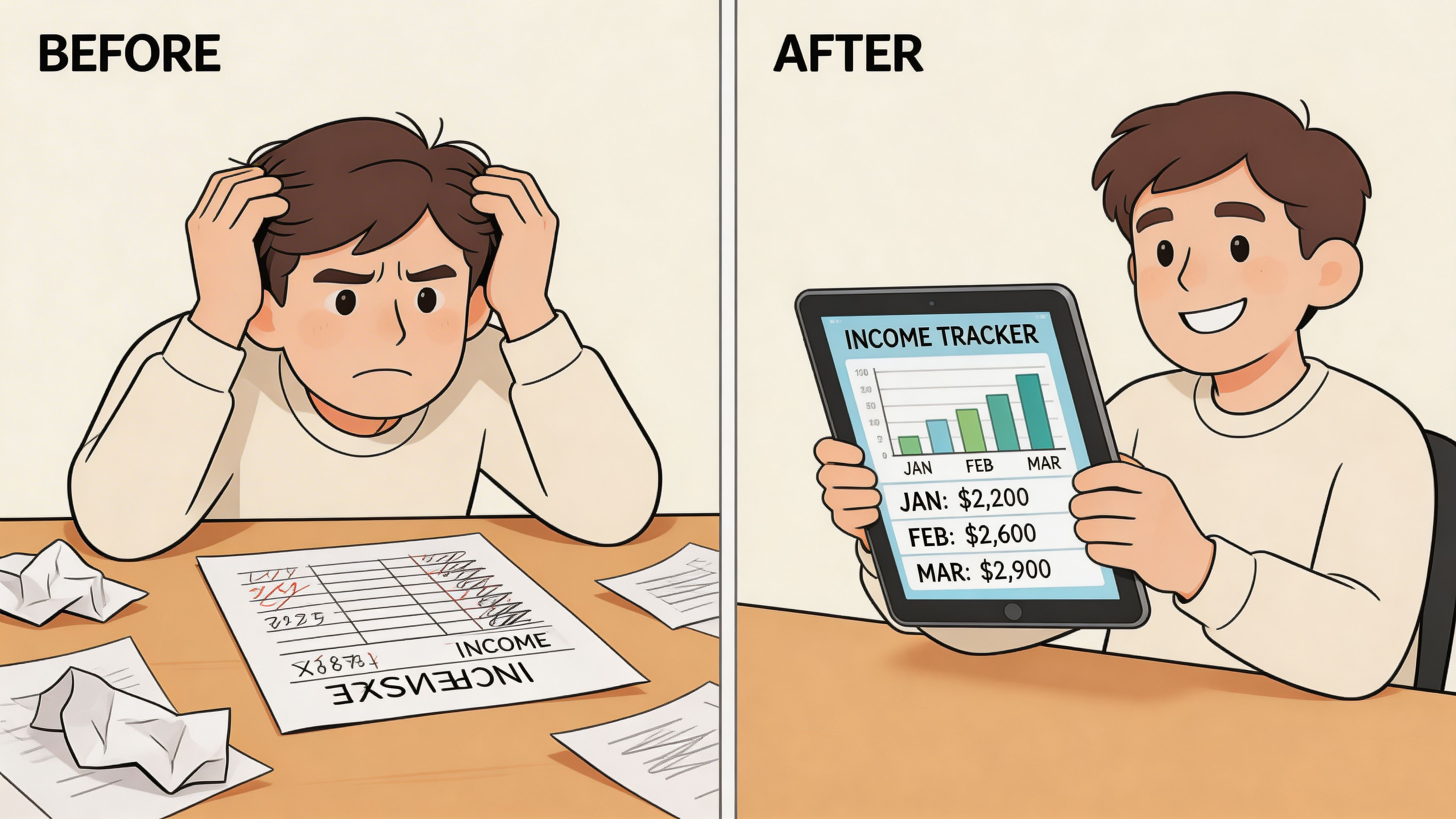
Why manual tracking breaks down
The problem usually isn't that people can't add numbers.
It's that they don't want to spend their evening hunting through statements, searching deposits, and checking whether an amount was salary, a refund, a transfer, or a side-gig payment. If you're still using spreadsheets, this guide to a bank reconciliation format in Excel is a practical resource for understanding how to match records properly.
What better tracking looks like
A useful system should help you:
- See all income deposits in one place
- Spot irregular payments quickly
- Separate income from transfers and reimbursements
- Keep a running picture of year-to-date earnings
That matters even more if your income changes from month to month. Instead of rebuilding your totals from scratch every time you need them, you want a live record you can review when a lender asks for documents, when tax season arrives, or when you're checking whether a raise changed your financial life.
For that kind of day-to-day monitoring, Transactions with AI can help categorise deposits and surface patterns without forcing you to maintain a manual ledger.
Frequently Asked Questions About Annual Gross Income
Some questions come up almost every time this topic does. Here are the short, practical answers.
Is my salary the same as my annual gross income
Sometimes, yes.
If you only earn a fixed salary and have no bonus, commission, freelance income, rental income, or investment income, your salary may effectively be your annual gross income. If you have other income sources, your annual gross income is broader than salary alone.
Should I budget using gross income or net income
Use both, but for different jobs.
Use gross income for long-range planning, major affordability decisions, and understanding your overall earning picture. Use net pay for your monthly spending plan, because that's the money you have available to cover bills and daily life.
What documents can prove my income in Canada
It depends on the situation, but common documents include:
- Pay stubs
- T4 slips
- Notices of assessment
- Employment letters
- Bank records showing deposits
- T2125-related records if you're self-employed
If you're gathering paperwork for an application, having organised online bank statements can make the process easier because they help confirm deposits and timing alongside your tax slips.
Does annual gross income include side hustles
Yes, if that side hustle earns income.
Freelance work, contract work, and business income should be included when you're calculating your full annual gross income. People often leave these out because the income feels occasional, but occasional income is still income.
Do non-taxable credits count as gross income
Not automatically.
Many people make mistakes here. Some government payments are taxable and belong in income reporting. Some credits are non-taxable and shouldn't be added to your gross income just because they hit your account.
What's the fastest way to get clear on my number
Pull one full year of records and total your income by source.
If you're employed, start with salary and slips. If you're self-employed, start with deposits and business records. If you have mixed income, list each stream separately first, then total them. That simple split prevents a lot of confusion.
If you want an easier way to turn all of this into something useful, Fintrack can help you see income, spending, and trends in one place so you can budget from real numbers instead of rough guesses.