
You’re checking a new pay stub or enrolling in benefits after starting a job. You see a line about RRSP matching and move on.
That reaction is common. It looks like one more optional perk to deal with later, somewhere below health benefits, vacation, and whatever else HR sent you.
That is usually the wrong way to look at it.
What is RRSP matching? It’s an arrangement where you contribute to a workplace RRSP, usually through payroll, and your employer adds money too based on a formula in the plan. If you do not contribute, you usually do not get the employer money. In practical terms, that means part of your compensation only shows up if you actively claim it.
Your Employer Offers You Free Money Are You Taking It
A new employee earning $80,000 puts off RRSP enrolment for a year because cash flow feels tight. Their plan matches dollar for dollar up to 4% of salary. That decision can cost them $3,200 from the employer in one year alone, plus the tax-deferred growth on that money. Few compensation mistakes are that expensive and that easy to fix.
It is compensation you have to claim
In practice, I often see employees treat RRSP matching as something they will get around to after the next raise, after a bonus, or after a few bills are cleared. That framing causes real losses because the match is part of pay, not a side perk.
If your employer offers matching, they are offering to add money to your retirement account when you contribute under the plan rules. If you do nothing, that portion of your compensation stays with the employer.
A simple example makes the point. Contribute $200 per month and get a 50% match. Your employer adds $100 per month. Skip enrolment for 12 months and you do not just miss your own savings habit. You give up $1,200 that was available only because you work there.
Why waiting costs more than people expect
The problem is not only the missed deposit. Many plans match contributions only through payroll and only during the period when those contributions are made. You often cannot write a cheque at year-end and recover months of missed matching.
That makes RRSP matching the highest guaranteed return available to many employees. A 100% match turns a $100 contribution into $200 on day one. A 50% match turns $100 into $150. You can debate investment choices later. The first decision is whether you are willing to decline a guaranteed return that high.
For readers who want to understand how employer matching works in 401k plans, the core logic is similar. Employer matching rewards contributions made under the plan, and delay can mean forfeited dollars.
Practical takeaway: Fund enough to get the full match before you spend time optimizing the rest of your retirement strategy.
What to check today
Start with these three items:
- Your match formula: Look for wording such as “50% up to 6% of pay” or “100% up to 3%.”
- Your eligibility date: Some plans start right away. Others begin after a waiting period.
- Your payroll timing: If deductions must run through payroll, missed pay periods may mean missed matching that cannot be recovered.
If you want a clearer view of workplace benefits you may not be using, track your RRSP match and other employer perks in one place.
How Employer RRSP Matching Works
RRSP matching is simpler than it sounds once you strip away the benefits language.
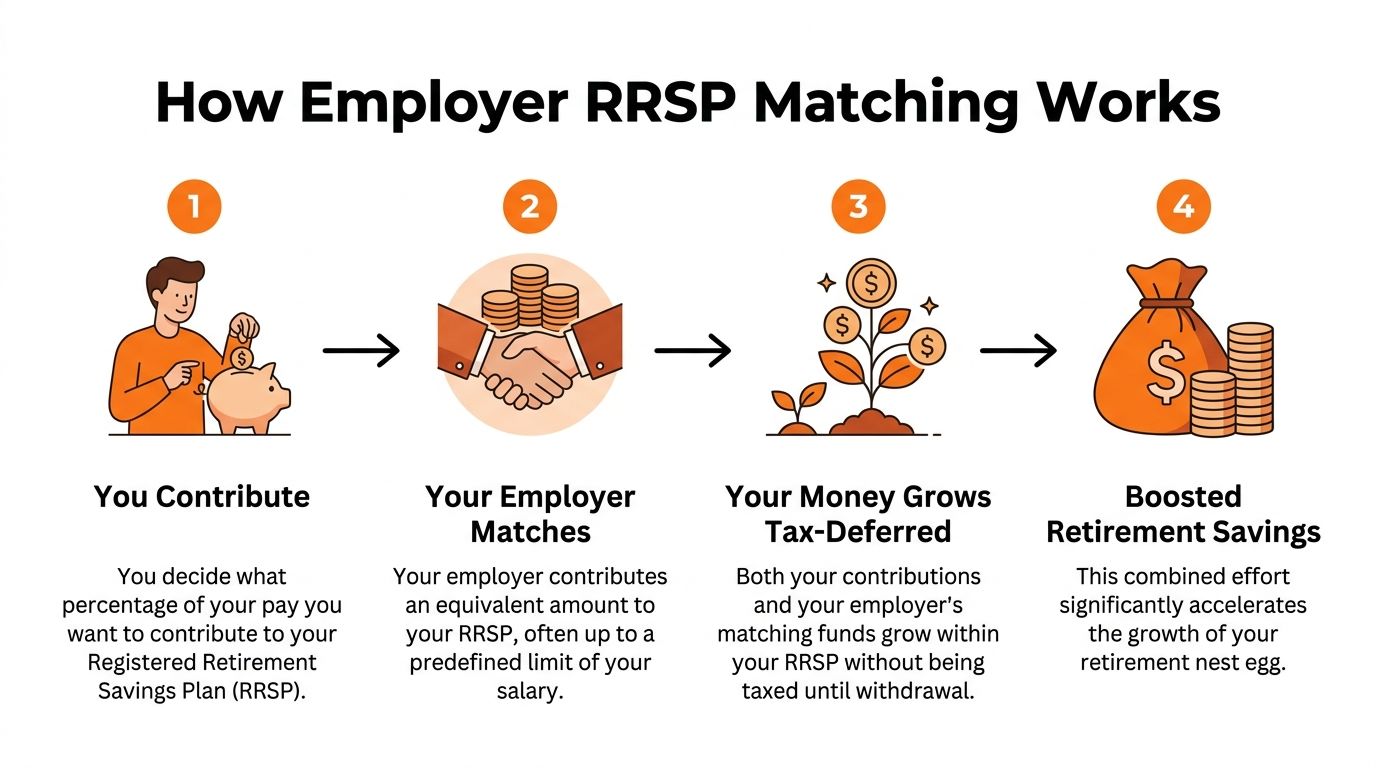
You choose a contribution amount, usually as a percentage of pay. Payroll deducts that amount. Your employer adds its matching contribution into the group RRSP based on the plan rules.
The basic flow
Most plans follow a straightforward sequence:
- You enrol in the group RRSP
- You pick your contribution rate
- Payroll deducts your contribution from each paycheque
- Your employer deposits the matching amount
- Both amounts stay invested inside the RRSP
That’s why matching works so well for people who are busy. Once it is set up correctly, it often becomes automatic.
Common formulas you’ll see
Employers can design different matching formulas, but the structure is usually one of these:
- Partial match: The employer contributes part of what you contribute, up to a stated limit.
- Dollar-for-dollar match: The employer matches your contribution equally, up to a cap.
- Tiered match: One rate applies to the first slice of contributions, and another rate applies after that.
A useful real example is this: a typical employer plan might match 50% of your contributions up to 6% of salary. If you earn $70,000 and contribute 6% ($4,200), your employer adds $2,100. The same source notes that over a quarter of participants with access still failed to contribute enough to get the full match at Benefits and Pensions Monitor.
That is the key operational point. You often need to contribute up to the plan ceiling, not just contribute something.
Why payroll timing matters
Many plans work through active payroll deductions. That means the system looks at each pay run and applies the matching formula then.
If you make your own lump-sum RRSP contribution outside payroll, that may help your personal RRSP savings, but it may not trigger the employer match. This is one of the most common misunderstandings.
If you want a comparable workplace-plan explainer from a U.S. retirement-plan angle, this guide can help you understand how employer matching works in 401k plans. The account type is different, but the basic incentive logic is very similar.
Tip: If you are unsure whether your plan matches per pay period or at year-end, ask payroll or HR before changing your strategy.
When you want help making sense of your cash flow and benefit choices in one place, an assistant like Finny can make those decisions easier to review alongside the rest of your finances.
Understanding Vesting Limits and Contribution Room
Once the match is set up, the next mistakes usually happen in the fine print.
Employees tend to focus on the headline benefit and skip the rules that control when the money is fully theirs, how much they should contribute, and how the plan fits with their broader RRSP room.
What vesting means
Vesting is about ownership of the employer contribution.
In some plans, the employer money is yours right away. In others, you keep it only after staying employed for a certain period. If you leave too soon, you may keep your own contributions but lose some or all of the employer-funded portion.
That is why two questions matter before you enrol or resign:
- When do employer contributions vest?
- Does the plan say vesting is immediate or tied to service?
This is not a reason to avoid matching. It is a reason to know the rule before you make career decisions.
Contribution room still matters
A match does not create unlimited RRSP space. Your RRSP room still has to support what goes into the plan.
In practice, that means you should not assume the employer contribution sits outside the system. If you are also making separate RRSP contributions on your own, you need to keep your available room in mind and review your tax reporting carefully.
A lot of over-contribution problems happen because someone has:
- payroll RRSP deductions through work
- an employer match
- separate automatic deposits to a personal RRSP
- no habit of checking the full picture
That combination can get messy fast.
Read the plan document for these limits
The most important details are usually in a short benefits summary or enrolment guide. Look for language about:
- Eligibility rules: You may need to complete a probation or service period.
- Matching cap: The employer may stop matching after a certain contribution level.
- Contribution frequency: The plan may calculate the match per pay period or on another schedule.
- Investment default: If you do not choose investments, the plan may place you into a default option.
- Transfers and portability: You may be able to transfer funds when you leave, depending on the plan structure.
The practical mistake to avoid
The worst setup is contributing below the employer ceiling for months because nobody translated the plan into a simple action.
For example, someone may join the group RRSP at a low deduction level thinking they are “participating,” while still missing part of the employer contribution every paycheque. They are doing enough to feel responsible, but not enough to capture the full benefit.
Key point: Participating in the plan is not the same as maximising the plan.
If you use savings tools to organise goals, the useful move is to treat the match threshold as a required baseline. A goal system such as Strategies & Goals is most useful when it reflects the actual contribution target needed to unlock the full employer amount, not just an arbitrary monthly savings number.
RRSP Matching in Action Real Scenarios
A client earning $80,000 asked whether increasing payroll deductions by a few hundred dollars a month was really worth it. The answer was yes, because the decision was not just about saving more. It was about collecting compensation already available through the plan.
That is the practical lens for RRSP matching. Your contribution starts the deposit. The employer match adds money you do not get unless you participate at the required level. If you stop short of the match ceiling, part of your pay never reaches you.
One confirmed example
Here is a concrete case from a Canadian RRSP matching example. An employee earning $80,000 who contributes 5% ($4,000) and receives a 4% employer match ($3,200) gets an immediate 80% return on that contribution. Over 30 years, assuming a 5% annual return, that extra $3,200 each year can add approximately $212,000 to the final retirement balance compared with contributing alone at NerdWallet Canada.
That is why I do not describe matching as a perk. In practice, it is one of the strongest parts of a compensation package because it offers a built-in return the market does not need to provide.
Three salary scenarios with the same formula
The examples below use a plan formula of 50% match on the first 6% of salary.
Illustrative only: The 20-year projections assume a consistent 5% annual return with contributions made each year. Actual investment results, fees, and employment changes will affect outcomes. These are not guaranteed.
| Annual Salary | Your 6% Contribution | Employer Match (3%) | Total Annual Contribution | Projected Value After 20 Years (5% return) | Projected Value Without Match After 20 Years | Estimated Gain From Matching |
|---|---|---|---|---|---|---|
| $50,000 | $3,000 | $1,500 | $4,500 | $148,799 | $99,199 | $49,600 |
| $80,000 | $4,800 | $2,400 | $7,200 | $238,079 | $158,719 | $79,360 |
| $120,000 | $7,200 | $3,600 | $10,800 | $357,119 | $238,079 | $119,040 |
The pattern is hard to ignore. The employee who contributes enough to unlock the full match finishes with a larger balance because more money goes in every year and has more time to grow.
Skipping the match is not a neutral choice. In the $80,000 example, it means giving up $2,400 a year in employer money and an estimated $79,360 over 20 years under these assumptions. That is a direct cost of inaction.
What these scenarios mean in real life
The issue is not just retirement income decades from now. It is current compensation.
If your plan matches 50% of contributions up to 6% of salary, then every dollar you contribute inside that range pulls in another fifty cents from your employer. Few financial decisions come with that kind of immediate payoff. You still need to choose suitable investments and stay within your RRSP room, but the first decision is simpler than people make it. Get the full match if cash flow allows.
Often, the issue is not inability but mis-prioritisation.
I see employees spend months trimming small budget categories while leaving part of their match untouched. If a modest spending reset would let you reach the full ceiling, that move usually deserves priority over lower-impact savings tactics. A structured reset, such as a 30-day saving money challenge, can be enough to free up the payroll deduction needed to capture the match.
Decision rule: If your budget can support the full match without pushing you into high-interest debt, treat that contribution level as part of your base pay strategy.
A simple way to test your own numbers
Use your actual payroll details, not rough guesses.
- Find the employee contribution rate required to earn the maximum match.
- Calculate that dollar amount from your salary.
- Calculate the employer dollars tied to it.
- Compare both figures with what is happening on your pay stub now.
If you are below the required deduction, the shortfall is money you are not collecting each pay cycle. Seeing that amount in plain payroll dollars usually changes the conversation fast.
How Matching Fits Your Broader Savings Strategy
Once you are capturing the full employer match, the next question is where the next dollar should go.
The answer is not the same for everyone. But there is a sensible order of operations.
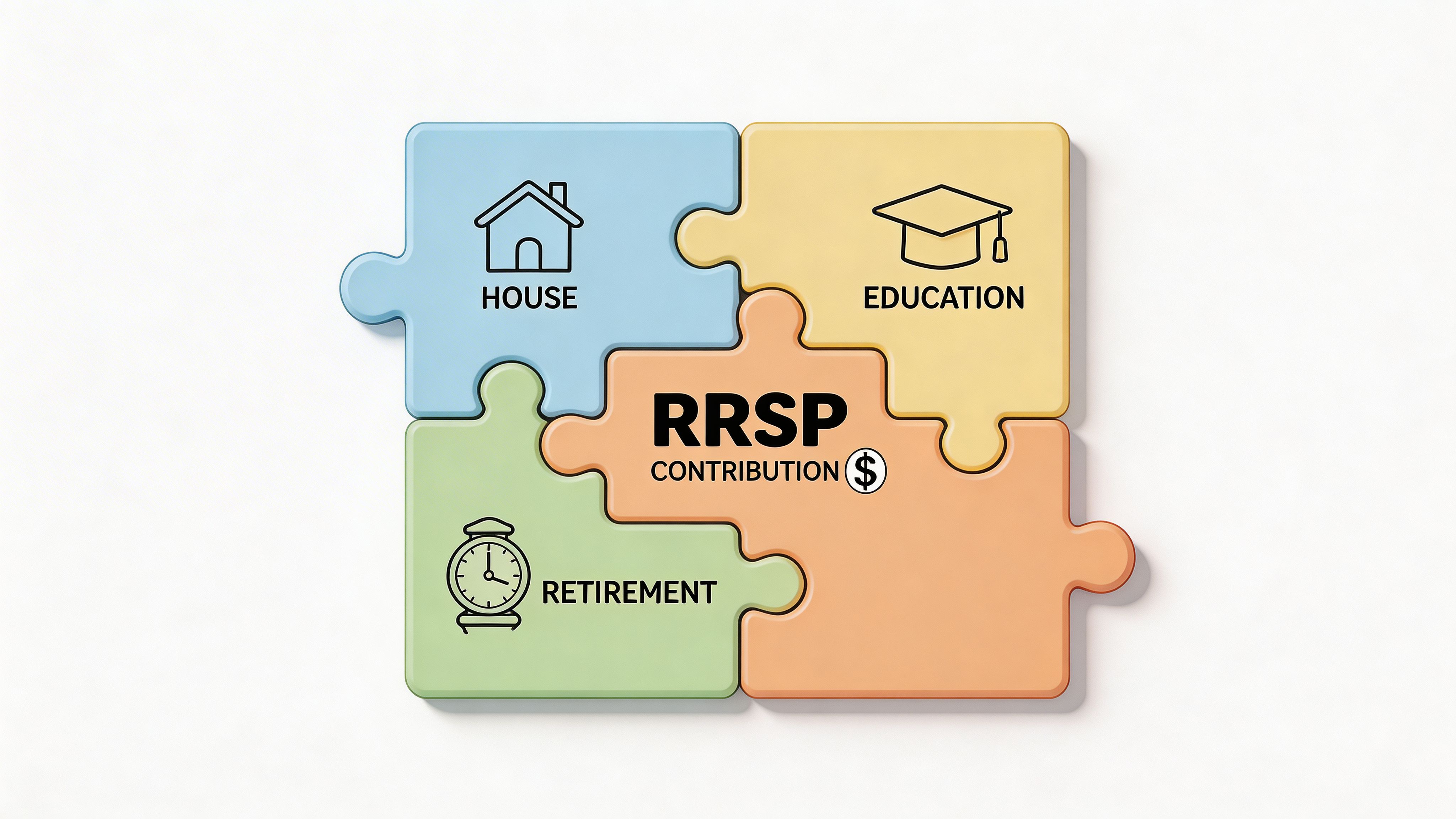
The first priority
If your employer offers matching, contribute enough to get the full match.
That comes first because it changes your compensation immediately. Skipping that while sending the same dollars elsewhere usually means choosing the weaker option first.
What comes after the match
After the full match is covered, the next best use of savings dollars usually depends on tax position, flexibility needs, and debt pressure.
More RRSP contributions
This can make sense if you want additional tax-deferred retirement savings and you have room available.
It is often a good fit for people whose current income makes the deduction especially useful, or for people who want one unified retirement account strategy.
TFSA contributions
A TFSA can be the better next step if flexibility matters more.
That can be true when you want easier access to funds, you are balancing medium-term goals, or you want to diversify how your savings are taxed later.
Debt repayment
If you are carrying expensive debt, that may deserve attention after you secure the employer match.
The reason is practical. Matching is valuable, but debt with a punishing interest rate can still undermine the rest of your plan if you ignore it.
How workplace plans compare
Some employees also have access to other retirement structures through work. The key difference is usually not whether one is “good” and the other is “bad.” It is about flexibility, portability, and how the plan is administered.
A group RRSP is often easier to follow because you can usually see your own contributions and the employer contributions directly, and the account often moves more easily with you if you change jobs. Other workplace plans may have different rules around transfers and access.
A simple priority ladder
Use this order as a working rule:
- Get the full RRSP match
- Deal with urgent high-cost debt
- Direct new savings to RRSP or TFSA based on your tax and flexibility needs
- Increase overall savings rate as income grows
If you need help finding room in your budget to move money toward that first step, practical habits matter more than dramatic cuts. A small reset like the ideas in this guide on the saving money challenge can free up the cash flow needed to hit your match threshold.
Common Employer Policy Variations to Watch
Two RRSP matching plans can sound similar in a job offer and still behave very differently in practice.
That matters because the wrong contribution pattern can leave money behind even when you think you are doing everything right.
Per pay period versus annual matching
Some employers match each pay period. Others may reconcile contributions on a different schedule.
If your employer matches per pay period, a late-year catch-up contribution may not fix missed matching from earlier payroll cycles. You still save in your RRSP, but you may not recover the employer dollars tied to those missed deductions.
That is why regular payroll contributions usually work better than waiting until the RRSP deadline.
Tiered formulas
Not every plan uses one simple rate.
You may see wording that applies one match rate to the first portion of your contribution and a different rate after that. These formulas are not necessarily bad, but they are easy to misunderstand if you only skim the summary.
Read carefully:
- the contribution percentage needed to unlock the maximum employer amount
- whether the formula changes after the first band
- whether the cap is stated as a percentage, a dollar amount, or both
Service requirements and waiting periods
Some employers do not let new hires join immediately.
That is normal, but it changes your action plan. If there is a waiting period, put a reminder in your calendar before the eligibility date so you do not miss the enrolment window or delay again once you qualify.
Investment defaults and enrolment friction
A surprising number of employees stall because the investment menu feels complicated.
Do not let perfect become the enemy of funded. If the plan is waiting on your investment election, make the best informed choice you can from the plan options and get the contribution process active. An unfunded account does less for you than an imperfect but active one.
Practical rule: The biggest workplace-plan mistake is often not picking the “wrong” fund. It is failing to enrol or failing to contribute enough for the full match.
Performance-based or conditional features
Some plans include conditions that are not obvious from the headline summary. Read any references to forfeiture, eligibility changes, or employer discretion carefully.
If a plan has unusual rules, ask HR one direct question: “What do I need to do to receive the maximum employer contribution and keep it?”
That phrasing usually gets you a more useful answer than asking for a generic overview.
How to Claim and Track Your RRSP Match Today
This is one of those financial tasks that should take one short session, not six months of procrastination.
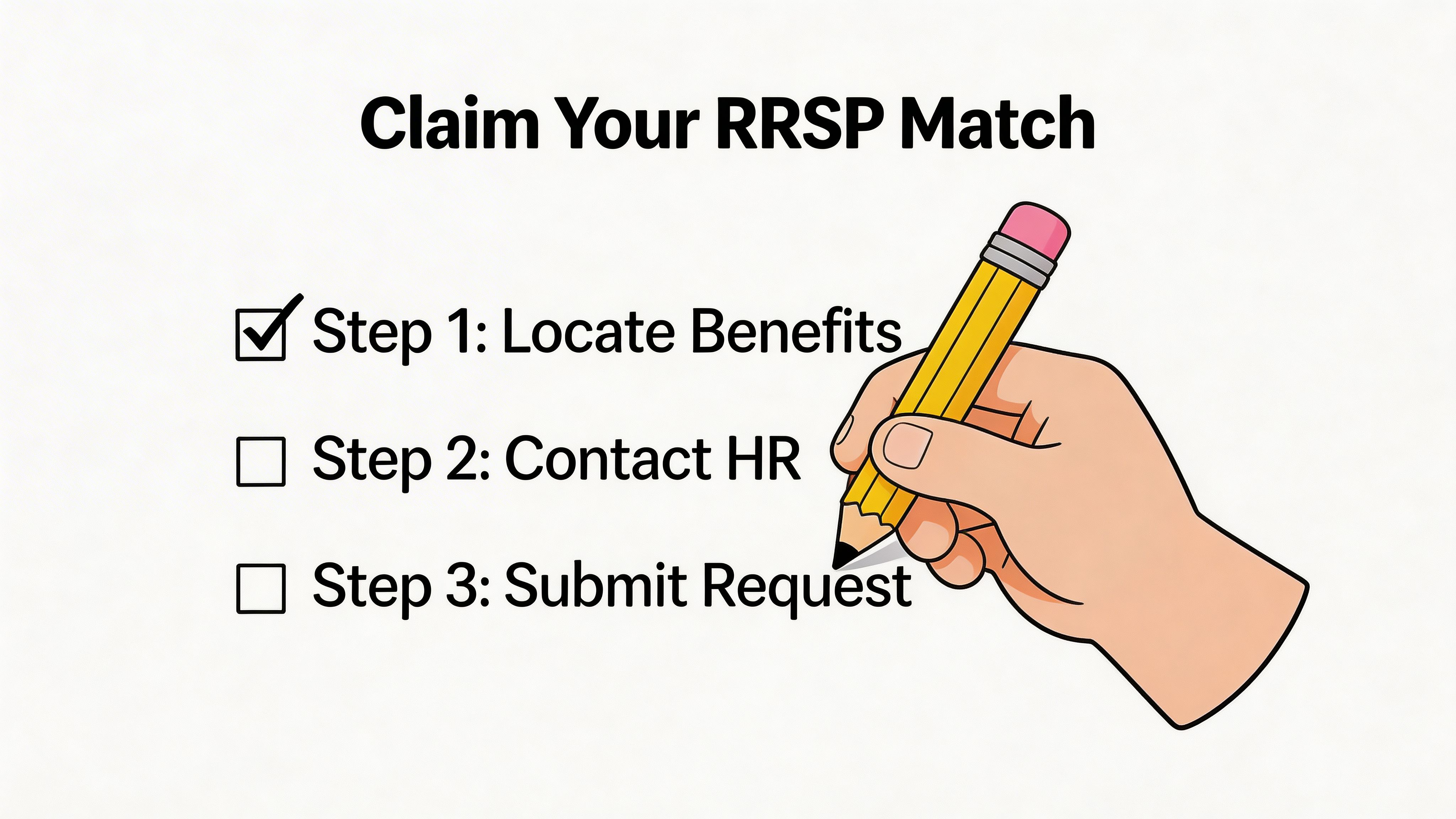
The fastest way to handle it is to treat it like a checklist.
Your five-step checklist
Find your plan documents Log into your HR or benefits portal and locate the group RRSP summary, enrolment page, or payroll deductions section.
Identify the key rule set You need four details: the match formula, the maximum match, the eligibility date, and whether matching is calculated through payroll timing.
Set your contribution rate If cash flow allows it, set your deduction at the percentage needed to receive the full match. If that feels too aggressive today, increase toward the target on a set schedule rather than leaving it vague.
Check your next pay stub Confirm both entries appear correctly. You want to see your contribution and the employer contribution, not just one of them.
Review it again after any salary change A raise, promotion, leave, or payroll change can affect whether your contribution rate still lines up with the plan.
What to watch for after setup
Once enrolled, keep an eye on a few things:
- Missing employer deposits: If the employer amount does not appear as expected, ask payroll quickly.
- Below-threshold contributions: Auto-enrolment defaults may be lower than the level needed for the full match.
- Lapsed participation after job changes: Internal transfers or system migrations can create administrative gaps.
Make the benefit visible
People stay engaged with savings when they can see it clearly.
That is why it helps to track your matched contributions as part of your bigger financial picture rather than treating them like invisible payroll plumbing. A dashboard such as the personal finance assistant can make it easier to review income, savings progress, and recurring patterns in one place so the employer contribution does not disappear into the background.
Frequently Asked Questions About RRSP Matching
What happens to my RRSP match if I leave my job
It depends on the plan rules.
Your own contributions are generally yours. The employer contributions may also be yours, but vesting rules can matter. If the plan has a service requirement and you leave before meeting it, you may lose some employer-funded amounts. Always check the plan booklet before resigning if vesting is involved.
Can I make a lump-sum contribution near the RRSP deadline and still get the match
Sometimes no.
Many workplace matching programs are tied to payroll deductions made during active pay periods. A personal lump-sum contribution to an RRSP can still help your retirement savings and tax planning, but it may not trigger employer matching if the plan only matches payroll-based contributions. If you want the full employer benefit, regular payroll deductions are usually the safer route.
Does employer matching count as taxable income
The tax treatment can feel confusing, especially because payroll, tax slips, and RRSP contribution reporting all interact.
The important practical point is that you should not assume the employer contribution exists outside the normal RRSP and tax framework. Review your year-end reporting, make sure your records line up with what was contributed through the plan, and ask a tax professional if your slips or deduction totals do not make sense.
Do government changes affect how I should use RRSP matching
They can, which is one reason employees get stuck.
Confusion often arises from new government programs and tax changes. For example, Finance Canada's 2026 budget updates may enhance tax credits for employers offering matches, but employees are often unsure how this affects their personal situation, such as interactions with FHSA transfers or spousal RRSP rules, as discussed at iFinance Canada.
For most employees, the practical answer is still the same. Learn your plan rules first, claim the full available match if you can, and then coordinate the rest of your savings strategy around that base.
If you want to turn this into action, Fintrack can help you see your retirement contributions, spending trade-offs, and savings goals in one place so you can make sure your RRSP match is being captured instead of missed.