
A Toronto barista looks at her $2,400 biweekly pay stub and mentally assigns every dollar before it arrives. Rent takes the largest bite, transit follows, groceries fill the gaps, and a couple of Tim Hortons runs seem harmless until the balance is gone. The holiday she keeps promising herself will have to wait for another paycheque.
The 50/30/20 budget rule gives that money a simple structure. It divides after-tax income into 50% for needs, 30% for wants, and 20% for savings or extra debt repayment, a framework commonly traced in Canadian explainers to Elizabeth Warren and Amelia Warren Tyagi's All Your Worth, published in 2006 (CanooQ's Canadian explanation). It's useful because it makes you label spending before the month disappears.
You'll see sample budgets at three Canadian income levels, practical ways to respond when housing already exceeds the needs target, and a manual-entry Fintrack routine for keeping the split visible. The rule is a flexible starting point, not a moral scorecard.
A Paycheck That Finally Has a Plan
The barista's problem isn't that she lacks discipline. She has recurring obligations, small comforts, and future goals all competing for the same income. Without categories, rent and coffee purchases feel like one long list of withdrawals rather than different financial priorities.
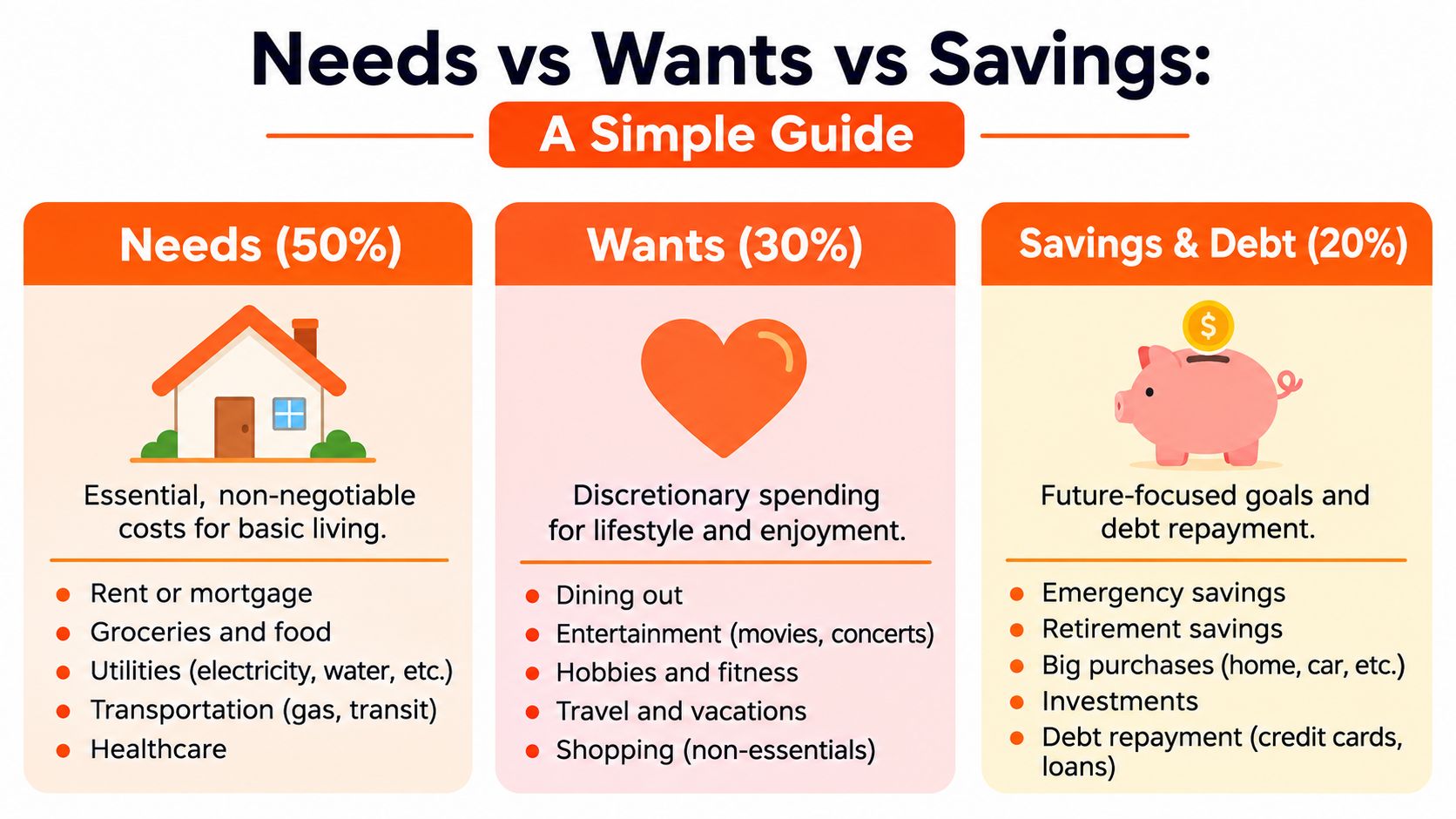
The rule separates those priorities into three buckets:
- Needs: Costs you must cover to keep your household functioning.
- Wants: Optional spending that adds enjoyment or convenience.
- Savings and debt repayment: Money that strengthens your future position.
The framework became durable shorthand because it offers a quick check without requiring a detailed spreadsheet. Canadian guidance uses it to compare take-home pay with common household pressures such as shelter, food, transportation, and debt (Wealthsimple's Canadian guide).
A useful starting question: If your income arrived today, which dollars would protect your housing, health, work, and basic food first?
Start with net income, meaning the money that reaches your account after deductions. Then review a recent month and assign each transaction to its most honest bucket. You don't need perfect classifications on the first attempt. You need a clear enough picture to see whether your fixed commitments leave room for both enjoyment and resilience.
If money regularly runs out before payday, the living paycheck to paycheck guide can help you examine the timing problem separately from the category problem. A budget works better when it shows not only what you spend, but also when bills and pay arrive.
The percentages are targets, not a test you pass or fail. A renter with unusually high housing costs may need a different temporary split, while someone with low fixed costs may direct more toward debt or savings. The point is to make the trade-offs visible.
What Needs, Wants, and Savings Mean
A budget becomes easier to use once each expense has a clear job. A need keeps your household operating, a want improves your quality of life, and savings builds future options. The same purchase can fit different buckets depending on your circumstances.
Needs keep the month running
Needs are required or difficult-to-avoid costs. Common examples include:
- Housing: Rent or mortgage payments, such as a Vancouver basement suite costing $1,800.
- Utilities: Hydro and other basic household services.
- Food: Groceries for meals at home.
- Transportation: Transit, car insurance, fuel, and necessary vehicle payments.
- Work-related care: Child care required so you can earn income.
- Debt obligations: Minimum payments that keep accounts current.
A higher-priced apartment may be a want when a cheaper, workable option is available. It can function as a need when location, safety, accessibility, or employment makes the alternatives unrealistic. Context matters more than the store receipt.
Use household budget categories if you need smaller labels beneath these three broad buckets. Detailed labels can clarify where your money goes without changing the main rule.
Wants make life more enjoyable
Wants are optional choices. A $90 monthly streaming bundle is a want because your household could continue functioning without it. Restaurant meals, hobbies, gym memberships, travel, phone upgrades, and entertainment usually belong here.
This category is not a punishment box. Planning for enjoyment gives the budget room for real life, which can make it easier to follow than a plan that assumes convenience and fun will disappear.
Savings and debt repayment build options
The final bucket includes emergency fund deposits, TFSA and RRSP contributions, long-term investing, and debt payments above the minimum. These dollars can absorb an unexpected bill, reduce interest, or give you more choices later.
For a broader foundation, understanding budgeting basics explains income, fixed costs, variable costs, and financial goals. If an expense sits between categories, choose the label that best reflects its role, record the decision, and apply the same standard next month.
Why the 50% Needs Bucket Feels So Tight in Canada
A household can follow the rule carefully and still find that housing takes more than half of its take-home pay. After rent or mortgage payments, there may be little room left for groceries, utilities, transportation, insurance, minimum debt payments, and work-related care.
Statistics Canada reported that Canadian households spent an average of $67,126 on goods and services in 2021, including $21,106 on shelter, $10,305 on food, and $10,099 on transportation (Statistics Canada data cited by Wealthsimple). Those three categories alone help explain why the needs bucket can feel compressed.
The pressure starts with fixed costs
Housing usually takes the largest share because rent or mortgage payments arrive before discretionary choices. A household may cut restaurant meals and subscriptions, yet still exceed the suggested needs share if its housing or commuting costs are high.
| Category | Annual Average | Monthly Average | % of Median After-Tax Income |
|---|---|---|---|
| Shelter | $21,106 | About $1,759 | Not provided |
| Food | $10,305 | About $859 | Not provided |
| Transportation | $10,099 | About $842 | Not provided |
The monthly figures are simple annual averages divided by twelve. The source reports average household spending, not a median after-tax-income comparison, so the table does not assign an unsupported percentage.
Why a national rule needs local judgement
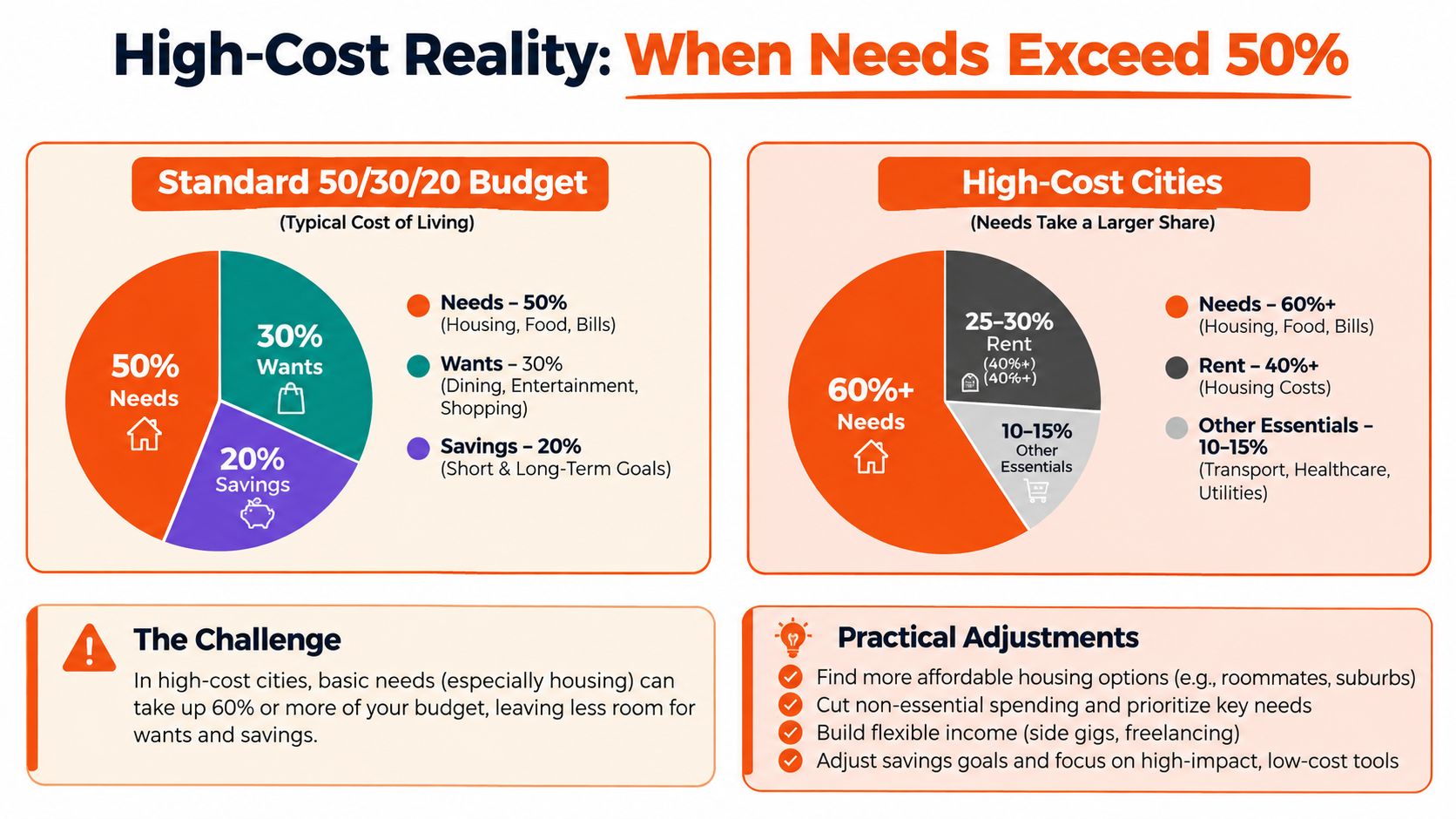
A fixed split can hide regional differences. In high-cost urban markets, housing alone may consume more than 50% for all needs, leaving the rule unable to describe a workable budget. Households outside those markets may have more flexibility. Canadian explainers often present the rule as a clean after-tax formula without fully resolving that affordability gap (Fortunave's Canadian discussion).
Use the percentages as a diagnostic, not a pass-or-fail test. If needs exceed the target, record the overage and identify its source. Fintrack's manual-entry AI tracking can help keep that record honest, especially when automatic categories miss irregular housing, transportation, or care costs. The next adjustment might involve housing, commuting, food, debt, or wants, depending on what your actual budget can change.
Sample Budgets at Three Canadian Income Levels
A percentage becomes easier to use when you translate it into dollars. The examples below use hypothetical take-home incomes to illustrate the structure, not to describe average Canadian households or prescribe the right amount for everyone.
| Category | Solo at $2,800/mo | Couple at $6,500/mo | Household at $9,800/mo |
|---|---|---|---|
| Needs target, 50% | $1,400 | $3,250 | $4,900 |
| Wants target, 30% | $840 | $1,950 | $2,940 |
| Savings and extra debt target, 20% | $560 | $1,300 | $1,960 |
| Example needs allocation | Rent $850, transit $120, groceries $300, phone and utilities $80, minimum debt $50 | Housing $2,000, groceries $650, daycare $450, transportation $100, insurance and utilities $50 | Mortgage $3,000, groceries $700, transportation $400, insurance and utilities $500, minimum debt $300 |
| Example wants allocation | Dining $180, streaming $90, hobbies $150, clothing $120, flexible spending $300 | Dining $300, entertainment $250, travel fund $500, hobbies $300, flexible spending $600 | Dining $450, travel $700, hobbies $400, upgrades $300, flexible spending $1,090 |
| Example savings allocation | Emergency fund $300, TFSA $160, extra debt $100 | Emergency fund $400, RESP $300, RRSP or TFSA $600 | Emergency fund $300, RRSP top-up $900, TFSA $500, extra debt $260 |
The solo example leaves little room for error. If rent rises or groceries run over plan, the person may need to reduce wants temporarily rather than treat the target as a rigid entitlement.
The couple's example includes daycare as a need because it supports earning income. An RESP contribution belongs in the future-focused bucket, while household entertainment remains discretionary.
The higher-income example gives the household more room to assign money across goals, but larger income doesn't eliminate the need to track recurring commitments. A mortgage, insurance, transportation, and debt can still absorb the needs allocation.
For a reusable worksheet, the monthly budget template can help you list recurring bills, flexible spending, and savings transfers before assigning targets.
What to Do When Needs Already Exceed 50%
A needs category above 50% is common enough to plan for, especially for renters in expensive Canadian cities. The wrong response is to abandon the framework because the first calculation looks uncomfortable. The better response is to treat the gap as information.
Adjust the framework without losing its purpose
Try these decisions in order:
- Protect the essentials first. Keep housing, food, utilities, transportation, insurance, child care, and minimum debt payments funded.
- Reduce flexible wants next. Audit streaming services, pause unused memberships, plan meals around groceries already at home, and set a weekly restaurant limit.
- Separate minimums from extra repayment. Minimum debt payments remain needs. Extra principal belongs with savings and debt repayment.
- Use a temporary split. A 60/20/20 or 70/20/10 structure can acknowledge high needs while preserving some discretionary spending and future progress.
Those alternative splits are adjustment frameworks, not additional standards you must hit. A household may use one while searching for lower-cost housing, changing transportation, paying for a temporary care expense, or rebuilding after a major bill.
Keep one future-facing habit
If needs absorb more than planned, don't let savings disappear indefinitely. Even a smaller, consistent transfer keeps the future visible while you work on the larger cost problem. Revisit the arrangement when a lease, debt payment, care cost, or income changes.
A budget that reflects your real housing cost is more useful than a perfect-looking budget you can't live with.
The 50/30/20 rule should help you make trade-offs deliberately. It shouldn't turn an unaffordable housing market into a personal character judgement.
Treating the 20% Slice as a Resilience Buffer First
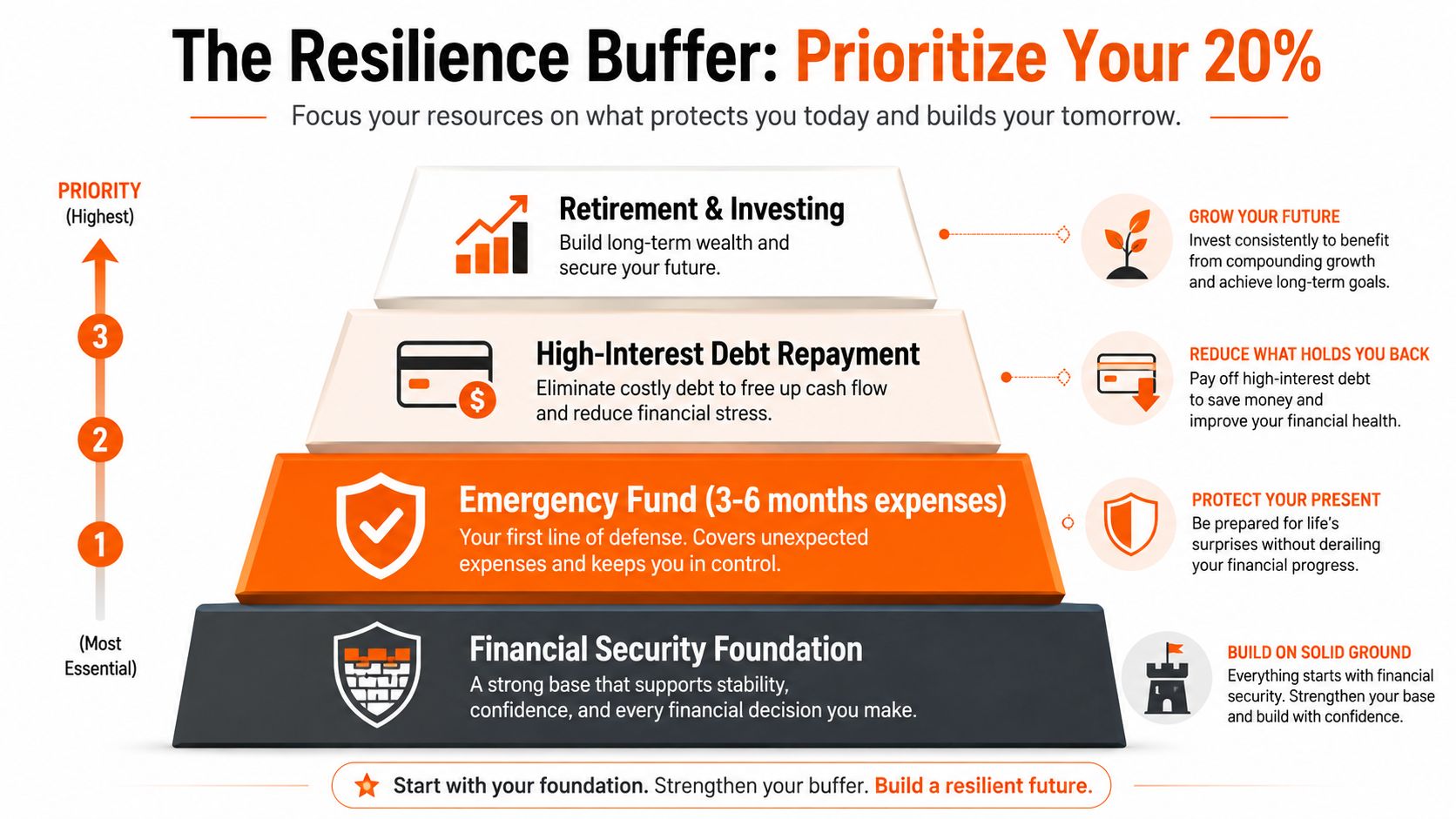
A surprise dental bill, broken phone, or missed shift can push a household toward high-cost credit when there is no cash set aside. The 20% savings slice has several jobs, but they should happen in an order that protects your next month before building long-term wealth.
The Financial Consumer Agency of Canada reported that 47% of respondents said they save for an unexpected expense very often or often, while 24% said seldom or never (FCAC survey backgrounder). That gap helps explain why accessible emergency cash comes before extra investing or accelerated debt repayment.
Build the base before optimising
Use this order as a starting point:
- Emergency reserve: Begin with a liquid $1,000 buffer, then work toward three to six months of needs spending.
- High-interest debt: After immediate cash protection is in place, direct extra money toward costly revolving debt.
- Employer-supported retirement: Take an available employer RRSP match before assigning extra savings elsewhere.
- TFSA contributions: Fund suitable goals through a TFSA after the earlier priorities are covered.
- Long-term investing: Invest remaining funds according to your time horizon and risk tolerance.
The best sequence can change with interest rates, employer plans, tax circumstances, and an urgent debt. The guiding principle remains resilience first, wealth building second.
The same FCAC backgrounder also reports that financially resilient households declined from 31% in June 2021 to 24% in June 2023. In a high-cost Canadian city, housing may already consume more than half of take-home pay, so the 20% target may be temporarily out of reach. Direct whatever amount is realistic toward a buffer, and record each manual expense in Fintrack so the rule reflects actual spending rather than assumptions.
For a Canada-specific plan, see how to build an emergency fund in Canada. Keep this money accessible, separate from everyday spending, and easy to replenish after use.
Setting Up Fintrack to Run the Rule for You
Manual entry can work well when you don't want to connect a bank account or when you use cash, debit, and e-transfers across several accounts. The value comes from recording purchases consistently, not from making the categories look tidy after the fact.
Create the structure first
- Make three top-level categories. Name them Needs, Wants, and Savings.
- Add useful Canadian subcategories. Under Needs, use Rent, Hydro, Groceries, Transit, Insurance, and Minimum Debt. Under Wants, add Dining, Streaming, Hobbies, and Travel. Under Savings, add Emergency Fund, TFSA, RRSP, and Extra Debt.
- Set monthly limits. Use your net pay as the base, then assign 50%, 30%, and 20% to the three top-level categories. A dollar limit makes the boundary easier to act on than a percentage alone.
Fintrack's budget planning feature is designed for category limits and progress tracking. If you're comparing different approaches, a resource covering the top budget tracking tools of 2026 can help you assess which workflow suits your comfort with manual entry and bank connections.
Make the routine small enough to repeat
Log purchases through Fintrack's AI manual-entry prompt the same evening. Write something simple such as “$18 lunch, Dining” or “$72 hydro, Needs,” then check that the category matches your written rules.
Set alerts at 80% of each Needs category and 90% of Wants categories if those thresholds are available in your setup. The purpose is to catch drift while you still have choices, not to shame you after the money is gone.
Once a week, check the progress bars. Move money between Wants subcategories when one is underspent and another needs room, confirm the Savings transfer landed, and review the plan before the next payday. Manual entry also keeps cash purchases and e-transfers visible instead of leaving gaps in the month.
Common Mistakes and How to Make the Rule Stick
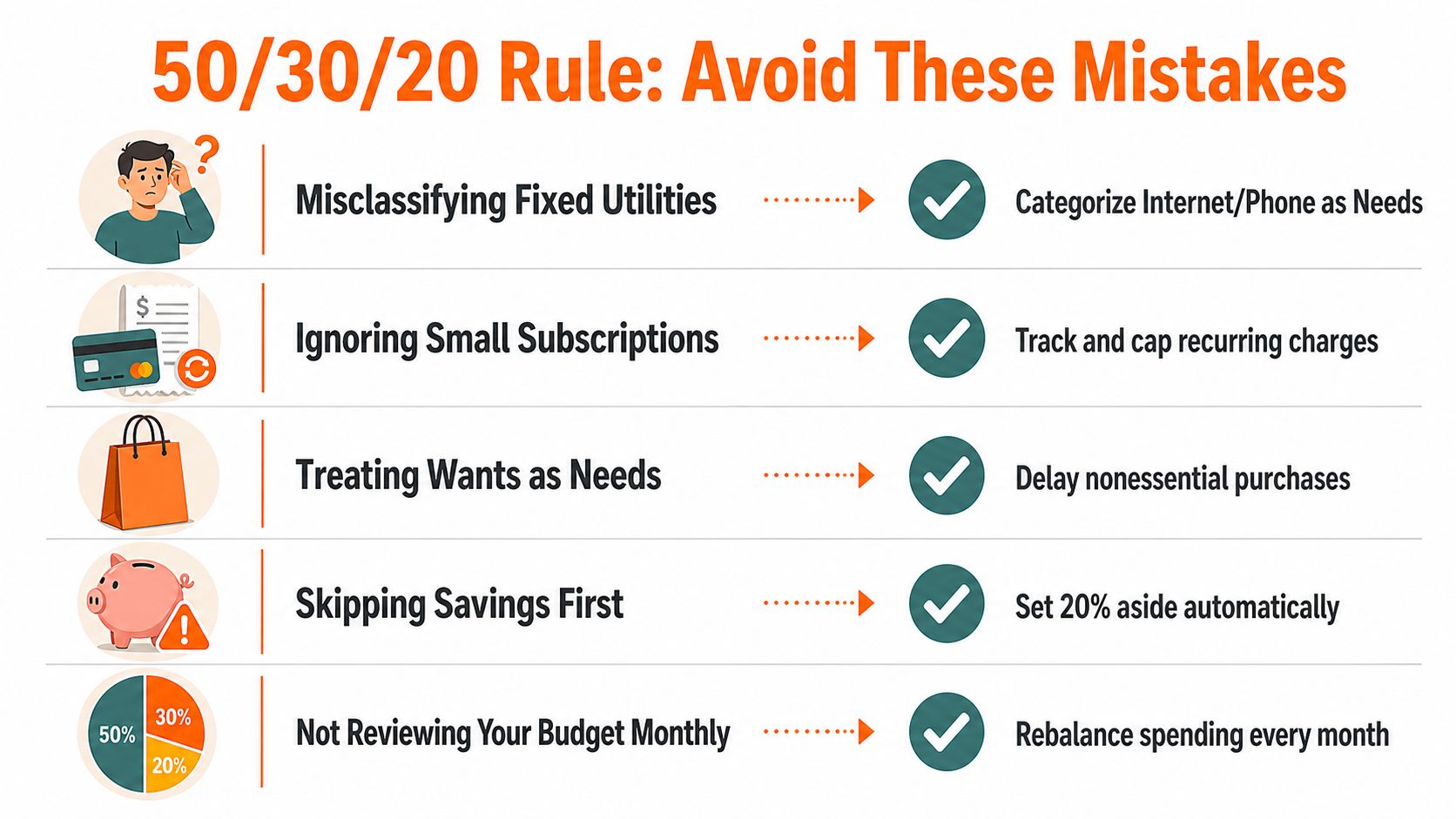
A simple framework can still produce misleading results if you apply the labels inconsistently. These are the corrections that keep the rule connected to real household obligations.
Mistake one, misclassifying essential connectivity
Cell phone and internet costs often get lumped with streaming and entertainment. Basic phone and internet service may support work, school, banking, and household administration, while a premium streaming bundle is a want. Separate them so the needs total reflects obligations accurately.
Mistake two, counting the same retirement money twice
Employer pension or matched RRSP contributions may already come out of your pay. Decide whether your personal version of the rule includes those contributions in the 20%, then track it consistently. Don't count the contribution once through payroll and again as a new transfer.
Mistake three, investing before preparing for shocks
The 20% slice isn't automatically an investing bucket. Build emergency cash first, then consider high-interest debt, employer matching, TFSAs, and longer-term investments according to your situation.
Mistake four, keeping the budget in your head
A mental plan changes whenever a bill arrives or a tempting purchase appears. Enter the three limits in Fintrack at the start of each month, then use actual transactions to check whether the plan matches reality.
Mistake five, ignoring annual obligations
Car insurance, property tax, gifts, and other irregular bills can inflate Needs when they arrive. Set aside a monthly amount in a sinking fund within the Savings bucket, so the expense doesn't become a surprise.
Use a short Sunday review to check category progress, upcoming bills, and the next savings transfer. That small ritual keeps the framework honest as paycheques, rent, and everyday temptations change.
Fintrack lets you create category limits, record spending manually without a bank connection, and review progress across Needs, Wants, and Savings in one place. Visit Fintrack to put your own Canadian 50/30/20 plan into practice and start with the categories that matter most this month.