
A lot of people start thinking about a bank safety deposit box at exactly the wrong moment. A parent dies. A move is coming up. A wildfire warning hits the neighbourhood. You open a drawer or a shoebox and find jewellery, deeds, old family photos, military papers, or a wedding ring that no one wants to lose.
That’s when the usual advice starts sounding too thin. “Put valuables in a bank box” is easy to say. It’s less helpful when you’re deciding who should have access, whether the contents are insured, and what happens if your branch closes or you can’t get there when you need something.
A bank safety deposit box can be a smart tool. It’s just not a complete plan on its own. The best results come from treating it as one part of building a robust physical security strategy, alongside home storage, digital backups, and a clear record of what you own.
If you’re trying to organise the broader money side of that process, this guide pairs well with a practical review of planning your personal finance.
Your Guide to Keeping Valuables Safe

A bank safety deposit box is a rented container kept inside a bank or credit union vault. People usually use one for items that are hard to replace, awkward to store at home, or too meaningful to leave in a bedside drawer.
That sounds simple. In practice, the value of the box depends less on the metal container and more on the decisions around it. The right documents, the right access setup, and the right insurance matter more than the phrase “in a vault”.
Why people still choose them
For many households, the appeal is straightforward:
- Better physical protection: A vault offers stronger security than a filing cabinet or most home hiding spots.
- Good fit for irreplaceable items: Original records, small heirlooms, and backup media are easier to protect when they’re out of everyday circulation.
- Separation from daily clutter: Important items stay in one known location instead of being scattered across drawers, safes, and storage bins.
A safety deposit box works best for items you want protected, but don’t need on short notice.
Where people get caught off guard
The hidden issues aren’t usually about theft. They’re about logistics.
- Access is limited: You can’t get into the box whenever you want.
- Insurance is often misunderstood: Many renters assume the bank covers the contents when it usually doesn’t.
- Estate planning gets messy fast: A box can become hard for family members to access if the paperwork isn’t set up properly.
That’s why the smartest approach is practical, not sentimental. Use the box for a narrow purpose. Document everything. Make sure another trusted person can deal with it if you can’t.
How a Bank Safety Deposit Box Works
The first thing to know is that a bank safety deposit box doesn’t open like a home safe. You usually need both your key and the bank’s guard key. In California banks, safe deposit boxes commonly use UL 437-certified dual-control locks, which require the customer key and a bank guard key at the same time. These locks are engineered to resist picking, impressioning, and lock bumping for at least 45 minutes, and forcing for 5 minutes, under UL standards used nationwide, including California financial institutions, as explained in this overview of safe deposit lock security.
That dual-control setup is one reason these boxes remain useful for small, high-value items. It reduces the chance that one lost key or one rogue actor can access the contents alone.
What access looks like in real life
Using the box is usually a short branch appointment, not a quick in-and-out errand.
A staff member verifies your identity, escorts you to the vault area, uses the bank’s guard key with your key, and then gives you a private space to review the contents. If you want convenience similar to a household drawer, this won’t feel convenient. If you want controlled access, that’s the point.
Practical rule: Only store items in a bank safety deposit box if you can tolerate waiting until branch hours to retrieve them.
Sizes and annual cost
Banks usually offer a small range of standard box sizes. A common starting point is 3x5x22 inches for small valuables such as keys and passports, at roughly $25 to $50 per year, while larger boxes can reach 10x10x22 inches at about $100 to $200 per year, according to this guide to safe deposit box sizes and pricing.
Here’s a simple way to view it:
| Box size | Best for | Typical annual cost |
|---|---|---|
| 3x5x22 inches | Small documents, keys, compact jewellery | ~$25 to $50 |
| 10x10x22 inches | Larger document bundles, jewellery cases, heirlooms | $100 to $200 |
The same source notes that these boxes use steel construction and offer significant fire resistance. That doesn’t mean you should cram them full. It means they’re built for secure storage of compact items, not for replacing a home archive room.
Who it suits best
A bank safety deposit box usually makes sense when all three of these are true:
- You have originals that are costly or impossible to replace
- You don’t need those items frequently
- You’re willing to keep a separate inventory outside the box
If one of those is missing, the box may still help, but it may not be the best answer.
What Belongs in Your Box and What Does Not
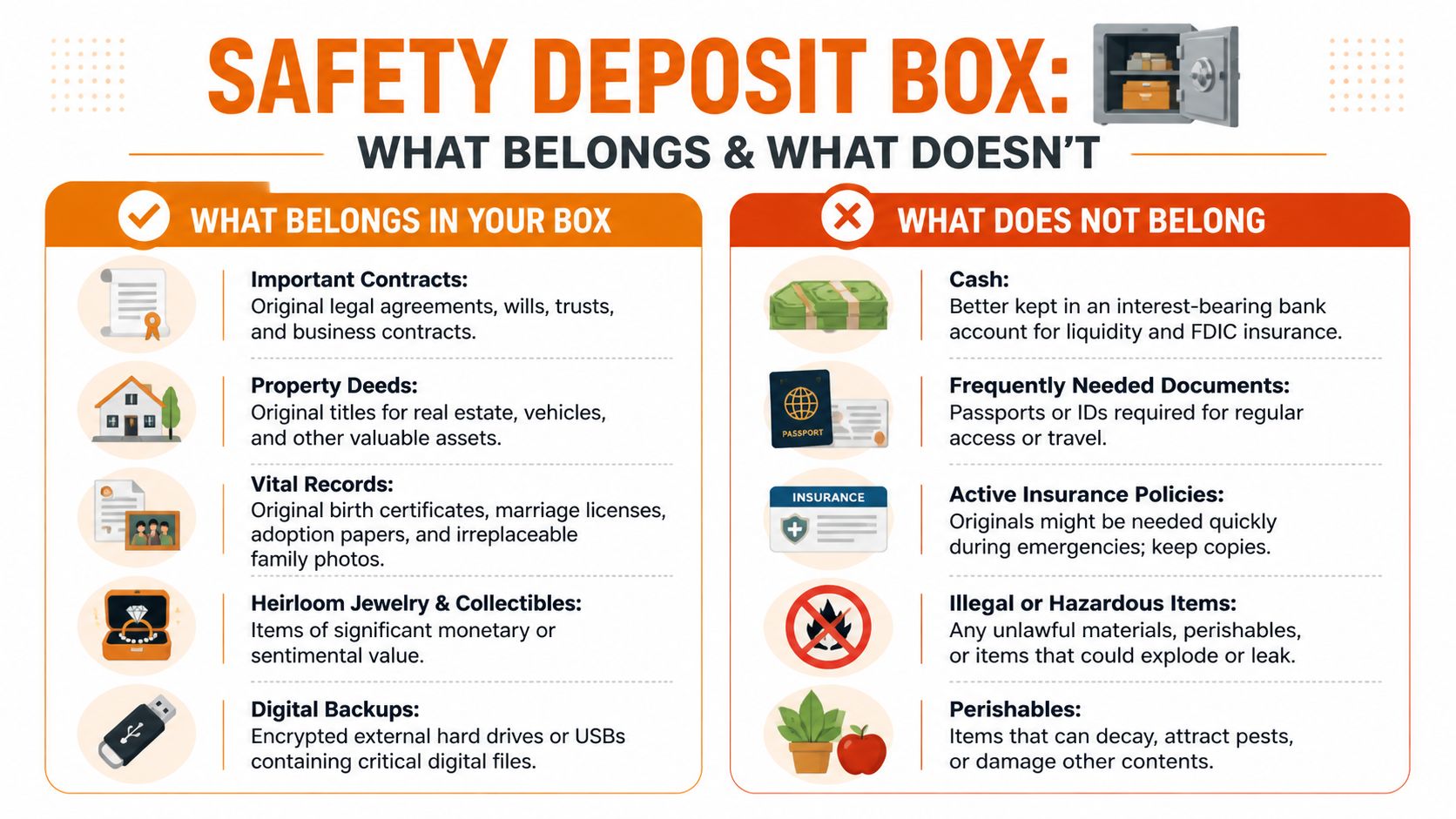
Most mistakes happen because people use a bank safety deposit box as a catch-all for “important stuff”. That’s too vague. The better test is this: store items that are hard to replace, physically small, and unlikely to be needed urgently.
What belongs in the box
These are usually good candidates:
- Original vital records: Birth certificates, marriage records, adoption papers, citizenship documents, and similar originals that are difficult to replace.
- Property documents: Deeds, titles, signed contracts, and records tied to ownership.
- Small heirlooms: Jewellery, medals, family keepsakes, and other compact valuables with sentimental or financial value.
- Encrypted backups: A USB drive or external drive with critical digital records, if you’ve encrypted it properly.
- Archival family material: Old photographs or paper records that you want stored more carefully than a closet allows.
If you’re setting money aside for document replacement, insurance deductibles, or legal fees around major life admin, it also helps to understand what a sinking fund is and how to build one before the need becomes urgent.
What does not belong
Some items cause more problems than they solve when locked in a vault.
- Cash: A bank safety deposit box is storage, not a banking product. Cash inside doesn’t earn interest and can create complications if you ever need to prove ownership.
- Anything you may need tonight: Passports, immigration papers for imminent travel, spare house keys, or documents you might need during a medical emergency should stay accessible.
- The only copy of instructions your family will need quickly: If a loved one has to act without you, a locked box can become a barrier.
- Illegal, hazardous, or perishable items: These create legal and practical risks and don’t belong in a bank vault.
- Loose, unlabelled valuables: If no one can tell what something is, when you acquired it, or why it matters, your heirs will have a harder time dealing with it later.
Don’t judge items only by value. Judge them by replacement difficulty and urgency of access.
A better sorting method
When clients are unsure, I suggest a three-pile test:
- Need within 24 hours
- Need within a year
- Need only for preservation or inheritance
The third pile is the strongest match for a bank safety deposit box. The first pile usually belongs somewhere you or a trusted person can reach immediately.
The Fine Print Insurance Legal Access and Estate Planning
The biggest misunderstanding about a bank safety deposit box is also the most expensive one. The box may be secure, but the contents are not automatically insured by the bank or by FDIC coverage.
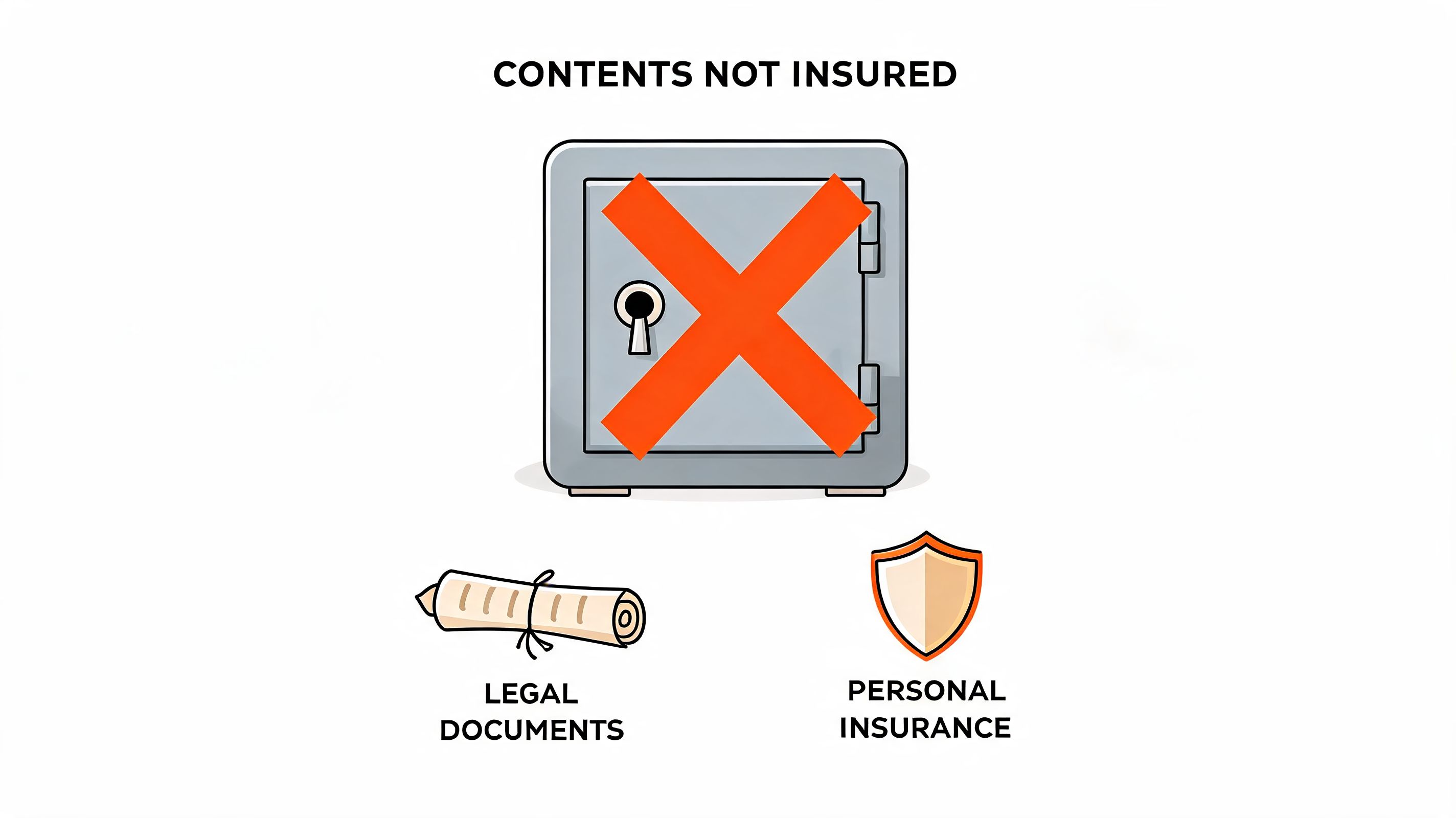
AARP notes that FDIC insurance does not cover safe deposit box contents, and valuables are unprotected from fire, floods, or theft unless you add a rider to your homeowners or renters insurance policy. That extra coverage can cost about $50 to $200 per year according to its guide to safe deposit box insurance limits.
Insurance is your job
Many people hear “bank vault” and assume “insured”. Those are not the same thing.
If you plan to store jewellery, rare watches, or other high-value pieces, talk to your insurer before the items go into the box. For readers evaluating specialty coverage for jewellery in particular, this visual reference on insurance for high-value rings is a useful reminder that a standard home policy may not fully match the value or category of the item.

A solid insurance routine looks like this:
- Photograph every item clearly
- Keep appraisals, receipts, or notes of origin
- Store the inventory outside the box
- Confirm the rider covers the actual type of item
Access problems after illness or death
Legal access is where good intentions often fall apart.
If you’re the only authorised renter and you become incapacitated, the person who knows exactly what’s inside may still be unable to reach it quickly. If you die, family members may face delays while they prove authority to access the contents. That’s especially painful when the box holds records needed to settle your estate.
A bank safety deposit box should never be the only place where your family can find key instructions.
Better estate planning choices
A few habits prevent most of the avoidable mess:
- Name a co-renter or authorised deputy if appropriate: This can help with continuity, but only if you trust the person completely.
- Tell your executor the box exists: It sounds obvious, but hidden boxes stay hidden.
- Keep a contents list with your estate documents: Not in the box itself.
- Avoid storing your only original will there: If the will is needed to enable other legal steps, you don’t want the box becoming part of the bottleneck.
The practical standard
Think of the box as a storage location, not a planning system. Insurance, documentation, and legal authority all live outside the vault. If those pieces are missing, the steel door doesn’t solve much.
Comparing Your Options Beyond the Bank Vault
A bank safety deposit box is no longer the automatic default for everyone. Access has become less predictable in some markets, and some banks are reducing availability. A Bogleheads discussion summarising the trend notes that major banks are phasing out safe deposit boxes amid branch transformations, pushing more people toward alternatives such as credit unions, private vaults at $300+ per year, or high-quality fireproof home safes at $100 to $500 one time. You can see that framing in this discussion of safe deposit box alternatives.
That shift matters because the best storage option depends on what you value most: access, cost, security, or convenience.
Side by side trade-offs
| Option | Best for | Main downside |
|---|---|---|
| Bank safety deposit box | Original documents, small heirlooms, controlled access | Limited to branch hours |
| Credit union box | Similar use case with potentially lower annual cost | Fewer locations and variable availability |
| Private vault | High-value physical items needing specialist handling | Much higher recurring cost |
| Home fireproof safe | Immediate access to key records and emergency items | Home exposure to theft, fire, or poor installation |
| Encrypted digital storage | Copies of documents and family records | Not suitable for physical valuables |
When a home safe wins
A home safe is often the better answer for documents you might need fast. Insurance policies, passports for active travel, medical directives, and backup cash reserves are common examples. If your priority is rapid access during disruption, a home solution can outperform a vault.
Portable security also has a place in narrower situations. For travel, shared spaces, or poolside and gym environments, products like AquaVault anti-theft lock boxes solve a different problem than a bank vault, but they highlight a useful principle: match the security tool to the exact access risk you’re dealing with.
When the bank box still makes sense
The bank box remains strong when your items are small, important, and rarely needed. It’s especially useful for records that matter over years, not hours.
What it doesn’t do well is emergency access planning. For that side of the equation, your broader household reserves matter just as much. If you’re balancing storage choices with liquidity planning, it helps to review how an emergency fund in Canada works, because the wrong place to keep cash is often a bigger problem than the wrong place to keep papers.
The best setup for many households isn’t one storage method. It’s a split system: immediate-access items at home, archival items in a vault, and digital copies where appropriate.
Your Step-by-Step Guide to Renting a Box
Renting a bank safety deposit box is usually simple once you know what to ask. The key is to decide the purpose before you sign anything.
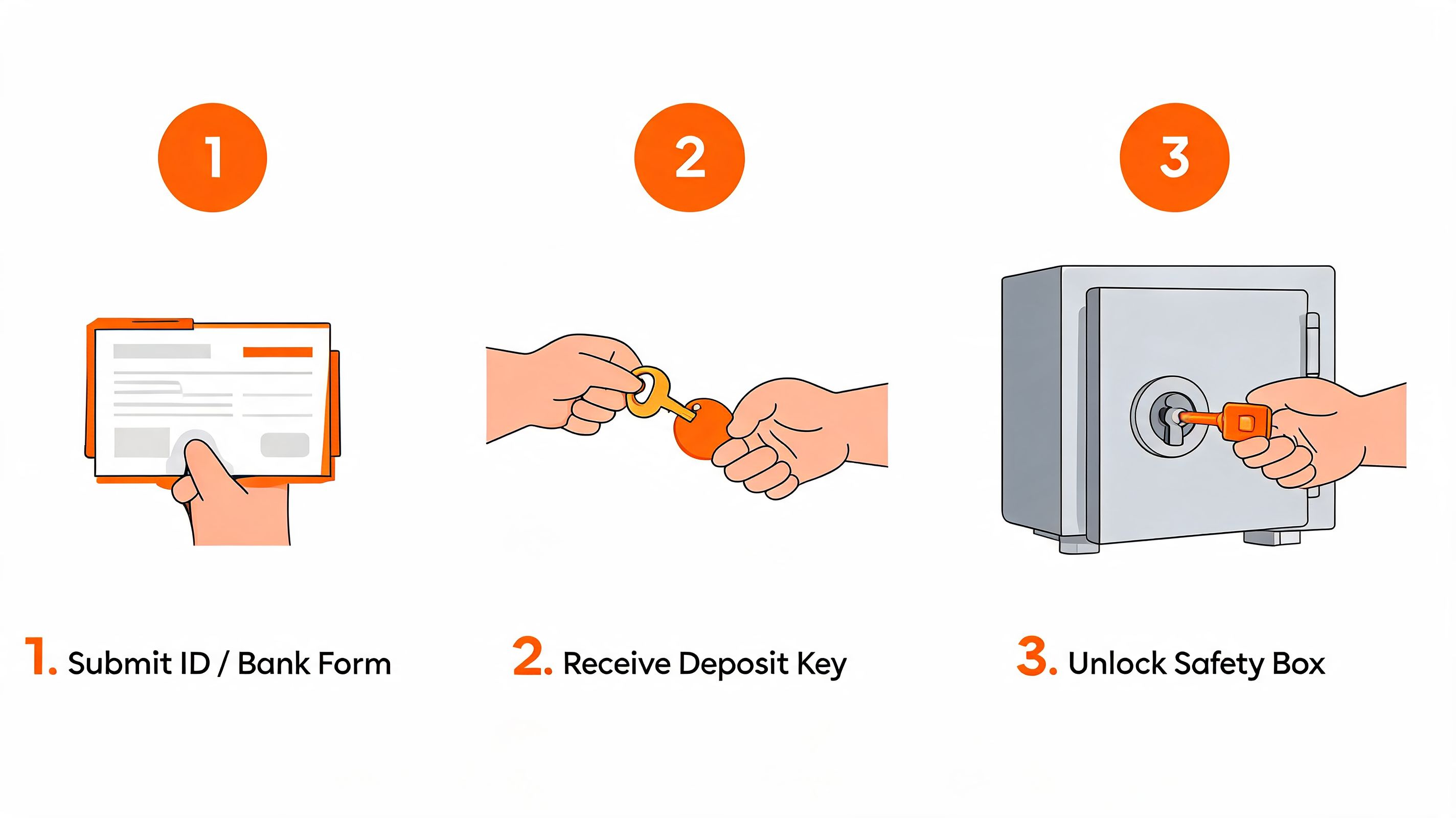
A practical rental checklist
Call local branches first
Don’t assume boxes are available. Ask whether the branch still offers them, what sizes are open, what the annual fee looks like, and how access works.Bring the identification they require
Most institutions will ask for government ID and may want proof of address or account information. Ask in advance so you don’t make two trips.Choose the smallest size that fits your real use case
People often overestimate what they need. Bring a rough list of intended contents and think in terms of folders, pouches, and small cases, not just “important stuff”.Read the access terms carefully
Check who can access the box, what happens if a key is lost, and whether you can name another authorised person. Practical estate planning begins with these considerations.Ask about the branch’s future plans
If the location is being consolidated or redesigned, that matters. A box at the wrong branch can become an inconvenience for years.Create your inventory before you load the box
Photograph items, note serial numbers or identifying details where relevant, and keep that list outside the vault.
For anyone comparing financial institutions while setting up other household systems, this overview of PenFed can be useful as part of a broader banking review.
What to bring on day one
A small envelope or folder system works better than loose items. Label documents plainly. Put jewellery in separate pouches. If you’re storing digital backups, label the drive and note what’s on it somewhere outside the box.
That little bit of organisation matters more than people expect. A bank box is easiest to manage when someone else could understand it without your help.
Your Safety Deposit Box Checklist
Use this as a final review before you rent a box or reorganise one you already have.
Keep this list simple and specific
Choose the box for storage, not for convenience
If you may need the item urgently, keep it elsewhere.List every item before it goes in
Include photos, descriptions, and any appraisals or receipts you have.Store only originals or valuables that are hard to replace
Avoid turning the box into a miscellaneous archive.Check your insurance separately
Don’t assume the bank covers the contents.Make access part of your estate plan
An executor or trusted family member should know the box exists and know how to deal with it.Never rely on the box as the only source of essential instructions
Keep critical directions and at least some key records accessible outside the vault.Review the contents once a year
Remove outdated papers, update your inventory, and confirm the box still fits your needs.Keep ongoing costs visible in your monthly plan
Annual fees are easy to forget when they’re small.
If you want one place to keep recurring charges, annual renewals, and irregular financial admin visible, a simple monthly bill tracker can help you avoid paying for forgotten services and storage you no longer use.
A good next step is to add your safe deposit box fee, insurance rider, and any related storage costs into Fintrack. That gives you a clearer view of what you’re paying to protect your valuables, and makes it easier to keep those costs organised alongside the rest of your financial life.