
You get paid, check your account, pay the bills, and still wonder whether you're saving enough. Some months the answer feels like yes, because money is moving into a savings account. Other months it feels like no, because an emergency, a rent jump, or a late credit card payment eats the cushion you thought you had.
That confusion is normal. The problem usually isn't effort, it's that the typical starting point is a vague idea like “save what's left” instead of a clear target tied to income, debt, and life stage. A better question is not just how much should you save of your income, but how to turn one simple rule into a real monthly plan you can keep.
Why This Question Keeps People Up at Night
A lot of people don't wake up worried about investing strategy or tax jargon. They worry about the moment the bank app opens and the balance looks smaller than expected. That's when the question lands, how much should you save of your income so you're not always one surprise away from stress?
The anxiety usually comes from inconsistency. One person saves a little when they can, another tries to follow a percentage rule without knowing whether it fits their situation, and both end up unsure if they're doing enough. Saving “whatever is left” often feels practical, but it rarely gives you a dependable answer.
Practical rule: start with a number you can defend, then make it automatic. A target is easier to follow than a feeling.
That's where a structured approach helps. Instead of guessing, you can start with the standard benchmark, then adjust for debt, income swings, and your short-term goals. If you've ever felt like your savings plan changes every month, the fix is usually a clearer baseline, not more willpower.
For readers who feel stuck in that loop, it can help to see what that gap looks like in real life. The pressure is often highest when you're living close to the edge, which is why a guide like living paycheck to paycheck is a useful companion to this topic.
The Two clearest savings rules to start with
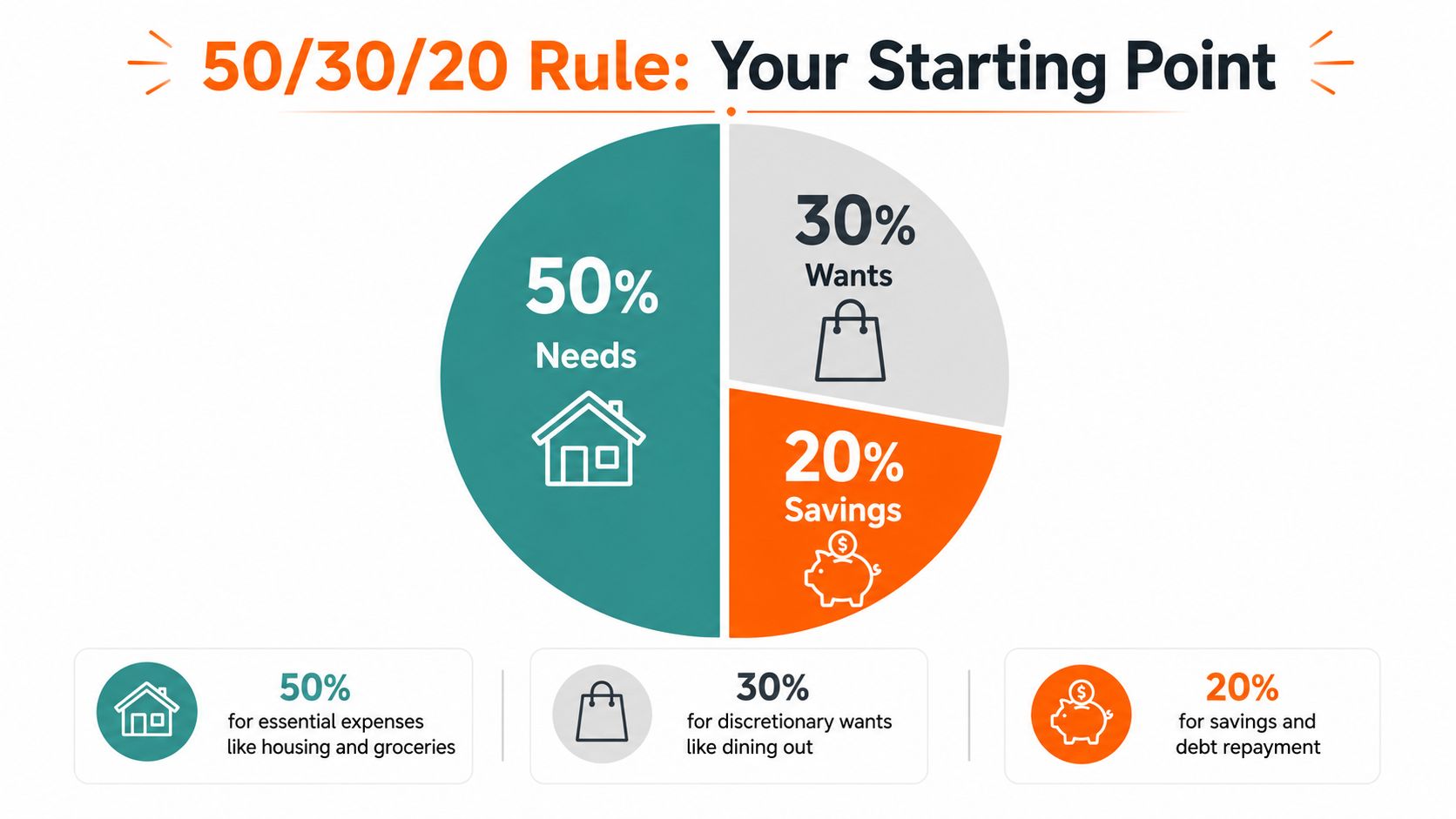
The cleanest way to answer how much should you save of your income is to start with two rules that do different jobs. One helps you manage monthly cash flow. The other helps you prepare for retirement over decades. Together, they give you a practical starting range instead of a vague guess.
The 50/30/20 rule gives you a working budget split
The 50/30/20 budget rule divides take-home pay into 50% needs, 30% wants, and 20% savings and debt repayment. Citizens Bank explains the rule in exactly those terms, and Bankrate and NerdWallet describe the same 20% savings-and-debt slice as the core benchmark inside the framework, which makes it a useful everyday budgeting guide. You're not trying to be perfect with it, you're trying to give every dollar a job.
This is also why people like the rule. It's simple enough to remember on payday, but structured enough to stop savings from turning into an afterthought. If your monthly spending is hard to track mentally, a fixed percentage is much easier to follow than a promise to “save more later.”
Fidelity's 15% benchmark is the retirement anchor
For long-term planning, Fidelity says to save at least 15% of pre-tax income for retirement, including employer contributions, based on research that assumes saving starts at age 25 and continues until age 67, with a goal of replacing about 45% of pre-retirement income through age 93, according to Fidelity's retirement savings guidance. That's a much stronger benchmark than a random monthly guess because it ties your savings rate to retirement adequacy.
For many people, the two rules line up more closely than they first appear. The 20% slice in a household budget often covers retirement saving plus debt repayment, while the 15% benchmark is the minimum retirement-oriented number many planners use as a long-range starting point. If you want a more hands-on way to frame the habit, the pay yourself first method is the right mindset to pair with these percentages.
Useful comparison: budget rules help you survive the month, retirement rules help you avoid under-saving for decades. You need both.
If you want to go deeper on contribution limits for highly structured retirement plans, cash balance plan contribution limits is a useful reference point for the planning side, especially when comparing different savings vehicles.
How your personal situation changes the target rate
The baseline is useful, but it's not the final answer. Your real savings rate depends on how stable your income is, how much debt you carry, how old you are, and what you're trying to fund next. That's why two people can both be “saving enough” while using different percentages.
Think in a ladder, not a single number
A practical way to personalise the target is to think in stages. The Budget Ledger describes a common progression of 2% to 5% when stabilising, 10% as a beginner target, 15% to 20% as a stronger long-term baseline, and 25%+ for aggressive goals, and PrimeWay FCU gives a similar split for dividing 15% to 20% of take-home pay across retirement, emergency savings, and other goals. Those ranges are helpful because they show that savings can grow as your finances get steadier.
If you're carrying high-interest debt, your immediate savings rate may need to be lower while you attack the balance. If your income comes in unevenly, a fixed percentage still helps, but the amount you can save each month may need to flex around the cash you have. That's where a simple rule is useful, it gives you direction even when the month is messy.
Your target should reflect your current bottleneck. For one person that's debt, for another it's income swings, and for someone else it's not saving enough for retirement.
Emergency cash comes before aggressive investing
A more rigorous savings plan also needs liquidity. A 3 to 6 month emergency fund is a widely used practical benchmark, because it gives you a buffer before you push harder into long-term investing, according to PrimeWay FCU's savings guidance. That matters for people with variable income or specialised work, since a shock is harder to absorb when paycheques aren't predictable.
For Canadian readers, a technical benchmark often used in budgeting is at least 20% of take-home pay for savings and debt repayment, while 15% of gross income is often treated as a minimum retirement-saving rate. Higher earners may need 25% or more to reach long-term retirement security, as noted by SmartAsset's income-savings discussion. The main point is simple, the standard rule is a starting point, not a ceiling.
Location and pay structure matter too
Canadian and American households often face the same question through different lenses. A Canadian household might need to balance high fixed housing costs with savings goals, while an American freelancer might need a bigger buffer because income lands unevenly. In both cases, the same percentage can feel very different once you account for debt, rent, and timing.
If you're trying to buy a home, a separate savings target can make the plan clearer. A house savings strategy helps you separate “money for later” from “money for a down payment,” which is where a lot of people get tangled up.
Three examples of personalized savings targets
Abstract percentages make more sense when you can see them in a real budget. The same rule can produce very different answers depending on what the person is trying to do and what kind of cash flow they have.
Maya, steady income, no debt
Maya is a 29-year-old Canadian professional with steady take-home pay and no consumer debt. She doesn't need to spend much energy stabilising her finances, so the 15% to 20% long-term range makes sense as her starting zone. She lands near the middle because she wants a retirement foundation without feeling squeezed every month.
That means her target is not about perfection, it's about consistency. She can split the money across retirement, an emergency fund, and a longer-term home goal. For someone in her position, the savings question is less “Can I save anything?” and more “How much should I prioritise each goal?”
Jordan, variable income, uneven months
Jordan is a 42-year-old American freelancer with income that swings from month to month. A rigid flat number would probably fail him in a slow month, so he uses a baseline percentage and lets the actual dollar amount move with income. That's more realistic than pretending every month is the same.
He also keeps a larger emergency cushion because his pay isn't predictable. The goal here isn't to maximise every dollar into investing right away, it's to avoid having one weak month blow up the whole plan. For people like Jordan, the savings rate has to fit the rhythm of the work.
Priya, debt now, catch-up later
Priya is a 34-year-old Canadian with student debt and a strong desire to catch up on retirement savings. Her target ends up higher than a beginner's plan because she wants to address both present debt and future security. That makes her savings rate more aggressive than the basic 20% benchmark.
A useful way to think about this is that Priya is not just saving, she's reallocating. Some money goes to debt elimination, some to long-term savings, and some to short-term resilience. If you want a structured way to think about age and milestones, how much you should have saved by 30 is a helpful companion article.
How to build your savings plan step by step
A savings percentage only matters once it becomes a monthly habit. The easiest way to do that is to choose a baseline, convert it into dollars, and make the transfer happen before you've had time to spend the money elsewhere.
Start with a number you can actually live with
If you're stabilising after a rough patch, a smaller starting target can be sensible. If you're already saving consistently, moving toward the 15% to 20% range gives you a stronger long-term track. If you're carrying high-interest debt or chasing a more aggressive retirement goal, your number may look different, and that's okay.
The point is to make the target specific. “I should save more” doesn't help on payday. “I save this percentage every month” does, because it turns a vague intention into a visible rule.
Automate the transfer so you don't rely on memory
Once you've picked the percentage, calculate the monthly amount and set up an automatic transfer on payday. That way, the money moves before day-to-day spending can absorb it. If you wait to save what's left over, the leftovers tend to disappear.
A budgeting tool can make the process easier. Fintrack lets you track income, expenses, and savings goals in one place, so your target doesn't live only in your head. It also surfaces hidden value through its Benefits Wallet, which can help you recover cashback, unused credits, and loyalty points before they go unused.
Review the plan on a schedule
Savings plans drift when nobody checks them. A quarterly review is usually enough for most households, especially if your pay changes, your rent changes, or you knock out a debt payment and free up room. If your emergency fund is already in the 3 to 6 month range, you can shift some of that monthly saving toward other goals.
The best savings plan is the one you can explain in one sentence and follow in a busy month.
For people who want a specific emergency-fund roadmap alongside the savings percentage, how to build an emergency fund pairs well with this approach.
Common savings mistakes that keep rates too low
A lot of people know they should save more, but a few habits hold their rate down. The biggest issue is that these habits feel harmless in the moment, then create a long-term gap.
Saving whatever is left usually isn't enough
Historical savings behaviour shows why this approach struggles. Forbes reported that U.S. Americans were setting aside only 7.2% of disposable personal income at the end of 2019, and the average monthly personal savings rate over the prior decade ranged from 5.8% to 12%, with even the Great Recession peak reaching only 8.2%, according to Forbes' coverage of savings behaviour. That's far below the 15% to 20% range many people aim for.
The lesson isn't that people don't care. It's that “whatever is left” often becomes a much smaller number than they expected. Fixed percentage saving works better because it puts structure ahead of mood.
Mixing up gross and take-home pay creates confusion
Another common mistake is using the wrong income base. Fidelity's retirement benchmark is based on pre-tax income, while many budget frameworks use take-home pay. If you blur the two together, the target can feel either too easy or too hard, and that makes the plan less useful.
Keep the measure consistent. If you decide to use gross income for retirement, stick with gross income. If you use take-home pay for monthly budgeting, keep that as your reference point throughout the plan.
Treating the percentage as fixed forever
A good savings goal is not carved in stone. A raise, a new rent payment, or a debt payoff can all change what makes sense. If you never revisit the number, your savings plan starts drifting away from your real life.
That's especially true for specialised retirement planning. A resource like federal employee retirement planning can be useful when your workplace benefits shape how much of your income needs to be redirected. The broader point still holds, your percentage should change when your situation changes.
How to keep your savings rate on track over time
The final step is making your savings plan visible. If you can see the number, compare it against your target, and adjust it without guessing, the whole thing becomes much easier to maintain.
Track what actually happened, not what you hoped happened
Each month, check whether your savings transfer really went through and whether the amount matched your target. Don't assume a good intention counts as progress. A quick review tells you whether you're on pace or slipping.
A tool like Fintrack can help here because it keeps income, expenses, and goals in one view. That makes it easier to compare your actual rate against your planned rate without doing manual math every time you review the budget.
Build a monthly reset into the routine
A short monthly money review is enough for most people. Ask three simple questions. Did savings move as planned, did income change, and did any new expense throw off the percentage?
If the answer is no, fix the process rather than blaming yourself. A missed automation, a surprise bill, or a drop in income is a systems problem, not a character flaw. The fix is usually to tweak the transfer, not abandon the plan.
Protect the rate when your income improves
A raise is one of the best chances to improve your savings rate without feeling much pain. If your expenses have already adapted to your current income, directing part of a pay increase into savings is one of the cleanest ways to move closer to the 15% to 20% range. That's how a percentage target turns into a durable habit instead of a once-a-year resolution.
If you want a simple place to start, set up your baseline, name your goal, and let the plan run for a full month before changing anything. Then use Fintrack to track your income, expenses, and savings goals in one place, so your target feels concrete instead of abstract.