
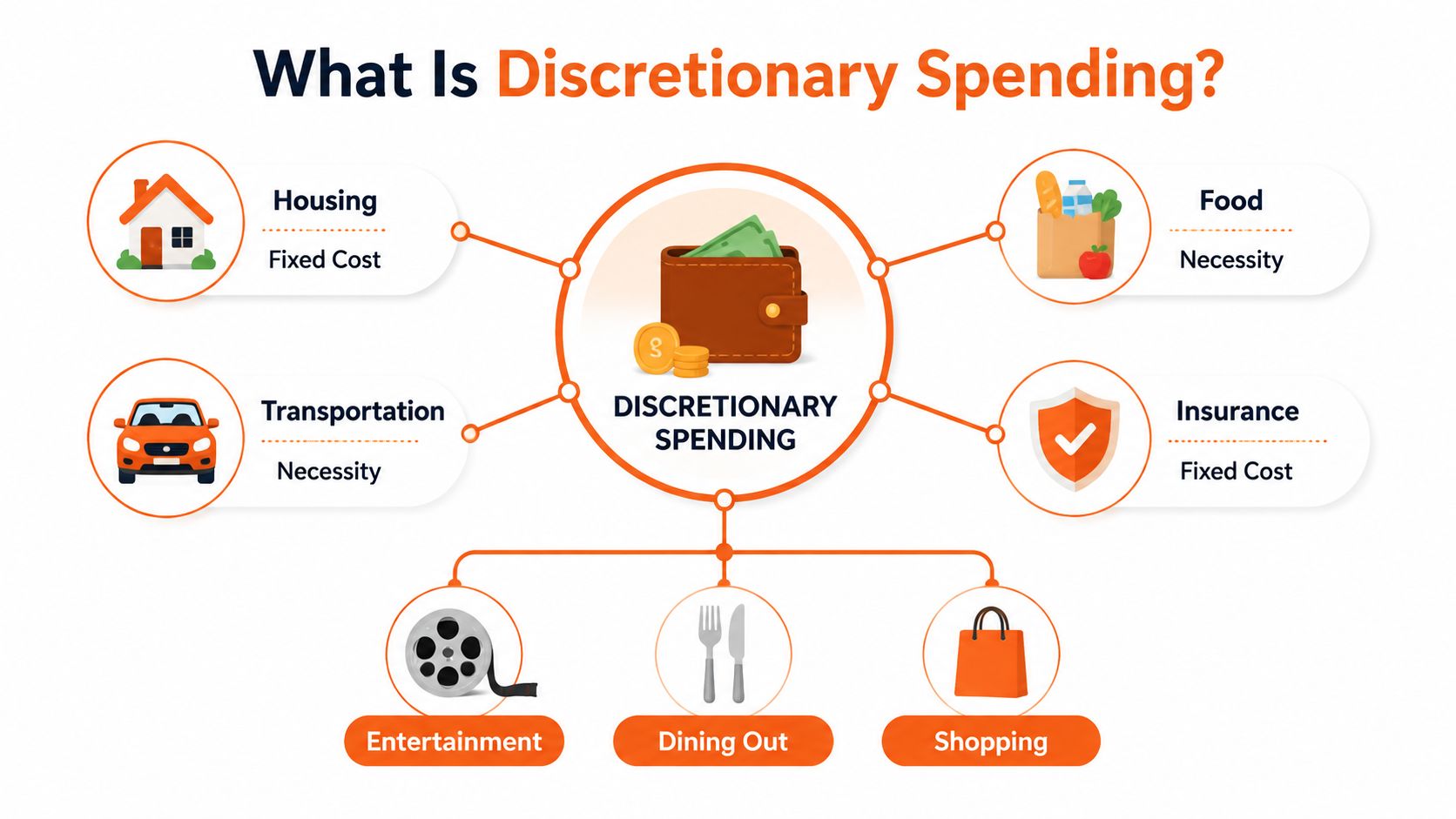
Discretionary spending is the money left after you pay for essentials such as housing, food, transportation, and insurance. It's the flexible part of your budget that you can adjust, delay, or cut when your priorities or circumstances change.
It's the end of the month, and you're looking at your bank app wondering where your paycheque went. Rent, groceries, and insurance were covered, yet takeout, streaming subscriptions, online orders, and weekend plans used up the rest. Nothing felt extravagant on its own, but the total is difficult to explain.
That situation is common because a budget becomes much clearer when you separate necessary spending from optional spending. The aim isn't to remove every enjoyable purchase. It's to understand which dollars are flexible, calculate how much room you have, and decide where that room should go.
Why Your Budget Feels Out of Control
Housing, utilities, insurance, and car payments are common expenses. The harder task is tracking what happens after those bills are paid. A restaurant meal, delivery fee, online order, streaming subscription, or unplanned shopping trip may seem minor alone, yet repeated charges can use the money intended for savings, debt repayment, or unexpected bills.
The pressure can grow even when income has not changed. Inflation raises the cost of ordinary purchases, while higher interest rates can increase loan payments and reduce the room left for flexible choices. A household may start treating restaurant meals or subscriptions differently after a rent increase, job change, or new family responsibility. The boundary between a need and a want can shift with the household's priorities.
The hidden cost of unclear categories
A subscription is optional, but its recurring charge can become easy to overlook. Groceries are necessary, while prepared meals and premium products add a flexible layer to the same trip. A phone may support work and family needs, but replacing a functioning device with the newest model is usually a choice.
Ask one practical question:
Which expenses must happen, and which expenses could be changed without putting housing, health, work, or basic household needs at risk?
Reviewing statements through this lens turns financial stress into specific decisions. Group flexible purchases, notice which triggers repeat, and set a boundary before spending begins. For more help identifying those patterns, read this guide to stopping overspending.
What Is Discretionary Spending
Discretionary spending is the money left after essential expenses are paid. It covers purchases you can usually postpone, reduce, replace, or skip, including dining out, entertainment, hobbies, holidays, premium subscriptions, and non-essential shopping.
That doesn't make discretionary spending irresponsible. A concert, meal with friends, hobby, or family outing can be a legitimate use of money. The issue starts when these choices go untracked and leave too little for savings, debt repayment, annual bills, or other priorities.
For a straightforward example, suppose your monthly take-home pay is $4,500 and your essential expenses total $3,000. Your available discretionary spending capacity is $1,500. That figure isn't automatically a target to spend. It's the flexible pool from which you might fund enjoyment, savings goals, extra debt payments, and irregular expenses.
A practical way to define it
Use three tests for each transaction:
- Could you delay it? A holiday, new clothing purchase, or restaurant booking can often move to a later date.
- Could you choose a cheaper version? A basic grocery shop may be necessary, while upgraded brands or convenience items may be flexible.
- Would skipping it create immediate harm? Missing a rent payment, insurance premium, or minimum debt payment carries consequences that skipping a hobby purchase usually doesn't.
For Canadian households, Statistics Canada's Survey of Household Spending is useful background because it measures detailed categories across regions rather than treating all spending as one simple list. In a personal budget, discretionary spending works best as a residual category based on your actual circumstances and transaction details.
Discretionary vs Non-Discretionary Spending
Non-discretionary spending usually includes contractual or survival-level costs. Examples include rent or mortgage payments, basic utilities, groceries, transportation needed for work, insurance premiums, minimum debt payments, and childcare.
Discretionary spending includes the costs that support comfort, enjoyment, convenience, or personal preference. Restaurant meals, streaming platforms, gym memberships, travel, designer clothing, hobby supplies, and impulse purchases often fall here.
The boundary isn't always obvious. A smartphone can be essential for employment, banking, and communication, but upgrading a working phone may be discretionary. Groceries are a need, but premium brands, prepared meals, and treats can add a wants component to the same receipt.
Use three decision questions
Ask whether the charge is contractual, whether stopping it would create immediate harm, and whether a lower-cost alternative exists. These questions are more helpful than relying on the merchant name alone.
| Expense Category | Non-Discretionary (Need) | Discretionary (Want) | Notes |
|---|---|---|---|
| Housing | Rent or mortgage | Larger home chosen for extra space | The required housing cost is usually essential, while an upgrade may be flexible |
| Food | Basic groceries | Takeout, delivery, premium items | One transaction can contain both needs and wants |
| Transportation | Necessary commuting costs | Optional trips or vehicle upgrades | Dependence on a vehicle varies by household |
| Insurance | Required coverage | Extra coverage chosen for preference | Review the policy before cancelling anything |
| Phone | Basic service needed for work or safety | Device upgrade or premium plan | The service and the upgrade may belong in different categories |
| Fitness | Health-related necessity in some circumstances | Gym membership or paid classes | Personal health needs can change the classification |
| Entertainment | Usually not essential | Streaming, games, concerts, and events | The amount and frequency are flexible |
| Clothing | Basic work or seasonal clothing | Designer or trend purchases | Replace worn essentials first |
Fixed costs and flexible costs can overlap, so learning how fixed expenses differ from variable expenses helps you classify a transaction without assuming that every recurring charge is a need.
How Economic Shifts Change What Counts as Discretionary
The line between needs and wants moves with inflation, interest rates, income, and household circumstances. A cost that felt comfortable in a stable period can become a serious pressure when food, housing, or borrowing costs rise.
Canadian spending data illustrates why context matters. Statistics Canada reports that, in 2023, Canadian households spent an average of $12,046 on food, $12,090 on transportation, and $20,200 on shelter in its household spending materials (Statistics Canada household spending brochure). Those categories can absorb more of a household's available income when prices or rates increase, leaving less room for travel, subscriptions, dining, and shopping.
The same release identifies recreation as a measurable category. Canadian households spent an average of $5,231 on recreation in 2023, an amount that was 23.9% higher than in 2021, according to Statistics Canada's 2023 household spending release.
| Expense Category | Stable Economy (Discretionary) | High Inflation / Rate Hikes (Non-Discretionary Pressure) |
|---|---|---|
| Groceries | Room for preferred brands and convenience items | Basic food costs take more budget space |
| Dining out | A flexible social and leisure choice | Reduced or delayed as households protect cash flow |
| Housing | Extra space or upgrades may feel manageable | Mortgage or rent pressure can crowd out other choices |
| Transportation | Optional trips and vehicle preferences | Work-related transport remains difficult to reduce |
| Travel | A planned quality-of-life purchase | Often delayed while essential costs rise |
| Childcare | A household priority that may vary | Can become unavoidable when work arrangements change |
Interest rates can also change spending behaviour. TD Economics reports that discretionary spending in Canada surged as the economy reopened in 2021, then slowed to below 5% year-over-year growth in 2023–24 as borrowing costs rose (TD Economics analysis). Your budget should therefore be reviewed when your income, household, or major monthly costs change.
How to Calculate and Track Your Discretionary Spending
You don't need a perfect category system on the first attempt. You need a repeatable calculation that shows what remains after essentials and reveals where that flexible money is going.
Follow the four-step calculation
- Total your net monthly income. Use the amount that reaches your account, not gross salary.
- List essential expenses. Include housing, utilities, insurance, minimum debt payments, basic groceries, and necessary transportation.
- Subtract essentials from income. The remainder is your potential discretionary pool.
- Compare the pool with actual transactions. Sort dining, entertainment, subscriptions, hobbies, shopping, and other flexible purchases into clear categories.
Suppose a household receives $4,500 after tax and identifies $3,000 in essential expenses. The remaining $1,500 is the starting pool. During the month, the household can separate restaurant charges from groceries, entertainment from necessary transport, and recurring subscriptions from insurance.
A worksheet can make the first review easier, especially if you prefer writing down transactions before moving them into a digital system. The Loyaltie printable planner bundle offers a fillable format for organising meal, budget, and goal information.
Track the pace, not only the total
A month-end total tells you what happened. A weekly review tells you whether your flexible budget is being used too quickly. Mark recurring charges, divide discretionary categories into realistic allowances, and check whether a purchase was planned, necessary, or merely convenient.
For more detail on reviewing transactions, use this practical method for tracking monthly spending. Manual entry can also suit people who don't want to connect a bank account, while statements and spreadsheets remain perfectly workable options.
Practical Strategies to Manage Discretionary Spending
Managing flexible spending doesn't mean removing everything enjoyable. It means choosing what matters instead of allowing every small purchase to compete for the same unprotected balance.
Give every flexible dollar a job
A familiar budgeting approach is to reserve a defined portion of income for wants, then divide that amount among dining, entertainment, shopping, and personal goals. Don't treat the framework as a law. Use it as a ceiling that prevents flexible spending from taking over money needed for essentials and priorities.
Slow down impulse purchases
Apply a 24-hour pause before buying something unplanned. Add the item to a list, check upcoming bills, and decide the next day. The pause won't block every purchase, but it creates time to distinguish genuine value from a temporary urge.
Audit recurring charges
Review subscriptions and memberships on a regular schedule. If you've kept a service because cancelling feels inconvenient, ask whether you'd choose it again today. Redirecting even one unwanted charge can create room without reducing the activities you actively enjoy.
Create a visible allowance
Use cash envelopes, a prepaid card, or a separate digital category for flexible spending. When the allowance is nearly used, you can pause, move money consciously from another goal, or wait until the next budget period.
Judge value by use
Divide a discretionary purchase by how often you expect to use it. A hobby tool used repeatedly may deliver more value than a cheaper item that sits unused. This isn't a demand for perfect maths, it's a prompt to connect spending with satisfaction.
Practical rule: Cut the purchases that add little value before cutting the activities that genuinely help you rest, connect, or enjoy your time.
Take Control of Your Spending with Fintrack
Once you've separated essentials from flexible purchases, the hardest part is keeping the categories current. Income changes, bills arrive at different times, and a period of higher rates or household pressure can make yesterday's budget unrealistic.
Fintrack's AI expense tracker can help you review categories such as dining, shopping, subscriptions, and entertainment. It supports spending visibility and can help you compare flexible transactions with the rest of your budget, whether you prefer connected accounts or manual tracking.
Start by reviewing one complete month. Look for the categories that absorb flexible money fastest, then choose one adjustment that supports your current priority. The purpose isn't restriction. It's making your spending visible enough that your choices are deliberate.
Fintrack helps you organise income, expenses, budgets, and goals in one place, with manual entry available if you'd rather not connect a bank account. Visit Fintrack to review your discretionary spending patterns and set a clearer plan for the money you can adjust.