
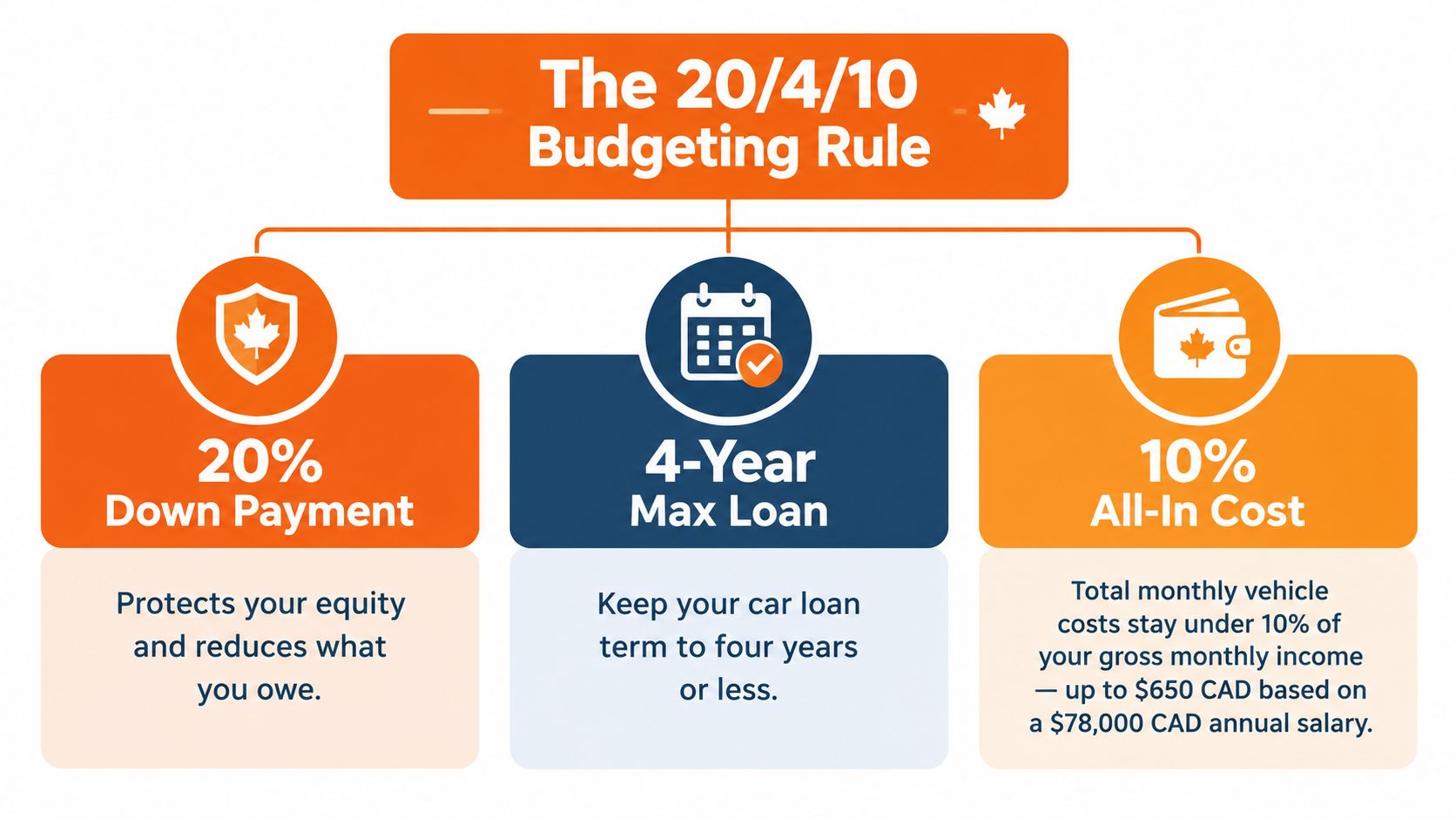
The 20/4/10 rule means putting at least 20% down, financing a vehicle for no more than 4 years, and keeping total transportation costs at or below 10% of gross monthly income. On a gross monthly income of $6,000, that creates a total vehicle-cost ceiling of $600, not a $600 loan payment.
You're standing at a dealership, the salesperson quotes a monthly payment that seems manageable, and the vehicle suddenly feels affordable. Then fuel, insurance, registration, maintenance, parking, and repairs start arriving as separate charges. The payment was comfortable, but the car wasn't.
That's the situation the 20/4/10 rule is designed to prevent. It's a budgeting screen, not a lending requirement, and it works only when you count the full cost of keeping the vehicle on the road.
The Real Cost of Your Monthly Car Payment
A car loan payment is easy to notice because it appears on a contract every month. Operating costs are less tidy. Insurance renews, fuel spending changes with your commute, and maintenance arrives in irregular amounts that can still disrupt a carefully balanced budget.
Suppose a buyer chooses a payment that fits neatly into their monthly plan. They haven't yet added insurance or fuel, so the number looks safe. After a few months, the vehicle consumes far more cash than expected, leaving less room for groceries, savings, debt repayment, and unexpected bills.

Why the payment creates a false sense of security
The monthly quote often reflects only principal and interest. It may also be based on a longer loan term, a smaller down payment, or assumptions about taxes and fees that don't match the buyer's final paperwork.
A better pre-purchase question is: What will this vehicle cost me every month when everything is included? That figure should cover:
- Financing: Principal and interest on the vehicle loan.
- Insurance: The recurring premium required to keep the vehicle legal and protected.
- Driving: Fuel, electricity where relevant, tolls, and parking.
- Upkeep: Maintenance, registration, and a reserve for repairs.
California data shows why this broader view matters. A Public Policy Institute of California analysis found that low-income households spent an average of $2,164 per year on transportation, or 13% of household budgets, while higher-income households spent $6,569, or 15%. For households using private vehicles, vehicle-related spending consumed about 19% of low-income household budgets and 16% of higher-income household budgets. The figures show that ownership and operation can push a household beyond the rule even before unusually expensive financing enters the picture.
Practical rule: Never approve a vehicle because the loan payment fits. Approve it only after the complete monthly ownership budget fits.
Before visiting a dealer, use this guide to saving money for a car to build the down payment separately from your regular spending. That makes the purchase decision less dependent on whatever payment a salesperson presents.
What the 20/4/10 Budgeting Rule Actually Means
The rule has three limits, and each one addresses a different risk. The down payment reduces what you borrow, the term limits how long the debt follows you, and the 10% ceiling protects monthly cash flow.
Start with 20% down
A 20% down payment means contributing one-fifth of the vehicle price before financing. It reduces the principal immediately, which lowers the amount on which interest accrues and gives you more equity at the beginning of ownership.
For example, if the vehicle price is $30,000, a 20% down payment would be $6,000, leaving $24,000 to finance before other costs. A larger down payment can reduce the payment further, but it also ties up cash that might otherwise support an emergency fund or another important goal.
Keep the loan to four years or less
The second limit is a maximum term of four years. A shorter term generally means a higher required payment than a longer loan, but it also limits the period over which interest accumulates and helps you repay the balance faster.
That matters because vehicles can lose value while the loan balance remains high. A buyer who chooses a longer term for payment relief may owe more than the vehicle is worth for longer.
Reserve 10% for the complete vehicle cost
The final limit is 10% of gross monthly income, before tax. Someone earning $6,000 gross per month would set a maximum total transportation budget of $600.
That $600 must include the loan payment and operating costs. It isn't a $600 payment allowance. The simplest calculation is:
- Multiply gross monthly income by 10%.
- Estimate insurance, fuel, maintenance, registration, parking, and tolls.
- Subtract those operating costs from the ceiling.
- Use what remains as the maximum finance payment.
- Check that the down payment and loan term still meet the first two limits.
This differs from a general 50/30/20 budgeting approach, which divides income across broad spending priorities. The 20/4/10 rule focuses narrowly on whether one major purchase can fit without taking over the household budget.
Breaking Down Total Cost of Ownership
The most useful adjustment is to treat the 10% limit as a small household budget with several categories, rather than as a loan-payment rule.
One California estimate places annual insurance at $1,861, fuel at $1,801, registration at $524, and maintenance at $1,158, for a total of $5,344 before financing, depreciation, taxes, and repairs. The estimate is published by MoneyGeek's analysis of car ownership costs. Those listed costs average about $445 per month, leaving only about $355 from an $800 monthly transportation ceiling for financing if the figures are representative.
That example shows why a payment-only calculation fails. A loan quote can look reasonable while insurance, fuel, registration, and maintenance have already used most of the available budget.
Fixed costs and variable costs behave differently
Insurance and registration are relatively predictable. Fuel changes with mileage, vehicle efficiency, fuel prices, and commuting patterns. Maintenance is less regular, but ignoring it doesn't make it disappear.
California insurance estimates from AutoInsurance.com's registration and insurance guide put full-coverage insurance at about $1,899 annually, or roughly $158 monthly, before fuel, maintenance, parking, registration, and tolls. California also charges a $76 original-registration or renewal fee, while the DMV notes that total registration costs vary by vehicle value, location, type, and weight.
For a household targeting $500 in total monthly transportation spending, insurance alone could use approximately 32% of the allowance, leaving about $342 for the loan payment and every other operating cost. That isn't an argument against owning a car. It is an argument for getting an insurance quote before choosing the vehicle.
A practical worksheet should separate the costs like this:
| Category | What to estimate |
|---|---|
| Fixed ownership | Insurance and registration |
| Variable driving | Fuel, tolls, and parking |
| Upkeep reserve | Maintenance and repairs |
| Financing | Principal and interest |
California location also changes the result. Research from San Jose State University reported average annual transportation costs of about $6,804 for transit-oriented-development households and $11,332 for non-transit-oriented households. Those amounts represented approximately 10% and 17%, respectively, of the 2010 California median household income of $66,605. The study found that, among transit-oriented households, roughly 52% of transportation spending came from vehicle ownership, 43% from vehicle operation, and 6% from transit use.
For a practical discussion of reducing the ownership burden, this budget-friendly car guide is useful alongside your own estimates. You can also use categories of expense to organise the budget so irregular maintenance doesn't get confused with ordinary monthly spending.
How Loan Terms Impact Your Long-Term Affordability
A longer loan solves one problem, the required monthly payment, by creating another, the total cost and length of the debt.
California credit-union rate tables show new-auto APRs ranging from 4.64% to 13.64% for terms up to 60 months and 4.89% to 13.89% for terms up to 72 months. The same table lists payments of $18.71 to $23.08 per $1,000 financed at 60 months, compared with $16.05 to $20.55 at 72 months, as shown by California Credit Union's auto-loan rate table.
At the listed minimum rates, financing $30,000 would cost approximately $562 per month for 60 months versus $482 for 72 months. The 72-month option lowers the displayed payment, but it requires 12 additional payments and increases total interest. A 20% down payment would reduce the financed principal to $24,000, lowering both the payment and the risk of owing more than the vehicle is worth.
Compare the payment with the debt timeline
The four-year limit forces a useful question: can the household afford the vehicle without relying on a long repayment schedule? If the answer is no, the vehicle may be too expensive, even if the lender approves the application.
Long terms can also delay equity. If the vehicle depreciates faster than the loan balance falls, selling or replacing it may require cash to cover the difference. The buyer has traded immediate payment relief for reduced flexibility later.
A sensible comparison includes:
- 48 months: Higher required payment, less time accruing interest, and a faster path to ownership equity.
- 60 months: Lower payment than the four-year option, but outside the rule and more expensive over the full term.
- 72 months: Lower displayed payment again, with an even longer period of interest exposure and negative-equity risk.
The same principle applies in Canada. The Financial Consumer Agency of Canada's guidance on long-term car loans defines long-term auto loans as terms of 72 months, or six years, or longer. It warns that interest can cost more overall because it accumulates for longer, and explains that negative equity occurs when the vehicle is worth less than the outstanding loan balance.
The lowest monthly payment isn't automatically the cheapest option. It may simply spread the cost across more of your future.
Before applying, review how different terms affect your broader borrowing profile with this credit application guide. The useful comparison isn't just whether the lender says yes. It's whether the payment, interest, and ownership timeline leave enough room for the rest of your financial life.
Is the 20/4/10 Rule Right for Your Budget?
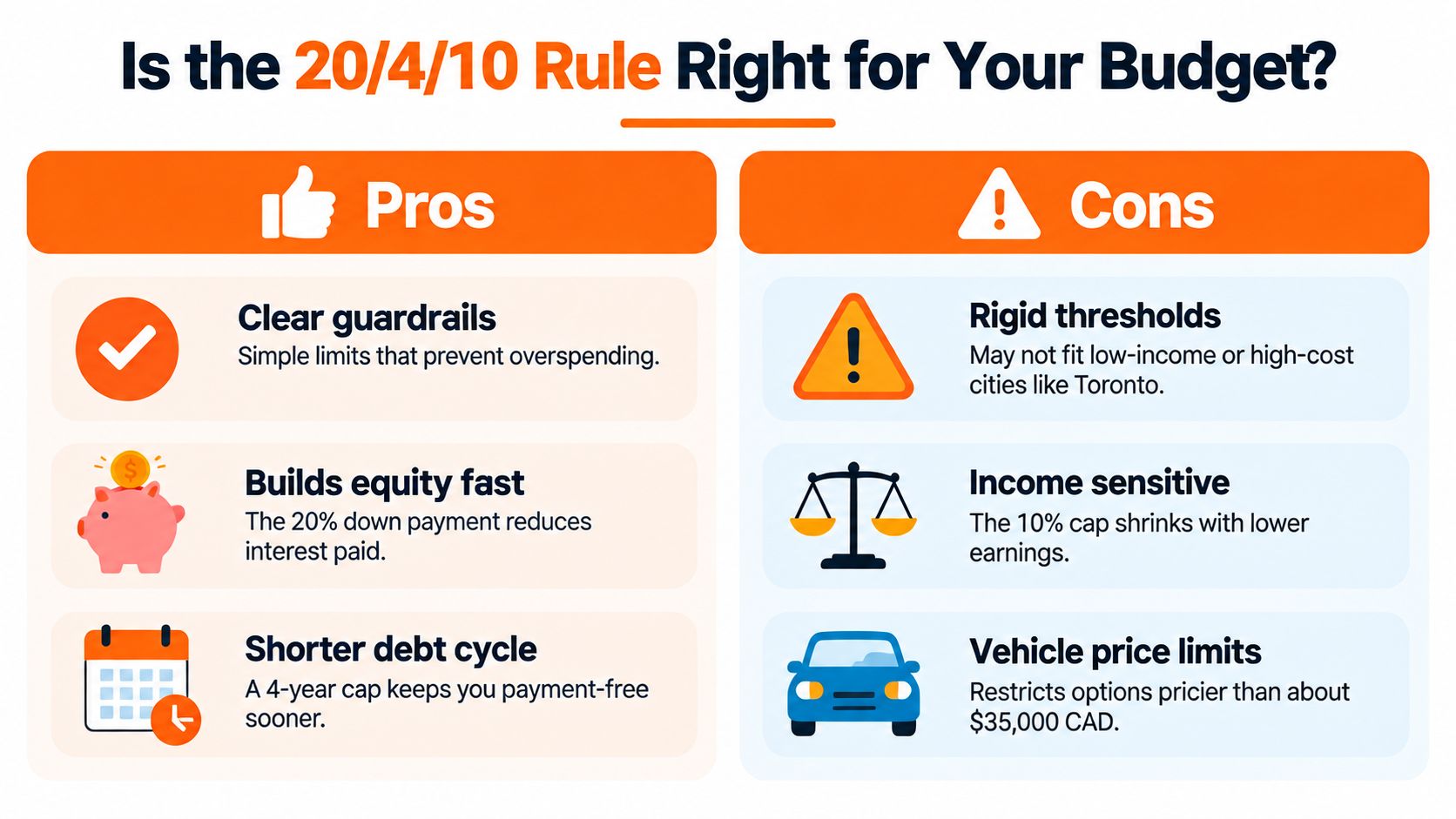
The rule works best as a conservative starting point. It gives buyers a clear boundary before emotions, dealer incentives, or a preferred vehicle turn the decision into a payment negotiation.
It can also be too rigid if applied without context. A household in an expensive city, a driver with a long commute, or someone who has no practical transit alternative may face costs that make the benchmark difficult even with a modest vehicle. The right response isn't automatically to ignore the rule. It is to identify which constraint is causing the problem.
When the framework is useful
The rule is particularly helpful when:
- You have stable income: A consistent gross monthly income makes the 10% ceiling easier to monitor.
- You're comparing several vehicles: The limits keep a higher-priced model from winning solely because the dealer extends the term.
- You're buying used: A lower purchase price may make the down payment and shorter term more realistic, though repair and financing costs still require separate estimates.
- You're protecting other goals: A firm vehicle ceiling leaves more room for emergency savings, housing, and debt repayment.
The framework is less comfortable when the vehicle is essential for work and alternatives are limited. In that situation, calculate the actual cost of the commute and consider whether a less expensive vehicle, a different location, carpooling, or a larger down payment changes the equation.
Turn the rule into a monthly decision
Start with the 10% ceiling, then subtract operating costs before looking at vehicle prices. If the remaining payment is too low for the vehicle you need, adjust the vehicle price or down payment before extending the term beyond four years.
| Decision | What works | What doesn't |
|---|---|---|
| Down payment | Save at least 20% while preserving necessary cash reserves | Emptying your emergency savings to reach the target |
| Loan term | Choose the shortest term that fits the complete budget | Selecting six or seven years only to reduce the quote |
| Vehicle cost | Match the purchase to income, mileage, insurance, and upkeep | Treating a lender's maximum approval as your budget |
| 10% ceiling | Count payment and operating expenses together | Counting only principal and interest |
Vehicle prices and loan structures can also make the rule demanding. A 2025 California estimate put the average new-vehicle price at $49,611, 26.7% above 2019 levels, while the average car-loan rate was reported around 7%. The same source reported that loans lasting 84 months or longer represented 22.9% of financed new-car purchases in the United States in the first quarter of the reported year, an all-time high, as described by The San Diego Union-Tribune. Those conditions don't make the rule obsolete. They make it a deliberate trade-off between vehicle choice, cash, term, and risk.
Implementing the Rule with Fintrack
The easiest way to use the rule is to turn it into categories you can review before and after buying.
- Set the ceiling. Calculate 10% of gross monthly income and record it as the maximum transportation budget.
- Create separate categories. Track financing, insurance, fuel, registration, parking, maintenance, and repairs independently.
- Test the purchase scenario. Add the expected payment to the operating estimates, then check whether the complete total remains within the ceiling.
- Track the down payment. Create a goal for the 20% contribution rather than treating it as money that can be spent elsewhere.
- Review actual spending. Compare real fuel and maintenance costs with the estimates after each month.
Fintrack supports manual entry without requiring a bank connection, which can be useful when you want to test a vehicle budget before linking financial accounts. Set up the categories and goals in Fintrack's budget planning feature, then use the resulting view to decide whether the vehicle fits your household rather than relying on the dealer's payment quote.
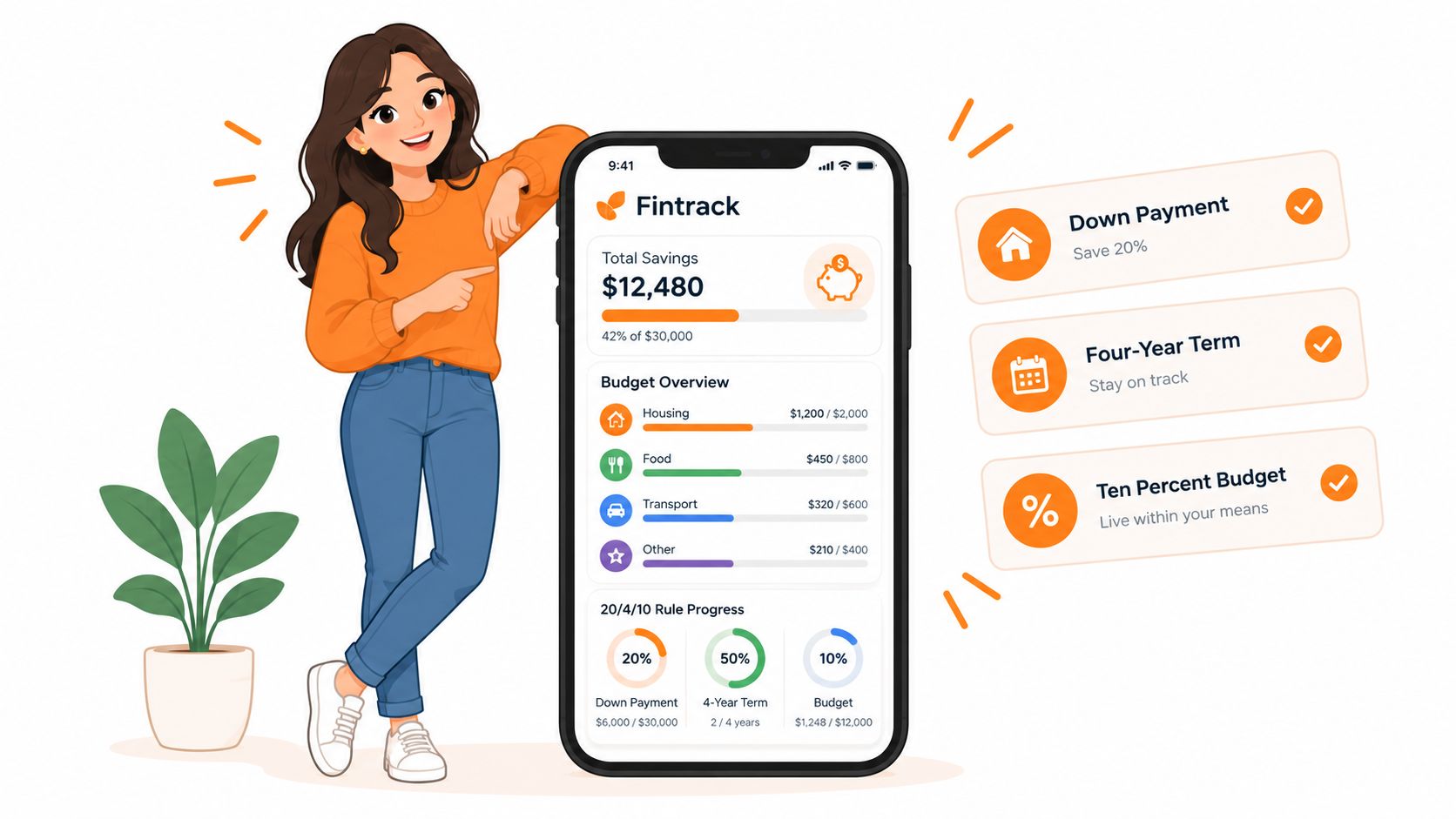
The rule is most useful when it remains visible after the purchase. A vehicle can pass the initial test and still become expensive if mileage rises, insurance changes, or maintenance arrives sooner than expected.
Fintrack lets you organise the full vehicle budget, including the payment, insurance, fuel, maintenance, and savings for the down payment, in one place. Visit Fintrack to build a realistic 20/4/10 plan before you commit to your next car.