
You're staring at an application page, the offer looks decent, and one nagging question keeps getting in the way, what happens if you hit submit right now? A lot of people treat a credit application like a quick form. In reality, it's the point where a lender starts checking whether your income, debts, identity, and recent borrowing behaviour line up well enough for approval.
That's why the weeks or days before you apply matter so much. If you walk in prepared, you're not guessing your way through the process, you're showing the lender a file that's easier to review and easier to trust.
What a Credit Application Actually Is
A credit application is a formal request for borrowed money or a revolving account, and it can be as simple as a credit card form or as detailed as a mortgage file. The moment you submit it, the lender usually starts a financial review, not just a paperwork check. That review is about whether you can repay, whether the account fits the lender's rules, and how much risk they think they're taking on.
Take someone applying for a first serious credit card. They might think the decision rests mostly on score, but the application also asks about income, housing costs, and identity details. A mortgage or auto loan goes further, because the lender is trying to understand the payment you can sustain, not just whether you have a decent score.
Personal and business applications work differently too. Household credit usually focuses on the applicant's own income, debts, and history, while business credit looks at the company's financial health and documentation in addition to the owner's profile. The U.S. Census Bureau's Annual Business Survey shows that business credit demand and outcomes both shifted after the pandemic, which is a reminder that lenders respond to broader conditions, not just one number on a bureau file. The share of employer firms that applied for new credit fell from 14.3% in 2020 to 13.0% in 2023, and the share receiving all the credit they asked for rose to 57.2% in 2023 from 54.9% in 2020 (U.S. Census Bureau).
Practical rule: A strong application is usually less about “perfect credit” and more about whether your file tells a clear, consistent story.
That's why preparation matters. If your income, debts, and documents don't line up, the lender has to slow down, ask follow-up questions, or turn you down.
Types of Credit Applications and How the Process Works
A credit application usually follows the same broad path, even when the product changes. You submit the form, the lender checks identity, pulls credit data, reviews income and debts, then decides whether to approve, decline, or ask for more information. The details change by product, but the logic stays the same.
Personal credit applications
Credit cards are usually the quickest and lightest application. They tend to ask for your name, address, income, and tax ID, then the issuer verifies what you entered and checks your credit file. Mortgage and auto loan applications take longer because the lender is evaluating the payment amount, collateral, and your ability to carry the debt over time.
A mortgage file often includes the most detailed review because the lender has to confirm both your repayment capacity and the property-related risk. Auto lenders are somewhere in between, since the vehicle acts as collateral but the decision still depends heavily on income and existing obligations. Personal loans can be fast or slow depending on whether the lender wants simple self-reported information or full document uploads.
Business credit applications
Business credit applications usually ask for company registration details, business financials, and sometimes a business plan or cash-flow projection. The lender wants to know whether the company generates enough consistent revenue to support the requested credit. That's different from a consumer file, where the focus is more on personal debt and household income.
What happens during the review
The review generally starts with identity verification. In Canada, an applicant must verify identity with two pieces of identification, including at least one piece of picture identification, and a personal application often asks for an address, date of birth, and social insurance number (Alberta credit applications guide). After that comes the credit check and underwriting review.
If the lender can't verify who you are, the file usually doesn't move forward.
That's why getting your paperwork ready before you apply saves time. It also reduces the chance that a lender pauses the file while waiting for another document.
For readers comparing paperwork before they start, a commitment letter for mortgage basics can help make the approval stage feel less mysterious.
Hard Inquiries vs Soft Inquiries and Your Credit Score
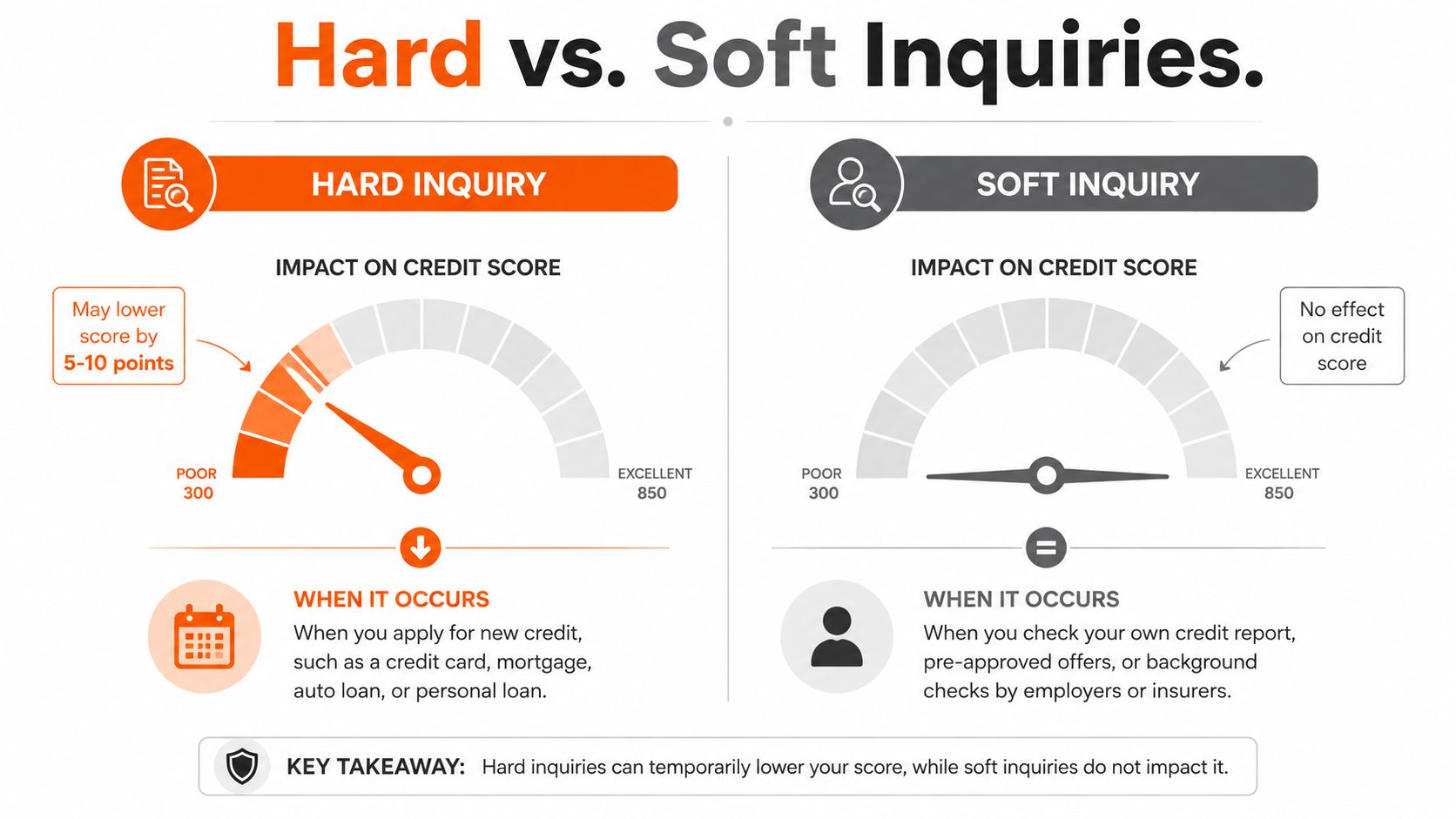
A hard inquiry happens when a lender checks your full credit report to make a lending decision. A soft inquiry happens when you check your own report, a lender pre-qualifies you, or a third party runs a background-style review that isn't tied to a new credit decision. The difference matters because one can affect your score and the other can't.
Credit scoring models treat hard inquiries as a signal that you may be taking on new debt. That doesn't mean every inquiry is a problem, but too many in a short period can make you look more credit-hungry than you really are. Soft inquiries don't carry that signal, so they're useful when you want to compare options before you commit.
When each one shows up
A hard inquiry usually appears when you submit a new application for a credit card, loan, mortgage, or auto financing. A soft inquiry can happen when you look at your own credit, when a lender pre-screens you, or when you're checking whether you're likely to qualify before you apply. If you're uncertain, ask whether the review is a full application pull or a pre-qualification pull.
The timing matters too. Mortgage and auto lenders often treat multiple similar applications in a tighter window more leniently than card issuers do, because shoppers are usually rate-shopping rather than opening several unrelated accounts. Credit card applications are less forgiving because each one can signal new revolving debt on top of existing balances.
If you're trying to understand how your existing balances affect the picture, a credit utilisation calculator guide can help you see how card use affects the rest of the file.
What to avoid before you apply
Don't submit applications casually if you're close to a major borrowing decision. A few unnecessary hard inquiries won't wreck a strong file, but they can add friction. If you're comparing offers, use pre-qualification where possible, because that's the safer way to shop.
Practical rule: If you don't need the credit right now, don't let curiosity turn into a hard pull.
That simple habit can keep your file cleaner when the application happens.
Documents Lenders Require and Why Each One Matters
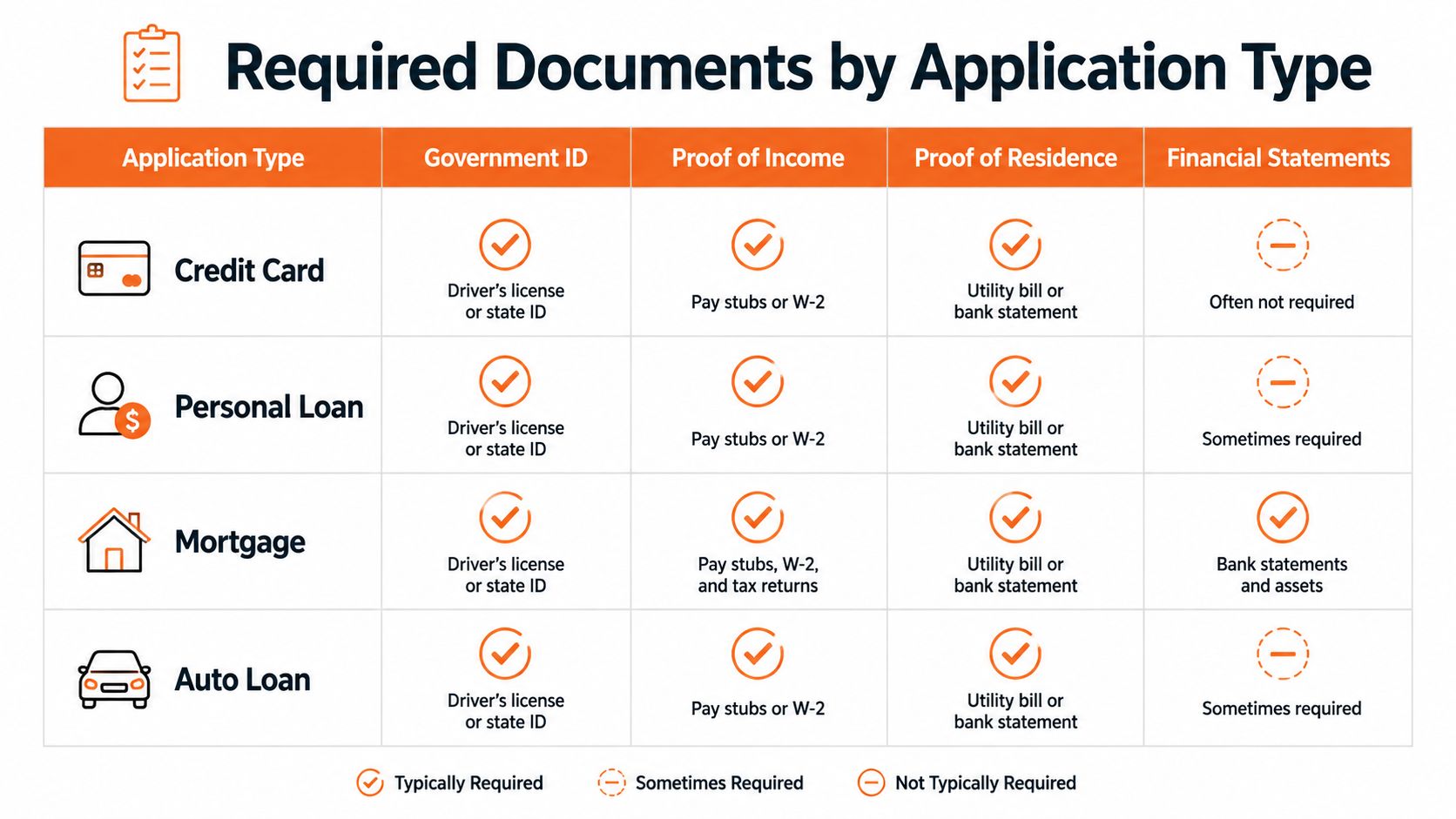
Lenders ask for documents because they're trying to confirm three things, who you are, what you earn, and whether the debt fits your finances. If those answers are unclear, the file slows down quickly. That's why a strong application isn't just about filling in blanks, it's about matching the story on the form with the proof behind it.
Personal applications
For a consumer application, the usual starting point is government-issued identification. Many lenders also ask for proof of income, like pay stubs, tax returns, or bank statements, because they want to see ongoing repayment capacity. If you have other debt, the lender may also look for details that show how much of your income is already committed.
A useful way to think about it is this, the lender isn't just asking whether you have money. It's asking whether your money arrives reliably, whether it leaves room for a new payment, and whether the file can be verified without guesswork.
Business applications
Business credit asks for more than personal income. Expect requests for business registration documents, financial statements, and sometimes a business plan if the lender needs to understand how the company earns and spends. For a small business, the file often needs both the company's numbers and the owner's personal support data.
If you're pulling together tax records or transcripts, the Allied Tax Advisors transcript guide is a practical reference for getting that part organised before the lender asks.
Younger applicants and income rules
U.S. applicants under 21 have a separate issue to think about. Chase says applicants must be over 18 and have either an SSN or ITIN, and those under 21 need a co-signer or proof of income under the Credit CARD Act framework. Discover similarly says you can apply at 18, but if you're under 21, you must show your own source of income that doesn't include another person's income or assets (Chase credit card application basics).
That rule catches a lot of first-time applicants off guard. If you're applying young, the lender wants to see that you can support the account without relying on a parent's money unless the product specifically allows a co-signer arrangement.
For borrowers who want a broader document checklist, annual gross income basics can help you separate the income you should include from the money that doesn't usually count.
Common Rejection Reasons Beyond Your Credit Score
A good credit score helps, but it doesn't guarantee approval. Lenders look at the full application, and sometimes the issue has nothing to do with score at all. The most common problem is that the file doesn't leave enough room for the new payment once existing obligations are counted.
What often goes wrong
High debt relative to income can make a lender hesitate, even when the score looks fine. Insufficient income for the requested limit, too many recent applications, short credit history, and errors on the report can all weaken the file. Employment instability can do the same thing, especially when the lender wants predictable cash flow.
For Canadian mortgage applicants, the Mortgage Stress Test is a major hurdle because applicants must qualify at the higher of the Bank of Canada benchmark rate or their contract rate plus 2 percentage points (Mortgage Stress Test technical rule). That means the maximum borrowing capacity can shrink even if the applicant's current payment looks manageable. It's a built-in affordability check, not a reflection of whether the borrower is responsible.
How to figure out what's hurting you
Start by asking which part of the file looks tightest. If your income is steady but balances are high, debt load is probably the problem. If your income is strong but your credit history is thin or your report has errors, the issue may be file quality rather than capacity.
The denial letter rarely tells the whole story, so you need to read the file like an underwriter would.
That means checking for mismatched income figures, outdated employment information, and debts that weren't fully accounted for.
If you've had a recent account go bad, a delinquent account explanation can help you sort out whether the account is still affecting how lenders read your profile.
Practical Tips to Improve Your Approval Chances
The best time to improve your chances is before the application goes in. Small clean-up steps often make the file easier to approve than trying to explain problems after the fact. Start with the items that directly affect the lender's risk view.
Focus on the parts that move the file
- Pay down revolving balances: Lower card balances can improve how your file looks because lenders see more breathing room between income and debt.
- Check your credit report for errors: Wrong balances, wrong account status, or accounts that don't belong to you should be disputed before you apply.
- Leave space between applications: If you're preparing for a major loan, avoid piling up new hard inquiries unless you need them.
- Keep payments consistent: A steady on-time history is easier for lenders to trust than a file with gaps and exceptions.
- Organise income and expense records: Clean statements make it easier to show how money moves through your accounts.
There's also growing room for applicants with thin files or limited bureau history. Lenders are paying more attention to cash-flow data and alternative signals when traditional scoring leaves gaps, especially for people whose credit profile doesn't fully show recurring income or bill payment patterns. That doesn't mean every alternative data source helps, only that the file can be stronger when the lender can see the full picture.
For people rebuilding after setbacks, a secured card credit-building guide is useful background on how a simpler product can support a cleaner profile over time.
Use your budget as application prep
A budgeting tool can show whether your monthly spending leaves enough room for the payment you want to take on. It can also reveal subscriptions, duplicate charges, and categories where you're leaking cash without noticing. That matters because lenders care about whether your cash flow looks stable, not just whether you can quote a decent income figure on a form.
If you've found collection accounts that are still dragging on your file, how to remove collection items from your credit report is a helpful next read before you submit anything.
Your Pre-Application Checklist
The strongest applications usually look boring in the best way. The numbers line up, the documents are ready, and the lender doesn't have to wonder whether a missing detail will surface later. If you want a simple workflow, use this sequence before you submit.
A practical order to follow
- Review your credit report: Look for errors, old balances, and accounts that don't belong to you.
- Measure your debt load: Compare your monthly obligations with your income so you know whether the new payment fits.
- Gather your documents: Have ID, income proof, and any extra records ready before you start.
- Reduce revolving balances: Bring down card usage where you can, especially if you're close to a limit.
- Pause unnecessary applications: Give your file a quiet period so you're not stacking avoidable hard inquiries.
- Check your cash flow: Make sure your monthly spending still leaves room for the payment.
- Confirm the application details: Match your form entries to your documents so nothing conflicts.
A useful habit is to treat the application like a file review, not a gamble. That's especially true for small business owners and self-employed applicants, because lenders often want cleaner records before they'll trust irregular income. For owners pursuing government-backed financing, a GoSBA Loans 7(a) guide can help you understand why preparation and documentation matter so much in that process.
Final check: If a lender asked you to explain every line of the application, could you do it without scrambling?
If the answer is yes, you're probably ready to apply. If not, give yourself a few more days to fix the weak spots before you submit.
A careful credit application starts with knowing what lenders see, what they ask for, and where files usually get held up. If you want a clearer view of your spending, balances, and monthly room for a new payment, Fintrack can help you review the numbers before you apply and keep your finances organised in one place.