
You check your banking app on a Sunday night, and the number on the screen feels off. Maybe a restaurant charge shows up twice, a subscription renewed earlier than you expected, or a refund is still sitting there as pending when you thought it would already be back in your account.
That uneasy moment is exactly where account reconciliation starts to matter for personal finance. It's the habit of comparing what you think happened with what your bank, card issuer, or other statement says happened, so small mistakes don't sit around and turn into bigger surprises later.
The Night You Notice Something Doesn't Add Up
The first clue is usually ordinary, not dramatic. You scroll through transactions, spot a charge you don't recognise, then remember it might be a hotel hold, a tip that posted later, or the second half of a split payment.
That's why spending trackers are so useful, especially when they make it easy to spot patterns before month-end. If you want a simple companion to this habit, the NomadCards spending tracking guide is a helpful reference for seeing how transaction review can stay practical instead of becoming a spreadsheet project.
Why that moment matters
Once you notice the mismatch, the goal isn't to panic. It's to slow down and ask a few basic questions: did I spend this, did it post late, or is something wrong?
Practical rule: if the number looks off, don't assume fraud first. Check timing, duplicates, and whether the merchant name changed before you worry.
That simple pause saves a lot of stress. It also turns reconciliation from a once-a-year accounting chore into a normal money habit, the same way brushing your teeth is easier than fixing a cavity later.
A lot of people already do a rough version of this without calling it reconciliation. They glance at balances, notice odd charges, and compare a statement against their memory of what they bought.
The difference is that a proper habit gives you a repeatable method. Instead of relying on memory, you compare records in a calm, organised way and deal with differences while they're still easy to explain.
What Account Reconciliation Actually Means
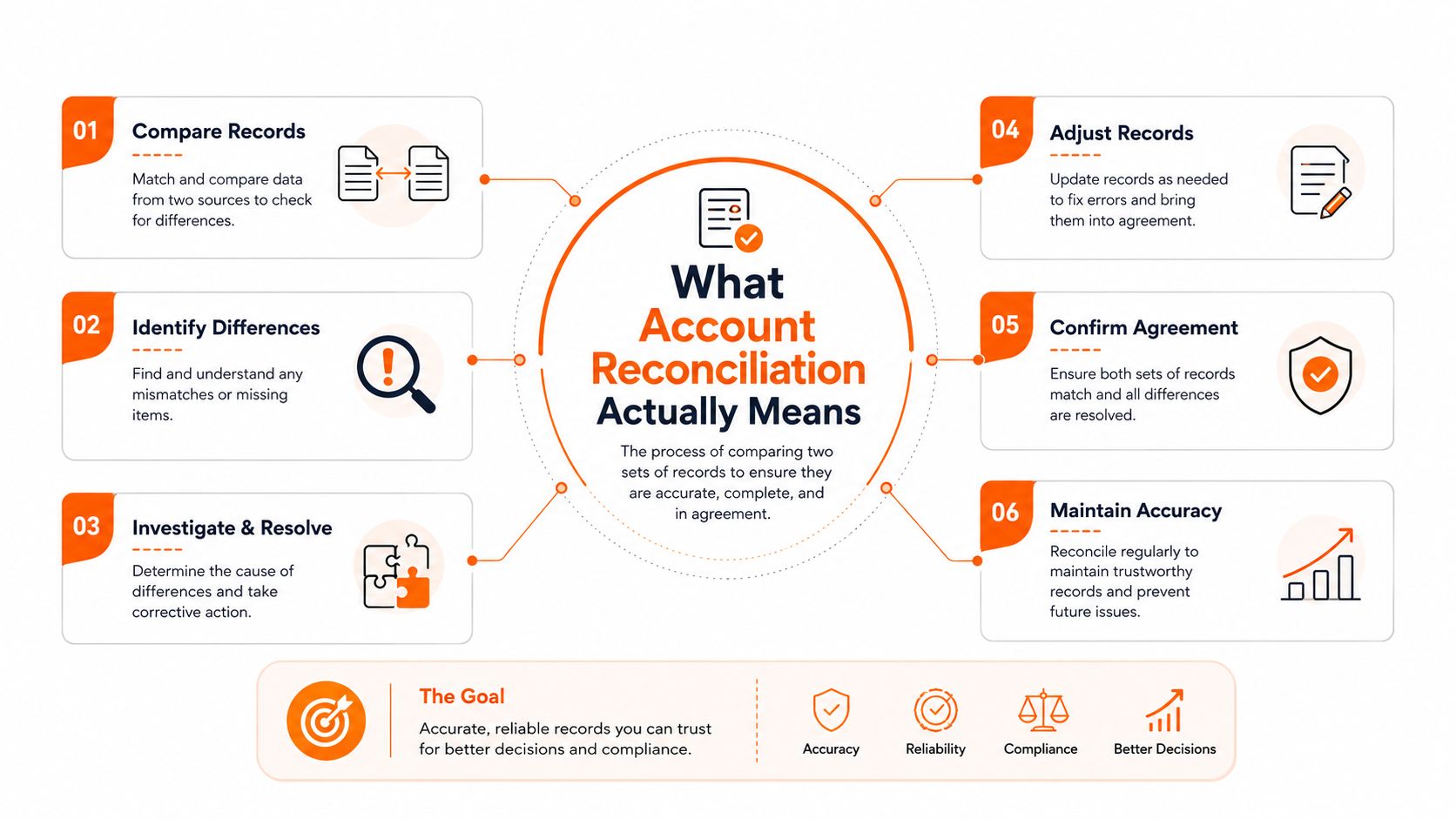
Account reconciliation means matching your own records of money in and out against an independent source, such as a bank statement or credit card bill, then resolving the differences. In plain terms, it's like checking your shopping list against what landed in the cart.
Your side of the comparison might be a notes app, a budget app, or a list of transactions you saved from your banking history. The other side is the official statement from the bank or card provider, which acts as the external reference point.
Matching is only half the job
The useful part of reconciliation isn't just finding differences. It's proving that each difference has a reason, and that the reason is understood and documented.
If the numbers still don't match, the work isn't finished. The explanation needs to be as clear as the balance itself.
That's why reconciliation is both a matching exercise and a control exercise. A missing charge might be a late settlement, or it might be a merchant error, and the process helps you tell those apart without guessing.
For people who want to see how this looks in a more formal setting, the journal entry examples for accruals offer useful context on how accountants explain timing and adjustments. The personal finance version is simpler, but the logic is the same, compare, explain, and keep proof.
If you can explain reconciliation in one sentence, make it this one, you compare your own record against an outside record until every difference is either fixed or clearly understood.
Why Personal Finances Need Reconciliation Too
Personal accounts get messy in ways that feel small until they pile up. A streaming service renews on a different day, a grocery store posts a final amount after the card hold disappears, or cashback shows up in the app but not where you expected it.
The point of reconciliation is to catch those gaps before they distort the rest of your money decisions. If your spending records are wrong, your budget, savings targets, and “safe to spend” number all start drifting too.
The everyday mistakes that are worth checking
- Pending charges that later change: A café or hotel may place one amount at authorisation and another at settlement, so the first number isn't the final one.
- Duplicate-looking transactions: A hold and a posted charge can look like two purchases when only one final payment really exists.
- Rewards and credits that drift: Cashback, loyalty points, and merchant credits can land later than the original purchase, which makes the record look incomplete for a while.
- Transfers between your own accounts: Money moved from chequing to savings can look like spending unless you label it correctly.
That's where reconciliation becomes a budgeting tool, not just an accuracy check. The cleaner your transaction list, the easier it is to trust your monthly totals and spot a real problem quickly.
If you keep a dashboard for your money, this habit belongs there. A good starting point is a personal finance dashboard overview, because that's where balances, spending, and account activity start to make sense together.
A Clear Step-by-Step Reconciliation Workflow
The easiest way to do this is to follow the same order every time. Start with one account, one statement period, and one cutoff date, then stick to that window so new transactions don't sneak in while you're comparing.
A simple monthly flow
- Choose a cutoff date. If you're working on March, don't mix in April transactions just because they already appear in your app.
- Gather both sides. Pull the bank or card statement and your own transaction list, notes, or expense tracker.
- Match line by line. A grocery purchase, a gas station charge, or a transfer should appear on both sides in the same period.
- Flag anything unmatched. Put pending refunds, card holds, and unfamiliar merchants into a separate list.
- Investigate the cause. Check whether the item is a timing delay, a duplicate, or a real error.
- Record the resolution. Note whether you corrected the amount, moved the transaction, or confirmed that it was legitimate.
- Store the evidence. Keep the statement, notes, and any receipts together so you can revisit them later if needed.
The general ledger reconciliation guide from Book Tech LLC is a useful comparison point if you're curious how formal accounting teams think about the same process. Personal reconciliation follows the same logic, but with fewer moving parts and a lot less jargon.
The shortest way to keep this sane is to work in the same order every time. That way, you're not rediscovering the process each month, you're just repeating it.
Transaction history becomes much more useful once you treat it as a record to review, not just a list to scroll through. That one shift makes the workflow faster and easier to trust.
Types of Personal Accounts You Should Reconcile
Not every account needs the same attention. Some move constantly and deserve frequent checks, while others change slowly and can wait a bit longer.
| Account type | Suggested frequency | What to watch for |
|---|---|---|
| Chequing account | Monthly | Deposits, bill payments, transfers, and fees |
| Savings account | Monthly | Interest postings, transfers, and missing deposits |
| Credit card | Weekly or biweekly | Pending holds, tips, refunds, and duplicate-looking charges |
| Investment account | Quarterly | Dividend reinvestments, trade settlement timing, and transfer mismatches |
| Rewards or cashback account | Quarterly | Credits that post late, expired offers, and balances that don't match receipts |
| Shared or household account | Monthly | Transfers between people, split bills, and shared subscriptions |
A practical way to think about frequency
If money moves through an account often, reconcile it often. If the balance is stable and the activity is light, a slower review is usually enough.
The benchmark data for businesses gives a useful reference point here. One study found that 63% of U.S. companies had 100 to 500 active accounts, while another 30% had 501 to 3,000, and 83% reconciled 100 to 500 accounts at least quarterly (resourcefulfinancepro.com). That's corporate data, but the underlying lesson applies to households too, more accounts mean more places for a mismatch to hide.
For shared money, the simplest rule is to keep the same cadence as personal accounts and add a second set of eyes. One person can prepare the review, and the other can sanity-check the totals before they're accepted.
Common Reconciliation Errors and How to Fix Them
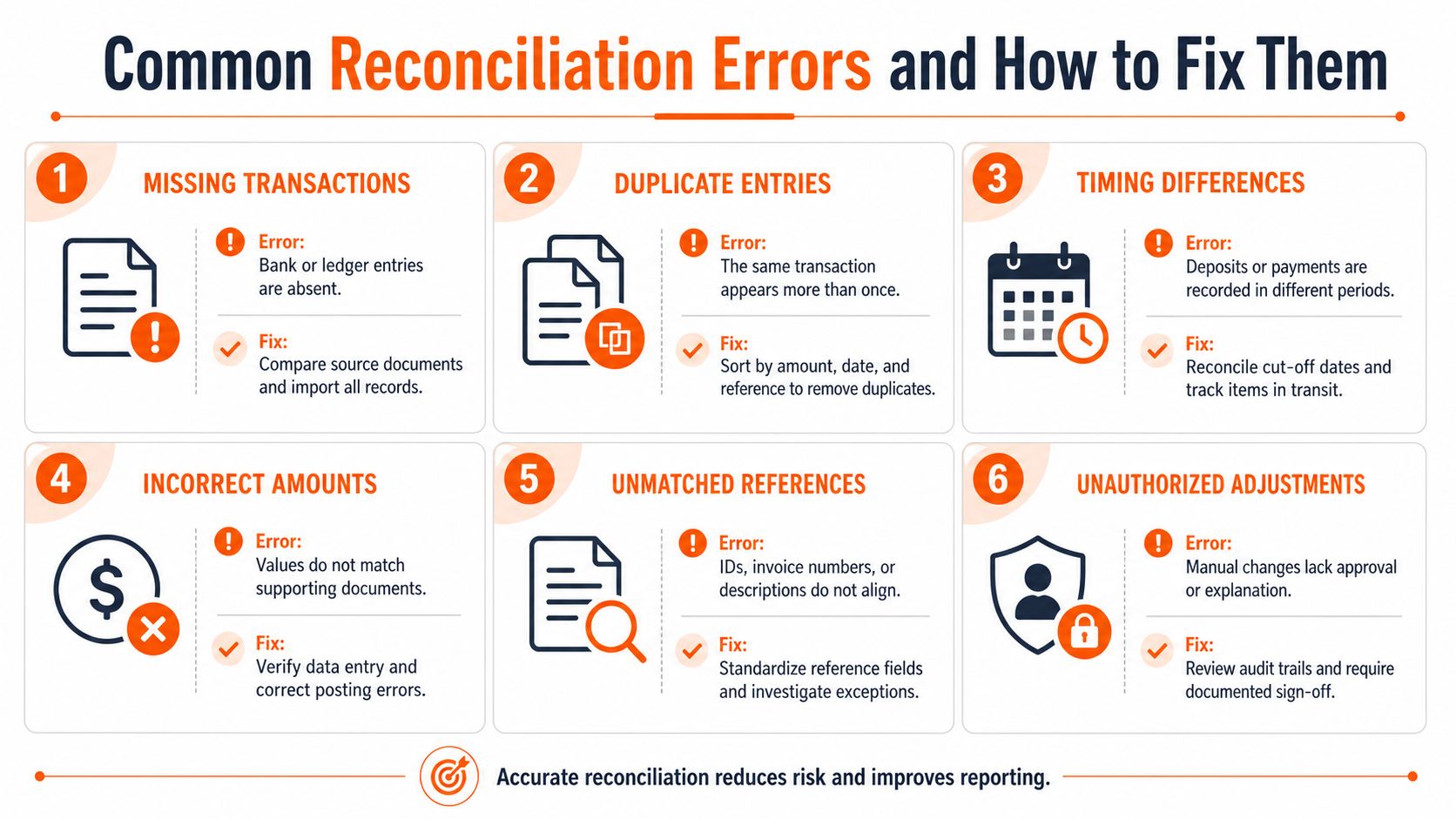
Most mismatches look worse than they are. In everyday personal finance, the issue is usually timing, categorisation, or a transaction that was recorded differently on each side.
The patterns that show up most often
- Timing differences: A pending charge, delayed refund, or late-posting subscription can make the statement and your records look out of sync. Fix: wait for posting, then match the final amount.
- Duplicates: A hold and a settled charge can look like two transactions, or a subscription can renew twice if the first payment failed. Fix: confirm which item is an authorisation and which one is final.
- Data drift: Merchant names change, app categories mislabel a purchase, or a rewards entry lands under a different description. Fix: search by amount and date instead of merchant name alone.
- Human entry errors: A typo, missed note, or transfer mislabelled as spending creates a false mismatch. Fix: compare the receipt, date, and account destination before changing the record.
The best part is that most of these are not emergencies. They're the normal messiness of digital payments, especially when cards, apps, and banking systems don't post at the same speed.
If you keep receipts, the cleanest habit is to store them where you'll find them. A guide to organising receipts makes that easier, and it pairs well with reconciliation because support documents matter when you need to explain a mismatch later.
A quick mental check helps too. If the amount is right but the description is odd, it's probably categorisation. If the description is familiar but the timing feels off, it's probably a posting delay.
How Automation and Fintrack Simplify Reconciliation
Manual reconciliation still works, but it can start to feel slow once your spending is spread across cards, apps, subscriptions, and cashback rewards. Automation removes the repetitive matching work, so you can focus on the few transactions that need a human decision.
For personal finance, that means imported transactions can be sorted into groups, recurring merchants can be recognised, and unusual items can be flagged before you scroll through the whole list. The market for account reconciliation software is already large and still expanding, with one report placing it at USD 3.9 billion in 2025 and projecting USD 9.4 billion by 2034 at a 9.99% CAGR, while another projects USD 2.75 billion in 2025 growing to USD 7.10 billion by 2033 at 14.4% CAGR. North America holds over 35.6% of the market in one report, which shows how much finance teams value automation in mature markets (IMARC Group).
What a good tool should do for you
A solid app should help you see recurring charges, match transactions faster, and surface surprises without forcing you to comb through every line manually. In Canada, that matters even more because consumer banking is highly digital, the Canadian Bankers Association says 97% of Canadians bank online or on mobile and Canadians made more than 20 billion electronic transactions in 2023 (Numeric's account reconciliation overview).
Fintrack fits that kind of routine because it centres transaction tracking, AI categorisation, real-time spending alerts, and subscription detection. It also includes a Benefits Wallet for cashback, credits, and loyalty value that can slip past a manual review, and it works without a bank connection with manual entry support, which gives Canadian users a privacy-friendly option when they want one. The AI transaction matching feature helps connect those scattered pieces so you can check them against your statement faster.
The win isn't doing reconciliation faster just for the sake of speed. It's turning a messy month-end task into a short, regular check that fits into normal life.
If your money already lives across multiple cards and apps, automation keeps the review from becoming a chore. It does not replace judgement. It narrows the list to the few items worth your attention.
Your Monthly Reconciliation Checklist and Best Practices
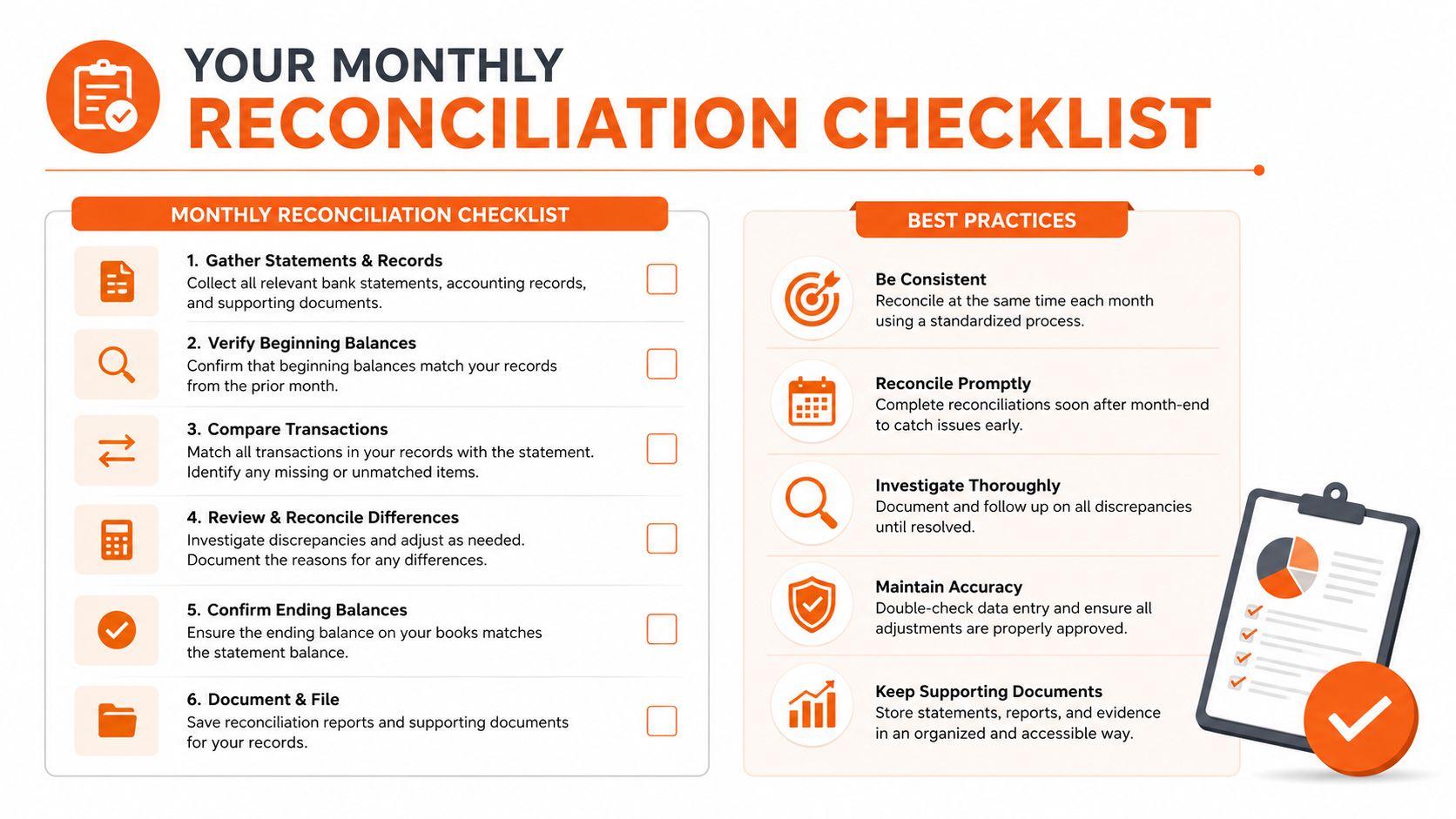
A good routine is short enough that you'll repeat it. Pick one monthly date, keep your notes in the same place, and use the same sequence until it feels automatic.
A checklist you can reuse
- Set a cutoff date. Use the same date range for your statement and your own transaction list.
- Confirm the opening balance. Make sure you're starting from the last ending balance, not an old number.
- Match the obvious items first. Clear the easy transactions before looking at the exceptions.
- Review pending items separately. Keep authorisations, refunds, and transfers in their own bucket.
- Write down the explanation. A short note is enough if you know why something didn't line up.
- Save the backup. Keep the statement, receipts, and any screenshots together.
A few habits make this easier to sustain. Check statements weekly if you're a frequent card user, set aside 10 to 15 minutes instead of waiting for a perfect long session, and keep a short list of merchants that repeat every month.
It also helps to revisit frequency when life changes. A new job, a new card, a move, or a household change usually means your transaction pattern has changed too.
For a broader money routine, the income and expense tracking guide is a natural companion, because reconciliation works best when your spending records are already clean.
If you want a calmer way to keep your transactions organised, Fintrack brings your spending, subscriptions, alerts, and hidden credits into one place so reconciliation feels less like detective work. Visit Fintrack to make your monthly money check a quick habit instead of a stressful catch-up.