It's the last week of the month. Your chequing account holds less than you expected, the credit card balance crept up again, and somewhere in your statements sit two or three subscriptions you couldn't name if someone asked. You want a straight answer about where the money went, and you want it tonight, not after a $250 introductory meeting with a planner who mostly serves clients with six-figure portfolios.
So you open a chatbot and type the question you'd rather not ask a person out loud: what am I spending?
An AI financial advisor can answer that, and answer it well. These tools are useful for day-to-day clarity: sorting transactions into categories, building a budget from what you really spend, forecasting when a savings goal lands, and flagging money that leaks away. What they can't do is replace a licensed human on investments, tax or retirement decisions, and treating them as a substitute is where people get hurt.
Here's the route through this guide. You'll see what these tools are and how they work under the hood, the everyday jobs where they beat an hourly fee, the decisions where a human still wins, how to judge security and accountability before you hand over your data, and a routing table for common money choices. Examples draw on Canadian and US rules for 2026.
What Is an AI Financial Advisor and How Does It Work
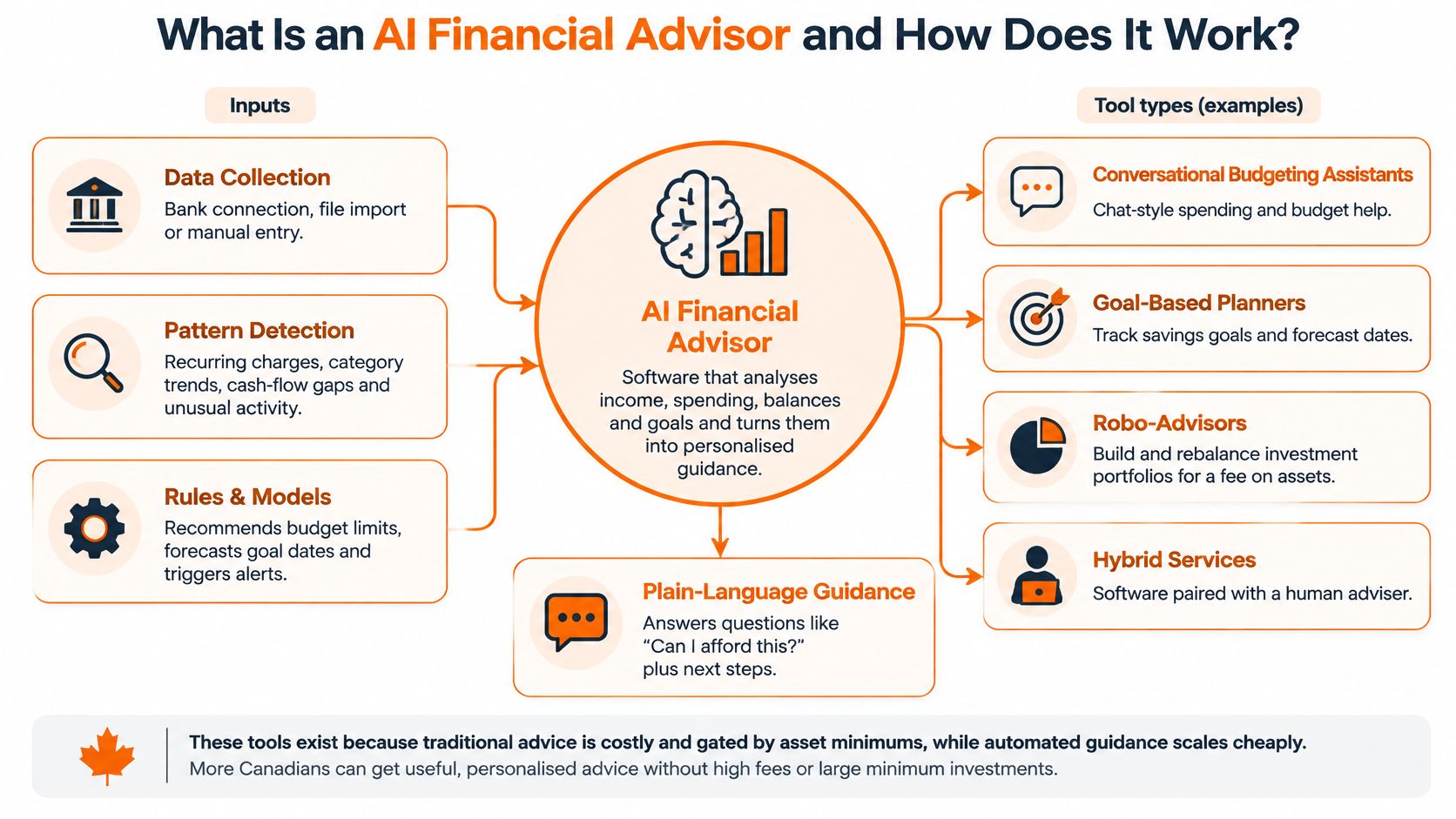
An AI financial advisor is software that analyses your financial data, including income, spending, balances and goals, and turns it into personalised, actionable guidance.
That definition draws the boundary. The software isn't weighing your career change or your father's health. It reads patterns in the numbers you hand it, then converts those patterns into a recommendation you can act on this week.
From Raw Data to Advice in Four Steps
- Collection. Data arrives through a bank connection, a statement import, or manual entry. Manual entry isn't a downgrade here. Plenty of people would rather type their numbers than hand a third party their banking login, and CSV imports cover most of the same ground.
- Pattern detection. The system hunts for recurring charges, category drift, cash-flow gaps and transactions that don't fit the usual shape. This layer is what the industry calls automated insights, and it's where most of the practical value sits.
- Rules and models. Rules set the guardrails, such as a grocery cap or a savings target, while models estimate what happens next: the date a goal gets funded, the week a budget runs dry.
- Plain-language output. You get an answer to a direct question, whether you can afford something, plus the next step that follows from it.
The four stages connect in a loop, and the diagram below shows how the inputs feed the analysis and the analysis feeds the advice.
Four Kinds of Tools on One Spectrum
- Conversational budgeting assistants answer questions about your own transactions in chat, in plain language.
- Goal-based planners track a savings target and forecast the finish date, adjusting when contributions slip.
- Robo-advisors build and rebalance investment portfolios for a fee charged on assets, so their incentive is tied to portfolio size.
- Hybrid services pair software with a human adviser, usually at a higher price than either alone.
The category exists for a reason that has little to do with technology. Traditional advice is costly and often gated behind asset minimums. Research from the Rady School of Management at the University of California, San Diego, tracking weekly deposits into Wealthfront from December 2014 through February 2016, estimated that access to robo-advising could generate a gain equivalent to approximately a 5% annual pay raise for the average investor, and found that lowering participation barriers raised the number of middle-class participants by 108%.
Cheap guidance at scale is the entire promise. The next question is where that promise holds up.
What AI Financial Advisors Do Well in Everyday Money Decisions
The value lands in ordinary moments, not in dramatic investment calls. Someone sitting at a kitchen table with a phone, trying to work out whether the next ten days are survivable, is exactly the user these tools were built for.

People are already using them this way. In 2024, 42% of Canadians using AI for financial management said they used it to identify new investment strategies, according to Ipsos research commissioned by BMO, which tells you the curiosity runs ahead of the caution.
Five Jobs Worth Handing to Software
The strongest use case is the boring one. Ask "how much did I spend eating out this month?" and get a real number pulled from your own transactions, not a rule of thumb from a book. That single capability replaces an hour of spreadsheet work and a fair amount of dread.
- Waste detection. Forgotten subscriptions, duplicate charges and credits that expire unused are hard to spot in a statement and easy to spot in a categorised feed. Money that leaves in small automatic amounts is money no one misses until it's listed in one place.
- Pace alerts. A warning in week two, when spending is on track to overshoot a budget by month-end, is worth more than a statement in week five confirming the damage. If an alert reveals a genuine shortfall rather than a timing problem, borrowing becomes the next question, and small-dollar loan risks and state rules are worth reading before you sign anything.
- Goal forecasting. Software can estimate the arrival date for an emergency fund or a trip fund, then suggest a pace fix after a thin month. That's financial forecasting in its most practical form, done on your numbers rather than an assumed income.
The fifth job is the one people underrate. Testing a budget privately, before anyone sees it, removes the performance anxiety that keeps people out of the conversation entirely.
An Angus Reid survey of 1,501 Canadian adults found that 15% had used AI tools for financial guidance in the previous year, while 32% had sought financial advice online. Among the online group, 69% valued faster access, 27% wanted anonymity and 23% wanted advice without feeling judged, and 47% used AI to educate themselves before speaking with a professional. That last figure is the healthiest pattern in the whole survey.
Lots of data, clear answers, low regret. That's automation's sweet spot, and it's worth protecting by cross-checking anything consequential against official sources such as the Financial Consumer Agency of Canada or the Canada Revenue Agency.
AI Financial Advisor vs Human Advisor
| Factor | Human financial advisor | AI financial advisor |
|---|---|---|
| Accountability | Licensed, owes suitability or fiduciary duties, answers to regulators | Terms of service typically limit liability |
| Judgement | Weighs life context, emotions and trade-offs | Extrapolates from data patterns and misses context not in the data |
| Cost | Billed by time, flat fee or assets under management | Free tiers or subscriptions; robo-advisors charge on assets |
| Availability | Often gated by asset minimums and booking lead times | Available any time, usually at low cost |
The table settles the easy part. Three differences need more than a cell.

Accountability Is the Line That Matters
A licensed adviser owes you a duty, and a regulator can act when that duty is breached. An app owes you what its contract says, which is usually a limitation of liability. Regulators have noticed the gap. California's Department of Financial Protection and Innovation lists "consumer protection and automated financial advice" on its AI oversight agenda, alongside fair lending and internal model use, as set out in DFPI's annual report. Translated for a user: automated advice is being supervised as advice, not as a neutral calculator.
Judgement Is Where Context Lives
Software extrapolates. A person asks questions. When you lose a job, separate from a partner, or take in a parent, the right answer changes in ways no transaction history records. Canadians seem to grasp this: 68% said AI could not understand how emotions influence financial planning, while 52% said it could support informed financial decision-making, per Ipsos research for BMO. Both statements can be true, and together they describe the useful role.
Investments show the gap fastest. Software will score a risk tolerance assessment in minutes and build a portfolio from the result. Whether you'd hold that portfolio through a bad year is a question someone has to ask you.
Cost Decides Who Gets Help at All
Price is not a detail. The Financial Consumer Agency of Canada's 2024 Canadian Financial Capability Survey, based on nearly 8,000 Canadians, found that only 35% sought financial advice in the previous 12 months, and 76% of those who did used free sources, with friends and family the most popular. Paid advice is already a minority product. Software changes the arithmetic for everyone outside that minority.
Preferences split along the same fault line. In an Ipsos survey of 2,501 Canadian adults, 39% preferred AI-supported human help for setting a budget and 39% for product recommendations, yet 55% wanted human-only financial-planning advice and 53% wanted human-only retirement advice.
Working rule: software for the daily layer, a person for the checkpoint. Specific decisions get routed in the final section.
Limitations and Red Flags of AI Financial Advice
Start with the failure that matters most. These systems are fluent when they're wrong. A model can produce a confident paragraph about contribution limits, tax treatment or withdrawal rules that contains one outdated figure and reads perfectly, and you'll only catch it if you already know the answer.
Ask the same question twice with different phrasing and the answer can shift. Add a detail about your household and a generic template may swallow it. Feed in six weeks of uncategorised transactions and you'll get advice built on a picture that doesn't match your life. Data quality governs output quality, and no interface design fixes that.
Public confidence reflects the problem. A Gallup survey of 2,117 Canadian adults found that only 4% had a great deal of confidence in AI as a source of financial guidance, with no more than three in ten holding at least some confidence. A Fidelity retirement report in the same coverage found that 26% of pre-retirees and 11% of retirees had used AI for financial planning, but only 5% of AI users considered it their most trusted source.
Where the damage becomes irreversible is fraud wearing an AI label. California's Department of Financial Protection and Innovation has documented alleged schemes promising fixed returns, with claimed daily figures of approximately 0.6%, 1%, 1.5% and 4.81%, and some allegedly paying purported profits out of new investor deposits rather than trading, as detailed in DFPI's report on AI investment schemes. Real markets don't pay fixed daily returns. Anything that does is describing something other than trading.
Red Flags of a Predatory AI Investment Scheme
| Red flag | What it looks like | What to do |
|---|---|---|
| Fixed or guaranteed high returns | Promises of steady daily returns far above market rates | Treat it as a stop sign; genuine markets don't pay fixed returns |
| Paying earlier investors with new deposits | Returns that appear to come from new investor funds rather than trading | Ask for independently verified, audited performance |
| Vague AI trading claims | Proprietary AI with no disclosed strategy, fees or drawdown data | Require net-of-fee results and risk data in writing |
| Unregistered adviser | No registration number, or no record with CIRO or a provincial regulator | Confirm registration before sending any money |
| Pressure to act now | Urgency, limited-time offers, pressure to move funds quickly | Pause; irreversible decisions deserve time |
The unregistered-adviser row deserves extra weight, because the pitch often arrives disguised as a retirement move. Anyone rolling over an old workplace plan should read up on protecting your 401k rollover from fraud before transferring a dollar, since rollover paperwork is exactly what these operations ask for.
The more irreversible the decision, the more an accountable human matters. That single test sorts most of these situations before you need to analyse them.
Security and Privacy Checklist Before You Share Financial Data
Connecting an account or importing a statement hands a system the most sensitive data you own: where you live, what you earn, who you pay, what you owe. Vet the provider the way you'd vet a bank branch, not the way you'd try a free photo app.

The stakes are social as much as technical. 56% of Canadians said protecting data and privacy would increase their trust in companies using AI, 55% wanted companies to accept responsibility when something goes wrong, and 52% said human oversight or intervention would build trust, according to Ipsos research on trust in AI. Turn those three expectations into a checklist and you have something you can verify.
The Seven-Point Check
- Encryption in transit and at rest, plus independent audit signals. Look for SOC 2 compliance or an equivalent third-party report. A privacy policy is a promise; an audit is evidence.
- Clear data ownership and deletion rights. You should be able to export everything and delete your account without emailing support and waiting a week. Read the data handling and confidentiality terms, the way you would review privacy terms from another provider, before you upload a single statement.
- Read-only connections, or no connection at all. Read-only bank links can't move money. If you'd rather keep logins out of the app entirely, manual entry and CSV import do the job.
- Plain-language disclosure of what the AI does. You should be able to point at a sentence explaining how recommendations are generated and where they stop.
- A human escalation path. Ask what happens when something goes wrong and a person answers.
- Registration for any investment guidance. In Canada, check CIRO and the provincial regulator. In the US, check the SEC and FINRA.
- A published breach-notification record. How a company behaved after its last incident tells you more than its marketing page.
Regulators are moving in parallel. Canadian securities regulators apply existing accountability rules to AI-assisted advice, and California's rules show the direction of travel: AB 2013 requires AI developers to publish a high-level summary of the datasets used to develop a system by January 1, 2026, and SB 942 requires detection tools and visible markings for AI-generated content from the same date, per California's guidance on how existing law applies to AI.
Know where your data goes, too. Understanding data aggregation explains why some apps ask for a login while others accept a file, and that distinction should shape your choice, not the app's design.
When to Use an AI Financial Advisor and Your Next Step
| Money decision | Use an AI advisor | Bring in a human |
|---|---|---|
| Monthly budget and spending review | Yes: categorise spending, set limits, track progress | Only if overspending points to a deeper issue |
| Emergency fund building | Yes: forecast the finish date and suggest pace fixes | Rarely needed |
| Choosing investments | Education and scenario testing only | Yes: suitability advice from a licensed adviser |
| Tax planning | Organise records and flag deadlines | Yes for business, rental, cross-border or estate situations |
| Retirement planning | Track progress and run simple projections | Yes: pension, drawdown and decumulation strategy |
| Debt repayment | Yes: payoff order and cash-flow checks | Yes if collections, legal action or insolvency loom |
| Insurance and estate decisions | Background research and checklists | Yes: licensed agent, lawyer or notary |
The principle behind the table is simple. Software runs the daily layer: tracking, categorising, alerting, forecasting. Humans handle decisions that are high-stakes, irreversible or regulated, and the accountability question is sharper than expected. A December 2025 joint notice from the Canadian Securities Administrators and the Canadian Investment Regulatory Organization states that people using AI to provide investment advice or promote investments may be responsible for what the AI does, just as if they had acted directly. That standard lands on the person behind the AI, not on the model.
A Four-Step Workflow
- Build visibility first. Get categorised spending, budgets and goals into one place before asking for recommendations. Advice without a clean picture is guesswork with confidence.
- Stress-test the decision. Ask scenario questions: what happens if income drops 20% for three months, or if this cost rises next year?
- Write down the assumptions. Before acting, note the inputs the answer depended on. When one of them changes, the old advice expires.
- Take the big decision to a licensed professional, with your summary in hand. A prepared one-page summary shortens billable time, so the AI layer pays for itself even then.
For the everyday layer, Fintrack's AI assistant is built for exactly this: Finny, the assistant, answers questions about your spending, budgets, goals and accounts using your real financial data rather than generic templates, and a free account takes under a minute to set up with no credit card. If you're still comparing tools, the overview of financial planning software covers what to look for before you commit.
The verdict is a split, not a competition. Use an AI financial advisor to see your money clearly every day. Use a human when the stakes demand someone accountable for the answer.
Fintrack puts the daily layer in one place: an AI-powered dashboard where Finny answers questions about your spending, budgets and goals using your own numbers, and where spending alerts and subscription detection catch the leaks before month-end closes them for you. Start with a single month of transactions and see whether the picture matches what you assumed. You can create a free Fintrack account in under a minute, no credit card required.