A risk tolerance assessment is a short set of questions that rates how much investment loss you can accept emotionally and financially, and the result guides how much risk you take.
You might feel comfortable investing until you realise the same money may be needed for rent, a home purchase or an unexpected repair. Or you might have steady income and healthy savings but still feel sick when your investment balance falls.
A useful assessment makes room for both reactions. Feeling comfortable with risk and being able to afford it aren't the same thing.
Sample Questions and How to Score Them
- Goal timing. When will you need this money? Under 1 year = 1 point; 1 to 3 years = 2; more than 3 to 5 years = 3; over 5 years = 4.
- Reaction to a loss. What would you do after a hypothetical 20% portfolio drop? Sell everything = 1 point; sell some = 2; hold = 3; buy more = 4.
- Acceptable loss. What's the largest hypothetical loss you could accept over a year without abandoning your plan? Under 5% = 1 point; 5% to under 10% = 2; 10% to 20% = 3; over 20% = 4.
- Investing experience. How much practical experience do you have? None = 1 point; up to 1 year = 2; more than 1 to 5 years = 3; more than 5 years = 4.
- Income stability. How predictable is your income? Highly variable = 1 point; somewhat unpredictable = 2; mostly steady = 3; steady and secure = 4.
- Emergency reserves. How much essential spending could your accessible savings cover? Under 1 month = 1 point; 1 to 3 months = 2; more than 3 to 6 months = 3; over 6 months = 4.
- Debt burden. How demanding are your debt payments relative to your income? High and difficult to manage = 1 point; substantial but manageable = 2; low and comfortable = 3; no debt payments = 4.
- Main priority. What matters most for this money? Protecting value = 1 point; stability with some growth = 2; growth with meaningful fluctuations = 3; maximising growth while accepting substantial losses = 4.
These are illustrative educational questions, not a validated questionnaire or a substitute for an adviser's assessment. Choose answers that describe your current circumstances, not the investor you hope to become.
Add the points, then check the weak spots
Add one answer from each question for a total of 8 to 32 points. The following bands are a simple teaching framework, not regulatory categories or a formula for choosing investments.
Score bands and what each profile means
| Total score | Profile | What it usually means |
|---|---|---|
| 8 to 13 | Conservative | Prioritises stable value and small drawdowns |
| 14 to 19 | Moderate | Accepts some swings in exchange for steadier growth |
| 20 to 25 | Balanced | Comfortable with meaningful swings across a diversified mix |
| 26 to 32 | Growth-oriented | Expresses greater comfort with losses, subject to financial capacity |
For a worked example, answers worth 3, 3, 2, 4, 3, 2, 3 and 2 points total 22, placing this hypothetical person in the Balanced band. Their reserves answer still deserves attention before they add investment risk.
A high score on the growth-priority question mustn't cancel out weak income or reserves. Keep two notes beside the total: how you feel about losses and what your household could withstand.
Practical rule: Use the total to start a conversation, not to overrule a financial constraint.
Experience deserves its own check, too. A study of Gen Z investment risk-taking identified investment-account ownership, stated willingness to take risks and self-reported tolerance as principal associated factors, supporting an assessment that looks beyond a simple attitude label.
Three Ways to Run a Risk Tolerance Assessment
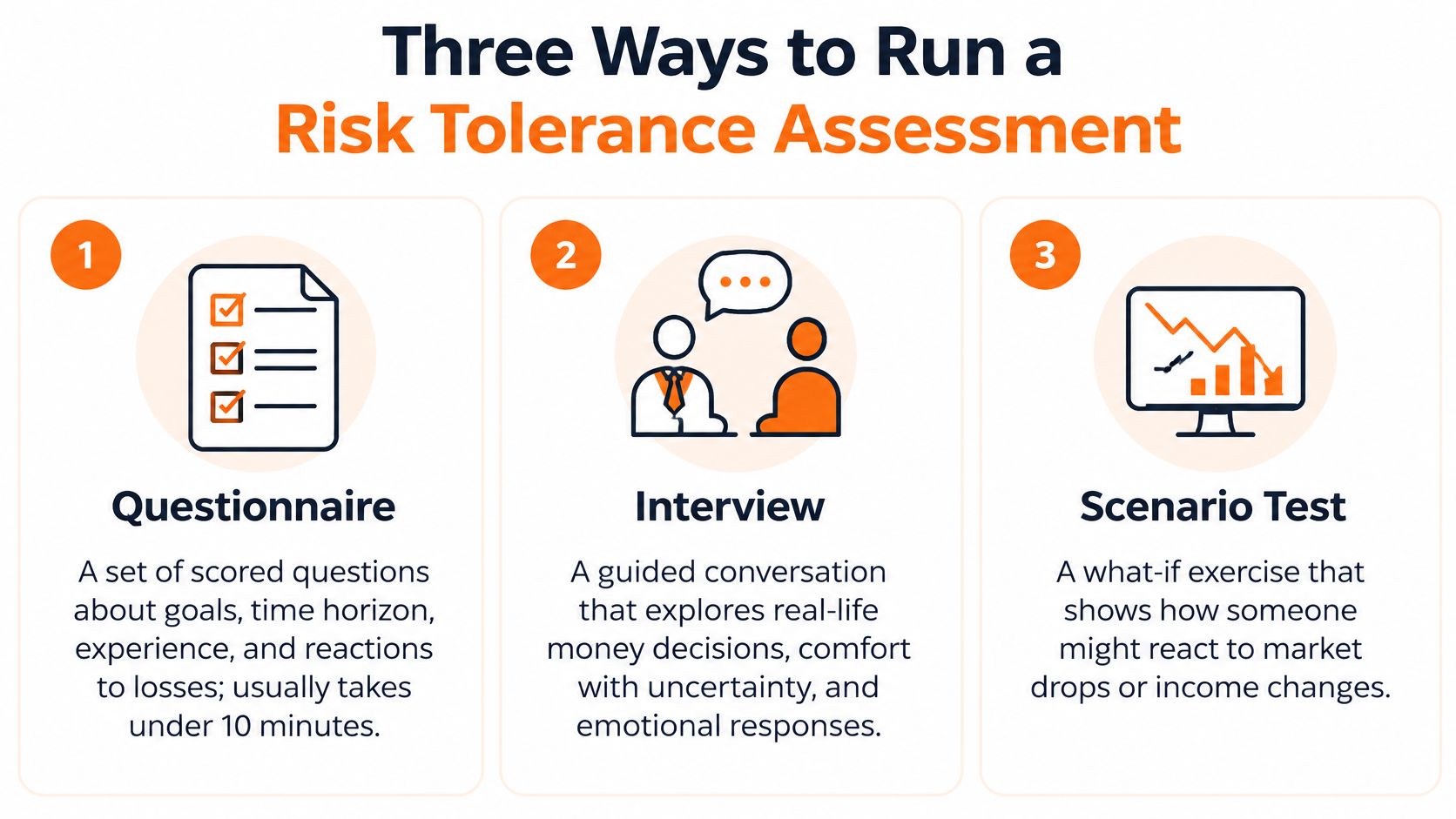
Questionnaire, behavioural and situational methods compared
| Method | How it works | Best for | Main limit |
|---|---|---|---|
| Questionnaire | Score answers about goals, losses and experience | A quick baseline, with under 10 minutes as a practical target for this sample | Answers can reflect mood and the current market |
| Behavioural | Review what you did during past market drops | Checking whether stated tolerance matches action | Needs real history, which new investors lack |
| Situational | Test a scenario with dollar amounts and a job loss | Testing capacity under pressure | Hypothetical, so pair it with a reserves check |
Begin with what you say
A questionnaire gives you a consistent starting point. Answer for a particular goal, rather than combining emergency savings, a home purchase and retirement into one response.
Don't force yourself to finish quickly if you need to check an account balance or debt payment. Accurate household information matters more than a fast result.
The visual below includes an interview, which is a useful way to explore the behavioural side of the assessment.
Check what you've done and what you could survive
For the behavioural assessment, review previous decisions. Did you sell because you feared further losses, or because you needed money for bills? Those actions may look identical in an account statement but reveal different problems.
An adviser's interview can help separate the reasons. New investors can discuss other money decisions under pressure, while recognising that those experiences won't perfectly predict their reaction to an investment loss.
For a situational assessment, write out a hypothetical portfolio decline alongside an income interruption. For example, test a 20% portfolio drop occurring during a three-month income gap, then calculate the dollar loss using your actual balance.
Ask which expenses you'd pay from savings, which contributions you'd pause and whether you'd need to sell investments. An answer such as “I'd buy more” needs a follow-up: with what available cash?
A questionnaire shows what you say, behaviour shows what you do, and a scenario tests what you could survive.
The joint Canadian Securities Administrators and Canadian Investment Regulatory Organization guidance distinguishes subjective willingness from objective loss-bearing ability and says firms should assess them separately, with the overall profile reflecting the lower result.
Use that sequence before acting: questionnaire, behavioural check, then financial stress test. A confident answer alone doesn't make cash available.
Reading Your Profile and Matching It to Time Horizon
A profile label isn't a product choice. Balanced doesn't identify a particular fund, and growth-oriented doesn't mean choosing the investment with the greatest possible loss.
Your withdrawal date changes what's reasonable. Money needed soon has a limited recovery window, regardless of how calmly you watch market movements.
The RBC Wealth Management investor risk-profile questionnaire assigns 1 point to goals within one year, 2 points to goals in one to three years and 3 points to goals in three to five years. That illustrates why a useful questionnaire asks when you'll need the money.
Time horizon and a suggested risk ceiling
| Time until you need the money | Suggested risk ceiling | Why |
|---|---|---|
| Under 1 year | Low | Little time to recover from a decline |
| 1 to 3 years | Low to moderate | A limited recovery window |
| 3 to 5 years | Moderate | Some time for swings to even out |
| More than 5 years | Moderate to high, if capacity allows | Longer time to recover from losses |
These are educational planning ceilings, not RBC allocation recommendations or guarantees of recovery. A fixed deadline, essential goal or low loss-bearing ability can justify taking less risk than the table suggests.
Give each goal its own assessment
Say you're saving for a home down payment in two years and retirement in 25 years. Those hypothetical goals shouldn't automatically share the same investment approach, even though they belong to the same person.
A decline in the down-payment fund could delay the purchase. Retirement money has a longer timeline, but you still need to consider income security, withdrawals and your response to losses.
For the longer goal, this guide to long-term investment planning can help organise the decisions. If debt payments compete with retirement contributions, Toya AI's discussion of how to balance debt payoff and retirement savings provides additional planning context.
Before acting, make these checks:
- Confirm the deadline. Write a withdrawal date or expected period beside each goal.
- Protect emergency money. Keep the emergency layer separate from money exposed to investment losses.
- Respect the limiting factor. Choose a working risk level that fits both your emotional comfort and financial position.
This framework is general education, not personal advice about an allocation or investment product.
How to Turn Your Profile Into a Budget Plan
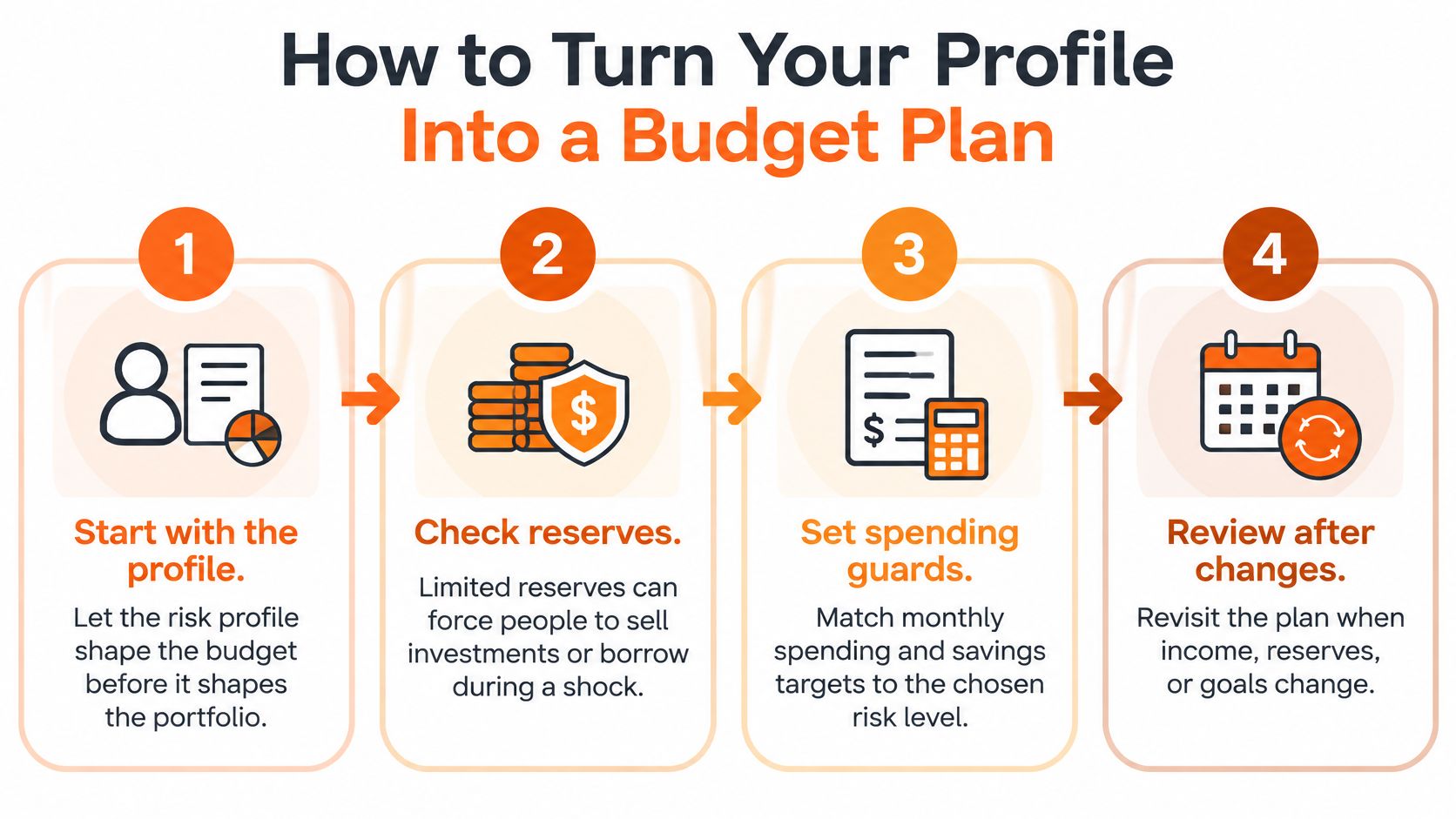
Suppose your essential monthly bills total $3,000 and you have $1,500 in accessible savings. That covers half a month of essentials, so building reserves may need to come before taking on more investment risk. A budget connects your comfort with risk to what your finances can absorb.
Limited accessible savings can leave you choosing between selling investments and borrowing. A Public Policy Institute of California analysis estimates that 58% of California families have reserves sufficient for three months of basic needs, accounting for credit-card debt.
Make the monthly numbers usable
- List essential monthly spending. Include housing, basic food, utilities, minimum debt payments and necessary transport. Leave optional purchases out.
- Calculate reserve coverage. Divide accessible emergency savings by essential monthly spending. Don't count investments you might have to sell at an uncertain price.
- Assign a practical reserve band. Use under one month, one to three months, or more than three months as budgeting checkpoints, not universal safety thresholds.
- Choose the immediate priority. Below one month, prioritize rebuilding reserves before adding investment risk. In the middle band, protect goal contributions and avoid growth-heavy choices for near-term money. Above three months, consider whether your household needs a larger buffer.
- Date each goal. Record its time horizon and use the horizon table to set an educational risk ceiling.
- Set affordable transfers. Assign a monthly amount to each goal, then track everyday spending against what remains.
- Test and adjust. Review the plan monthly for two months. If essential spending rises, adjust goal transfers rather than drawing down reserves.
A monthly budget-planning routine can help make these choices repeatable. If you prefer not to link bank accounts, a spreadsheet or notebook works for recording income, essential expenses, goal transfers and your remaining reserve balance.
Don't count the same savings twice. Money set aside for an upcoming purchase is not fully available for emergencies unless you're willing to postpone that purchase.
Common Mistakes That Skew Your Result
A bold answer after a strong market year may describe your current mood better than your ability to handle losses. Answer for an uncomfortable situation, not just a favourable one.
- Answering from recent gains. Revisit the questionnaire using a hypothetical 20% decline rather than the balance you hope to see. Describe what you'd do before selecting the most confident answer.
- Treating the result as a permanent personality trait. Reassess after changes to employment, household responsibilities or savings. Keep the old answers so you can identify what changed.
- Reading growth-oriented as permission to choose the riskiest product. Check withdrawal needs and financial dependence on the money first. The CIRO investor questionnaire describes its high-risk profile as assuming no significant investment-income requirements and at least a medium-term horizon.
- Ignoring weak reserves. In a hypothetical household with two months of reserves, an enthusiastic response to losses may still call for a more cautious plan. Use an emergency-fund calculation to check the cash buffer before accepting the label.
- Trusting one website's score. Compare the result with a behavioural review or a scenario test. Investigate disagreements instead of averaging them away.
- Leaving goal dates blank. Put a date beside each purpose for the money. Otherwise, a near-term purchase can accidentally end up in a growth-heavy allocation.
Separate your profile from product safety
Your willingness to take risk doesn't establish whether a particular investment is suitable or well structured. You still need to understand access restrictions, fees, concentration and how you could lose money.
For property-related products, Pie Assets' guide to assessing fractional real estate investment safety offers a focused example of product-level questions. That investigation complements a personal risk assessment; it doesn't replace one.
How Often to Reassess Your Risk Profile
A yearly review gives you a regular chance to check whether your risk profile still fits your household. Reassess sooner if your income, expenses, dependants, reserves, or goals change. Your comfort with investment losses may stay the same while your ability to absorb them shifts, so let the more cautious of the two guide your plan.
Reassessment triggers and what to recheck
| Trigger | What to recheck | Timing |
|---|---|---|
| Yearly check-in | Scores, goals and horizons | Once a year |
| Job or income change | Income stability and reserves | Within 30 days |
| New dependant or large purchase | Fixed costs, reserves and horizon | Before the next contribution |
| Reserves fall below one month | Capacity band and risk ceiling | Immediately |
| A goal date moves within three years | Horizon and allocation range | When the date changes |
These are practical workflow checkpoints, not regulatory deadlines. Review sooner if you may otherwise make a contribution using outdated information.
Change the affected parts, not everything
If a job change makes your income less predictable, revisit the income question, recalculate reserve coverage, and check whether planned transfers still fit. The review can focus on what changed.
A new dependant may increase essential spending even if income stays steady. If reserves fall, you may need to redirect contributions temporarily rather than alter every long-term investment.
Keep a short change log: what changed, which answer changed, and what action you'll take.
Compare the new score with the old one, but check the answers behind each total too. A similar score can mask a weaker financial position if one answer improved while another worsened.
When a target amount or deadline changes, a financial goals calculator can help you revise the monthly contribution. Taking more investment risk is only one possible response to a funding gap.
Confirm Your Profile and Plan Your Next Step
The useful outcome isn't a label to memorise. It's a written plan you can check against your spending, savings and upcoming commitments.
Use this checklist before making investment decisions:
- Record the result. Save your answers, total and illustrative profile, including any question you found difficult.
- Write your working level. Note the more cautious result from your willingness and loss-bearing checks, with a short explanation.
- List each goal. Include its target amount, date, horizon and planned monthly transfer.
- Check the emergency layer. For this educational routine, confirm at least one month of essential spending before adding risk, while recognising that your household may need substantially more.
- Schedule the review. Put a reassessment date on the calendar and record the events that would bring it forward.
Keep the plan specific enough to use
Each goal needs a timeline, contribution and reassessment trigger. “Save for a home” is incomplete; a target date and an affordable transfer make it possible to judge progress without relying on investment gains.
A personal finance planning checklist can help organise these decisions alongside debt and everyday expenses. Keep your budget, reserve calculation and goals together so you don't overlook competing demands on the same money.
A savings-goal planning tool is a natural place to record those amounts and timelines. Manual records are also useful when you prefer to plan without linking accounts.
This remains a planning exercise, not a product recommendation. If your results conflict, or a loss could affect essential living costs, seek qualified personal advice before choosing an allocation.
What a Risk Tolerance Assessment Measures
A saver watches a portfolio fall 15% in a hypothetical month and feels ready to sell, even with a steady paycheque and six months of reserves. Their finances may give them room to wait, while their reaction signals that market losses feel difficult to tolerate.
A risk tolerance assessment helps separate these two questions: How much uncertainty are you comfortable with, and how much loss could your finances absorb? The first is about feelings and likely behaviour. The second is about the resources and obligations that shape your financial room to manoeuvre.

| Component | What it measures | What to examine |
|---|---|---|
| Risk tolerance | Emotional willingness to accept investment fluctuations | Anxiety, likely reactions and comfort with uncertainty |
| Risk capacity | Financial ability to absorb losses | Reserves, income, debts, dependants and withdrawal needs |
Stated appetite varies. 46% of Canadian investors said they were willing to accept moderate or significant investment risk in 2024, according to the Canadian Securities Administrators, citing CIRO's investor survey. A willingness to take risk, on its own, does not show whether a person can afford a loss.
Consider someone who feels bold but has only one month of reserves. Their financial limits may call for more caution than their stated comfort suggests. Someone with stronger finances may have more capacity, but still feel uneasy with fluctuations. The lower of willingness and capacity should guide the plan.
Canadian securities guidance calls for willingness and capacity to be assessed separately. Use the more cautious result to guide the plan, then consider suitable options rather than choosing a product based on a score alone.
Fintrack brings spending, budgets and savings goals together in one dashboard. Visit Fintrack to record essential spending, organise each goal's timeline and set contributions that fit the financial capacity you've assessed.