A paycheque arrives, the rent or mortgage payment goes out, utilities are covered, and the remaining money looks reasonable. Then groceries cost more than expected, a few restaurant meals appear on the credit card, subscriptions renew, and small purchases fill the gaps. By the end of the month, you know you earned enough, but you can't explain where the money went.
The best budgeting tips for beginners don't start with extreme cutbacks. They start with visibility, then turn what you learn into a monthly system you can revise. You'll see how to use actual spending data, choose an allocation method, protect savings, find quick wins, and use alerts, subscription reviews, and goal tracking to keep the plan workable.
You don't need a perfect spreadsheet or a dependable bank connection to begin. Manual entry can be useful when account connections are unreliable, especially for Canadian users managing several institutions. Fintrack's budget planning tools can help you assign category limits and follow progress, while its transaction tracking, subscription detection, and Benefits Wallet checks can support the routine.
The 50/30/20 rule offers a simple starting allocation, but it isn't universal. Zero-based budgeting, pay-yourself-first saving, and envelope-style limits may fit your income and habits better. These budgeting tips for beginners are designed to help you choose a method you can maintain.
1. Start with the 50/30/20 budget rule
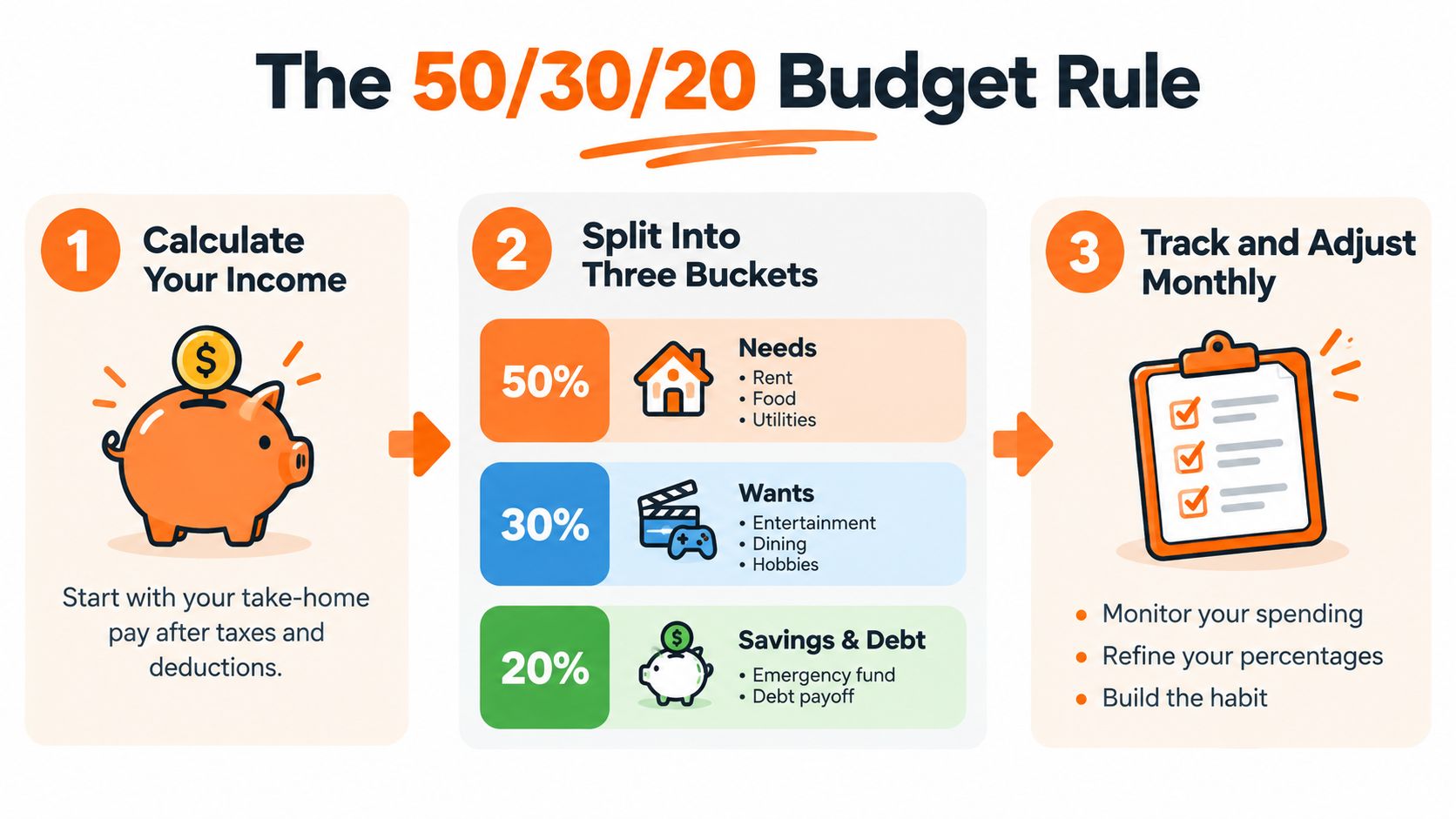
The 50/30/20 rule gives each part of your after-tax income a broad assignment. Put 50% toward needs, 30% toward wants, and 20% toward savings and debt repayment, as described in RBC's budgeting guidance. Needs can include housing, groceries, utilities, insurance, and transportation. Wants include dining out, entertainment, hobbies, holidays, and subscriptions.
For example, someone bringing home $3,000 per month might plan $1,500 for needs, $900 for wants, and $600 for savings and credit card payments. The point isn't to force every expense into an ideal ratio. The point is to create a quick picture of whether housing is consuming too much, wants are crowding out savings, or debt repayment needs more attention.
A freelancer can use the rule as a baseline during stronger income months, then reduce discretionary spending when earnings fall. A household facing unusually high housing costs might deliberately use a 60/20/20 split instead. That adjustment is more useful than pretending a standard ratio fits every city or household.
Practical rule: Use the ratio as a starting map, not a verdict on your finances.
Track your real spending before making large changes. Separate categories for needs, wants, savings, and debt so the allocation stays visible. For classification, this guide to budget categories can help when an expense sits between a need and a want. Eating at home is generally a need, while a restaurant meal is usually a want, even if both solve the same immediate problem.
2. Give every dollar a job with zero-based budgeting
Zero-based budgeting assigns your expected income to specific expenses, savings goals, and debt payments until planned income minus planned outgoings equals zero. It doesn't mean your bank balance must reach zero. It means unassigned money doesn't drift into accidental spending.
Start with fixed commitments, including rent, insurance, loan payments, and utilities. Then assign money to groceries, transportation, discretionary categories, irregular expenses, savings, and debt. If you earn side-hustle or freelance income, wait until it arrives before assigning it. Your base plan shouldn't depend on money that isn't guaranteed.
Irregular expenses deserve a place before they surprise you. Estimate an annual bill such as car maintenance, an annual subscription, or gifts, then divide the expected cost by 12 and reserve that amount monthly. The same approach creates a sinking fund for expenses that aren't monthly but are predictable.
Make the plan easy to adjust
Review the budget weekly at first. Compare each category's planned amount with actual spending, then move money deliberately when circumstances change. If income exceeds expectations, decide whether the surplus goes to savings, debt, or a planned purchase before spending it.
A digital envelope structure can make zero-based budgeting easier. Use tracking categories or sub-accounts for important allocations, then connect them to daily transaction reviews. Budget forecasting methods can help you account for upcoming income and expenses instead of treating every month as identical.
3. Pay yourself first
Saving whatever remains at the end of the month often produces nothing, because daily spending expands to use the available cash. Pay-yourself-first budgeting reverses the order. You move a planned amount to savings as soon as income arrives, then build the rest of the month around what remains.
Someone earning $3,500 monthly might transfer $350, or 10%, on payday and plan expenses around the remaining $3,150. A household with inconsistent income could choose a conservative $200 weekly transfer if that amount is sustainable. The right amount is the one that won't force you to reverse the transfer or rely on new debt.
Separate goals can make the habit more concrete. If you're saving for an emergency fund, a home deposit, and a holiday, divide the planned savings amount across separate accounts or clearly named categories. Seeing progress toward each goal helps you decide whether a short-term purchase is worth delaying.
Automate without making the plan brittle
Set the transfer for payday or the day after income arrives. If your income varies, use a lower dependable amount and add extra contributions manually during stronger months. When you receive a raise or bonus, consider increasing the transfer rather than allowing every new dollar to become a permanent expense.
If you have debt, split the amount between a modest emergency reserve and debt repayment. A reserve can reduce the chance that a repair or urgent bill sends you back to a credit card, while debt payments reduce the obligations competing with future savings.
4. Track and categorize every expense
A budget built from guesses usually fails for a simple reason. You're planning against the person you think you are, not the spending you do. Record purchases for at least a full month without trying to fix everything immediately. The first job is to collect usable information.
Keep the category list manageable. Groceries, transportation, housing, utilities, insurance, debt, dining out, entertainment, shopping, and savings may be enough for a first pass. Too many categories create maintenance work, while too few hide the decisions you need to make.
If possible, connect bank or card accounts to capture transactions automatically, then review categories weekly. Manual entry still has an important role when an account connection isn't available or you want to record cash purchases immediately. Canadian users who hold accounts across different institutions may prefer a mixed approach, with automatic imports where dependable and manual entry everywhere else.
Look for patterns, not shame
Cash purchases disappear from statements unless you record them. Keep receipts or add the amount to your phone as soon as you spend it, then use a regular review to correct categories and investigate unusual charges.
Compare the current month with prior spending when the data is available. You may find that a category rises during certain seasons or that a small recurring purchase has become routine. A detailed expense breakdown can help you turn transaction history into decisions. For an affordable starting point, plan meals around what you already buy and use resources such as cheap recipes for the week.
5. Use the envelope method for problem categories
The envelope method puts a spending limit in a separate physical or digital container. Once the grocery, restaurant, or entertainment envelope is empty, you stop spending in that category or make a conscious decision to reallocate money from somewhere else.
Physical cash can work well for discretionary categories because the limit is tangible. Digital envelopes are often more practical for fixed expenses, savings, and sinking funds. A household might create categories for groceries, utilities, car maintenance, entertainment, and clothing, then fund each one at the beginning of the month.
You don't need an envelope for every expense. Start with the category where you regularly overspend. If restaurants are the issue, create a restaurant limit before building a complicated system around predictable rent or insurance payments.
Treat transfers as decisions
Plan each envelope's amount around actual income and priorities. For irregular expenses such as gifts, holidays, or car maintenance, add a small monthly amount so the eventual bill doesn't arrive without a plan.
If you constantly move money between envelopes, the limits may be unrealistic or the categories may be poorly designed. Reallocation isn't failure, but it should be visible. At month-end, decide whether leftover money rolls forward, moves to savings, or funds a higher priority. Don't let it disappear into an untracked balance.
6. Build an emergency fund before optimising everything else
An emergency fund protects the rest of your budget when an unexpected cost arrives. RBC's 2026 poll found that 32% of Canadians didn't have an emergency fund, rising to 38% among households earning under $100,000. Ontario had the highest provincial share without one at 37%, according to the same RBC poll.
Scotiabank's 2026 guidance reported that 55% of Canadians had an emergency fund covering three months of expenses in 2024, compared with 64% in 2019, based on the Canadian survey data it cited in its emergency-fund guidance. The practical lesson is straightforward. Savings for shocks should be a distinct budget priority, not whatever remains after discretionary spending.
The Financial Consumer Agency of Canada recommends an emergency fund covering three to six months of regular expenses, or three to six months of income, depending on which calculation is easier for you to use. Its emergency-fund guidance gives beginners a measurable target without requiring a single universal dollar amount.
Protect the purpose of the fund
Open a separate savings account so everyday spending doesn't compete with emergency money. Define an emergency with your household. A major car repair or urgent medical expense may qualify, while a new phone or a holiday usually doesn't.
Automatic transfers help build the reserve steadily. If you use it, rebuild it before returning to optional goals. A budget that protects the fund may need fewer aggressive cuts elsewhere because it gives unexpected expenses a planned source of cash.
7. Audit unnecessary subscriptions
Recurring charges deserve an early review because they can continue without an active decision. Statistics Canada reported that in May 2025, prices for video and audio subscription services were 5.4% higher year over year, while internet access services rose 2.9%. Canadian households spent $11.3 billion on cable, satellite, and other programme distribution services in 2024, according to Statistics Canada's report.
These figures don't tell you which service to cancel. They do show why media and internet charges belong in a serious budget review, especially when prices and household bundles change. FCAC annual reporting also indicated that 31% of households borrowed money for daily expenses in 2024, down from 34% the prior year, as reported in FCAC's annual report. When cash flow is tight, silent recurring charges matter.
Run a recurring-charge audit
Pull recent bank and credit card statements and list each repeating charge. Record the name, cost, renewal date, and whether someone actively uses it. Then sort each service into keep, cancel, or maybe.
- Check duplicate services: Look for overlapping streaming, storage, security, fitness, or household accounts.
- Review trial renewals: Add a reminder before a trial ends so cancellation doesn't depend on memory.
- Negotiate wanted services: Ask providers about lower rates or different bundles before cancelling.
- Recheck monthly: Scan new recurring charges so cancelled services don't get replaced by unnoticed additions.
For a clearer process, follow this guide to managing subscriptions. Send the recovered cash to your emergency fund or debt payment instead of allowing it to become untracked spending.
8. Use real-time alerts and category limits
A monthly review tells you what happened. A spending alert can help you make a different decision while the month is still in progress. Set a category limit for areas that drift easily, then receive a notification when spending approaches the boundary.
For example, a $400 grocery limit could trigger an alert at $300, giving you time to adjust meal planning before the category is exhausted. A household might set a $200 restaurant limit and share the alert with both partners. An entertainment budget of $60 could produce a warning at $45, prompting lower-cost plans for the rest of the month.
Use alerts as feedback
Set the first threshold below the final limit, rather than waiting until you've already exceeded it. Alerts work best for discretionary categories where you can change behaviour. Rent, insurance, and other fixed costs usually don't need repeated warnings.
If you receive the same alert every month, don't just dismiss it. Either make the limit realistic or investigate the spending behind it. A grocery limit may need adjustment because of household size, while restaurant overspending may reflect convenience, social commitments, or poor meal planning.
Review categorization regularly. An incorrectly labelled purchase can make an alert misleading. Real-time expense tracking is most useful when notifications lead to a clear action, such as postponing a purchase, moving money from a lower-priority category, or choosing a cheaper alternative.
Comparison of 8 Beginner Budgeting Tips
| Method | Implementation complexity | Resource requirements | Expected outcomes | Ideal use cases | Key advantages |
|---|---|---|---|---|---|
| The 50/30/20 Budget Rule | Low, simple monthly allocations | Minimal, basic tracking or spreadsheet | Balanced spending with steady savings | Beginners with stable predictable income | Easy to understand and adapt |
| Zero-Based Budgeting (Every Dollar Has a Job) | High, detailed monthly planning and reviews | Time and active tracking tools/apps | Full control of cash; fewer leaks; faster debt/savings | People focused on debt payoff or precision budgeting | Eliminates unallocated money; highly intentional |
| The Pay-Yourself-First Strategy | Low, one-time automation setup | Automatic transfers and savings account(s) | Higher, consistent savings and habit formation | Those who struggle to save or want passive discipline | Automates saving; reduces reliance on willpower |
| Expense Tracking and Categorization | Medium, ongoing discipline and review | Time, apps or spreadsheets, linked accounts | Clear visibility into actual spending patterns | Anyone unsure where money goes; budget builders | Data-driven decisions; reveals hidden waste |
| The Envelope Method (Digital or Physical) | Medium, initial setup and category limits | Cash or multiple accounts/sub-accounts or app | Strong category control; reduced overspending | Visual learners and chronic overspenders | Visual, tangible limits that prevent category borrowing |
| Setting Up an Emergency Fund First | Low, consistent contributions over time | High-yield savings account and discipline | Financial buffer; reduced need for high-interest debt | People with unstable income or dependents | Provides security; protects other financial goals |
| Identifying and Cutting Unnecessary Subscriptions | Low, one-time audit with occasional maintenance | Bank/credit statements and short audit time | Immediate, often sizable monthly savings | Busy people seeking quick budget wins | Fast results with little lifestyle change |
| Using Real-Time Spending Alerts and Limits | Low–Medium, configure alerts and categories | Budgeting app or bank features with notifications | In-the-moment corrections; fewer budget overruns | Digital payers and busy households | Immediate feedback; prevents accidental overspend |
Turn Your First Budget Into a Monthly Routine
A useful budget is a routine, not a document you create once and abandon. Start with a month of spending data, choose one allocation method, fund savings deliberately, review recurring charges, and set alerts for the categories most likely to drift.
The Financial Consumer Agency of Canada's survey found that 49% of Canadians reported having a budget in 2019, while only 20% used a digital budgeting method such as a spreadsheet, mobile app, or other financial software. Among Canadians with a budget, 93% said they usually or always stayed within it, according to FCAC's Canadian Financial Capability Survey. That suggests the hardest step is often creating a repeatable system, not mastering complex optimisation.
Adoption remained uneven in later FCAC summaries, with 55% reporting a household budget by 2024, as documented in the FCAC material. The opportunity for a beginner is simple: capture spending consistently, make a few deliberate changes, and keep reviewing the plan.
A practical monthly rhythm
Today, gather recent bank and card statements, list income after deductions, and write down fixed bills. Add subscriptions, debts, savings transfers, and irregular expenses you know are coming.
This week, categorise transactions and choose either 50/30/20, zero-based budgeting, pay-yourself-first, or envelopes. Set one savings transfer, identify one recurring charge to review, and select the discretionary category that needs an alert.
Next payday, fund your planned savings and category allocations before casual spending begins. Record cash purchases, check progress during the month, and adjust the plan when reality differs from the estimate.
Statistics Canada's household-spending guidance recommends gathering regular bills and statements for utilities, rent or mortgage, communication services, and receipts for large purchases. Canadian household benchmarks also show why fixed categories deserve attention first. In 2019, average household spending included $20,200 on shelter, $12,737 on transportation, and $10,311 on food, according to the expense structure reproduced from Statistics Canada's Survey of Household Spending in this Canadian budgeting resource. Those figures aren't targets for your household, but they reinforce the value of starting with the biggest recurring obligations rather than only trimming small treats.
Fintrack can support the routine with a budget planning dashboard, manual entry or available transaction tracking, category alerts, subscription detection, and Benefits Wallet checks. Its assistant can also help you ask plain-language questions about spending and budget progress. Use the Fintrack budget planning feature to turn the method you choose into a visible monthly plan.
The best budget isn't the strictest one. It's the system you can maintain, inspect without judgment, and revise when your income, housing, household, or priorities change.
Fintrack helps you organise income, expenses, category limits, savings goals, alerts, subscriptions, and available benefits in one place. Visit Fintrack to start building a monthly budget that works with manual entry or available transaction tracking.