It's the 8th of the month. Rent cleared a week ago, your phone bill took its cut, the utility payment went through yesterday, and you've just tapped your card for groceries. Your next paycheque lands on the 15th. The account is short, and nothing about your spending was reckless.
That's the gap a cash flow budget closes. It tracks money in and out by date, so you can see the pinch coming while there's still time to move something. Most budgets only count the month's totals, and totals don't tell you whether the money is there on the day the bill clears.
Cash Flow Budget Basics in Plain Terms
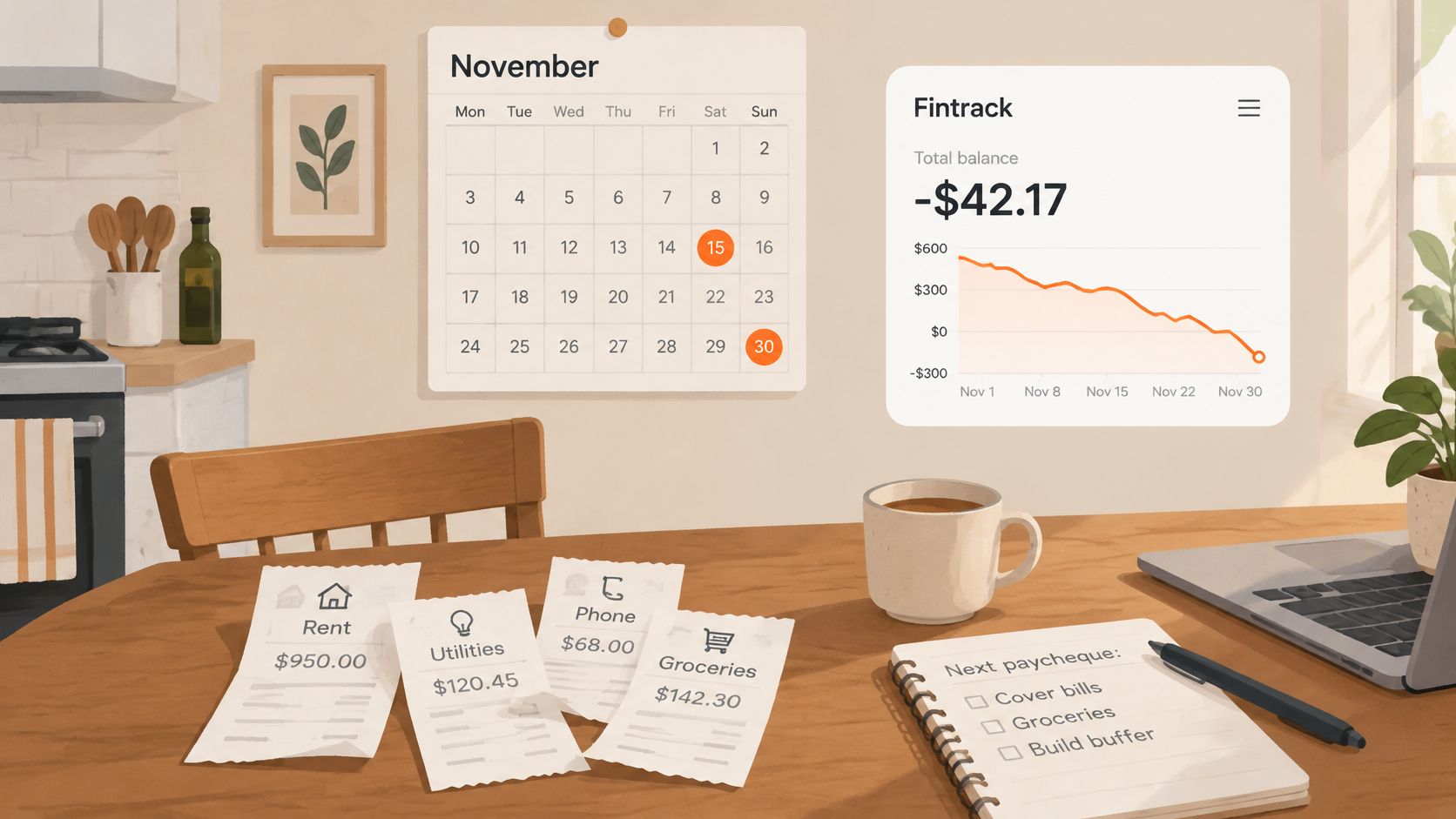
Say you rent in Calgary and get paid on the 15th and on the last day of the month. Rent, phone, utilities and the first grocery run all leave your chequing account before that first paycheque arrives. On March 8 the balance goes negative, even though the month as a whole ends with money left over.
Think of a bathtub. A regular budget tells you the total volume of water going in and out over the month. A cash flow budget tells you when the tap runs and when the drain opens. Same water, very different outcome if the drain opens first.
Three parts do the work, and you'll use all three:
- The income calendar: every payday, written at net pay, the amount that lands in your account.
- The committed bills: fixed costs and irregular costs, each parked on its real due date.
- The running balance: what's left after each dated item, carried forward line by line.
The Financial Consumer Agency of Canada's budgeting handbook sets the monthly test as total income minus total expenses, giving you a surplus or a deficit, and it treats irregular costs like car repairs, tuition and home maintenance as items to spread across months rather than ignore. That check is necessary. It just can't see timing.
Your lowest projected balance is the number that decides whether the plan holds. Above zero, you're fine. Below zero, the timing needs work, not only the spending.
If you're unsure what belongs on the income side, sorting your income and expenses into clear categories first makes the calendar much faster to build.
Sample Cash Flow Budget With Paydays and Bills
Here's a finished month before any instructions. Every figure is illustrative, in Canadian dollars, so swap in your own amounts and dates.
Sample monthly cash flow budget (CAD)
| Date | Item | Money in | Money out |
|---|---|---|---|
| Mar 1 | Opening balance | $1,800 | 0 |
| Mar 1 | Rent | 0 | $1,450 |
| Mar 2 | Phone and internet | 0 | $95 |
| Mar 6 | Utilities | 0 | $140 |
| Mar 8 | Groceries, week 1 | 0 | $180 |
| Mar 15 | Paycheque | $2,100 | 0 |
| Mar 20 | Car insurance set-aside | 0 | $100 |
| Mar 22 | Groceries, week 2 | 0 | $180 |
| Mar 31 | Paycheque | $2,100 | 0 |
| Mar 31 | Savings transfer | 0 | $300 |
Read the negative row first
March 8 is the whole story. After rent, phone, utilities and groceries, the running balance sits at negative $65. Nothing was overspent. The bills arrived ahead of the wage.
The monthly picture is still healthy: two paycheques of $2,100 bring in $4,200 against $2,445 of outflows. A budget that only compared those two totals would call this month comfortable and never flag March 8 at all.
Two fixes this example shows
- Move a date or shift a flexible item. Ask your utility or phone provider to bill after the 15th, or push the first grocery run to a smaller top-up shop and do the big shop on the 16th. Either change keeps the balance positive without cutting a dollar of spending.
- Hold a buffer to bridge the gap. A cushion in the account absorbs the timing mismatch so the payment clears and no overdraft charge lands.
Notice the $100 car insurance set-aside and the $300 savings transfer are planned rows, not leftovers you hope for at month end. They have dates and amounts like any bill, which is why they happen.
A negative running balance is a date to act on before the payment clears. It isn't a verdict on your month.
How to Build Your Cash Flow Budget Step by Step
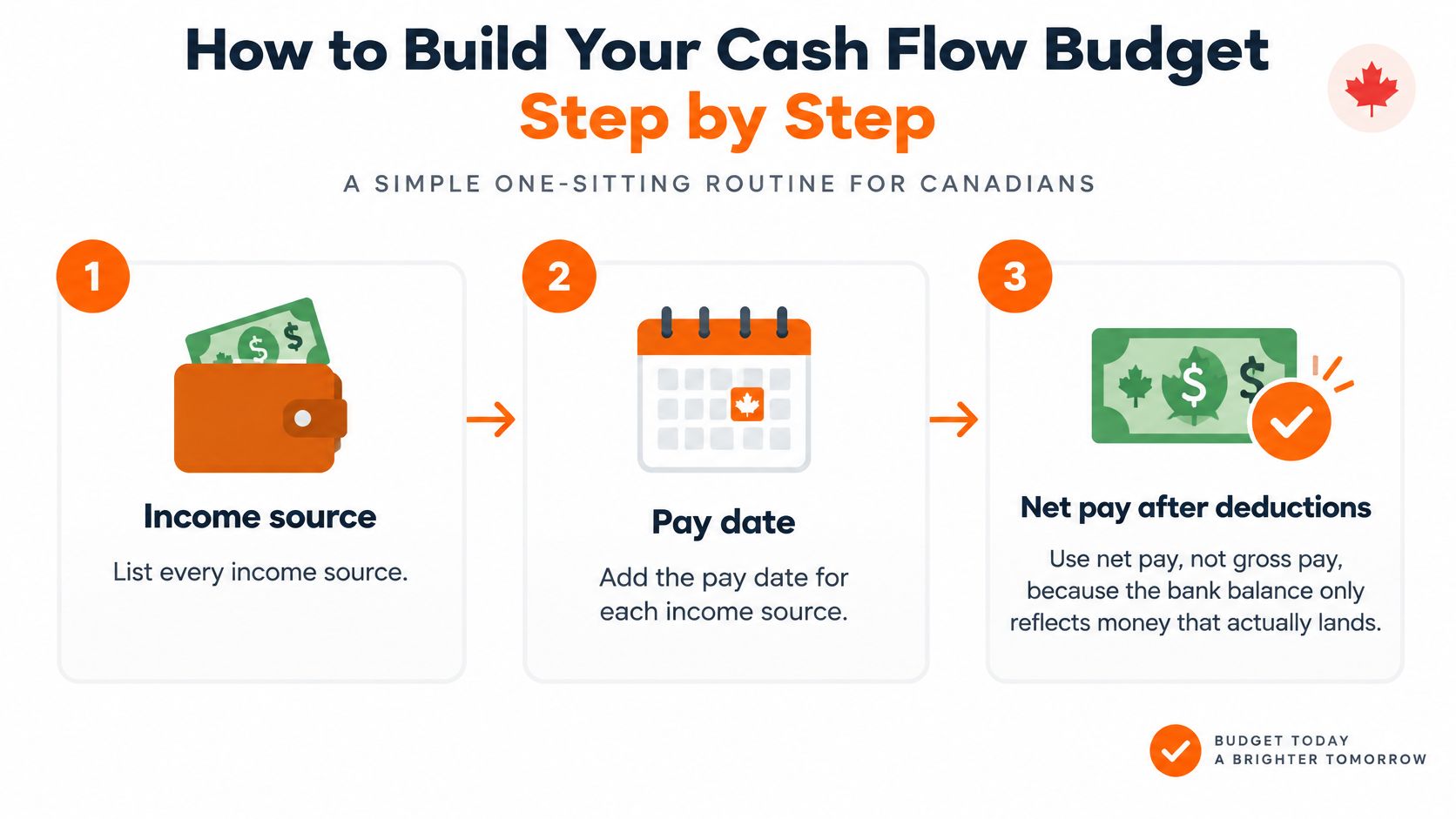
You can build the first version in one sitting, with your banking app and last three months of statements open. Work in order, because each step feeds the next.
Get the dates down
- List every income source with its pay date. Use net pay after deductions, not gross, because your balance only receives the net amount. Budgeting from a gross figure is the most common way people overstate what's available.
- Write your fixed bills with their due dates. Rent or mortgage, utilities, phone and internet, loan repayments, child care. Check the actual withdrawal date on a statement rather than the date printed on the invoice, since pre-authorized payments often leave a day or two earlier.
- Average your variable spending. Pull three months of statements and average groceries, fuel, transit and dining. Averages hide spikes, so keep the highest month in mind as a stress test.
- Turn irregular costs into monthly set-asides. Insurance renewals, vehicle repairs, gifts and dental work get a monthly amount instead of a surprise.
Place, project, then adjust
- Put every item on a calendar by date, starting the day after your first payday. Don't skip a second payday in a two-paycheque month, or you'll invent a gap that doesn't exist.
- Calculate the running balance for each day and circle the lowest point. That single number is your true risk, not the month-end total.
- Compare that low point to your buffer. Your buffer is the minimum balance you don't plan to drop below. If the projection dips under it, move a due date, trim a flexible item, or change the transfer amount.
- Review at month end. Compare planned amounts to what cleared, then update next month's calendar with the confirmed numbers.
Practical rule: the plan passes when the lowest projected balance stays above your buffer, not when the month ends in surplus.
Keep three balances separate in your head: what's planned, what's cleared, and what's projected. Pending card purchases and pre-authorized payments that haven't posted yet belong in the projection, otherwise you'll spend money that's already promised.
Matching Irregular Bills to Your Paydays
Take a car insurance renewal of $1,200 a year. Divide by 12 and you get $100 a month, transferred on each payday into a separate savings account. When the renewal lands, the money is already sitting there.
Irregular costs converted to monthly set-asides
| Irregular cost | Monthly set-aside | When it hits |
|---|---|---|
| Car insurance renewal ($1,200 a year) | $100 | Once a year |
| Tenant insurance renewal ($600 a year) | $50 | Once a year |
| Vehicle maintenance ($720 a year) | $60 | Several times a year |
| Holiday gifts ($900 a year) | $75 | December |
| Dental and eye care ($600 a year) | $50 | As needed, budget a yearly amount |
Replace those amounts with your own bills, and add rows for property tax instalments, school fees, winter tires or anything else seasonal. If a cost arrives in two instalments rather than twelve, divide by the number of payments you make and start early enough to be full before the first one.
The reason this matters is that a month looks affordable because the annual bill hasn't arrived yet. September feels roomy right up until the insurance renewal appears in October.
Timing pressure is real at the national level too. Statistics Canada's first-quarter 2025 household figures show household spending increased 1.0% while disposable-income growth was only 0.8%, and the household saving rate fell to 5.7%. When the cushion is that thin, a mid-month shortfall turns into an overdraft or a credit card balance rather than a withdrawal from savings.
So date each set-aside to the payday before the bill is due, not to the first of the month. A transfer on the 15th that funds a bill on the 20th works. A transfer on the 1st that funds a bill on the 28th leaves three weeks for the money to leak away.
Practical rule: if a bill lands within 30 days and its set-aside isn't full yet, put the shortfall on the calendar as a planned transfer on your next payday.
A sinking fund for irregular bills is the same idea with a name attached, and one account per category keeps the balances from blurring together.
How Much Buffer to Keep in Your Cash Flow Budget
Emergency buffer targets by essential monthly costs
| Essential monthly costs | Three-month buffer | Six-month buffer |
|---|---|---|
| $3,500 | $10,500 | $21,000 |
Each row is just the essential monthly total multiplied by three and by six. Substitute your own number.
To find it, add up housing, utilities, food, transport, insurance, minimum debt payments and other core costs. Leave out dining out, streaming and discretionary shopping, because those are the first things you'd stop in a bad month. A household with $3,500 of essentials is aiming at $10,500 to $21,000.
The Financial Consumer Agency of Canada's budgeting guidance recommends savings equal to three to six months of regular expenses, with three to six months of income as an alternative target, and points to illness, job loss and urgent repairs as the costs the fund is meant to absorb instead of payday loans or credit-card cash advances.
Build it in stages so the target doesn't feel impossible:
- One month of essentials first. This is the stage that stops most timing gaps from becoming debt.
- Then three months. Enough to ride out a job interruption while you look for work.
- Then six, if your income is irregular or you're the only earner in the household.
Keep the money in a separate savings account that isn't used for daily bill payments. If it sits in your chequing account, your running balance looks richer than it is and you'll spend the cushion by accident. The buffer never counts as spendable money in the projection.
Once a loan is paid off, redirect that former monthly payment straight into the buffer. You're already used to living without it, so the reserve grows without a new line in the budget. Setting a dated target for an emergency fund in Canada gives that redirected payment somewhere to go.
What to Prioritize When Income Cannot Cover Every Bill
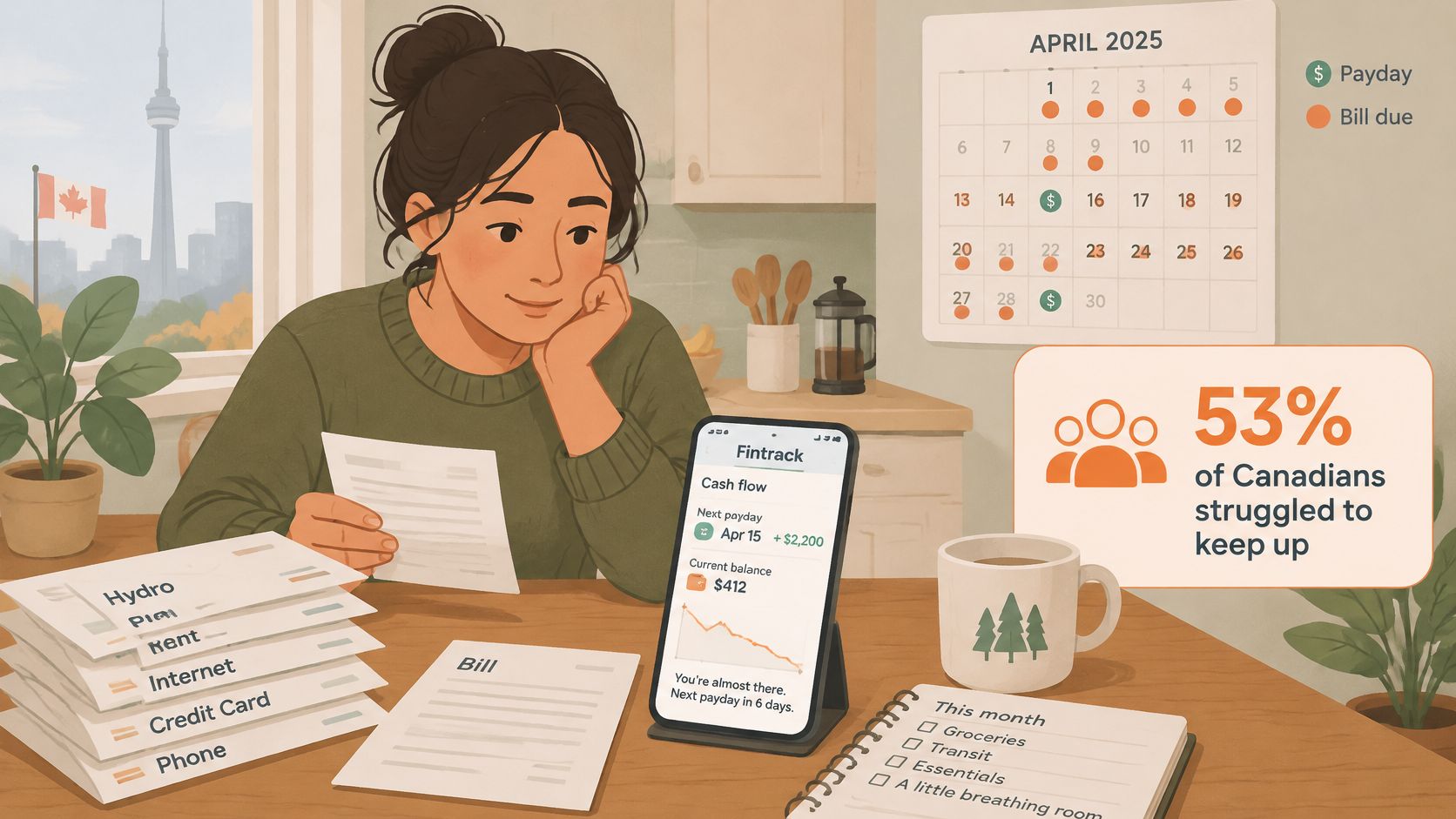
If your income doesn't stretch to every obligation, more discipline isn't the missing piece. In 2025, 53% of Canadians struggled to keep up with financial commitments and 33% borrowed to cover regular expenses, according to the Financial Consumer Agency of Canada's 2025 to 2026 annual report. You're in a large crowd, and the useful question is what gets paid first.
Pay in this order:
- Housing. Rent or mortgage, before anything else.
- Utilities and food. Heat, power, groceries.
- Insurance and work transport. Coverage you can't legally or practically drop, plus the fuel or transit pass that gets you to your job.
- Minimum debt payments. Minimums keep accounts in good standing while you stabilise.
- Everything else, including extra debt payments and savings beyond a token amount.
Then pick the mode that matches your calendar, and switch when the number changes:
- Crisis mode: your lowest projected balance goes negative within 14 days. Pause discretionary spending, and contact creditors before a payment is missed.
- Recovery mode: the balance stays positive but sits below one month of essentials. Trim flexible costs and send any surplus to the buffer.
- Stability mode: the buffer covers at least one month of essentials. Go back to the standard routine.
Calling a lender early is the highest-value move in crisis mode. Ask for a due-date change that lines up with your payday, or a short payment plan, and ask what it costs and what shows on your credit file. Most providers would rather rearrange a date than chase a missed payment, but you have to ask before the date passes.
Progress here isn't a perfect surplus. It's fewer late payments, no emergency borrowing, and a low point that's more predictable each month.
Small habits protect that progress, and knowing how overdraft fees are triggered helps you decide which payment can safely wait a day and which can't.
Set Up Your Cash Flow Budget This Week
Do one thing in the next few days: write the next 30 days of paydays and bills on a calendar and find your lowest projected balance. That's the number you've been missing.
If it falls below your buffer, set a recurring transfer on your next payday to close the gap, then pick one irregular cost and start its monthly set-aside. Two changes, one sitting.
The habit is worth more than the spreadsheet. In the Canadian Financial Capability Survey 2019, the Financial Consumer Agency of Canada found 18% of budgeters spent more than their monthly income, compared with 29% of non-budgeters, and 65% of budgeters had emergency savings, compared with 39% of people who felt too time-crunched or overwhelmed to budget.
A plain spreadsheet works fine for this, and so does a paper calendar. If you'd rather have it in one place, our Budget Planning tools hold the calendar and the running balance, and the dashboard shows income, expenses, budgets and goals together. You can set spending limits per category and track progress in real time, and velocity alerts warn you when your spending pace suggests you'll exceed a budget before month-end. Manual entry means it works without a bank connection, which matters if you'd rather not link your accounts.
Choose whichever you'll update on every payday. A monthly bill tracker you keep current beats a beautiful plan you abandon in week three.
Fintrack keeps your paydays, bills and category budgets on one calendar, with velocity alerts that flag a tight stretch before the payment clears, and manual entry so you can start without connecting a bank account. Build your first 30-day cash flow budget with your real pay dates and see where your lowest balance lands. Visit Fintrack to set it up this week.