Your paycheque arrives, you pay a few bills, and your account looks comfortable. Then groceries, a subscription renewal, and an insurance payment come out, and you're wondering how the money disappeared.
Tracking income & expenses gives you a clearer answer than checking your bank balance alone. The useful habit isn't a perfect calculation you make once. It's a monthly routine built around what you receive, what you spend, and what's already committed.
Income & Expenses Defined in Plain Language
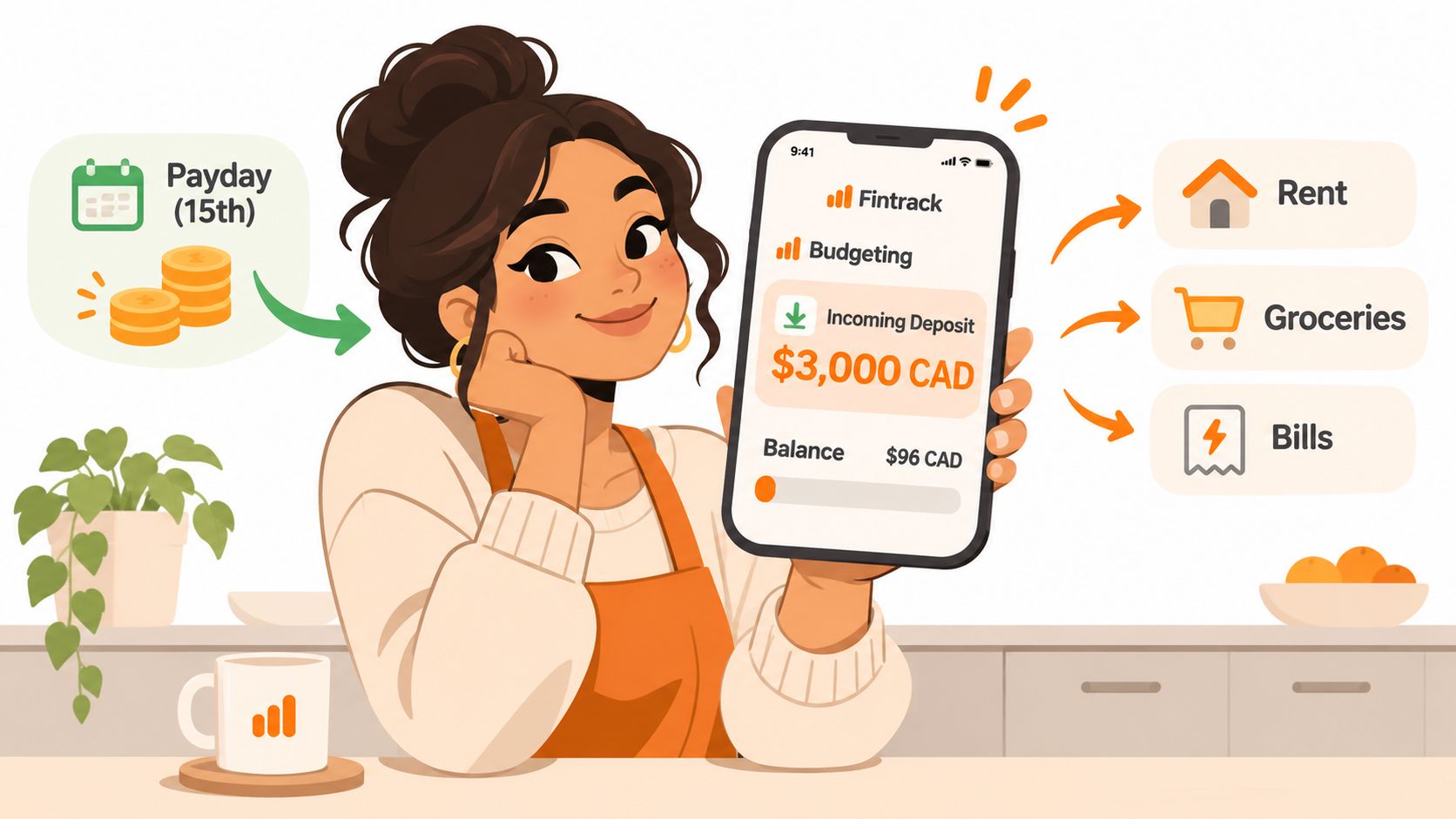
Say Maya gets paid on the 15th and assumes she has $3,000 to spend. By the end of the month, her account is nearly empty, even though she hasn't bought anything unusually expensive. She's treated the deposit as available spending money without accounting for everything it needs to cover.
Income is money coming in. For a household spending plan, use your take-home pay, the amount left after tax and payroll deductions, rather than the gross salary on your offer letter.
Your pay statement shows both amounts, but only the take-home amount is available for bills and everyday spending. If you're unsure how the two relate, this explanation of annual gross income can help you interpret your pay statement.
Think of your money as a bucket
Income is the water poured into the bucket. Expenses are the holes through which money leaves, including card purchases, bills, cash spending, and automatic withdrawals. What remains is the money you've kept during that period.
Net cash flow is income minus expenses. In a hypothetical month, $3,400 of income minus $3,050 of expenses leaves $350.
That positive result isn't automatically savings. The money might already be needed for an upcoming bill, while savings is money you deliberately keep for a future purpose. Moving existing savings into your everyday account doesn't create new income, either.
Income vs expenses at a glance
| Term | What It Covers | Examples | Where It Shows Up |
|---|---|---|---|
| Income | Money you receive | Net pay, government benefits, interest, rental income | Deposits and paycheques |
| Expenses | Money you pay out | Rent, groceries, transit, subscriptions, loan payments | Card charges, bill payments, cash withdrawals |
| Net cash flow | Income minus expenses | Money left after subtracting the month's expenses | Your monthly balance |
Start with two figures for the same calendar month: your total income and your total expenses. Use the table to sort each item before calculating the difference, rather than guessing from the amount currently in your account.
Sorting Your Income Sources and Expense Types
Begin with money that arrives on a schedule: regular net pay, government benefits, pension payments, and interest. Record the amount received, not an expected payment that hasn't arrived yet. Keep occasional income separate so you don't accidentally build ongoing commitments around it.
Not every deposit belongs in your income total. A refund lowers the expense it corrects, a reimbursement repays money you already spent, and loan proceeds are money you must repay. Label these clearly instead of treating them as extra earnings.
Give each expense a useful label
Group spending by how you need to plan for it. Fixed expenses repeat at the same amount, variable expenses change with prices or usage, and irregular expenses arrive less often.
A predictable annual premium is irregular because of its timing, even if its amount is known. A vehicle repair is also irregular, but you may need to estimate the reserve rather than work from a scheduled invoice.
Income and expense types to track
| Type | Examples | How Often | Tracking Note |
|---|---|---|---|
| Regular income | Net pay, benefits, pension | Each pay period | Record take-home, not gross |
| Fixed expenses | Rent or mortgage, insurance, loan payments | Same amount monthly | Easiest to plan; check once a year |
| Variable expenses | Groceries, fuel, dining out | Changes monthly | Set a limit and track weekly |
| Irregular expenses | Car repairs, gifts, annual insurance | A few times a year | Save a set amount each month |
Track housing as a complete cost, not just a rent or mortgage payment. In Canada, shelter was the largest average household spending category in 2023, at $24,671, while homeowners spent an average of $27,831, according to Statistics Canada.
Keep utilities, property-related expenses, and insurance visible alongside the main housing payment. Separate entries make changes easier to spot, while a combined housing total shows what the whole commitment costs.
For more help choosing labels, use these expense categories for a household budget. Then write down your three largest fixed costs and your two biggest irregular costs from the last year, checking statements rather than relying on memory.
How to Track Income and Expenses Each Month
Choose a complete calendar month for your first review. Keep the start and end dates consistent across every account you include, so you aren't comparing a full month of spending with only part of a month's income.
Build a record you can check
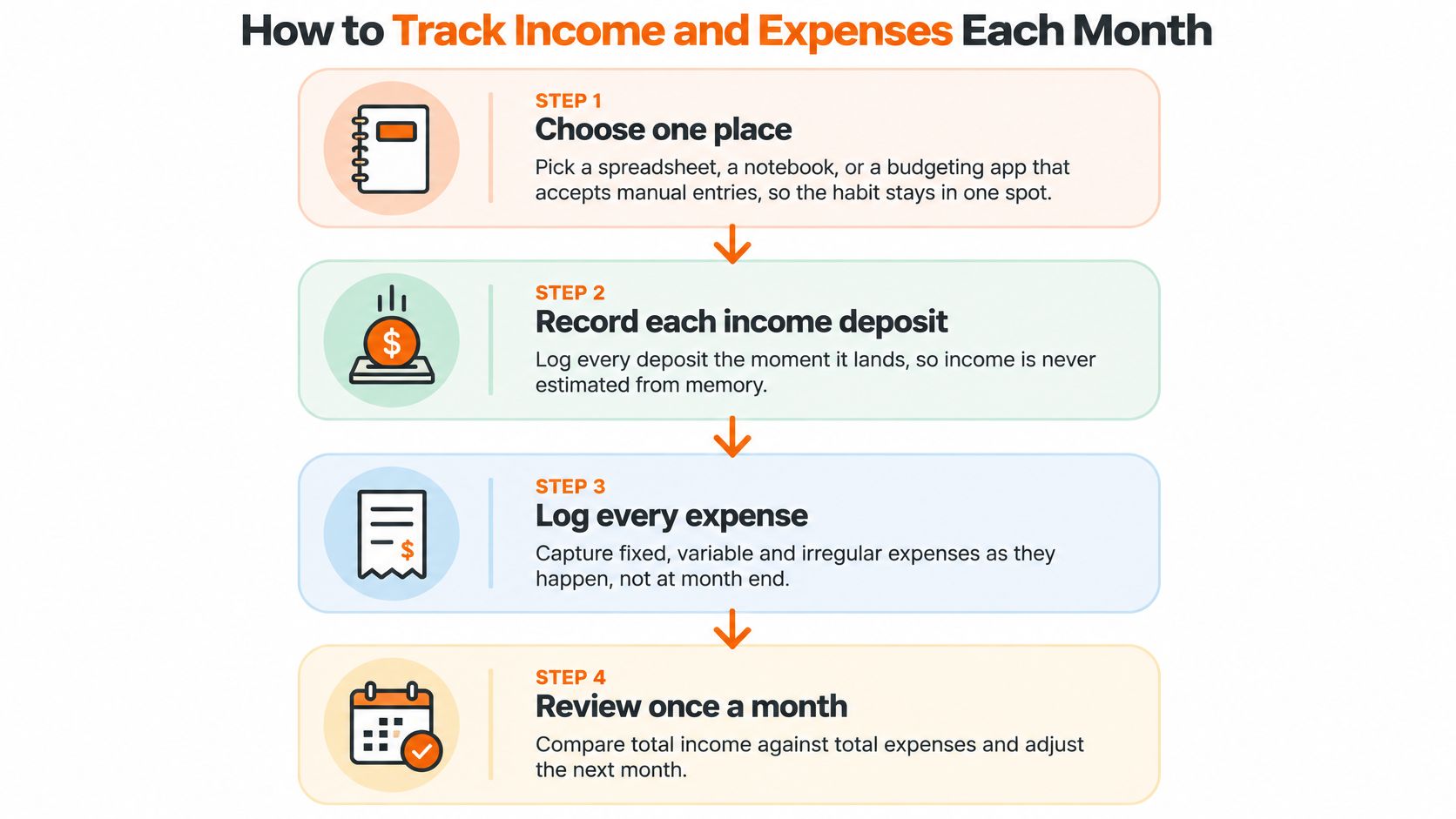
Choose one place to record everything. Use a spreadsheet, a notebook, or a budgeting app that accepts manual entries. Keep dates, descriptions, accounts, categories, and amounts together so you don't have to combine scattered notes later.
Record each income deposit when it lands. Enter the take-home amount and the payment date, using your statement to confirm both. For irregular pay, record actual deposits rather than copying an expected monthly amount.
Gather the last 30 days of transactions. Download statements or export a CSV from each relevant bank and credit card account. These records help you find forgotten purchases, but use the calendar boundaries you chose when preparing the final monthly total.
Assign every transaction a category. Give each purchase a purpose, such as groceries or transport, and mark large one-off charges as irregular. Keep those charges in the month's actual spending, but don't assume they'll recur every month.
Add cash spending and e-transfers. Check receipts, payment confirmations, and notes because a statement description may not explain what you bought. Record either a cash withdrawal as spending or the purchases made from it, not both; label personal transfers separately.
Total income and expenses, then subtract. Write the result beside the month and check it against your account records. If it doesn't reconcile, look for missing accounts, duplicate entries, outstanding card balances, or transfers before changing the totals.
Know when the month is complete
A complete record has every deposit entered, no uncategorised rows, and an explanation for any difference between your calculation and your account balances. If you include credit card purchases, reconcile the card balance too, rather than expecting the chequing account change alone to match.
Practical rule: A reconciled total is more useful than a tidy-looking total you can't explain.
You don't need to wait until month-end to enter purchases. A real-time expense tracking routine lets you capture details while you still remember them, leaving the monthly review for checking and deciding rather than reconstructing.
Mistakes That Throw Off Your Numbers
A transaction can be real without being a new expense or new income. Importing every line exactly as it appears on a statement won't necessarily produce a useful household total.
Check these common sources of confusion:
- Counting card spending twice. If you record each credit card purchase, treat the payment from your bank account to the card as a transfer. Record card interest and fees separately as expenses.
- Treating transfers as earnings or spending. Moving money between your own accounts changes its location, not your household income. Exclude both sides from income and expense totals, while keeping the transfer visible for reconciliation.
- Mixing pay periods with calendar months. A bill due on the first may be funded by the previous month's paycheque. For a cash-based monthly record, use the actual payment date consistently, then plan separately for when the money needs to be available.
- Mistaking an unusual month for a normal one. A large one-off charge belongs in actual spending, but it can inflate your estimate of routine costs. Tag it as irregular and compare a three-month average before resetting ongoing limits.
An irregular charge isn't an error to delete. It's a real cost to explain and prepare for.
Before trusting the result, confirm that no card payment, transfer, or refund has been counted twice. Check take-home pay, annual bills, and cash entries as well, then reconcile the records with your accounts, including any change in card debt.
Reading Your Monthly Balance Correctly
A surplus means income was higher than expenses. A break-even month means they matched, while a deficit means expenses were higher than income. Each result describes what happened during that period, not whether you're good or bad with money.
The single-month trap is reacting to an unusual bill as though it represents your everyday spending. An annual insurance payment can produce a deficit even when you've been preparing for it. Compare the result with a three-month average using the budgeting method below before making lasting changes.
What your monthly balance means
| Result | What It Means | First Move |
|---|---|---|
| Surplus | Income is higher than expenses | Direct the extra to savings or debt repayment |
| Break-even | Income matches expenses | Build a buffer for irregular costs |
| Deficit | Expenses are higher than income | Find the largest variable category and trim it |
| Irregular month | One large bill skews the result | Compare a three-month average before deciding |
If essential costs already exceed income, trimming variable spending may not be enough. Identify the size of the gap before assuming you can solve it by cutting small purchases.
Use benchmarks as context, not targets
Canadian households spent an average of $76,750 on goods and services in 2023, including $24,671 on shelter, $12,046 on food, and $12,090 on transportation, according to Statistics Canada's household spending overview; dividing those annual category amounts by 12 gives approximately $2,056, $1,004, and $1,008 per month, respectively.
These are Canadian household averages, not recommended limits or US spending benchmarks. Location, household size, and whether you rent or own can explain a substantial difference from your own spending.
A cash-flow management routine also considers timing: a positive monthly result doesn't ensure money was available on every bill's due date.
Choose your largest spending category and total its annual cost, then divide by 12 before comparing it with a monthly benchmark. If you already have a monthly figure, compare it directly, don't divide it again.
Using the Balance to Build a Realistic Budget
Set category limits from actual spending rather than the amount you wish you spent. Add the last three months in each category, divide by three, and round up slightly where needed. Keep identifiable annual charges separate from the routine baseline so you don't reserve for them twice.
Plan in the order money is needed
Cover fixed commitments first. In a hypothetical household with $4,200 in monthly take-home pay and $2,900 in fixed costs, those commitments leave $1,300 for everything else. Check due dates as well as totals, especially if most bills arrive before the next deposit.
Fund irregular expenses next. For example, a $600 annual insurance premium divided by 12 requires a $50 monthly reserve. Add similar reserves for other foreseeable costs, and keep the money clearly earmarked rather than treating it as available spending.
Set variable limits from what remains. Suppose the example household needs a $250 total monthly reserve for irregular bills. That leaves $1,050, which it might allocate as follows:
- Groceries and household supplies: $550.
- Transport: $200.
- Dining out and personal spending: $150.
- Savings goal: $150.
These are illustrative allocations, not recommended amounts for every household. If your actual essentials don't fit, change the plan instead of forcing your records to match an unrealistic target.
Keep the plan open to revision
A framework such as the 50/30/20 budget rule can help you think about priorities, but your actual commitments determine what's feasible. A category limit should guide a decision you can realistically make.
A budget is a plan to test against real life, not a final verdict on what you're allowed to need.
Check the next month's balance against the plan. If results differ from expectations for two months in a row, review the cause and adjust limits, reserves, or the savings contribution rather than repeatedly carrying forward a shortfall.
Start Tracking Your Numbers This Week
You can make a useful start in one sitting. Aim for a record you can check, not a perfect set of categories.
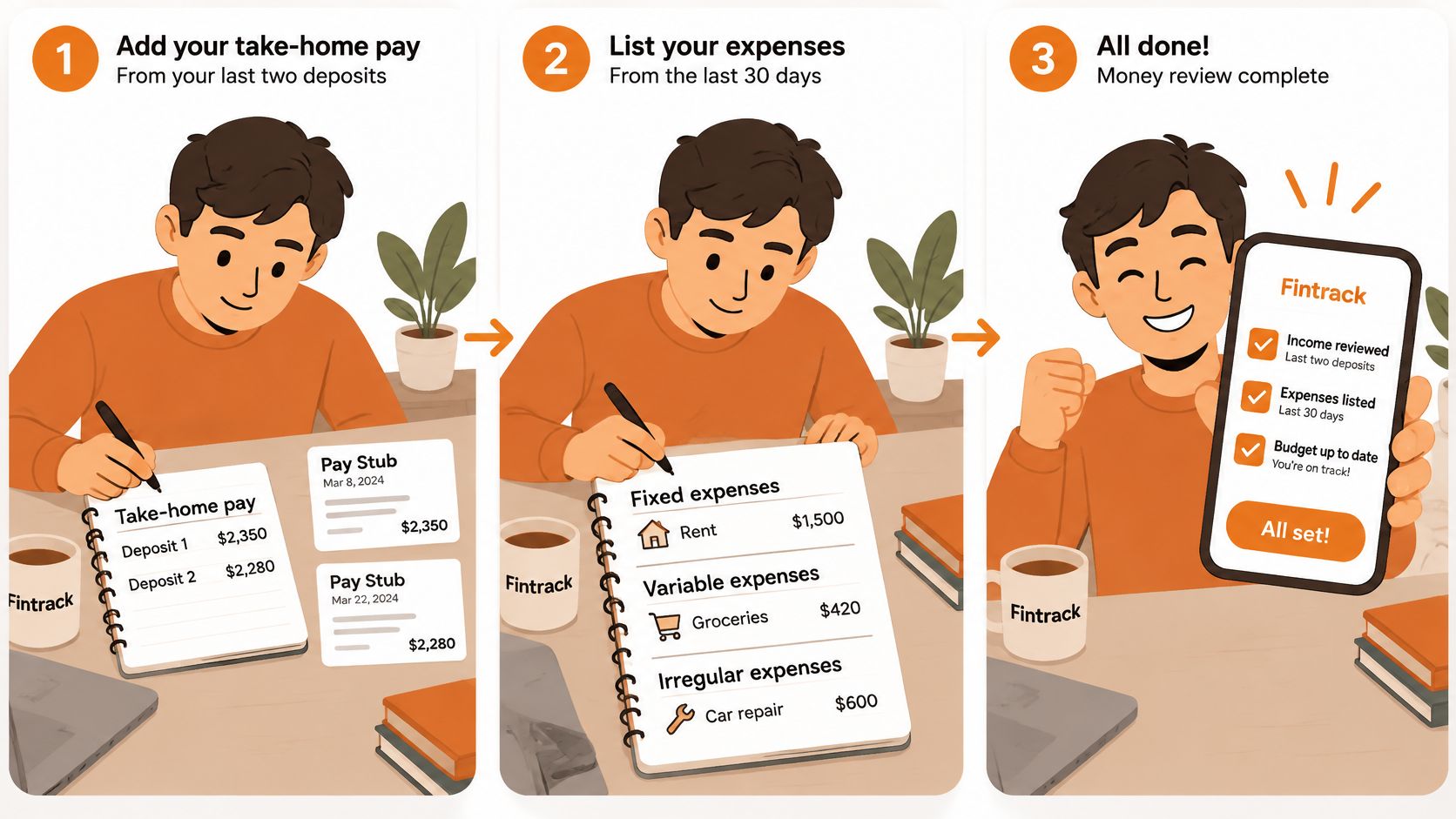
- Confirm your pay: Write down the take-home amounts from your last two deposits, then identify which deposits belong in the month you're reviewing.
- Collect your spending: List fixed, variable, and irregular expenses from the last 30 days, and flag known upcoming bills that didn't appear.
- Calculate the balance: Subtract expenses from income for the same period, then investigate any unexplained difference from your account records.
Choose a method you'll maintain
A notebook or spreadsheet works without a bank connection. Manual entry is also an option for Canadian users who prefer not to depend on bank feeds.
If you want less manual categorising, Fintrack's AI Expense Tracker is another option: our dashboard shows income, expenses, budgets, and goals in one place, and you can import CSV bank statements with AI classifying each row. Review the entries for accuracy before relying on the totals.
Repeat the calculation next month and compare the results. The comparison helps you decide what to keep, what to adjust, and which upcoming bills need a reserve.
Fintrack brings your income, expenses, budgets, and goals together so you can make this review a repeatable habit. Visit Fintrack to record your transactions manually or import a CSV, then use your monthly balance to plan the next month.