It's Thursday night, the rent left this morning, and your phone just buzzed for a streaming charge you forgot. The grocery debit from Friday is still sitting as a hold. Nothing in the account looks dramatic, yet one more debit can turn a few dollars short into a fee that costs more than the purchase. If you bank in Canada or the United States, the way to avoid overdraft fees is the same idea with very different prices. Coverage is not automatically the safer choice. You keep it only for bills a decline would make more expensive, and you let everyday card purchases fail.
What Overdraft and NSF Fees Cost Now
A $6 coffee can become an $41 mistake if it posts after rent has cleared. The app may show a balance that looks high enough, while the available balance already accounts for a pending grocery debit. That difference matters because banks decide whether to pay, decline, or cover a charge from the available figure.
Prices vary by country, and the gap changes the math. In Canada, about $5 is the common figure for pay-per-use overdraft, monthly protection, or a linked-account transfer. In the United States, a single overdraft often costs about $35. That means discretionary spending is usually cheaper to let fail. Coverage makes more sense for a bill whose late fee, service interruption, or credit consequence would cost more than the overdraft charge.
| Charge | Canada | United States | What happens to the payment |
|---|---|---|---|
| Pay-per-use overdraft | About $5 each time | Often about $35 | Payment usually completes |
| Monthly overdraft plan | About $5 per month at most banks | Often about $35 per use, not a flat monthly price at many banks | Coverage stays on |
| Linked savings transfer | About $5 per transfer | Some banks charge nothing; others bill a transfer fee listed in the schedule | Savings covers the shortfall |
| NSF or returned payment | Capped at $10 under the March 2026 regulation; no fee if the shortfall is under $10; one fee per two business days on personal accounts | Often similar to the overdraft fee, commonly about $35; each bank sets its own rule | Payment is rejected |
| Small-shortfall waiver | Some banks waive at $5 or less, or if repaid the same day | Not universal; a $1 gap can still trigger the full fee | Only when that bank's agreement includes a waiver |
| Interest on the negative balance | Possible on top of the fee | Possible on top of the fee | Separate from the flat fee |
Canada's price versus a US charge
In Canada, overdraft protection is usually a monthly plan or a pay-per-use charge. The Financial Consumer Agency of Canada reports that most banks charge about $5 per month for ongoing protection or $5 each time the service covers an overdraft, and a linked-account transfer may also cost about $5. Some institutions waive the fee when the account is overdrawn by a small amount, such as $5 or less, or when you repay the negative balance before the end of the day. Those waivers are optional bank policies, not a right you can demand.
Canada's NSF rule changes the downside of a declined personal payment. Under the March 2026 NSF regulation, the fee is capped at $10, there is no fee when the shortfall is under $10, and personal accounts are limited to one fee per two business days. That is very different from a US charge that can run about $35 even when the shortfall is tiny.
The California Attorney General's letter to banks and credit unions.pdf) puts a typical US charge at about $35, and notes that fee can apply even when the account is overdrawn by a small amount, so a $1 shortfall can cost the same as a $100 shortfall. California consumers paid an estimated $200 million in overdraft fees in 2022. A fee that size often exceeds the money the bank advanced.
Practical rule: Circle four lines in your own agreement before you enrol in anything: the overdraft fee, the NSF fee, the daily fee cap, and the linked-transfer charge.
Interest can sit on top of whichever flat fee you pay, so a “cheap” cover is not free just because the item went through. Business accounts in Canada sit outside the personal NSF cap, which is another reason to read the agreement for the account you use. I would start with the cheapest fix, which is declining discretionary debits, and only then decide whether a $5 Canadian cover or a roughly $35 US cover is worth keeping for a bill you cannot afford to miss.
How to Avoid Overdraft Fees With a Weekly Routine
Do this on the next payday. It takes one sitting, and it stops the Friday-hold problem before the card is in your hand. People who like paper envelopes can borrow the buffer idea from a guide to Goodbudget alternatives without logging every coffee.
- Read the available balance, not the ledger balance, and write down every pending card hold. A hold is already spent, even when the store hasn't sent the final amount.
- List every automatic debit due before the next pay, including subscriptions, and set a buffer at least as large as the biggest one. If a fixed dollar cushion isn't realistic, anchor the plan to the next paycheque date and put an alert on each bill instead.
- Move rent, utilities, and loan payments to the day after a verified payday, and leave one business day for the deposit to clear. A payday that lands on a holiday is not money you can spend that morning.
- Turn on low-balance and transaction alerts in the bank app, then confirm in writing whether debit and ATM overdraft coverage is on. In the United States, debit-card and ATM coverage generally needs an affirmative opt-in, so a setting you never chose on purpose should be switched off.
- Split the money the day it lands. Bills sit in one spot, everyday spending in another, so a card purchase can't drain the rent. A plain cash flow routine is enough. You don't need a second budgeting personality.
- During a tight week, check pending authorizations once a day until payday. That's the only extra habit. Skip it when the buffer is intact.
- If a fee already posted, call the same day. Note the deposit time and the posting time, and ask for a one-time reversal. A first mistake is easier to unwind than a third one.
Self-employed readers hit the same timing trap when a client pays late and a tax instalment doesn't. A clear walk-through of startup cash flow management is worth a look if your income arrives in lumps rather than on a salary calendar. The buffer still has to match the largest debit, not the average week.
Six avoided $35 fees keep about $210. One avoided fee a month keeps about $420 a year.
When Protection Beats a Declined Payment
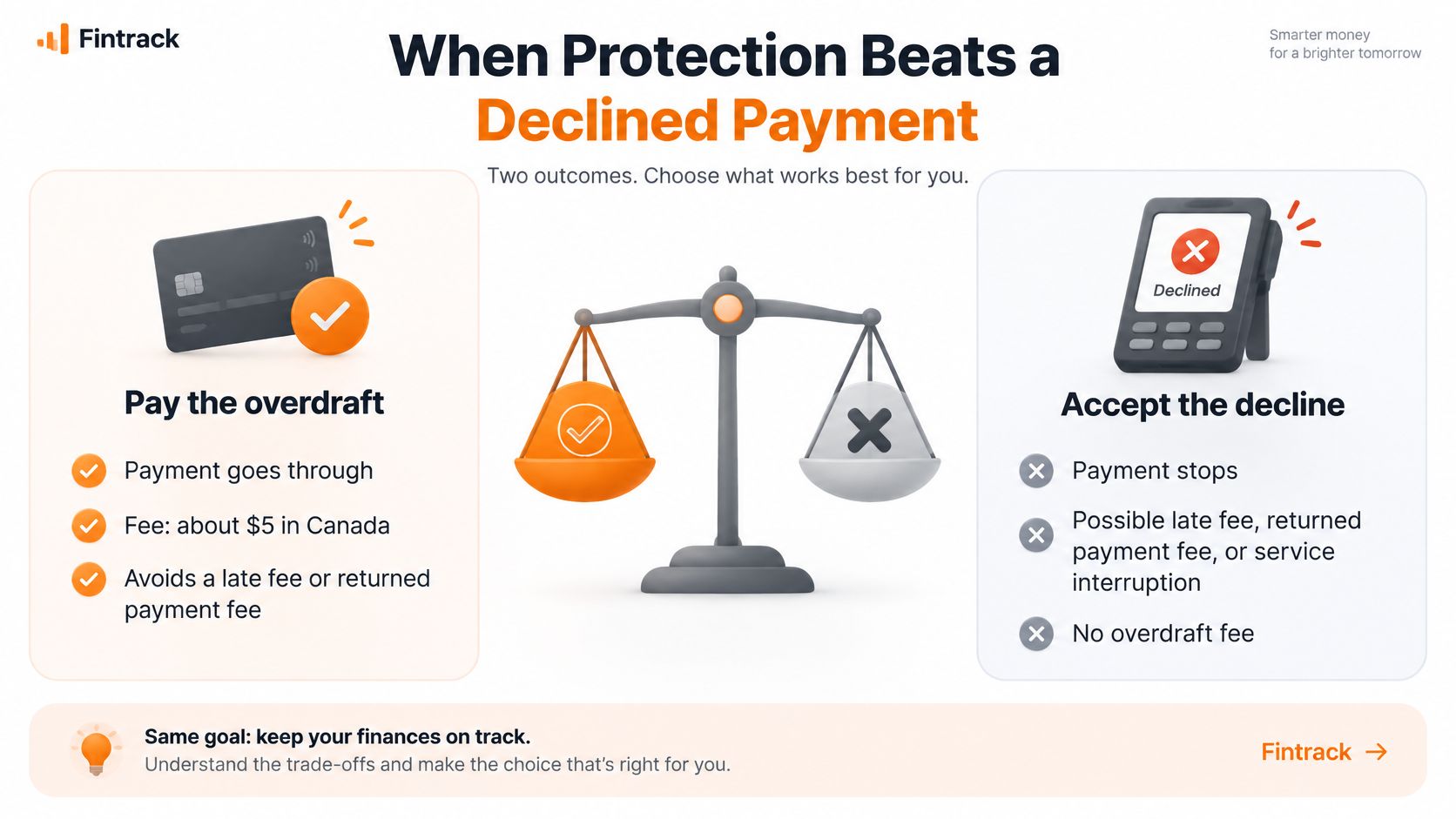
Overdraft coverage is a cost choice, not a safety switch. A paid overdraft lets the payment through and charges a fee, about $5 at many Canadian banks or about $35 at many US banks. A decline can instead bring a late fee, a shutoff, or a returned-payment charge. Sometimes that second cost is worse. Often it isn't, and blanket “turn coverage on” advice hides the difference.
The Financial Consumer Agency of Canada's overdraft guide draws the line clearly. Pay-per-use protection is a set charge each time the bank lets the account go negative, with the maximum generally described as $5, and the payment is typically completed. Without protection, an insufficient balance can return the payment and trigger an NSF fee, subject to the newer $10 federal cap and its restrictions. Compare four things before you pick a side: the bank fee, the chance the payment is returned, the biller's penalty, and how soon your income arrives.
| Payment | Default choice | If the bank covers it | If the bank declines it |
|---|---|---|---|
| Everyday debit card purchase | Decline coverage | About $5 in Canada or about $35 in the US | Purchase fails; usually no overdraft fee |
| ATM withdrawal | Decline coverage | Same overdraft fee if the bank approves it | Often no bank fee; California state-regulated institutions cannot charge for an immediate ATM decline since 1 January 2025 |
| Rent, utilities, insurance | Limited backup only | Protection fee, plus possible interest | Late fee, returned payment, or service interruption |
| Subscriptions and streaming | Cancel or move the date | Repeat $5 or about $35 charges | Canada NSF up to $10, and only one fee in two business days |
| Account with a possible state fee cap | Ask the bank before relying on it | Bank terms may set a lower cap, notice, or approval rule | A cap on bank fees does not remove a biller late fee |
Walk the rows, don't enrol for all of them
Everyday debit stays on decline. A bank fee can exceed the coffee or the groceries, and a failed purchase at the till is annoying, not a shutoff. ATM withdrawals belong in the same column. Since 1 January 2025, California's rule for state-regulated banks and credit unions bars a fee when an ATM withdrawal is declined immediately for insufficient funds. That protection does not cover an approved withdrawal that settles later, and it does not automatically cover federally chartered banks. If you aren't sure of the charter, ask before you assume the decline is free.
Keep a limited backup only for rent, utilities, insurance, or anything that can interrupt service. Put that backup in its own balance so Saturday spending can't touch it. Splitting the money is easier once you see how to manage multiple bank accounts without losing track of which one pays the landlord.
Subscriptions go in the cancel-or-move column, not the protection column. A streaming charge that fails is a prompt to change the date, not a reason to pay a cover fee every month.
If your bank or credit union is subject to a state fee rule, ask whether it applies to overdraft fees, NSF fees, or both, and whether it requires notice each time. Keep the answer with your account agreement. The bank cap still leaves the biller penalty outside the room, so the power company or insurer can add a late charge even when the bank fee is lower.
Stop a Repeat Overdraft Cycle
A second fee is a pattern, not bad luck. California Attorney General Bonta's warning, citing CFPB evidence, says consumers who pay more than 10 overdraft fees a year account for nearly three-quarters of all overdraft-fee revenue. If that is the year you are having, the weekly check is not enough. You need a 90-day cleanup, because repeat fees usually come from the same few timing gaps.
- Export 90 days of transactions from the bank, not from memory.
- Tag each fee as a subscription, a bill payment, a debit hold, a cheque, or a deposit that arrived late. The tag tells you which lever to pull.
- Note the available balance just before each fee. You are looking for the number that was short, which is often small.
- Cancel or move anything non-essential that hit more than once. One forgotten app trial can be the whole pattern.
- Put the next payment date after a verified payday, including benefit deposits if that is your income.
- Fund a separate bill amount on payday so everyday spending cannot touch it.
- Look at the account once after every pay cycle for the next month. If a new fee appears, the tag list is not finished.
A flat $35 fee on a small shortfall that gets repaid quickly works out to an expensive short-term advance. Preventing 10 of those annual fees avoids about $350 and can move you out of the high-frequency group the CFPB figure describes. Ask for a reversal on the first surprise, and keep the posting times. If the same fee returns with no explanation, escalate through the bank and, in Canada, the bank's complaint process or FCAC guidance. In California, repeated surprise fees can also go to state consumer-protection authorities.
A messy export is easier to read once categories are rebuilt. Fintrack's AI Expense Tracker auto-categorizes transactions and lets you ask spending questions in plain language, which helps when the fee pattern is buried in a long transaction list. Color-coded budget bars also show when a category is nearing its limit, shifting from green to yellow to red as spending approaches the cap. Real-time mobile spending alerts can catch unusual activity before it repeats, and Velocity alerts warn when your spending pace suggests you will exceed a budget before month-end.
If the fees line up with the week before payday, the cleanup belongs next to a plan for living paycheque to paycheque, not next to another overdraft enrolment form. Move the bill dates, protect the payday deposit window, and leave the optional charges for later. The cheaper setup is the one that removes the same shortfall before it reaches the bank again.
Pending Holds and Low-Balance Alerts
You did the payday routine. Tuesday still goes wrong. Payroll shows as pending because the cutoff was 6 p.m., a hotel hold is $80 more than the final bill, and the phone bill and the insurance draft both settle at 8 a.m. The plan was fine. The timing wasn't.
Treat the hold as spent, even when you expect the hotel to release the extra tomorrow. Two large withdrawals on one morning will race each other, and the one that posts second is the one that sees the shortfall.
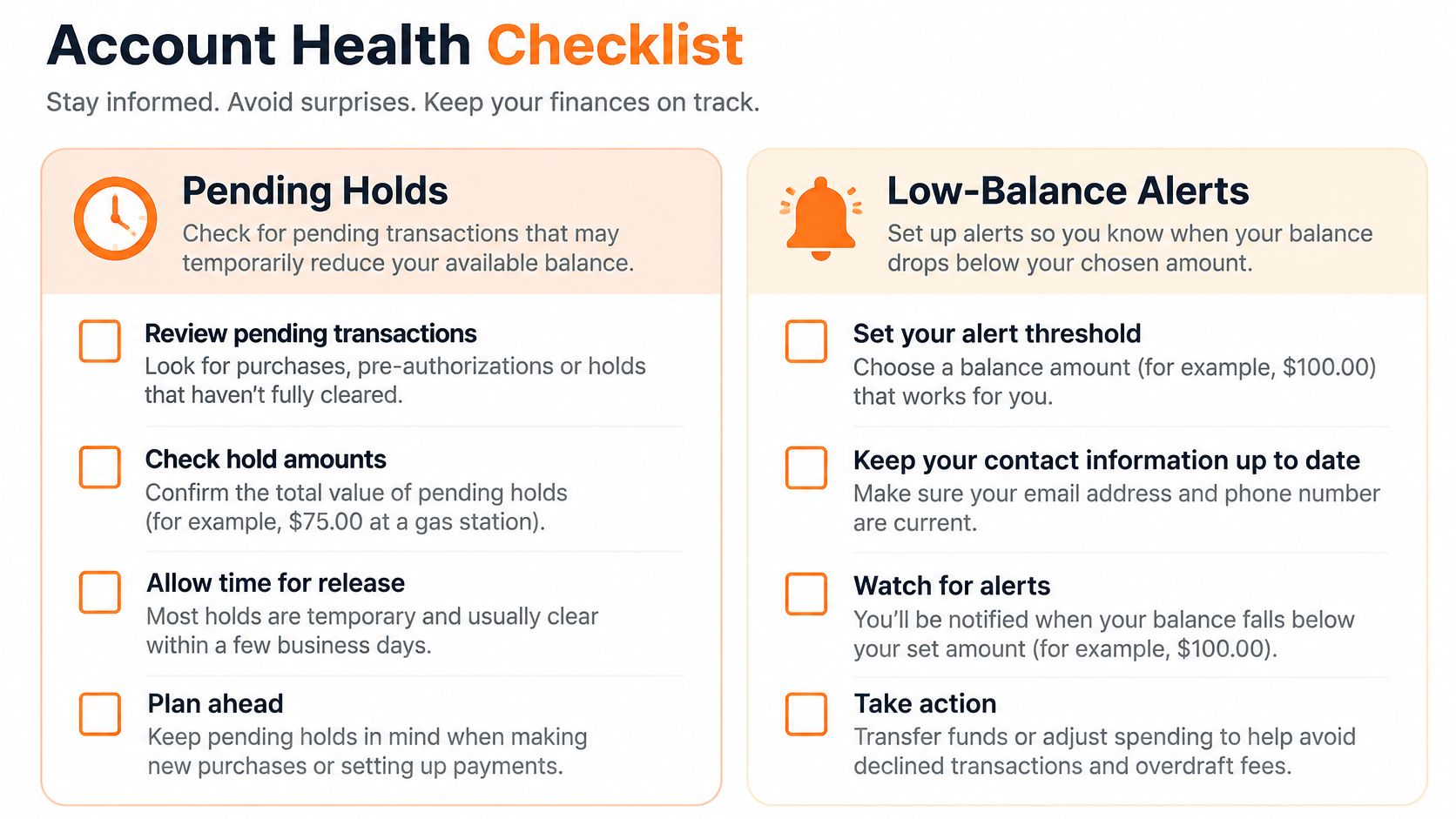
- Compare both balances: Look at available and ledger before any debit, and spend from the lower one.
- Count the hold: A pending authorization is already gone, including the extra a hotel or gas pump reserves.
- Split the morning: Don't schedule two large withdrawals on the same day if either one could miss.
- Ask the three outcomes: Will the bank return the payment, pay it, or let the merchant resubmit it tomorrow?
- Set the alert above the buffer: A warning at zero arrives after the decision. Put it higher than your largest pending debit.
The Canadian cap is a backstop
Since March 2026, Canada's NSF fee regulations cap non-sufficient-funds fees on personal deposit accounts at $10. A bank can't charge an NSF fee when the shortfall is less than $10, and it can't charge more than one NSF fee on the same personal account within two business days, even if a merchant retries the same payment. Corporate and business accounts are outside those rules. The payment can still be rejected, and overdraft interest or a protection fee can still apply. The cap limits the damage. It is not the plan.
A manual log still works when a bank connection drops, which matters for a lot of Canadian accounts. People rebuilding that log after unreliable feeds can start from PocketSmith alternatives and type the pending holds in by hand until the feed behaves. Pair that list with a bill reminder app so the insurance draft doesn't share a morning with rent.
An alert after the balance is already negative is a receipt, not a warning.
Set Your Buffer and Alerts This Week
Pick a buffer equal to the largest pending debit, decide which bills may use protection, and set a low-balance alert above that buffer. Keep discretionary card purchases on decline. Give a limited backup only to bills where a rejected payment creates a late fee, service interruption, or rescheduling cost. Move everything else to a new date or cancel it before it becomes a fee plan.
If a true emergency shows up before payday, compare a short-term option such as find fast cash with pawn loans against the late fee on the bill and against the slower path in these emergency fund tips. A pawn loan or any other quick advance is a priced choice. It should support a specific bill with a known cost, not paper over a buffer that keeps running short.
A free Fintrack account takes under a minute and doesn't need a credit card. Once it is running, real-time spending alerts on mobile flag activity as it happens, and velocity alerts warn when your spending pace suggests you will exceed a budget before month-end. That gives you a chance to move a payment before the bank makes the decision for you.
The useful setup is specific. Set category limits for the debits that caused past shortfalls, then watch the color-coded budget bars shift from green to yellow to red as spending approaches the limit. If a category keeps turning red before payday, use AI-recommended budgets to compare that limit with your spending history and set a more realistic amount. The expense tracker auto-categorizes transactions and lets you ask plain-language questions such as which checks cleared this month or how much groceries cost last week.
Set the alert threshold tonight, then check the available balance once before the next automatic bill. Keep the threshold above the buffer by enough room to catch the largest pending debit while you can still move money or change a payment date.
Fintrack brings your budgets, alerts, transactions, and savings goals into one place so a shortfall has somewhere to show up before the next automatic bill. Start with the bill due next, set its category limit, and tie that limit to the buffer you chose. Visit Fintrack and set the first alert against that bill.