Two paycheques land, rent comes out, and three weeks later you're both staring at the bank balance wondering where the rest went. It's not one big purchase. It's groceries that crept up, a yearly insurance bill you'd forgotten, and a few small charges nobody planned for.
A household budget plan fixes that by giving every dollar a job before the month starts. You'll need honest numbers, a rule that fits your income, and a small monthly set-aside for bills that don't arrive monthly. The first month will be rough, and that's normal. You're building a plan you'll check consistently, not a perfect spreadsheet.
Set Goals and Pull Every Income Source Together
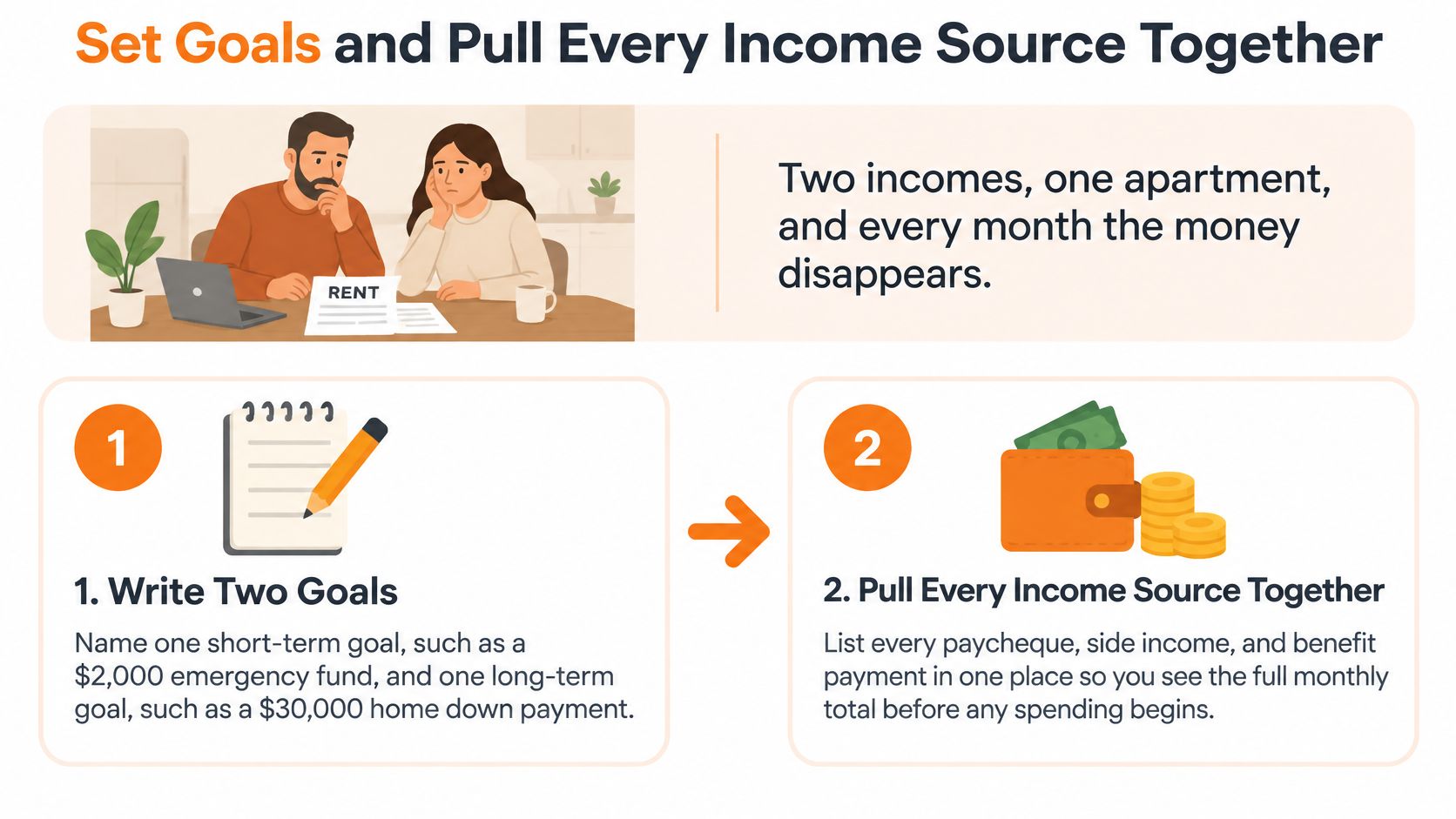
A two-income couple renting an apartment argues every month about where the money went. They earn enough on paper, yet savings never move. The fix starts before any numbers go on paper, because a household budget plan without a reason becomes a list you stop opening by week three.
Write goals you can rank
- Name two or three goals with an amount and a date: For example, a $6,000 emergency fund in 18 months, a $3,000 summer trip, and paying off a $4,200 credit card balance. Vague goals like "save more" don't tell you what to move on payday.
- Rank the goals in order: Put a small starter cash buffer first, so one surprise bill doesn't go on the credit card. Put high-interest debt second, such as that card balance, and the trip third. The ranking decides which goal gets leftover money first when a month goes well.
- Keep the list short: Two or three goals are enough to direct the plan. A longer list spreads money too thin and makes progress hard to see. If you need help choosing, a guide to setting financial goals you can measure can help you narrow the list before you build the budget around it.
Count income the way it actually arrives
List every income source at take-home pay, after tax and payroll deductions, not gross salary. Gross pay flatters the plan and leaves you short every month. Add paycheques, side work, and benefit payments in one place so you see one monthly total.
For irregular income such as side work or bonuses, use the lowest of the last six months, not the best one. A strong month then creates a surplus you can send to a goal, while a weak month doesn't break the rent payment. It's a conservative choice, and it's the one that survives contact with real life.
Start from statements, not memory
Gather three months of bank and card statements before you set any category amounts. Memory smooths over the takeout orders and the pharmacy runs. Statements don't. They also show you charges you'd forgotten you're still paying.
Use the national average only as a sanity check, not a target. Statistics Canada's 2023 household spending release reported that Canadian households spent an average of $76,750 on goods and services in 2023, up 14.3% from 2021, which works out to roughly $6,400 a month. If your first total is far outside a range that makes sense for your household size and city, check your figures before going further.
That same release found shelter was 32.1% of consumption, transportation 15.8%, and food 15.7%, together 63.6% of average consumption. Most of your money will sit in those three categories, so they deserve your attention before smaller discretionary lines.
By the end of this setup, you should have two inputs that every later step depends on. One is a single net monthly income figure. The other is a ranked goal list with amounts and dates. Without both, you're just sorting expenses with no direction.
Prices move, so old targets go stale. Rebuild your starting numbers from recent statements whenever rent, insurance, or commuting costs change, not once a year by habit.
Pick an Allocation Rule That Fits Your Income
An allocation rule is a starting split, not a verdict on how you live. The right one depends on how much of your take-home pay essentials already consume. Pick a rule that matches that reality, test it, and adjust it rather than forcing your life into percentages that don't fit.
Common budget allocation rules compared
| Rule | Split or method | Works best when | Watch out for |
|---|---|---|---|
| 50/30/20 | 50% needs, 30% wants, 20% savings and debt | Needs take about half of take-home pay or less | Needs above 50% leave no room, high rent often breaks it |
| Zero-based | Every dollar assigned until income minus spending equals zero | Income varies, or the household is tight on cash | Takes 30 to 60 minutes a month and needs regular updates |
| Pay yourself first | Savings moved out on payday, the rest split freely | A savings goal is the top priority | Leaves little room if essentials aren't already covered |
| Envelope or sinking fund | A fixed amount set aside for each category | Overspending in one category, such as dining out | Rigid, and irregular bills need their own envelopes |
| Essentials first | Housing, utilities, food, transport, and debt minimums funded before goals | Essentials take more than half of net pay | Cutting wants alone won't close a structural income gap |
How to choose in four steps
- Add up your essentials: housing, utilities, groceries, transportation, insurance, and minimum debt payments. Divide that total by net income to get your essentials share.
- Match the rule to that share: If essentials stay under roughly half of net pay, 50/30/20 can work as a rough guide, and a detailed walkthrough of the 50/30/20 budget rule shows how to apply it category by category. If they run higher, switch to an essentials-first approach and treat what remains as a survival budget.
- Handle variable income separately: If income changes month to month, choose zero-based budgeting so every dollar has a job before the month starts. You rebuild the plan each month around the income you expect to receive.
- Test before you judge: Run the rule for two full months. One month can be distorted by a single large bill. Two months show you whether the split or your category estimates need work.
When the percentages don't fit
Housing above 30% of gross income is common in high-cost cities, and it breaks tidy percentage rules fast. When that happens, don't abandon the plan. Rebuild around essentials, protect food, utilities, transportation, and debt minimums, then shrink the savings target to a smaller, reachable number.
That's not failure, it's honesty. A small transfer you make every payday beats a large one you reverse three weeks later. You can raise the target when income rises or a fixed cost drops.
Practical rule: The best allocation rule is the one you can check in about 15 minutes a month.
Catch Leaks and Plan for Irregular Bills
The bill that breaks most budgets isn't monthly. It's a yearly insurance premium, or a set of tires that wipes out the grocery money for the month. You knew the cost existed, you just never gave it a monthly line, so it arrives looking like an emergency.
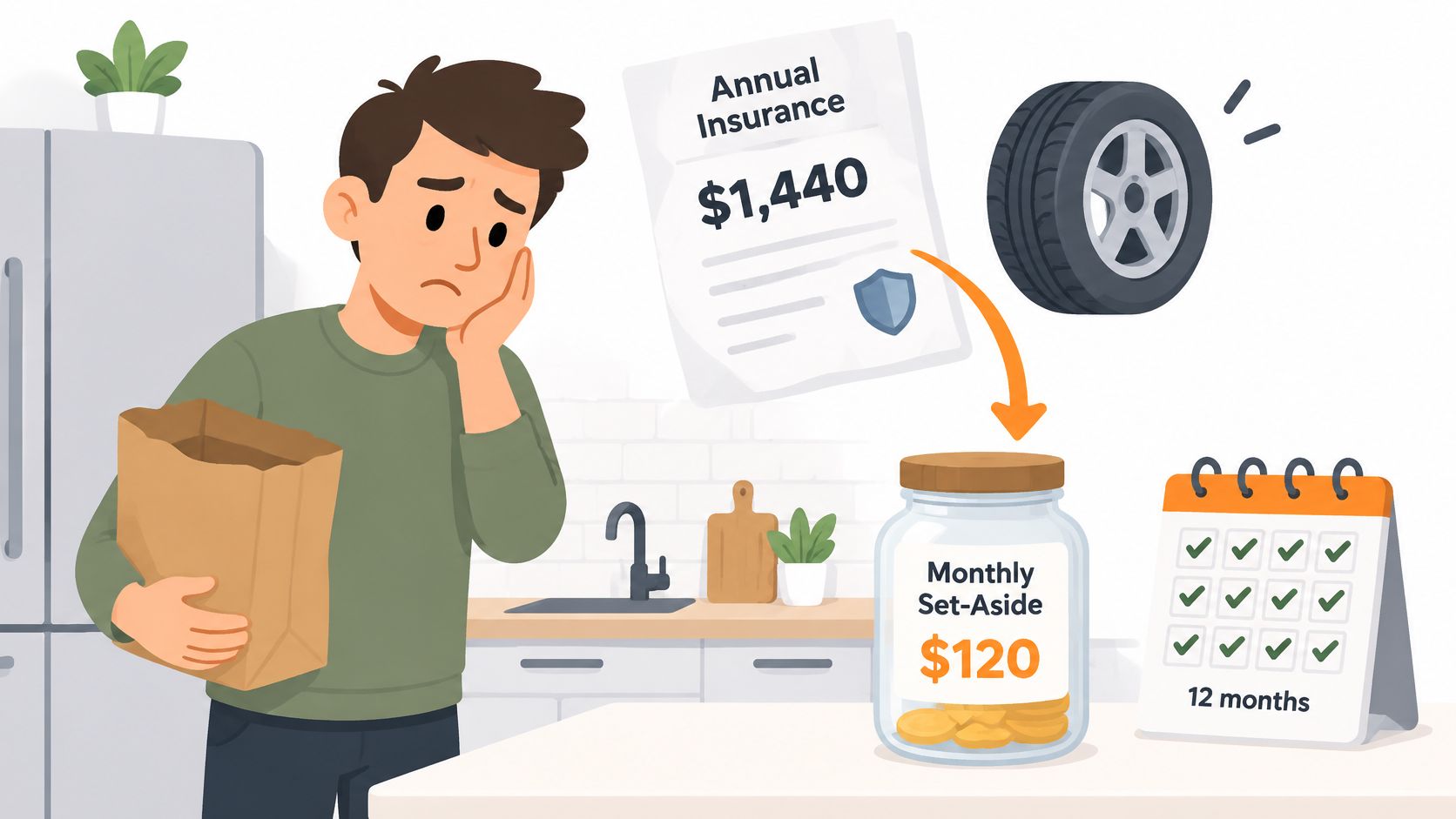
The fix is a sinking fund. Divide each yearly cost by 12, move that amount aside every month, and the bill becomes planned. A plain explanation of what a sinking fund is and how to start one covers the setup if the term is new to you.
Transportation shows why this matters. Statistics Canada's breakdown of 2023 household transportation spending put the average at $12,090, equal to 15.8% of total consumption, with spending 19.7% higher than in 2021. Owners with a mortgage averaged $15,581, owners without a mortgage $11,316, and renters $8,839, so your housing situation changes what the car really costs you.
Irregular expenses and their monthly set-asides
| Irregular expense | Average yearly cost | Monthly set-aside |
|---|---|---|
| Car registration and licence renewal | $120 | $10 |
| Vehicle maintenance (oil, brakes, filters) | $600 | $50 |
| Tires (one $800 set every four years) | $200 | $17 |
| Car insurance premium paid yearly | $1,200 | $100 |
| Gifts and holidays | $600 | $50 |
| Home or renter repairs | $480 | $40 |
| Dental cleanings and eye exams | $180 | $15 |
| Annual subscriptions and memberships | $240 | $20 |
| Total | $3,620 | $302 |
These are example amounts for a one-car household, so replace each one with your own bills. The method stays the same. Predictable items like fuel and transit belong in the monthly budget, while registration, repairs, and renewals belong in the sinking fund.
Find the leaks in three months of statements
- Cancel what you haven't used in 60 days: Recurring charges you no longer use are the easiest money to recover, because cancelling changes nothing about your daily life.
- Look for duplicate charges: The same amount twice within a few days often points to a double subscription or a pre-authorized hold. A tracking app with duplicate-charge alerts can surface these faster, but a manual scan does the same job.
- Check renewal price creep: Phone, internet, and insurance bills tend to rise at renewal without much notice. Compare the current charge with the one from three months ago.
- Use credits before they expire: Cashback, account credits, and loyalty points have real value, but only if you spend them before the expiry date.
- Watch for annual charges: Yearly fees rarely appear on a monthly scan, which is exactly why they surprise people. Search statements by merchant name across the full year if your bank allows it.
Don't try to plug every leak in one sitting. Cancel two or three charges, set up the sinking fund transfer, and move on. Small, finished fixes beat an exhausting audit you never repeat.
Sample Monthly Budget Template for a Two-Income Household
Priya and Dan bring home $5,640 a month between them. They rent a two-bedroom home and have one car. Their sample budget assigns every dollar of take-home pay, including money set aside for irregular bills. Use the figures as a working example, then replace them with your own.
Sample monthly budget for a two-income household
| Category | Planned monthly amount | Notes |
|---|---|---|
| Rent | $1,800 | Fixed monthly bill |
| Utilities (power, gas, water) | $220 | Three-month average |
| Groceries | $750 | Three-month average |
| Transportation (fuel, transit, car payment) | $650 | Includes one car payment |
| Renters insurance | $25 | Monthly share; car insurance is in sinking funds |
| Phone and internet | $140 | Bundle price; check every six months |
| Debt payments (minimums) | $250 | Credit card and student loan minimums |
| Savings transfer (emergency fund) | $500 | Automatic transfer on payday |
| Travel fund (summer trip) | $150 | Monthly contribution toward a ranked goal |
| Subscriptions | $60 | Streaming, apps, and memberships |
| Dining out and entertainment | $300 | Flexible spending |
| Personal care and clothing | $200 | Yearly costs spread across months |
| Medical and pharmacy | $60 | Prescriptions and deductibles |
| Sinking funds (irregular costs) | $302 | Monthly set-asides for irregular expenses |
| Miscellaneous buffer | $233 | Room for unplanned costs |
| Total planned spending | $5,640 | Matches monthly take-home pay |
How this template was built
- Enter fixed bills first: Start with rent, insurance, phone and internet, and minimum debt payments. Their due dates do not shift just because another category ran high.
- Use three-month averages for variable costs: Groceries and utilities are based on recent spending, including higher-cost months. A budget built around the cheapest month is likely to fall short.
- Give irregular bills a monthly line: The $302 sinking-fund amount represents set-asides for costs such as annual insurance and tire replacement. Saving a portion each month means those bills do not have to come out of one paycheque.
- Schedule savings before flexible spending: The emergency-fund transfer goes out on payday. If savings depend on what remains at month's end, everyday spending can use the money first.
- Keep a buffer for the first month: The $233 miscellaneous line gives the household somewhere to put small surprises while the plan meets real spending. Review actual costs after the first month, then adjust categories that were too low or too high.
The first version will be imperfect. A bill may arrive earlier than expected, or groceries may cost more than the average suggests. That is useful information, not proof that budgeting failed. Keep irregular expenses in their own line so the first-month review can distinguish a genuinely high monthly cost from a bill that arrives only occasionally.
Make the template yours
Housing costs vary by household. Statistics Canada's look at household finances and shelter costs provides context on household finances, but an average cannot set your housing budget. Enter your own rent or mortgage payment, along with any housing costs you pay regularly.
Add a Planned versus Actual column to your copy and fill it in as expenses happen. If you pay for childcare, give it a separate row rather than burying it in groceries or miscellaneous. Large recurring bills are easier to manage when you can see their full monthly cost.
If planned spending exceeds take-home pay, trim flexible categories first. Dining out, subscriptions, and the travel contribution may have room to change before debt minimums or savings set aside for known bills. If essential costs alone exceed income, the gap is larger than small cuts can solve. Review housing, transportation, income, or available support programs, then adjust the budget to match what the household can realistically afford.
Share Money Without Turning Every Bill into a Debate
Who pays for what, and does each person keep real spending freedom? Couples avoid this question until a shared card statement turns it into an argument. Settling the structure once is far easier than renegotiating every purchase.
Shared money setups compared
| Setup | How bills get paid | Best for | Main risk |
|---|---|---|---|
| Fully joint | All income goes into one account that pays every bill | Couples with similar habits and shared goals | One person's overspending affects both, less personal freedom |
| Hybrid | Shared bills come from a joint account, each person gets a fixed allowance | Most couples and roommates with different incomes | Allowances need review when incomes change |
| Proportional split | Each person pays a share of shared costs based on income | Partners with a large income gap | Needs a yearly recalculation, can feel like keeping score |
| Separate with split bills | Each pays their own accounts, shared costs are tracked and settled | Households that want full independence | Settlements are easy to forget, no shared view of savings |
Choose a setup and set the formula
- Agree on shared goals and shared costs first: Decide what counts as a shared expense and total it for the month before you pick a setup. Most disagreements are really about this definition.
- Match the setup to your income gap and habits: Similar incomes and habits can work fully joint. Different incomes or different spending styles usually suit the hybrid or proportional options better.
- Write down the formula: In a hybrid model, give each person a fixed personal allowance, such as $250 each, that needs no justification. For a proportional split, divide shared costs by income share. If one partner earns $4,000 and the other $2,000, shared costs of $3,000 split two to one, which means $2,000 and $1,000.
- Hold a 20-minute monthly money date: Compare planned and actual shared spending, adjust one or two lines, and stop. Short and regular beats long and rare. A budget template built for couples gives you a shared layout to bring to that conversation.
The friction point to design around
The usual flashpoint is a single shared category, often dining out, where one partner's habit becomes both partners' problem. The fix isn't a lecture. Give each person a separate personal allowance line, so personal choices stop drawing on shared money.
Roommates and blended families face a slightly different version of this. You may not share goals, but you do share due dates. Agree on a written settlement date each month, in writing, and settle in full on that date rather than carrying small balances that slowly grow into resentment.
Shared money works when the rules are boring. If you need a negotiation to buy lunch, the setup is wrong, not the person.
Automate, Review and Start Your First Month
Automate the transfers that remove the most willpower first. Schedule the emergency fund transfer for payday, set bill payments to run automatically, and move the sinking fund money on the same day. When the important money leaves before you start spending, the rest of the month gets simpler.
Pick a way to track that you'll keep using
Manual entry or a CSV import keeps control in your hands, and it suits people who don't want to connect bank accounts to an app. Fintrack works without a bank connection and supports manual entry, and Fintrack's budget planning features show how categories, sinking funds, and monthly reviews fit together in one place. A spreadsheet does the same core job if you'll open it weekly. The tool matters less than the habit, so choose based on what you'll still be using in three months.
Budget review schedule
| Check | How often | What to review |
|---|---|---|
| Quick balance check | Weekly, about 10 minutes | Spending in each category against plan, bills due in the next seven days |
| Monthly reconciliation | Once a month, after the last payday | Planned versus actual per category, any variance over about 10% |
| Goal and reserve update | Quarterly | Progress on the emergency fund and debt payoff, whether each goal still matters |
| Full rebuild | Yearly, or after a life change | New rent, rates, income, childcare, or a new car, rebuild the template from scratch |
Run the monthly reconciliation in three steps
- Enter or import the month's transactions: Get everything into one place, including cash spending you can remember and charges on every card. A partial picture produces confident, wrong decisions.
- Compare planned and actual for each category: Look at the size of each gap, not just whether one exists. A small grocery overshoot in a month with guests visiting isn't a budgeting problem.
- Move money between categories and note why: Write one line explaining each move, such as "moved $60 from dining to utilities, cold month." Those notes make next month's plan smarter, and automating parts of your personal finances can cut the repetitive parts of this routine down further.
Between reconciliations, spend about 10 minutes a week checking category balances against bills due in the next seven days. That quick look catches a shortfall while you can still adjust. Finding out at month's end only gives you a report, not a choice.
The variance rule that keeps the plan honest
If one category runs more than about 10% over plan for two months in a row, the plan is wrong, not the person. Raise the planned amount to match reality, or deliberately cut the category, and date the change in your notes. Repeatedly missing an unrealistic number teaches you to ignore the whole budget.
Update goal progress quarterly, and ask whether each goal still matters. Rebuild the template yearly, or sooner after a life change such as new rent, a new job, childcare starting, or a car purchase. Old plans built on old costs gradually stop describing your life.
Your first weekend
Copy the sample template and replace each line with your own three-month averages. Total it against net income, send any leftover to the buffer, and cut from discretionary lines if you're over. Then set the savings and sinking fund transfers to leave on payday, and book your first monthly review in the calendar before you close the laptop.
Your first month will be rough. Categories will be off, and at least one bill will surprise you anyway. That's the reality check working as intended. The goal isn't a perfect first month, it's a plan that gets checked, adjusted, and gradually becomes the way your household already thinks about money.
If you want your household budget plan, shared categories, and sinking funds in one place without connecting a bank account, Fintrack lets you track spending manually, set category budgets, and review progress together. Visit Fintrack to build your first month's plan from the template above and book your first review.