
Payday arrives, the bills go out, and for a day or two you feel organised. By Wednesday, the savings target has disappeared into groceries, subscriptions, and an expense you forgot to plan for. The problem usually isn't a lack of discipline. It's that “save more” has no amount, deadline, or automatic action attached to it.
Learning how to set financial goals means turning an intention into a system. You'll define SMART targets, rank short- and long-term priorities, assign each goal a budget line, choose suitable Canadian accounts, and review progress without living in a spreadsheet. The aim is simple: make the plan carry more of the work than your motivation.
Why Most Financial Goals Quietly Disappear
A goal such as “get ahead” sounds sensible, but it gives you nothing to do on payday. You can't check whether you're making progress, decide which account should hold the money, or know what to change when expenses rise. “Save for a holiday” has the same problem. Until you choose the destination, amount, date, and contribution, it remains a wish.
Canadian households often face more immediate needs than abstract wealth-building. The Financial Consumer Agency of Canada reports that 47% of Canadians save for unexpected expenses, while the 2019 Canadian Financial Capability Survey found that 64% had an emergency fund covering three months of expenses and 65% felt they could find $2,000 within a month. Those figures point to a practical starting place, emergency savings before lifestyle upgrades or ambitious investing goals. The Financial Consumer Agency of Canada's financial literacy progress report provides the broader context.
Practical rule: If a goal can't be expressed as an amount, a date, and a recurring action, it isn't ready for your budget.
The gap between intention and execution is why written planning matters. A useful financial advisor compliance guide also illustrates the value of a documented process, clear priorities, and regular reviews when financial decisions need to remain consistent. For a personal plan, that process can be much simpler: choose a few targets, fund them automatically, and check whether the numbers still fit.
The rest of the playbook follows that logic. You'll turn vague wishes into SMART goals, place them in priority lanes, fund them through your budget, use TFSA and RRSP room carefully, and keep a small scoreboard. For a helpful companion on the reasoning behind the process, see why goal setting is important.
Turning Loose Ideas into SMART Money Goals
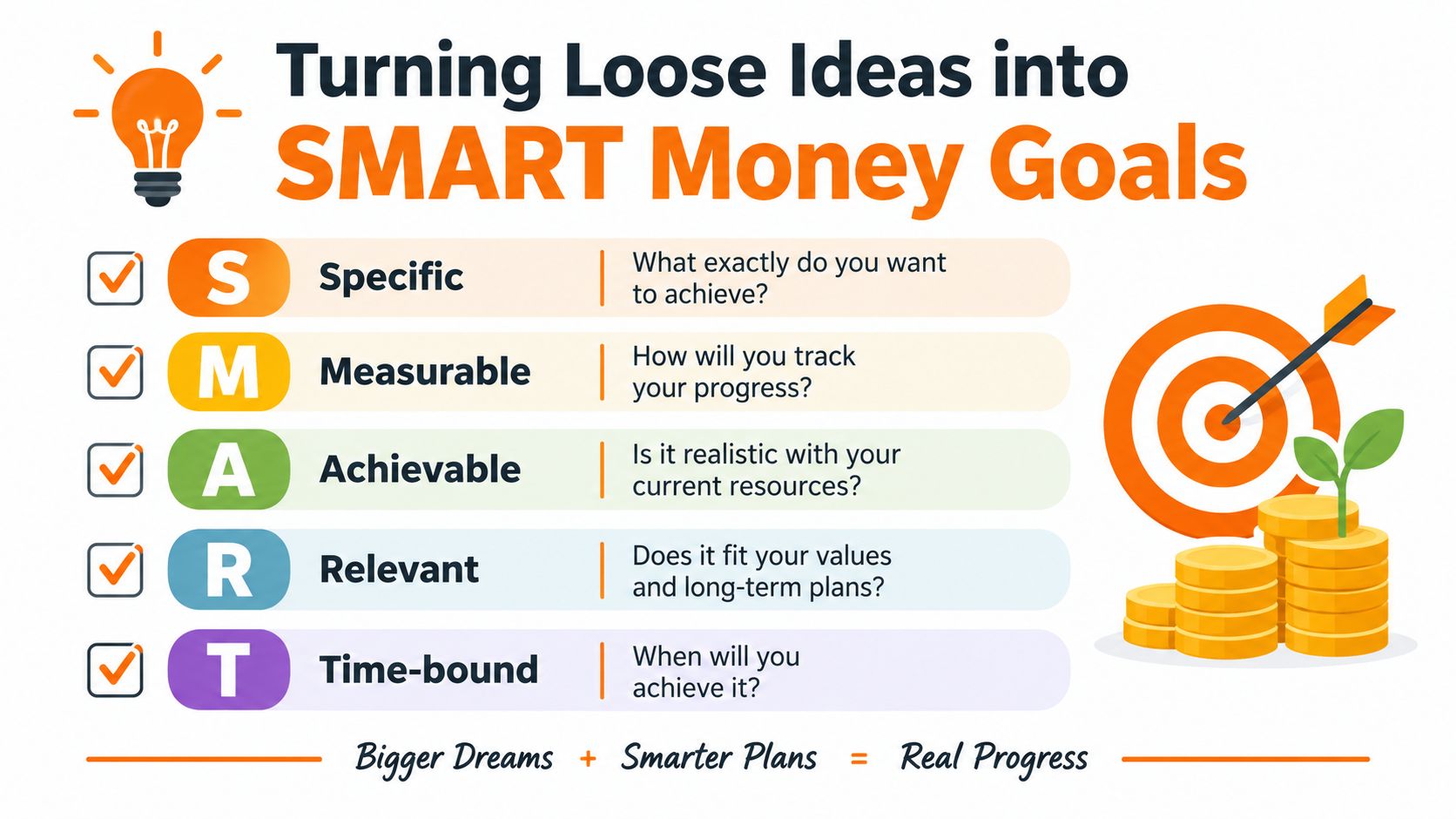
SMART goals work because they force a vague ambition to survive contact with your actual income and expenses. Use the five letters as a short quality check.
- Specific: Name exactly what the money is for.
- Measurable: Set a dollar target you can track.
- Achievable: Test the contribution against take-home pay and fixed obligations.
- Relevant: Connect the goal to something you actually value or need.
- Time-bound: Choose a firm date, not “someday”.
Take the loose idea “I want to travel more.” A workable version is: “Save $4,500 for a Portugal trip by departing June 2027, funded by $250 monthly auto-transfers into a separate savings account.” The destination makes it specific. The dollar amount makes it measurable. The monthly transfer gives it a behaviour, and the departure date gives every contribution a job.
The target still needs a reality check. Review your income, rent or mortgage, debt payments, food, transport, and existing savings commitments before you commit to the transfer. If $250 leaves no room for essentials or irregular costs, change the date, reduce the target, or choose a different trip. An unrealistic goal isn't ambitious. It's poorly designed.
Before adding any goal to your budget, ask:
- What exactly am I funding?
- What will it cost in Canadian dollars?
- When must the money be ready?
- What monthly transfer reaches the target?
- Can I make that transfer after covering fixed obligations?
- What will I pause if circumstances change?
The same test applies to investing. If your next step is to build your first investment portfolio, define the purpose, time horizon, contribution amount, and tolerance for losses before choosing investments. A goal becomes useful when it tells you what to do next.
Sorting Short Term Medium Term and Long Term Priorities
Time changes the right answer. Money needed soon should remain accessible and stable. Money intended for a distant objective has more time to absorb market fluctuations, but it also needs a larger and more consistent savings effort.
Use these lanes:
- Short term, under 2 years: emergency fund, vacation, phone upgrade, or an irregular bill.
- Medium term, 2 to 5 years: home down payment, wedding, vehicle, or major renovation.
- Long term, 5 years or more: retirement, a child's RESP, or early retirement.
The categories aren't rigid rules. They're a decision tool. A home down payment planned for next year belongs in a different holding strategy than retirement money you won't need for decades.
Goal priority tiers at a glance
| Time Horizon | Typical Goals | Suggested Account | Monthly Contribution Pace | Priority Type |
|---|---|---|---|---|
| Short term, under 2 years | Emergency fund, vacation, phone upgrade | High-interest savings account or accessible TFSA | Fixed transfer every payday, sized to the deadline | Needs-based first, aspirational second |
| Medium term, 2 to 5 years | Down payment, wedding, car | TFSA or suitable savings account | Steady monthly amount with a review when the date changes | Usually needs-based or high-value planned spending |
| Long term, 5+ years | Retirement, RESP, early retirement | RRSP, TFSA, or RESP where appropriate | Long-running automatic contributions that rise when cash flow allows | Core long-term priority |
Canadian households are already balancing several milestone types. The Financial Consumer Agency of Canada found that 66% expected some type of major expense within 3 years, including 11% planning to buy a home or condominium, 17% planning home improvement, 14% a vacation, and 13% a vehicle. That makes sequencing more useful than pretending every goal deserves equal funding at once.
Put the emergency fund and urgent debt obligations ahead of a discretionary upgrade. Keep a medium-term purchase visible while protecting retirement contributions. A clear list of short-term financial goals can help you separate money that must stay available from money that can remain invested.
Plugging Your Goals Into a Budget That Actually Funds Them
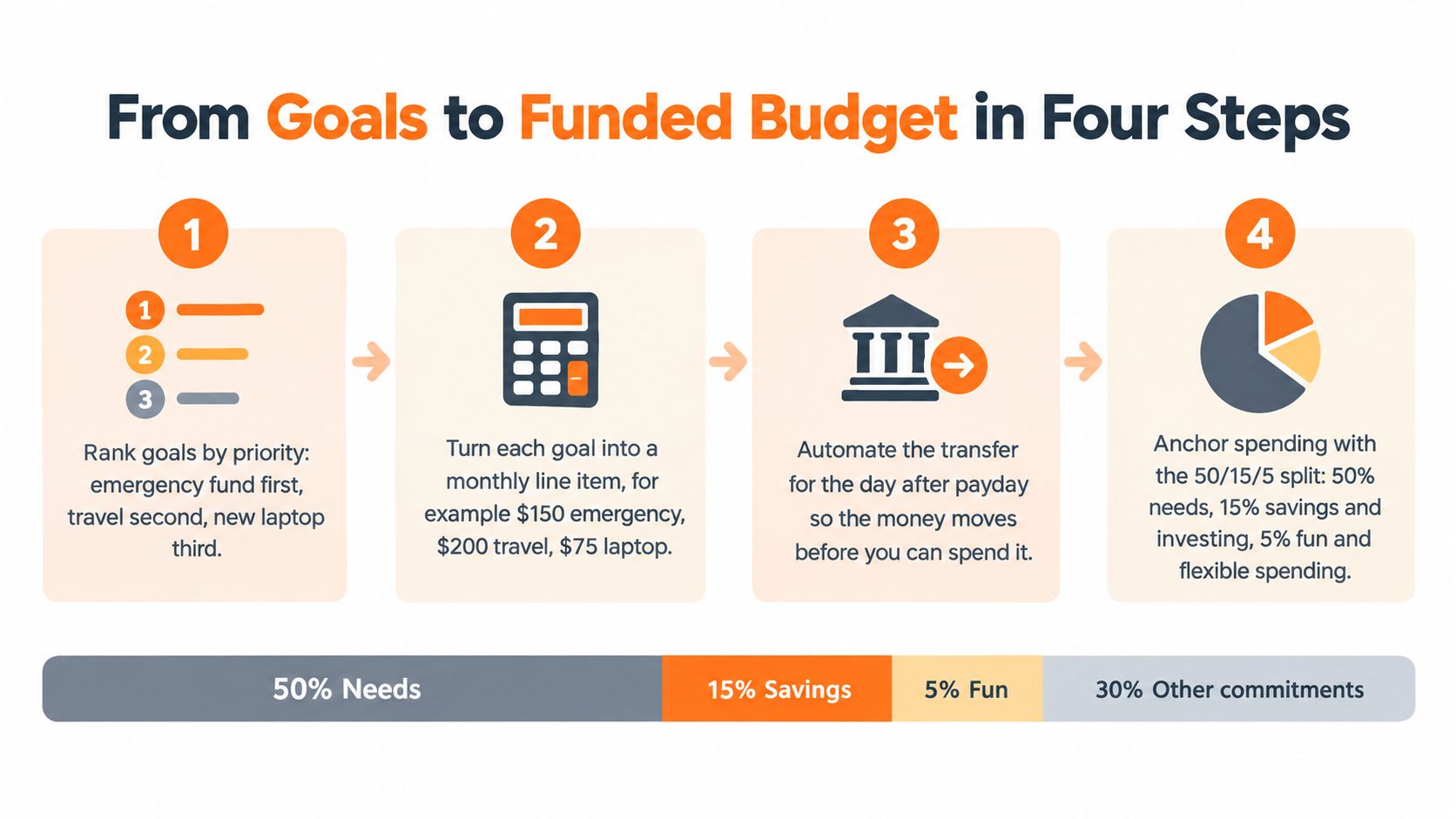
A goal shouldn't depend on what's left at the end of the month. Add it to the budget before discretionary spending, then schedule the transfer for the day after payday. That changes saving from a hopeful decision into a recurring bill you pay to your future self.
A useful starting anchor is the 50/15/5 rule. Fidelity Canada describes it as 50% of take-home pay for essential expenses, 15% of pre-tax income for retirement savings, and 5% of take-home pay for short-term savings. The remaining money can absorb debt repayment, medium-term goals, and lifestyle spending. Fidelity Canada's saving and spending guidance also uses six months of essential expenses as an emergency reserve benchmark.
Emergency savings need a ladder, not a single intimidating target:
- Build $1,000 quickly as an initial buffer.
- Work toward one month of essential expenses within six months.
- Build toward three to six months within a year, adjusting for job stability and household needs.
For a dollar target, multiply average monthly living expenses by the number of months you choose. RBC's emergency fund guide explains this calculation plainly. Keep the fund separate enough that you won't spend it casually, but accessible enough to use for a real emergency.
A Canadian household example
Suppose a couple brings home $7,200 per month. Their planned goal transfers might include:
- $400 to an emergency fund
- $350 to a vacation
- $250 to RESP contributions
- $300 to RRSP debt consolidation
Those transfers total $1,300, leaving the rest of the household cash flow for essentials, debt payments, bills, and flexible spending. The figures aren't a universal prescription. They show the important move: each objective gets a named line, a fixed amount, and an account destination.
The same approach works for debt. If credit card balances are limiting your ability to save, read this review from Debt Help U before deciding how much to divert toward investing or lifestyle goals. Funded goals beat inspired goals because the money moves even when the week gets messy. For another way to structure the categories, see the 50/30/20 budget rule.
Using Tax Smart Accounts to Stretch the Same Goal
The account matters, but the timeline matters first. A home down payment needed soon shouldn't be exposed to avoidable volatility just because a tax shelter is available. A retirement target shouldn't sit indefinitely in a taxable account if you have suitable registered room.
For 2026, the CRA lists the TFSA dollar limit at $7,000, with cumulative room of $109,000 for someone eligible since the TFSA began in 2009. The RRSP dollar limit is $33,810, and RRSP room generally reflects 18% of the previous year's earned income, up to that ceiling. Confirm your personal room through your CRA records before contributing. The CRA's registered-plan updates are the appropriate reference.
Consider a $25,000 down payment goal and a planned contribution of $500 per month. The same monthly habit has different consequences depending on where you hold it:
| Account | Net Contribution | Growth @ ~4.2% | Effective Annual Return | Best Use Case |
|---|---|---|---|---|
| Taxable high-interest savings account | $500 monthly | Interest may be taxable | Depends on tax rate and account terms | Money that exceeds registered room or needs simple access |
| TFSA | $500 monthly | Growth is sheltered from tax | Depends on the investment or savings rate | Flexible short- and medium-term goals |
| RRSP with refund reinvested | $500 monthly initially, with a 30% refund reinvested | Growth is tax-deferred | The refund can raise the effective contribution to roughly $715 monthly | Retirement or an eligible first-home strategy |
The RRSP example assumes the refund is reinvested and that the contribution produces the stated tax result. It isn't free money, and withdrawing outside the relevant rules can create tax consequences. A TFSA generally offers more flexibility for a down payment or wedding, while an RRSP fits retirement and may support a first-home withdrawal through the Home Buyers' Plan.
Registered accounts also have compliance limits. Excess RRSP contributions above the $2,000 lifetime buffer are generally subject to a 1% monthly penalty, and excess TFSA contributions face 1% per month while the excess remains. This registered-plan quick facts guide summarises the penalties. Track room before setting aggressive transfers, and use a sinking fund when the goal is a planned expense rather than retirement.
Tracking Progress Without Spreadsheets or Willpower
Tracking should answer three questions quickly: how much is funded, how long remains, and whether the monthly amount still works. You don't need a complicated dashboard. You need a review rhythm that catches drift before it becomes abandonment.
Use two appointments:
- Friday check-in: Spend 10 minutes confirming balances, checking missed transfers, and noting any unusual spending.
- Monthly review: Spend 30 minutes comparing actual progress with the plan, then direct surplus money or reduce a contribution that no longer fits.
Keep the scoreboard deliberately small:
| Status | Meaning |
|---|---|
| Green | Ahead of or aligned with the planned pace |
| Amber | Slightly off pace and worth adjusting |
| Red | Behind by more than 10%, requiring a revised amount, date, or priority |
Don't punish yourself for a missed transfer. Identify the cause. A lower paycheque, annual bill, or over-optimistic target calls for an adjustment, not a fresh promise to be more disciplined.
Fintrack can serve as the tracking layer for this workflow. It lets you create a goal, set a target amount and optional date, connect it to an account, and track contributions so you can see the monthly amount required. It also supports manual entry, which matters if you don't want to connect a bank account or if some Canadian accounts aren't supported. Use a personal finance dashboard to keep the review focused on decisions rather than data collection.

Consistency wins here. A modest transfer that runs every payday is more useful than a large transfer you repeatedly postpone.
Your First 90 Days of Goal Setting and What to Do Next
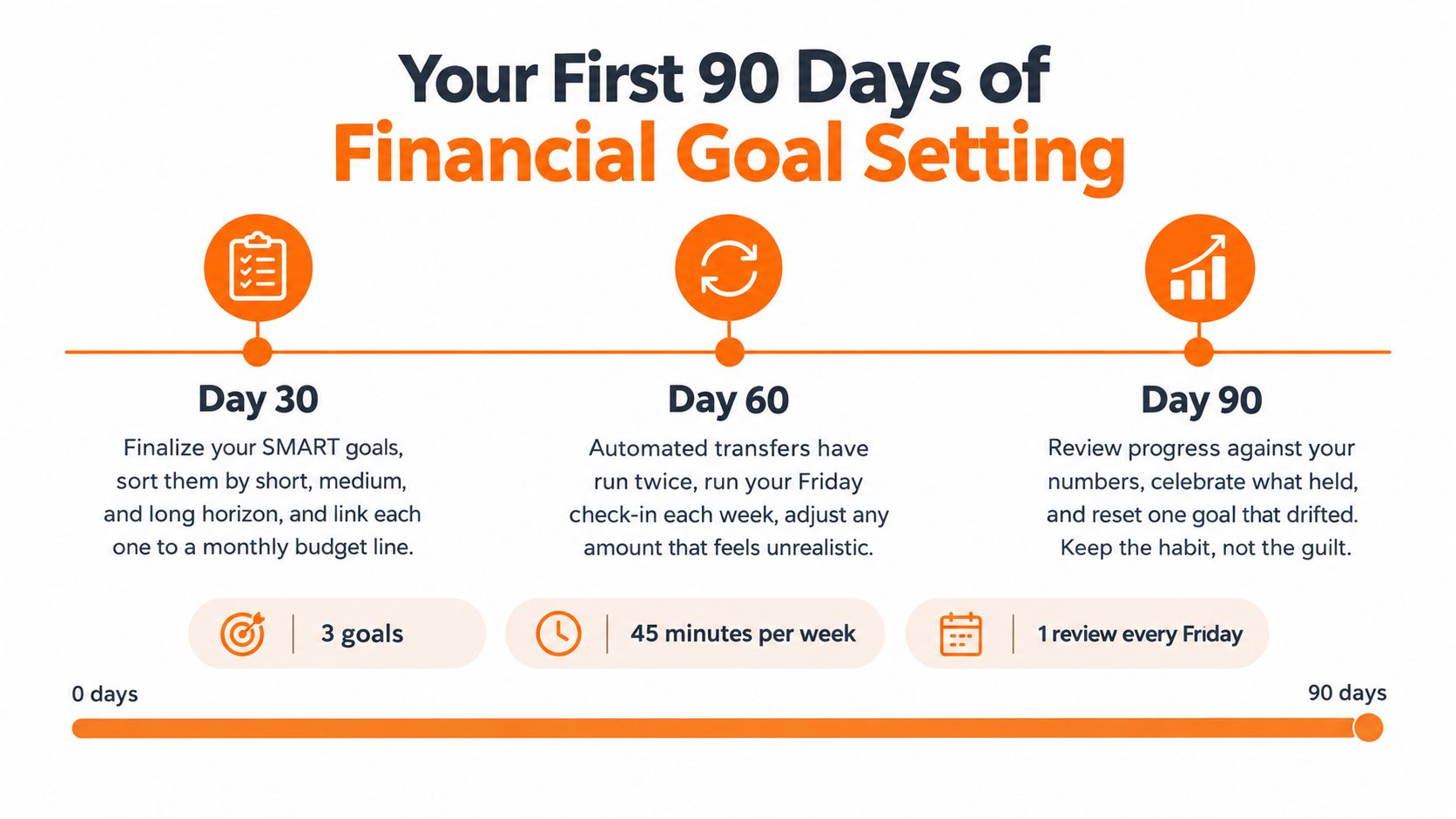
Use the first three months to install the system, not to overhaul your entire financial life. Limit the starting list to a few priorities, then earn the right to add more by proving that the routine works.
Days 1 to 30
Write each goal in SMART form, classify it as short, medium, or long term, and attach it to a monthly budget line. Build the emergency fund into the list rather than treating it as optional. Link each target to the account where the money will sit.
Days 31 to 60
Automate the transfers and run the Friday check-in each week. Open or top up the appropriate registered account after confirming your contribution room, then reduce any amount that repeatedly makes the rest of the budget fail.
Days 61 to 90
Stress-test the plan against an income drop or a surprise expense. Review which goals stayed on pace, which one drifted, and whether the target date still makes sense. Reset one amount or deadline instead of abandoning the entire plan.
Three mistakes repeatedly weaken otherwise sensible plans:
- Too many goals: Start with the priorities that protect stability and support your most important milestone.
- Optional emergency savings: Treat the buffer as a required budget line.
- Skipped reviews: Keep the Friday check-in short enough to survive busy weeks.
A plan becomes real when you create the first tracked goal, set its amount and date, and schedule the contribution. Do that today, then let the next review tell you what needs changing.
Fintrack brings goals, spending, budgets, and account activity into one place, with manual entry available when you prefer not to connect a bank account. Visit Fintrack to create your first goal, assign a target date, and turn the plan into a recurring money habit.