
You're looking at a stock in your brokerage app, and the dividend number seems simple until you try to use it. Is that the payout you get, the annual amount, or just a yield that moves every time the share price changes? If you've ever paused on that screen and thought, “What number am I supposed to trust?”, you're asking the right question.
How to find the dividend is really a small workflow, not a single lookup. First, you identify the listed payout, then you verify where it comes from, then you check whether the timing and business quality make it worth caring about. That matters because a dividend can be shown as a per-share amount, an annualized figure, or a yield, and each one tells you something slightly different.
The fastest way to avoid confusion is to treat the number on screen as a starting point, not the final answer. Once you know how to read it, you can compare stocks more cleanly, avoid stale data, and spot cases where a high yield is doing more harm than good.
The Dividend Question Beginners Often Skip
A lot of first-time investors stop at the number beside the word “dividend”. They see a stock, see a payout, and assume that number is fixed, current, and complete. In practice, it is often only one part of the story.
The better first question is, “what exactly am I looking at?” A brokerage app might show a trailing payout, a quoted annual amount, or a yield based on today's price. Those are connected, but they are not the same thing. A good dividend lookup starts with the number on screen, then checks where it came from, then asks whether the payout looks durable enough to matter. That is the same kind of careful reading you need when you compare income stocks over time, which is why Fintrack's long-term investment guide fits naturally beside this step.
Start with the number, then verify the source
A dividend lookup works best in layers. Begin with the displayed payout, then check whether it is an annual figure or a recent payment, and then confirm it against the issuer's own disclosure or filings. That habit matters because the number in a quote window can be useful without being the final word.
Practical rule: do not treat the first dividend number you see as the whole answer. Treat it as a lead to verify.
That verification mindset matters even more with funds and income-style holdings. If you are comparing a company dividend with a REIT distribution, the payout can look similar on a screen even when the underlying cash flow story is different.
Understanding Dividend Per Share, Annualized Dividend, and Yield
A dividend quote can look simple at first glance, then turn confusing fast. One screen may show the amount paid on each share, another may show a yearly figure, and a third may show a percentage that changes as the stock price moves. If you sort those three numbers out, the rest of the lookup becomes much easier.
Dividend per share is the base number
Dividend per share, or DPS, is the amount paid on each share. It is the starting point, the same way a receipt total comes before you work out a discount or tax. When a company pays more than once a year, annual dividends can be estimated by adding the last 12 months of payouts or by annualizing the most recent payment, depending on the payout pattern. Quarterly payers use 4, monthly payers use 12, and semiannual payers use 2. Fidelity's dividend yield guide uses this standard approach, and it is a clean way to turn a payment schedule into a yearly figure.
A stock that pays CAD 2.00 a year and trades at CAD 50.00 has a yield of 4.0%. That calculation, annual dividends per share divided by share price, is the basic comparison tool for income-focused stocks. It is also the number many screens are built around, which is why it helps to know what it means before you trust it.
Yield is a comparison, not the dividend itself
Yield changes whenever price changes. Two stocks can pay the same cash amount and still show different yields if one has risen and the other has fallen. That is why yield is useful for comparison, but not for understanding the payout on its own.
Use this order: first find the dividend per share, then annualise it if needed, then divide by price to get yield.
That order matters even more with trusts and other income structures, where the payout may not behave like a plain common stock dividend. If you want help with the calculation itself, Fintrack's dividend yield calculator guide walks through the math step by step. And if you are comparing those payouts with REIT distributions, ronkeodewumi's REITs guide gives useful context for why the numbers can look similar while the underlying cash flow story is different.
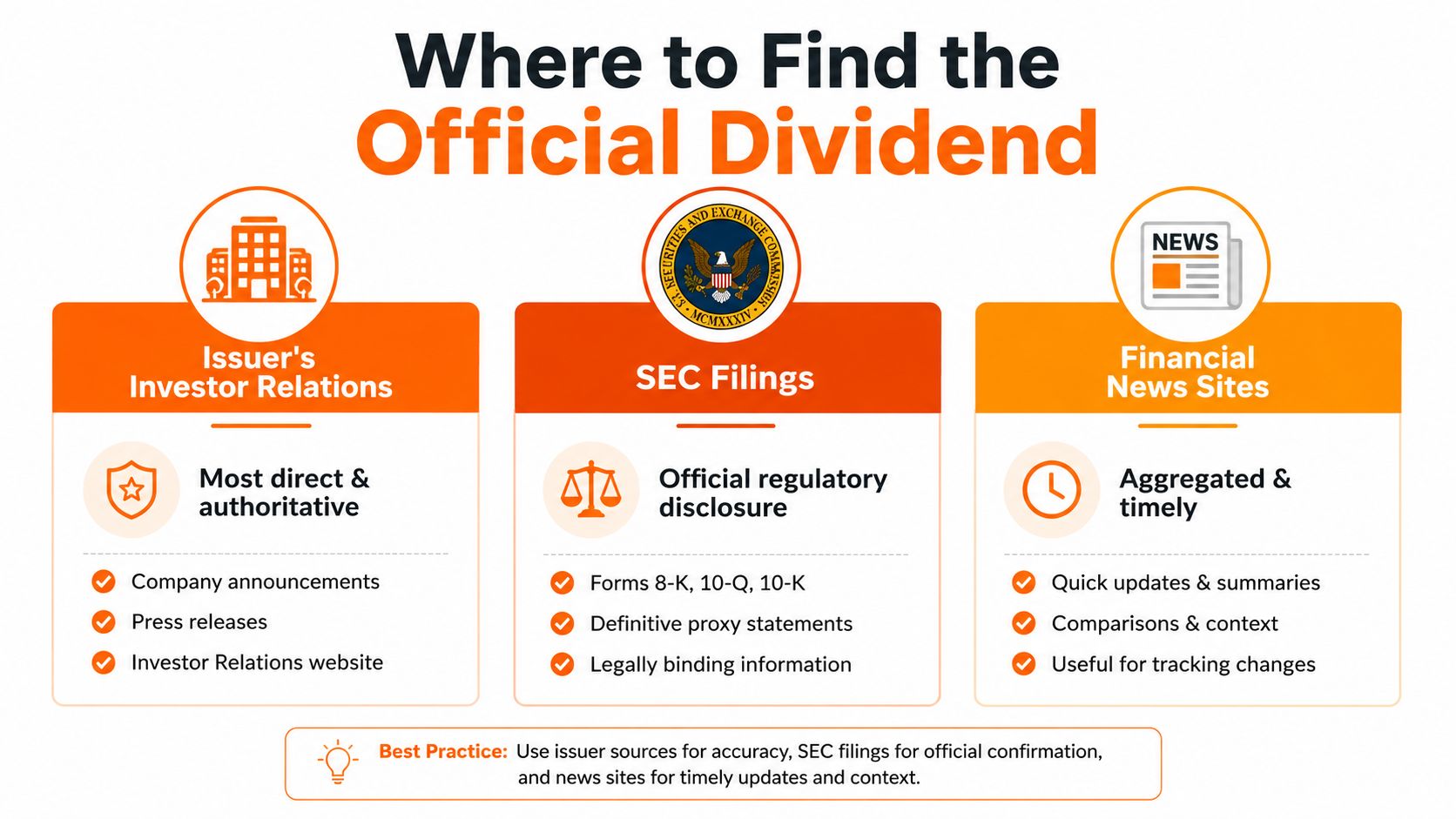
Where to Find the Official Dividend
The safest way to confirm a dividend is to work from the issuer outward. Start with the company's own investor relations page, then check the filing system used in its market, then use a data site to cross-check the number you found.
Three places to look up a dividend
| Source | Best for | Main caveat |
|---|---|---|
| Issuer investor relations | The company's own declaration and payment details | Can be slower to scan if the site is poorly organised |
| SEC or SEDAR-style filings | Primary-source disclosure from the issuer | Requires a little more reading |
| Financial news sites | Fast aggregation and quick comparison | Can be stale, simplified, or incomplete |
The SEC search tool lets you search by company name or ticker and open the latest reports and filings directly. That makes it a practical way to find primary-source dividend disclosure for U.S.-listed companies. For Canadian issuers, the same logic applies through Canadian continuous-disclosure filings, even though the exact portal is different.
What to check on the page
Look for the declared amount, the record date, the ex-dividend date, and the payment date. If the number is shown as an annual rate, check whether it's based on a regular quarterly schedule or an irregular payout pattern. Special dividends are often excluded from the headline figure because they're not part of the usual run rate, so a quoted dividend can look lower or cleaner than the cash flow history around it.
For a useful reminder that corporate actions are broader than one dividend line, Bharatstox's corporate action tracking overview is a good reference point. It helps you remember that a dividend often sits inside a wider set of announcements, not in isolation.
Estimating the Dividend From Financial Statements
Sometimes the dividend isn't easy to find in a neat market-data box. In that case, the financial statements can still help you estimate it, especially if you're checking whether a quoted number makes sense.
Read retained earnings against net income
Accounting guidance says dividends paid can be approximated as net income minus the change in retained earnings, assuming there aren't other direct adjustments to retained earnings in the period. Dividend payout ratio is then calculated as total dividends divided by net income. In practice, if a Canadian company earned CAD 100 million and retained earnings increased by CAD 70 million, the implied dividends paid would be about CAD 30 million. That means roughly 30% of earnings were distributed to shareholders, according to the accounting method described in Saxo's dividend calculation guide.
Practical rule: if the income statement and retained earnings don't line up neatly, treat the dividend estimate as a working number, not a final quote.
To turn that into per-share terms, divide the implied dividend total by shares outstanding. That is especially useful in Canada, where the practical workflow is to validate the share count against the issuer's latest continuous-disclosure filings and treat the result as an estimate because special dividends and other retained-earnings adjustments can distort the math. The Fool's dividend calculation guide explains that this share-based approach is the standard way to move from a total dividend estimate to DPS.
For readers who like working through full annual reports rather than skimming a market page, Futurecaps Stocks' annual report guide is a useful companion. It trains the eye to connect income, retained earnings, and payout policy without relying only on a quoted dividend screen.
Tracking Ex-Dividend and Payment Dates
A dividend only matters if you own the shares at the right time. That's where the ex-dividend date comes in, and it's the part many beginners miss.
Know which date actually decides payment
The ex-dividend date is the cutoff. If you buy after that date, you usually don't receive the upcoming dividend. The record date identifies who the company recognises on its books, and the payment date is when the cash arrives.
The UK market gives a very concrete version of this workflow. The ICAEW dividend information guide notes that the London Stock Exchange's electronic official lists include dividend information, and that the Electronic Weekly Official Intelligence list includes an Ex Dividend list for the coming week. It also mentions a Dividend and Shutting section that covers UK listed equity dividend and interest amounts, including Government Stocks, with a payment date within six months of publication.
Read the timing in order
A simple sequence looks like this:
- Declaration date. The company announces the dividend.
- Ex-dividend date. New buyers usually don't qualify for that payout.
- Record date. The company checks its shareholder list.
- Payment date. The cash lands in the account.
If you're looking at a fund distribution, the timing can feel similar but the mechanics can differ, so a fund-specific example like Fintrack's Scotia Canadian Dividend Fund guide can help you recognise the pattern without assuming every income product works the same way.
When a High Dividend Is a Warning Sign
A high yield can look like a bargain, but sometimes it's the market pricing in a cut. That's the trap: the number looks attractive because the share price has fallen for a reason.
Ask whether the dividend is durable
Screening guidance on dividend growth stocks emphasises more than yield. The better filter looks at payout ratio, cash flow, debt, and dividend-growth history together, because a strong-looking yield can hide a weak business. Koyfin's screening guide highlights that yields above 5% may only be attractive when they're paired with earnings growth, manageable debt levels, and a sustainable payout ratio.
That's the right framing for everyday investors too. The core question isn't just “what is the dividend?” It's “is this dividend likely to survive a tougher year, higher borrowing costs, or a slowdown in cash generation?”
Use a short checklist before you buy
- Check payout ratio: make sure the dividend isn't swallowing too much of earnings.
- Check cash flow: a payout backed by weak cash generation deserves caution.
- Check debt load: rising debt can pressure future distributions.
- Check history: steady dividend growth is a better sign than a one-time high yield.
For a second pass on income quality, Fintrack's guide to high-income funds is a helpful way to think about durability instead of headline yield alone. That's especially useful when the advertised income looks strong but the underlying risk is doing most of the talking.
Logging Dividend Income in Fintrack
Once you've found and verified a dividend, the next step is to treat it like real income in your money plan. If you don't record it, it's easy to miss how much of your cash flow is coming from investments rather than wages or transfers.
Put the payout into your cash flow view
In Fintrack, you can log a dividend as a transaction, tag it as dividend income, and keep it alongside your other money entries. That makes the payout visible inside your overall spending and income picture instead of leaving it buried in a brokerage history. Fintrack's transaction tracking feature is built for that kind of manual or detailed entry.
The useful part is not just the record itself. Once the dividend sits in your tracker, it can show up next to the rest of your monthly cash flow, which makes it easier to see whether the payout is helping with bills, savings, or a longer-term goal.
If you're starting with dividend lookups, keep the habit simple. Find the number, verify the source, check the timing, and then log the income where you manage your money.
If you want a clearer way to track dividend income alongside the rest of your budget, visit Fintrack and put the payout into a dashboard you'll use. It's a practical next step if you'd rather see income, expenses, and goals in one place than keep dividend notes scattered across brokerage screens.