
Meta description: A practical 2026 guide to the Scotia Canadian Dividend Fund, including holdings, fees, foreign exposure, risks, taxes, and lower-cost alternatives.
A lot of Canadians meet the Scotia Canadian Dividend Fund the same way. It shows up in a branch meeting, inside an RRSP recommendation, or on a shortlist of “solid dividend funds” from a bank advisor.
That makes sense. It's a long-running, well-known mutual fund with a familiar pitch: dividend income, Canadian blue-chip companies, and a smoother ride than an all-out growth fund. But if you're deciding whether to buy it now, the marketing summary isn't enough. You need to know what you're buying, what it costs, and how it fits beside simpler low-fee options.
This is the part that often gets skipped. A fund can be respectable and still be a questionable choice for some investors. The Scotia Canadian Dividend Fund is a good example of that trade-off.
What Are the Fund's Objectives and Structure
A lot of investors arrive at this fund through a practical decision, not a portfolio design exercise. You are in a branch meeting, you say you want dividends, and this lands on the shortlist.
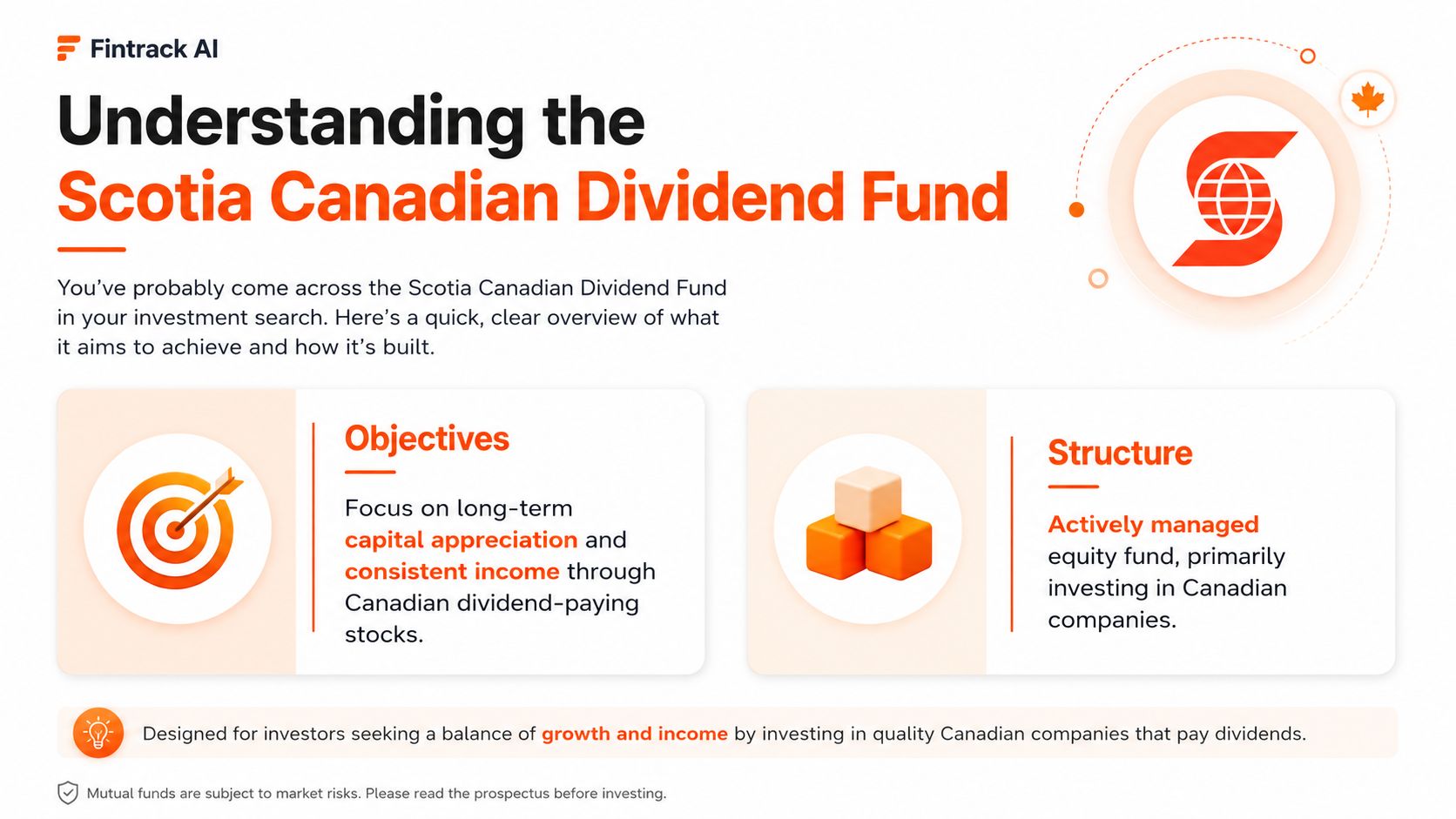
That context matters because the Scotia Canadian Dividend Fund is built to be easy to recommend. It is an actively managed mutual fund centred on dividend-paying Canadian equities, with room to hold preferred shares as well. The stated goal is straightforward: generate dividend income and pursue long-term capital growth.
The basic structure
At a high level, this is a traditional bank mutual fund. A portfolio manager has discretion over security selection, sector weights, and position sizing. Investors buy units of the fund rather than owning the underlying stocks directly, which is convenient, but it also means you are accepting the manager's judgment and the fund's fee structure.
The fund is also positioned as a Canadian dividend product first. That branding is useful, but it can lead investors to assume the exposure is simpler than it is. In practice, "Canadian dividend fund" tells you more about the fund's marketing label than the full economic exposure inside the portfolio. Many of the companies it can own are Canadian-listed firms with global operations, and that matters if you are trying to understand what role this fund plays beside your other Canadian holdings.
What the objective means in real life
Income plus growth sounds sensible because it is sensible. The trade-off is that the fund still lives in the equity bucket. A dividend mandate does not turn stocks into a safer asset class, and it does not protect you from sector-driven drawdowns.
That distinction gets missed all the time.
If you already hold the fund and want to verify how it appears in account documents, it also helps to understand your broker statement. That makes it easier to separate unit balances, distributions, book value, and account-level reporting.
A few structural features deserve attention before looking at performance or holdings:
- Active management: The manager is trying to select better dividend-paying securities rather than tracking a low-cost index.
- Equity exposure: This is still a stock fund, even if the income focus makes it sound more conservative than it is.
- Dividend tilt: The mandate naturally pushes the portfolio toward mature sectors such as financials, pipelines, telecoms, and utilities.
- Bank-shelf design: It fits neatly into registered accounts and advisor-led portfolios, which helps explain its popularity, but shelf placement is not the same thing as best value.
That last point is where I get more skeptical. A fund can be perfectly legitimate, widely used, and still be expensive for what it delivers. Before treating this as a core Canadian equity holding, it helps to ask two questions bank sales material often leaves in the background. How concentrated is the portfolio, and are you paying active-management prices for exposure you could get more cheaply elsewhere?
Deconstructing the Holdings and Investment Strategy
The fastest way to understand this fund is to ignore the brochure language and look at the portfolio.
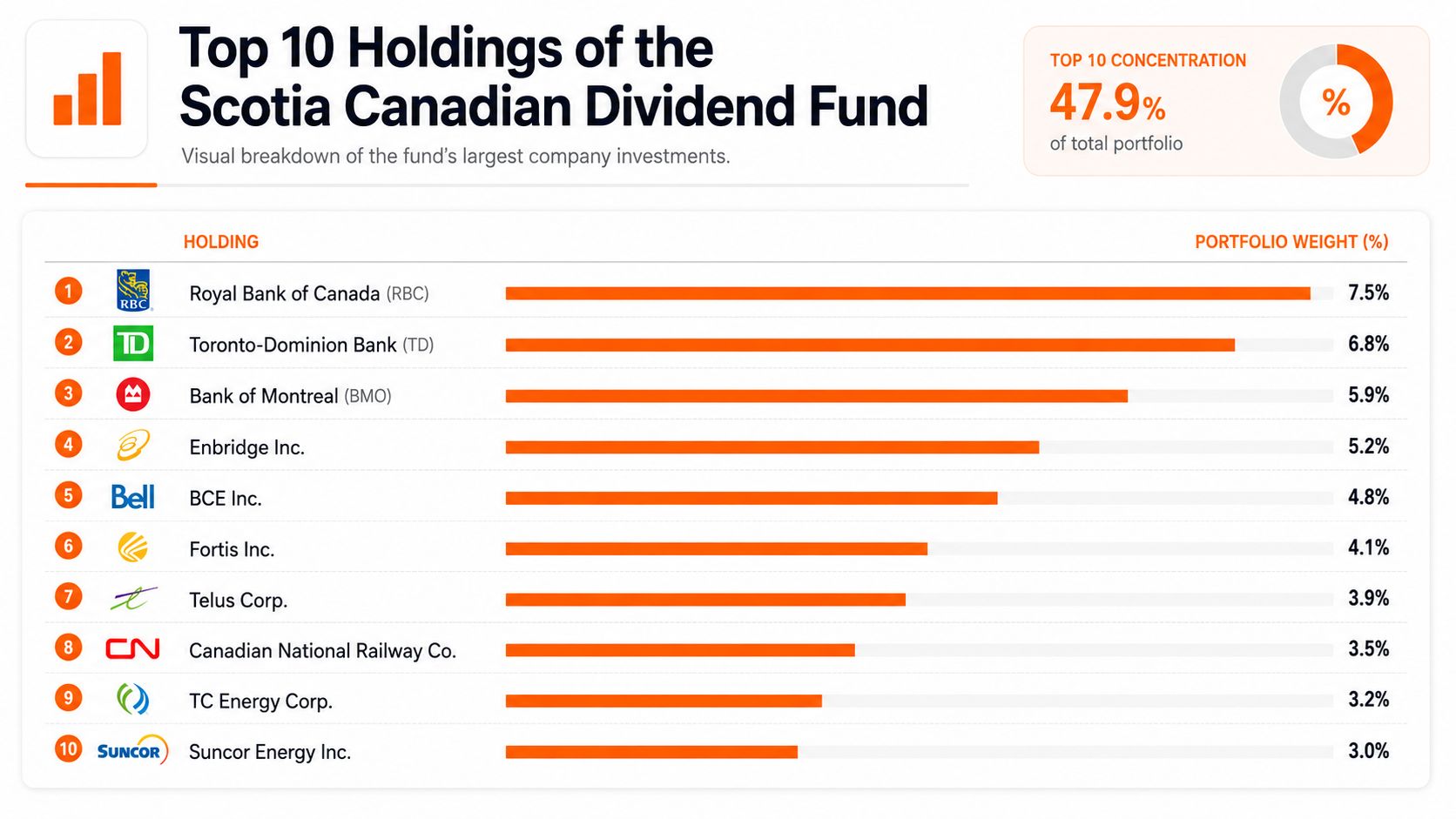
The fund's top holdings are concentrated in large Canadian companies. According to Bloomberg's portfolio snapshot for the Scotia Canadian Dividend Fund, the top 10 holdings are exclusively Canadian equities, with Royal Bank of Canada at 7.74%, Toronto-Dominion Bank at 6.48%, and Enbridge Inc at 4.06%. Those three alone represent over 18% of the portfolio, while the fund is heavily concentrated in financial services at 52.05% and energy at 11.38%.
What that concentration means in practice
This isn't a neutral slice of the Canadian market. It's a deliberate tilt toward sectors that have long dividend histories and established cash flow.
That can be useful if you want:
- Large-cap stability through names such as RBC and TD
- Income-oriented sectors like banks, pipelines, and utilities
- Lower overall volatility than a more aggressive growth-heavy equity fund
But concentration cuts both ways.
When more than half of a fund sits in one sector, you're not just buying “Canadian dividends.” You're making a substantial bet on that sector's durability.
If Canadian financials do well, the strategy looks smart. If financials face a rough stretch, the fund can feel far less diversified than its name suggests.
The foreign exposure most investors miss
This is the part I think more investors should scrutinise. Despite the name, the fund isn't necessarily a pure Canada-only holding.
Public discussion around the fund has pointed to a mismatch between the branding and the actual flexibility in the mandate. A widely shared analysis notes that the fund can hold up to 49% in foreign securities, and that nearly 18% of assets were in U.S. equity plus 2% in foreign equity at the time discussed, while the benchmark remained the S&P/TSX Composite Index, according to this commentary on the Scotia Canadian Dividend Fund's foreign exposure and benchmark mismatch.
That doesn't automatically make the fund bad. In some periods, foreign exposure can help. The issue is clarity. If you bought it assuming you were getting a straightforward Canadian dividend mandate, that assumption may not hold as neatly as the name implies.
Here's the practical takeaway:
- If you want active flexibility, this may not bother you.
- If you want label accuracy, it should.
- If you compare the fund to a Canadian-only benchmark, you should know the comparison may not be perfectly clean.
Historical Performance Dividend Yield and Fees
A lot of investors first notice this fund after a strong year. The harder question is whether the long-term results still look good after costs, and whether the fund earns its place versus a much cheaper dividend ETF.
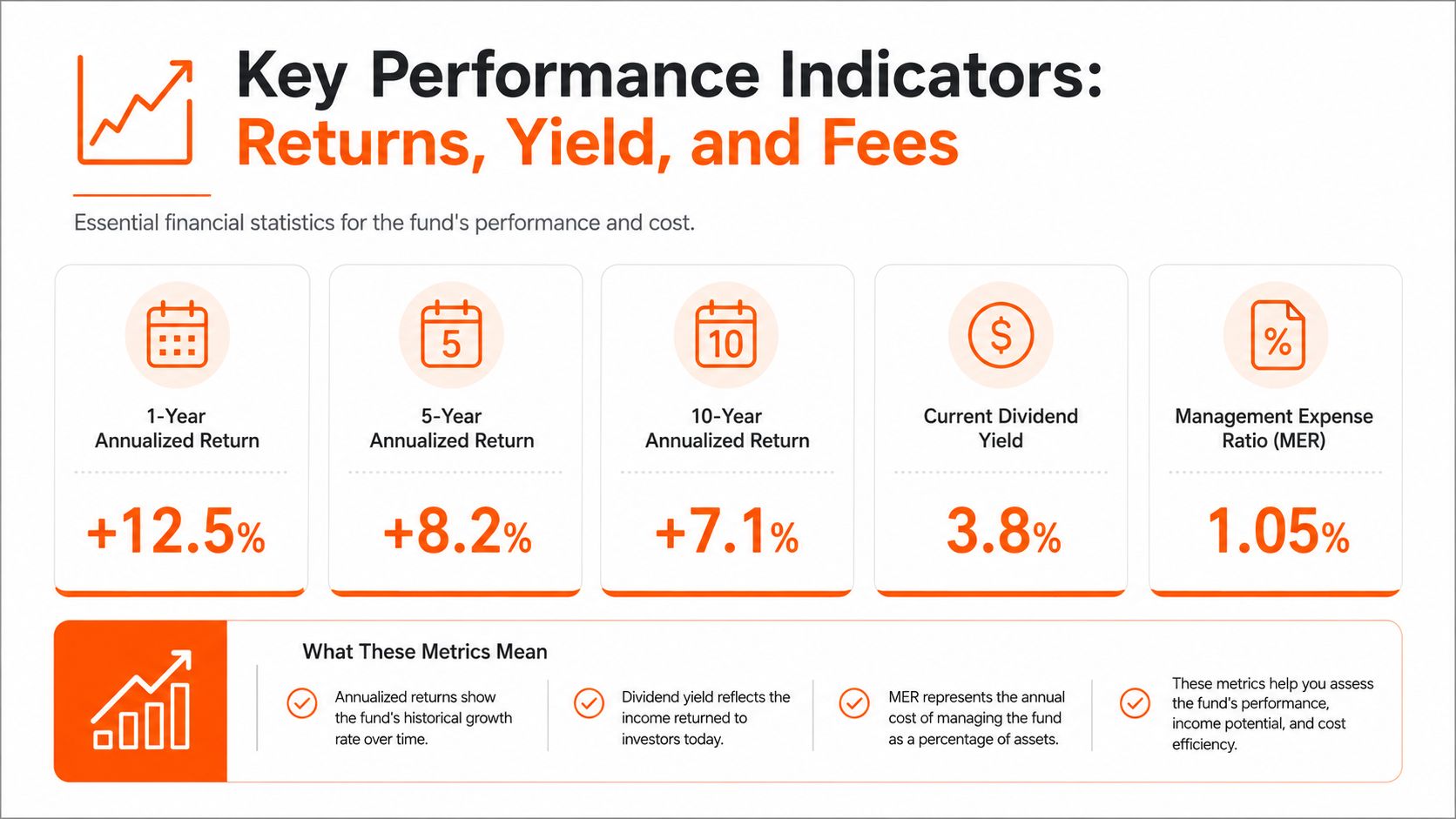
As of May 31, 2026, Series A reported a 1-year annualized return of 22.88%, a beta of 0.78, a yield of 2.81%, and an MER of 0.86%.
The long-term record
One good 12-month stretch can flatter almost any equity fund, especially after a rebound in bank and energy stocks. A dividend fund should be judged over a full cycle, not on a single hot year.
The long-run record here is respectable, as noted earlier. That helps explain why many bank-channel investors have held it for years in RRSPs and non-registered accounts. But respectable is not the same as exceptional. The benchmark for a seasoned investor is not just "did it make money?" but "did active management add enough after fees to beat simpler options?"
That comparison matters more here because the fund is sold as a steady dividend holding, which often leads investors to focus on familiarity and payout history instead of cost drag.
Yield is only part of the story
The yield gets attention because investors can see distributions arrive in cash or get reinvested. That can make the fund feel more productive than it really is.
What matters is total return after fees.
The 0.86% MER on Series A is not outrageous by bank mutual fund standards, but it is still high beside broad Canadian dividend ETFs that often charge a fraction of that. Over one year, the difference may feel minor. Over 10 or 20 years, it can leave a noticeable gap, especially in an account where you are compounding rather than spending the income.
That is why I usually treat the yield as a secondary number. If you are buying this fund for income, review how to calculate the dividend yield and then compare that income stream with the fund's fee, portfolio mix, and total return record.
A high-yield product can still disappoint if capital growth stalls or fees eat too much of the return. For a useful example outside Canada, this Ishares Asia Pacific Dividend ETF analysis shows how an income story can look better than the underlying growth picture.
How I read the numbers
| Measure | Practical takeaway |
|---|---|
| 1-year return of 22.88% | Strong recent performance, but not enough on its own to judge the fund |
| Beta of 0.78 | It has been less volatile than the market measure used by the provider |
| Yield of 2.81% for Series A | Useful income, though not high enough to ignore total return and tax treatment |
| MER of 0.86% | A real ongoing cost, and the clearest reason to compare it with lower-fee ETFs |
My bottom line is fairly simple. For an investor who wants a bank-sold, actively managed dividend fund and values convenience, these numbers are acceptable. For a DIY investor building a modern portfolio, the fee deserves scrutiny, especially once you factor in that the fund may not be as purely Canadian as the name suggests.
Key Risks and Tax Implications for Investors
A lot of investors buy a fund like this in a branch meeting, hear that the risk is "medium," and file it under safe enough. That is too casual for an equity fund with meaningful exposure to Canadian banks, energy companies, and some holdings outside Canada.
As noted earlier, the fund is described with a middle-of-the-road retail risk label. Use that as a rough starting point only. It does not mean stable returns, protected capital, or a gentle ride in a bad market.
What can actually go wrong
The biggest risk is concentration. If Canadian financials or energy stocks hit a weak period, this fund can feel it more than a broader equity portfolio. That matters because many Canadian investors already have extra exposure to those sectors through their jobs, pensions, or other holdings.
There is also plain market risk. This is still a stock fund, so it can fall hard in a broad selloff, even if the dividend story sounds defensive.
Active management adds another layer. You are relying on the manager to pick the right companies, trim at the right time, and justify the fee. Sometimes that helps. Sometimes you pay more for results that look a lot like a cheaper ETF.
One risk I think gets glossed over is mandate drift, or at least mandate surprise. The name suggests a straightforward Canadian dividend product, but the portfolio can include foreign securities. That is not automatically bad. It can improve diversification. Still, investors who want clean Canadian equity exposure should notice that the label tells only part of the story.
Ask a narrower question instead. Are these the specific risks you want in your portfolio, at this price, given the other holdings you already own?
The tax result depends on where you hold it
Account type matters almost as much as fund selection.
In a TFSA, growth and distributions stay sheltered. In an RRSP, tax is generally deferred until withdrawal. If you need a quick refresher, this plain-English guide to how tax deferral works in registered accounts covers the basic mechanics.
A non-registered account is more work. Distributions can be taxable in the year you receive them, and a sale can trigger a capital gain or capital loss. You also need to keep track of adjusted cost base properly, which many investors ignore until tax season becomes messy.
That is why I usually separate the fund question from the tax question. Eligible Canadian dividends can be tax-efficient in the right situation, but tax treatment does not rescue a fund that is too concentrated, too expensive, or redundant in the portfolio you already have.
Is This Dividend Fund a Good Fit for Your Portfolio
This fund isn't a universal yes or no. It fits certain investors well enough, and it's a poor match for others.
The easiest way to judge it is to stop asking whether it's “good” in the abstract and ask whether it suits the way you invest.
It can be a reasonable fit
The Scotia Canadian Dividend Fund may fit you if these points sound familiar:
- You already invest through Scotiabank or a bank advisor, and convenience matters more to you than squeezing every basis point out of fees.
- You want one packaged Canadian equity income fund rather than building a portfolio yourself.
- You prefer an active manager making allocation decisions, even if that means paying more than you would for an index ETF.
- You're comfortable with a fund that leans heavily into large Canadian financials and energy names.
For that kind of investor, the fund is understandable. It has a long operating history, a recognisable strategy, and a format that works inside common Canadian accounts.
It's probably not the best choice
I'd be more sceptical if any of these describe you:
- You're fee-sensitive. Even a reasonable bank-fund MER can look expensive once you compare it with broad-market or dividend ETFs.
- You want strict simplicity. The foreign exposure issue complicates the tidy “Canadian dividend fund” label.
- You're a DIY investor. If you already use a discount brokerage comfortably, you can usually access similar exposure more cheaply.
- You want broad diversification. A fund dominated by one sector won't solve that problem for you.
If your investing philosophy is “keep costs low, keep the strategy obvious, and avoid surprises,” this fund may feel harder to justify.
A short decision checklist
Ask yourself these four questions:
Am I paying for convenience or for investment skill?
If it's convenience, that can be fine. Just be honest about it.Do I understand what I own?
If the foreign-holdings flexibility bothers you, that matters.Would I buy this fund if it weren't offered by my bank?
That's often the cleanest test.Does it fit my long horizon?
This matters more than the current one-year return. If you're still building your investing framework, it helps to think in terms of long-term investment decisions, not just product familiarity.
How to Buy the Fund and Low-Cost Alternatives
A common real-world version of this decision looks like this: you already bank with Scotiabank, an advisor suggests a familiar dividend fund, and buying it takes a few clicks or one meeting. That convenience matters. It also makes it easy to skip the harder question, which is whether this fund earns its place over simpler, cheaper options.
How investors usually buy it
The practical purchase routes are straightforward:
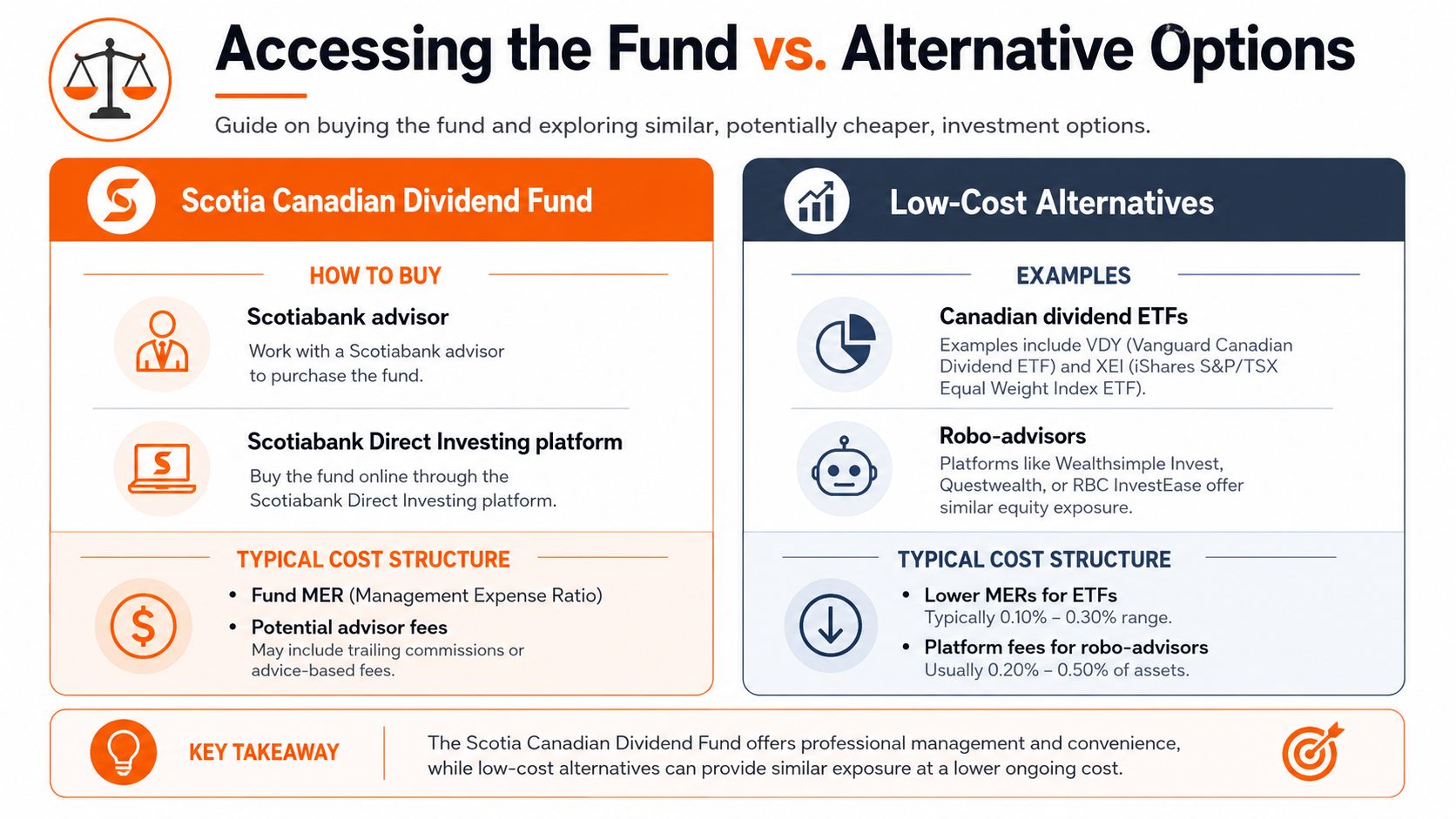
- Through a branch or advisor: A bank representative recommends the fund and submits the order for you.
- Inside a Scotia investment account: You choose the series available in your account and place the order there.
- Through a pre-authorized contribution plan: Regular deposits are one reason mutual funds still appeal to many bank clients. The minimums were noted earlier in the article, so I won't repeat the source here.
That setup is convenient for investors who want automation and a familiar process. It is less appealing for investors who are already comfortable using a brokerage account, because the convenience gap shrinks fast once you know how to buy an ETF.
The comparison your advisor may not stress
The bigger issue is not how to buy the fund. It is what you give up by buying it this way.
With a bank mutual fund, you are often paying more for packaging, advice-channel access, and active management. Sometimes that trade-off is reasonable. Sometimes it is just expensive habit. The awkward part with Scotia Canadian Dividend Fund is that the name sounds plain and focused, while the portfolio can be more flexible than many investors assume, including foreign exposure discussed earlier. If you want a clean Canadian dividend sleeve, that matters.
A lower-cost ETF will usually be simpler to evaluate. You can see the index, the sector weights, and the fee structure more clearly. You also avoid the situation where a familiar bank brand makes the product feel cheaper or simpler than it really is.
Here's the practical comparison:
| Option | Main advantage | Main drawback |
|---|---|---|
| Scotia Canadian Dividend Fund | Easy to buy through the bank, automatic contributions, active manager discretion | Higher ongoing costs and a mandate that may be less plain than the name suggests |
| Canadian dividend ETF | Lower fee drag, clearer rules, easy to compare with peers | You need a brokerage account and must place trades yourself |
| Broad equity ETF with dividend exposure | Better diversification and very low cost | Less tailored to investors who specifically want a dividend-labelled fund |
| Robo-advisor portfolio | Automatic investing and rebalancing | You do not control the exact dividend strategy |
For readers comparing other income-focused products sold in the same general part of the market, this review of the CI High Income Fund is a useful contrast. The same questions come up repeatedly: what do you own, how much are you paying, and is the income story cleaner in the marketing than in the portfolio?
One more point. Mutual fund convenience is real, but ETF investing is not difficult forever. There is a short learning curve, then the cost difference becomes much harder to ignore over long holding periods. Even though it uses U.S. products, Altymo's VTI vs VTSAX analysis is a good example of how structure, access method, and fees can affect the investor experience.
My view is simple. Buy this fund if you value the bank channel, want regular contributions handled for you, and have weighed the fee trade-off with open eyes. Pass on it if the main reason is that it was the default option presented to you. In a modern portfolio, default choices deserve more scrutiny than they usually get.
Tracking Your Dividend Cash Flow and Portfolio Fit
Once you own a dividend fund, the job isn't over. You need to see what the distributions and account activity do to your broader cash flow.
That's especially true if you hold multiple investments, reinvest some distributions, and take others in cash. A fund can look tidy inside an account statement while creating a surprisingly messy picture across your monthly finances.
A good routine is simple:
- Log each dividend payment so you can separate investment income from employment income
- Categorise reinvested distributions properly so you don't overstate spendable cash
- Review account-level cash flow alongside your budget, not in isolation
- Check portfolio fit once or twice a year instead of reacting to short-term performance
The point of tracking isn't administrative neatness. It's making sure your investments support your real financial plan.
If you want one place to review account activity and how it connects to the rest of your money, a personal finance dashboard can make that much easier.
If you want to put this into practice, Fintrack is a simple next step. You can manually log dividend payments, categorise them as income, and use the transaction tracking feature to see how investment cash flow fits with your spending, budget, and monthly money review, even if you don't want to connect a bank account.