Your balance looked fine on the first of the month. Now it's the twenty-eighth, the fridge is half empty, and you're trying to remember whether the insurance payment already came out. Nothing dramatic happened. No emergency, no big purchase. The money left in dozens of small, reasonable amounts.
That's the usual pattern. Saving fails less often because people are careless than because there was never a number to aim at. Once you have a monthly figure that fits your actual bills, saving stops being a leftover and becomes a line item you can defend.
This is a plain walkthrough of how to save money each month, built around the money you have. Essentials first, one target you can reach, then the recurring leaks, then a transfer that runs without you. A notebook and three months of statements are enough to start.
Calculate How Much to Save Each Month
Say you bring home $3,800 a month and your essentials come to $3,000. Rent takes $1,750, utilities and phone $260, groceries $480, car insurance and fuel $310, transit $110, and the minimum on a credit card $90. That leaves $800, and by the twenty-eighth it's gone. You didn't buy anything strange. The money had no job assigned to it.
Saving starts with a number you can name. Not a percentage from a magazine, and not whatever survives the month. A dollar figure that comes from your own bills.
Start With Three Months of Statements
Pull the last three months of bank and card statements, not just the most recent one. Three months catches the quarterly water bill, the insurance instalment that landed in month two, and the school-supply week that made one month look expensive.
List the essentials only. Rent or mortgage, utilities, groceries, insurance premiums, transit or fuel, and minimum debt payments. Leave out restaurants, gifts and streaming for now. Average the three months and round up slightly, because a budget built on your cheapest month is a budget that breaks in the second one.
Why three months, not one: A single month can flatter you. Three months shows the shape of your real spending, including the bills that only show up a few times a year.
Turn One Number Into Three Targets
The Financial Consumer Agency of Canada recommends an emergency fund worth 3 to 6 months of regular expenses, or alternatively 3 to 6 months of income, to cover unexpected costs and reduce the need to borrow when something goes wrong. The agency also suggests starting with a realistic amount rather than waiting until the full target feels affordable.
Three steps take you from one total to a working number.
- Write your essentials as one monthly total. In the example above, $3,000.
- Multiply that total by 1, 3 and 6. That gives $3,000, $9,000 and $18,000.
- Divide each target by the months you have. Twelve months keeps every contribution manageable.
| Stage | Target | Monthly saving over 12 months |
|---|---|---|
| Starter reserve | 1 month of essentials ($3,000) | $250 |
| Middle stage | 3 months of essentials ($9,000) | $750 |
| Full reserve | 6 months of essentials ($18,000) | $1,500 |
Choose the Row That Fits Your Pay
Take the largest row whose monthly amount fits inside your take-home pay after essentials. On $3,800 of income with $3,000 of essentials, the $250 starter row leaves $550 of breathing room. The $750 middle row doesn't fit, and forcing it puts you on a credit card within six weeks.
If no row fits, start at $50 a month and raise it by $25 each quarter. That isn't a fallback for people who failed at budgeting. It's how most households get there.
The starter reserve comes first because it covers one surprise bill, a tire, a dental visit, a dead furnace, without turning it into a balance you carry at 20% interest. Once it holds a full month of essentials, the same transfer keeps feeding the larger target. For a second opinion on the percentage, this breakdown of how much of your income to save is a useful cross-check.
Map Your Spending Into Five Categories
Before choosing what to trim, find the monthly amount your household can set aside. Start with the costs that keep your home, health, and daily routines running, then sort the rest. A month of real transactions gives you a clearer picture than guessing from memory. Rent is easy to remember; takeout, annual renewals, and small card charges are easier to miss.
Record One Month Before You Change Anything
Export one month of transactions from your bank and credit card, or write each purchase in a notebook as it happens. Keep the month representative: the aim is to see what usually happens, not to create a temporary low-spending month. If a bank feed misses transactions or an account will not connect, manual entry is a practical option, so cash purchases still count.
Give each transaction one of five categories. Split a receipt when it covers different kinds of spending. For example, groceries and a television on one big-box receipt belong in separate groups. Do the same with a phone bill that includes both a plan and a device instalment. The useful amount is the part that belongs in each category, not the total on the receipt.
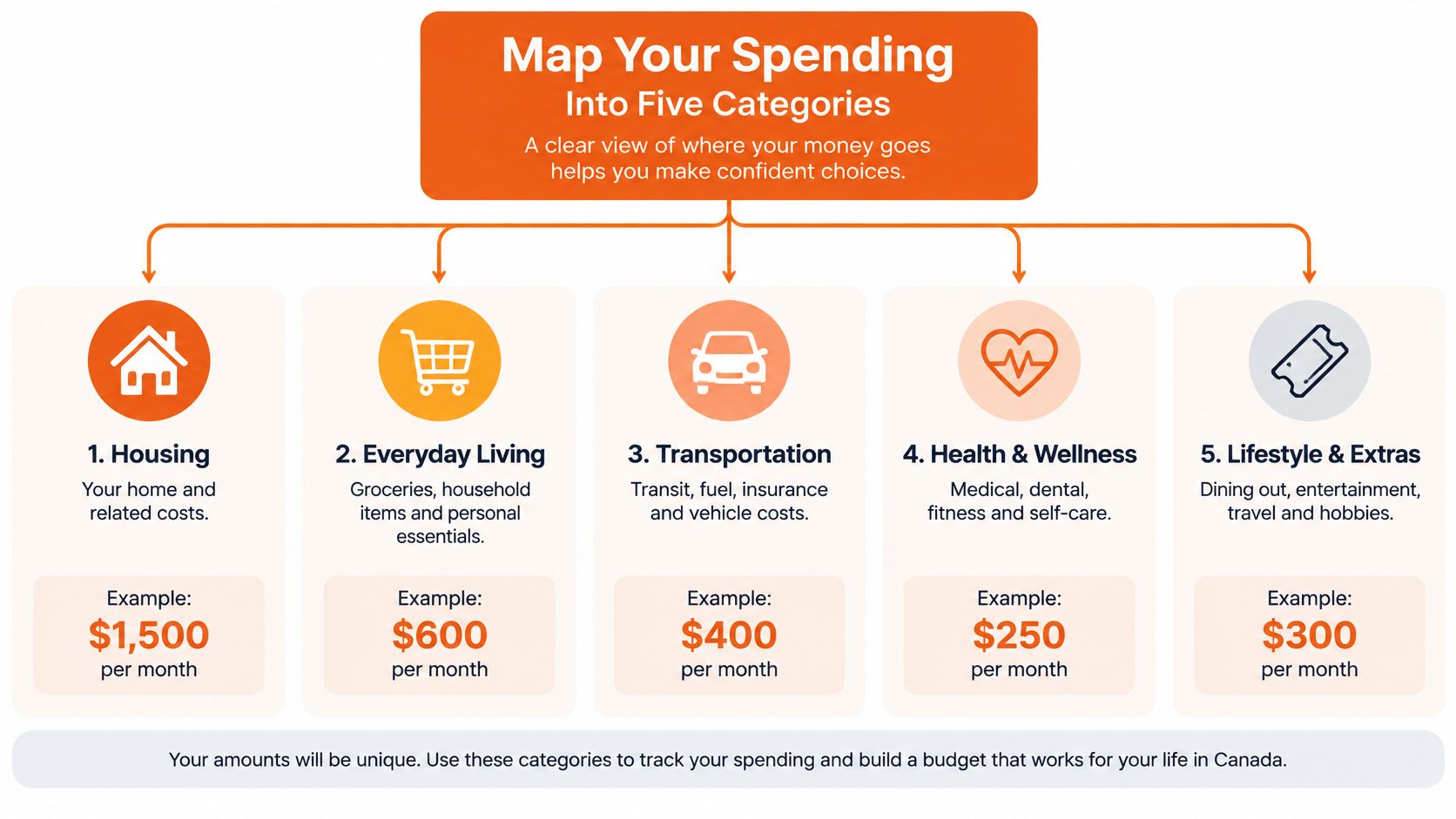
Fixed essentials are the regular bills with little room to change from month to month. Variable essentials, such as groceries and fuel, move around and may respond to planning. Discretionary costs are more flexible, but cutting them alone may not make enough room for a realistic savings transfer. Debt payments and annual costs need their own lines so they do not disappear inside another category. These personal budget categories can help you sort transactions consistently.
| Category | What belongs in it | How to set its monthly amount |
|---|---|---|
| Fixed essentials | Rent or mortgage, loan payments, insurance premiums | Budget the exact amount |
| Variable essentials | Groceries, utilities, transit, fuel | Use the average from three months |
| Discretionary | Dining out, shopping, entertainment | Set a limit and check it weekly |
| Debt payments | Credit card minimums, car or student loan | Keep minimums and add extra only after the first target |
| Irregular annual costs | Insurance renewals, gifts, travel, repairs | Divide the yearly total by 12 and save it monthly |
Convert Annual Costs Into Monthly Ones
An annual bill can make one month look unusually expensive. A $1,200 car insurance renewal works out to $100 a month when spread across the year. Set that monthly amount aside in a separate sinking fund, so the renewal is already accounted for when it arrives. The total bill stays the same; only its timing changes.
Use the same calculation for tuition instalments, professional dues, gifts, travel, and the winter tire swap. Add up the yearly cost, divide by 12, and include the result in your monthly plan. Refresh the estimate when the price changes. This turns a surprise-looking bill into a planned expense.
Run the Gap Check
Add the five category totals and compare them with take-home pay for that same month. If spending is below income, the difference shows the upper limit of what you could save, before allowing for any costs the month did not capture. If spending and income match, choose a category to adjust and name it in the plan. If spending is higher than income, the gap needs attention before a savings target can hold.
That result is information, not a judgment. Check that every transaction has a category, and that annual expenses are included as monthly amounts. Then look at the largest costs first. Small discretionary cuts may help, but the category totals show whether they can create enough room or whether another line needs attention.
Cut Recurring Costs Without Cutting What Protects You
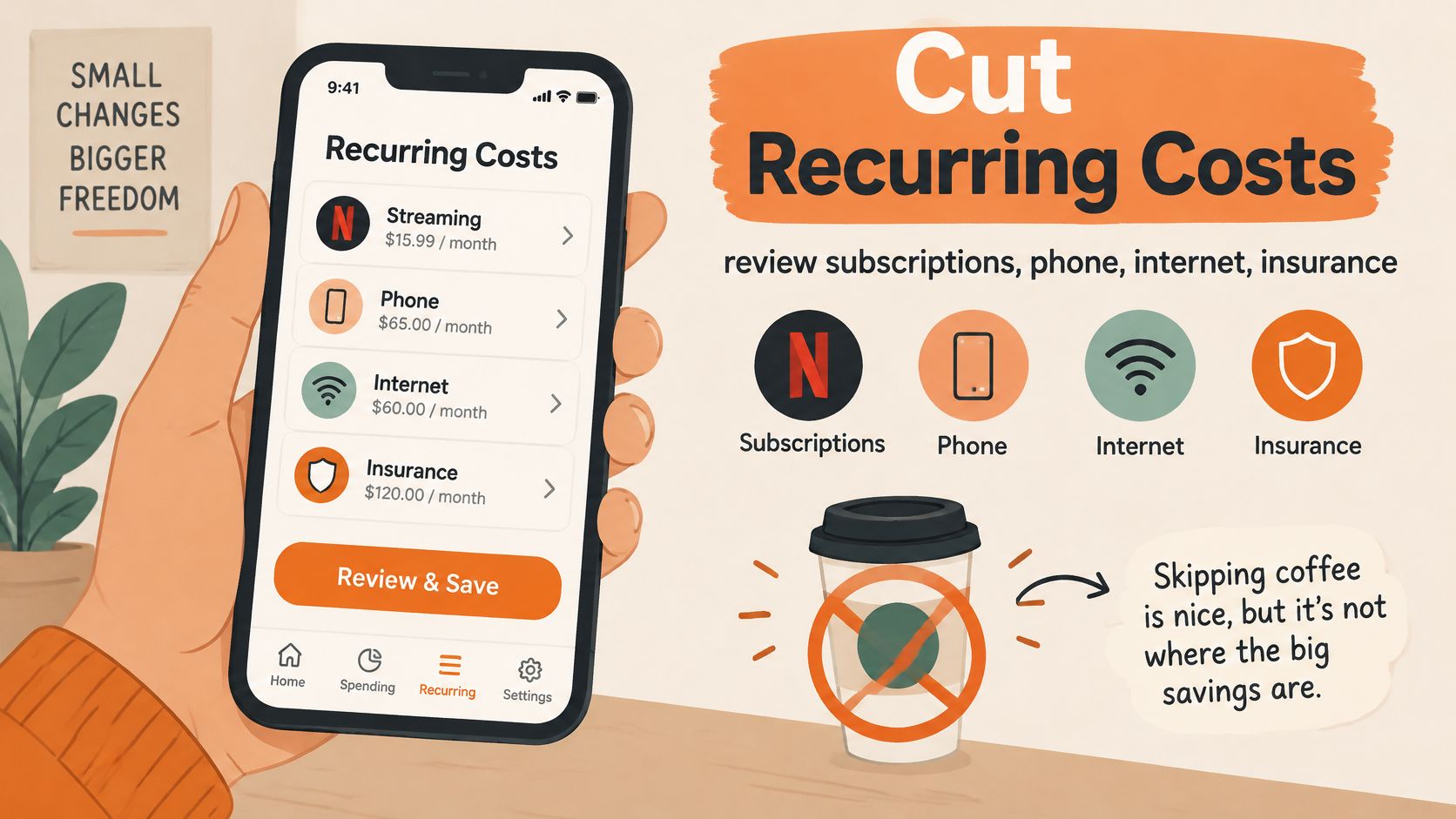
The advice that travels furthest is to stop buying coffee. Five dollars a day is roughly $110 a month, which is real money, but it's rarely where the biggest controllable savings sit. The larger sums hide in charges you set up once and stopped noticing, and cutting those costs you nothing.
Start with the ones that renew themselves.
Run a Recurring Charge Audit
- List every recurring charge from the last three months. Statements only, not memory. Include app subscriptions, streaming, the gym, cloud storage, memberships, insurance, and the phone and internet bills.
- Mark anything you used fewer than twice a month. Usage is the test for a subscription, not intention or the plan you meant to follow.
- Cancel or downgrade the top two, then call your phone and internet provider and ask for its current lower-rate plan. Ask specifically for the promotional or retention rate, and write down the date the promotion ends so the bill doesn't climb back.
- Check expiring credits, rewards and benefits before they lapse. A credit you never claimed and a membership you pay for and never open are the same money.
If coffee is a genuine daily habit, the cheaper answer is usually brewing at home rather than quitting, and this guide to affordable Keurig brewing covers pod cost and machine care without pretending you'll switch to instant.
Protect the Costs That Prevent Bigger Ones
Some spending looks cuttable and isn't. Minimum debt payments, required insurance, preventive health care, transport that gets you to work, and childcare.
Cutting a protective cost usually costs more later. Cancel the transit pass and miss a shift, and a day's pay disappears to save a monthly fare. Drop the insurance premium and one claim erases two years of progress. Let a card minimum slip and the late fee plus the rate increase outlasts the saving. Insurance is worth re-shopping every couple of years, but it's not worth dropping to hit a number.
Practical rule: Change two or three things a month, not the whole budget at once. A plan you still follow in week three beats a perfect one you abandon in week two.
Move each saving the same day you find it. Money left in the checking account after a cancellation tends to get absorbed within a fortnight, which is why the next step does more work than the best list of cuts. More ways to trim without weakening your position sit in these cost cutting strategies.
Automate Your Savings Transfer on Payday
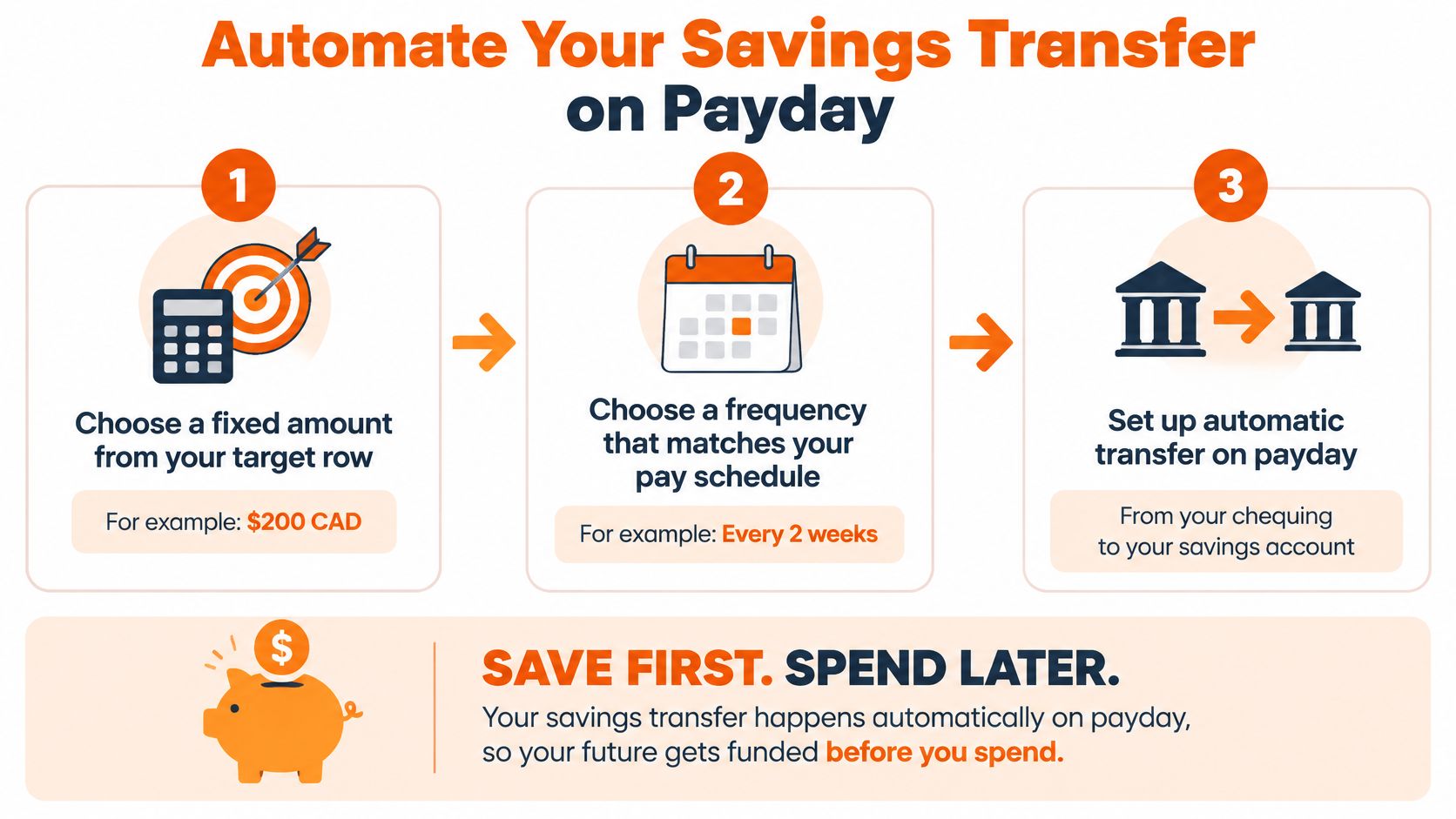
A transfer that happens on its own beats a good intention every time. You decide once, and the decision holds in the weeks when you're tired, busy, or standing in a checkout line.
Set It Up in Six Steps
- Choose a fixed amount from your target row. The starter row unless the arithmetic says otherwise.
- Choose a frequency that matches your pay schedule. Weekly pay, weekly transfer. Biweekly pay, biweekly transfer.
- Set the date for payday or the day after. The day after is often safer, because it confirms the deposit cleared.
- Confirm the checking balance still covers rent, bills and minimum payments after the transfer. Include the sinking fund for annual costs in that check.
- Send the money to a separate account labelled for its goal. "Starter reserve" tells you what the money is for. "Savings" doesn't.
- Review after the first month and lower the amount if the account dips. A transfer you can sustain beats a bigger one you cancel in week five.
The Financial Consumer Agency of Canada recommends this exact mechanic: pick a specific amount, date and frequency, then arrange an automatic transfer from a chequing account to a savings or investment account, so money moves as soon as income arrives rather than getting spent first. The agency presents automation as the way to make saving habitual.
Match the Schedule to Your Pay Cycle
The yearly total depends on both the amount and how often you move it.
| Schedule | Amount per transfer | Transfers a year | Saved before interest |
|---|---|---|---|
| Every two weeks | $100 | 26 | $2,600 |
| Weekly | $50 | 52 | $2,600 |
| Monthly | $250 | 12 | $3,000 |
Very different rhythms produce roughly the same annual result. A weekly $50 transfer is easier to absorb in a tight month, while a monthly $250 is simpler to check. Follow your pay days, not your bills.
Bills should never come first in the order of operations. That ordering is the whole point of the pay yourself first method, and automation is how you apply it without relying on willpower.
Review Progress Each Month and Adjust
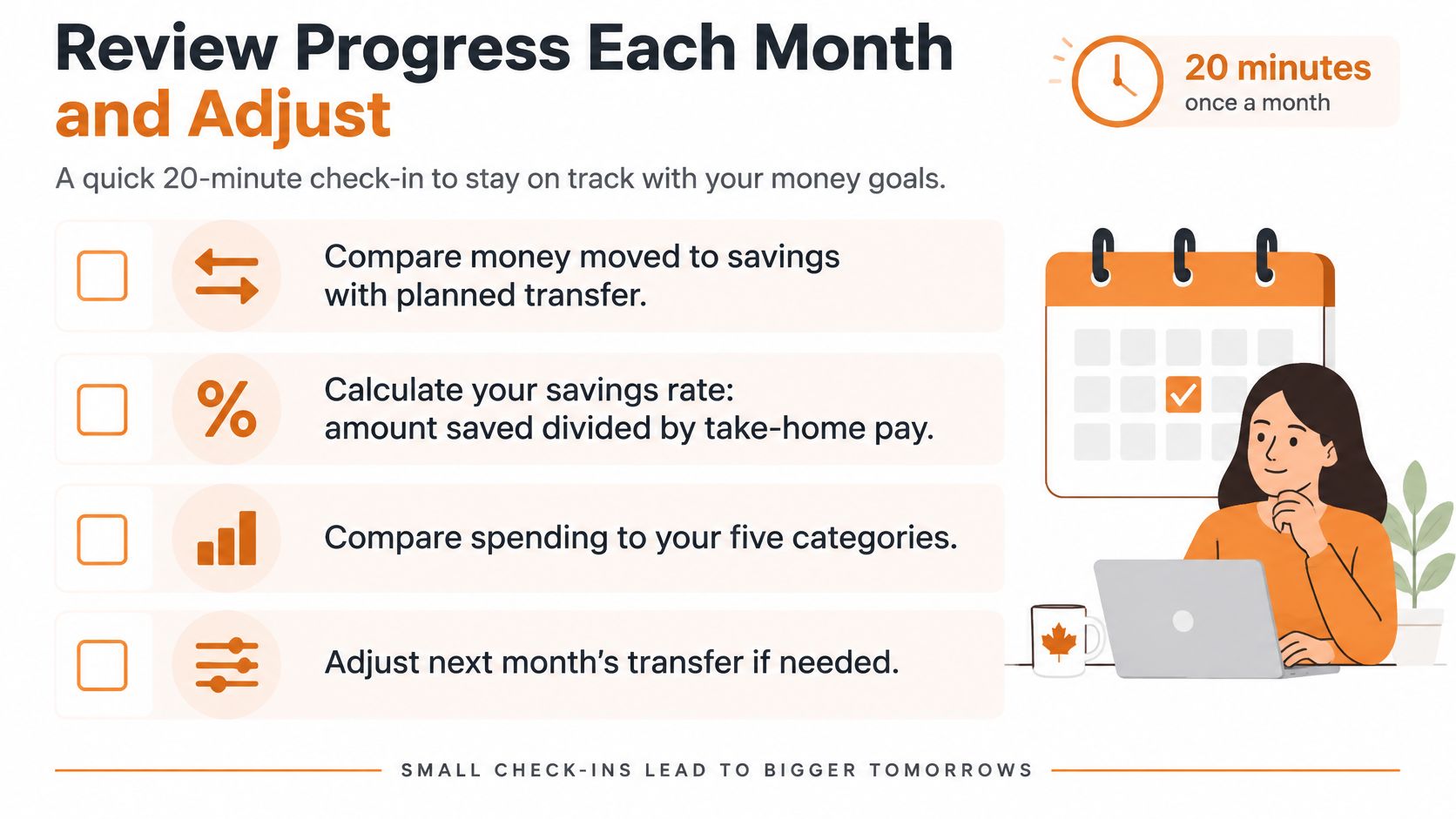
Set aside twenty minutes on the same date each month, ideally the day before payday. Five checks, in this order.
- Compare the money moved to savings with the planned transfer. Did the full amount leave, or less because a bill came out early?
- Calculate your savings rate. Amount saved divided by take-home pay.
- Compare discretionary spending with each category cap. Over by $40 on dining out is information, not a verdict.
- Count the days the account stayed above your planned floor. If it dipped below twice, the transfer is too big for now.
- Recheck the annual costs. Insurance, gifts, repairs, renewals.
Keep Annual Costs in Step With Prices
The sinking fund you set in January is a guess about prices twelve months out. Canada's consumer-price inflation was 2.4% in September 2025 and had stayed inside the Bank of Canada's 1% to 3% target range for 21 months, according to the federal government's 2025 economic overview, which projected average inflation of 2.1% for 2025 and 2.0% thereafter.
In plain numbers: if a planned expense costs $1,200 today and you assume 2% over the year, the figure to aim for is about $1,224. Treat that 2% as a planning assumption rather than a forecast. The habit matters more than the decimal, so recheck each yearly total at the monthly review instead of dividing once and never looking again.
When You Overspend, Reforecast and Keep Going
An overspent month is not a reason to rebuild from scratch. Change next month's cap, keep the transfer running, and send half of any saving from a cut or a small windfall to the reserve until the first target is reached.
The test of a plan: Can you restart it in ten minutes after a bad month? If not, it was too detailed to survive real life.
Record the savings rate where you'll see it. A month over month comparison turns one number into a trend, and the trend tells you whether the plan is working or being maintained.
Save Money Each Month, Starting With One Transfer
Start with a transfer you can sustain. Use the starter reserve amount from the first section's table, schedule it for payday, and name the account for its purpose. A steady, reachable amount is more useful than a larger transfer that leaves too little for essential costs.
A savings goal keeps the target visible when the month gets busy. Set a target amount, a deadline, or both, or start with a template for an emergency fund, vacation savings, or debt payoff. Finny analyzes your income and spending patterns to estimate when you'll reach each goal and suggests adjustments if you fall behind. Create a savings goal for your starter reserve and review its progress monthly.
Fintrack's dashboard brings income, expenses, budgets, and goals together. Set spending limits by category and track progress in real time. Velocity alerts warn you when your spending pace suggests you may exceed a budget before month-end. Ask Finny questions about your own figures to understand where your money is going, then adjust your transfer if needed. A Fintrack budgeting dashboard can help you track a month and see how the plan is working.