Your car's at the shop, the mechanic's quoting more than your chequing account holds, and you're searching for an emergency fund calculator at midnight. You don't need a slogan about six months. You need a number that matches your rent, your job risk, and what you can save.
Why the Three-Month Rule Breaks for Most People
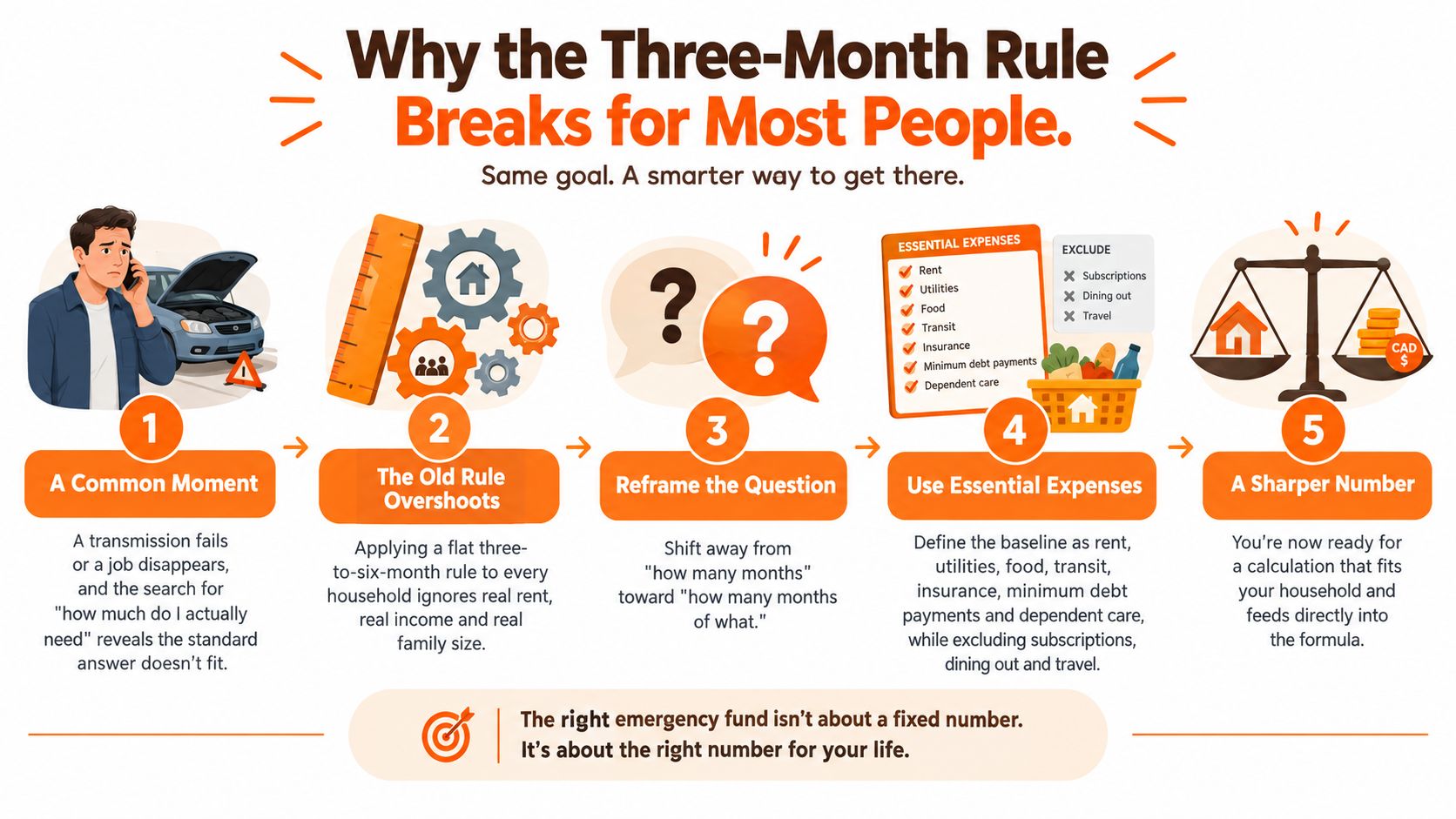
Last Tuesday it was a transmission. Next month it could be a layoff notice. Both send people to the same question, how much do I need, and both get the same flat answer, three to six months. That answer fails because it never asks, three months of what?
Months of essentials, not months of normal life
Your baseline isn't your usual spending. It's the cost of a lean month you can't pause.
- Count these: Rent or mortgage, utilities, groceries, transit or car costs, insurance, healthcare, minimum debt payments, and dependent care you'd lose work without.
- Leave these out: Dining out, subscriptions, travel, and shopping you could stop without real consequence.
Use normal spending and you'll overshoot, then quit because the target looks absurd. Use income and you'll also overshoot, because you wouldn't spend at your normal level with no pay coming in. Use essentials and the number gets smaller, sharper, and reachable.
California data shows why a single target misleads. PPIC estimates that about two-thirds of California families can cover one month of basic needs, at roughly $3,300, while only 58% can cover three months, at roughly $10,000. That drop matters. Many households aren't failing at saving, they're being handed an all or nothing goal.
Build for the month you'd actually have to survive, not the month you're living now.
Job risk splits households further. A dual income renter with easily replaced work needs less runway than a single earner in a cyclical industry. If you're mapping that risk, this job loss preparation guide for families is a useful companion for the non-cash steps, benefits, paperwork, and timing. The calculator inputs you need from here are simple, monthly essentials, current liquid cash, and a realistic monthly surplus.
The Two-Stage Formula Behind Every Emergency Fund Calculator
A good emergency fund calculator does two jobs, not one. It protects you from a bill this week, and from missing income over several months.
Stage 1 and Stage 2
Stage 1, the liquid-shock buffer. Add the essential costs that hit immediately, rent or mortgage, utilities, food, transportation, insurance, healthcare, minimum debt payments, and dependent care. This is cash you can reach without selling anything or borrowing.
Stage 2, the income-interruption reserve. Multiply those same monthly essentials by the number of months you want covered without income. In plain math, monthly essentials × target months = reserve target. Then subtract cash that's genuinely liquid. Don't count retirement accounts, volatile investments, or available credit.
If you're unsure what belongs on the essentials list, work through a complete list of household expenses line by line and mark only what you'd still pay in a lean month.
Handling irregular costs honestly
Annual and quarterly bills will wreck a tidy monthly number if you ignore them. Divide them into a monthly equivalent.
- List irregular essentials: Annual insurance premiums, car registration, and required maintenance you can't defer safely.
- Convert them: Divide each annual amount by twelve and add it to monthly essentials.
- Remove gross income: It doesn't belong in the formula at all, because it overstates what a lean month costs and what you can save.
Add a volatility adjustment if your income is irregular, you're the only earner, or you face medical costs or large deductibles. That adjustment usually means choosing more months, not inflating every expense category.
Finally, stress test the result. Show what happens if expenses rise by 10% or income falls by 20%. A calculator that hides that sensitivity gives false precision. You want a range you understand, then a first milestone you can fund. Recalculate after rent, household size, employment, insurance, or debt payments change, because the formula is only as current as its inputs.
Staged Milestones vs the Single Six-Month Target
One big number discourages people. Four checkpoints give them a sequence.

Four checkpoints, two kinds of risk
- $1,000 starter buffer: Covers an immediate shock without a card.
- $2,000 within 30 days: Covers a larger bill that can't wait for next month.
- One month of essentials: Keeps the household running through a short gap.
- Longer income-replacement reserve: Covers a real job search or lost contract.
The first two are probability oriented. Shocks happen to nearly everyone. A UCLA poll of 2,419 adults found 22% couldn't come up with $2,000 in 30 days. A separate California figure in the verified data puts difficulty with a $1,000 bill close behind. Don't make people wait years for their first win.
The affordability case is stronger still. United Ways of California found 35% of households, more than 3.8 million, don't earn enough to cover basic living expenses including housing, child care, transportation, health care, taxes, and food. Telling those households to save six months first is bad advice. Ask instead, what's the smallest reserve that materially reduces risk?
Tracking each checkpoint separately helps, which is why a savings goal tracker app works better than one blended savings balance. You can see the starter buffer close, then the next stone.
My rule: Stop stacking months once your reserve matches a realistic worst case job search for your industry. After that, extra cash usually earns its keep elsewhere.
Worked Examples for Two Real Households
Examples beat theory, so run two households through the same staged formula. Map yourself to the closer one and swap in your numbers.
Household A, dual income renters
A couple rents in a mid-cost city, no dependents, stable salaried jobs. Their lean month is $4,200 in essentials. With two incomes and replaceable roles, three months is a sensible main target, and six months is optional comfort, not a requirement.
Their math is straightforward. One month is $4,200, three months is $12,600, and six months is $25,200. Starting from zero, they'd need $1,050 a month for twelve months to reach the three month target. That's demanding, but the $1,000 starter buffer comes first and changes their risk within the first month.
Household B, single parent, freelance income
A single parent with one child, one car, and variable freelance income has $3,100 in essentials, including $180 a month in minimum debt payments. The dollar total is lower, but the risk is higher. One income, a dependent, and irregular pay argue for aiming beyond three months once the starter milestones are funded.
For this household, one month is $3,100, three months is $9,300, and six months is $18,600. Reaching three months in twelve months from zero takes $775 a month, which may not fit a variable income. The staged model still works, fund $1,000, then $2,000, then one month, and extend the timeline rather than abandoning the target.
If you want to test your own household inputs side by side, a household budget calculator helps you separate essentials from flexible spending before you set the reserve.
Emergency Fund Targets for Two Sample Households
| Household | Monthly essentials | Starter buffer | One month | Three months | Six months | Monthly contribution to hit 3-month target in 12 months |
|---|---|---|---|---|---|---|
| A, dual income renters | $4,200 | $1,000 | $4,200 | $12,600 | $25,200 | $1,050 |
| B, single parent, freelance | $3,100 | $1,000 | $3,100 | $9,300 | $18,600 | $775 |
Notice what the table doesn't do. It doesn't declare Household B safer because its target is cheaper. Risk, not just rent, decides how many months you need.
Designing an Emergency Fund Calculator People Will Actually Use
Most calculators ask too little, then output too much confidence. Design for honesty.
Inputs that matter
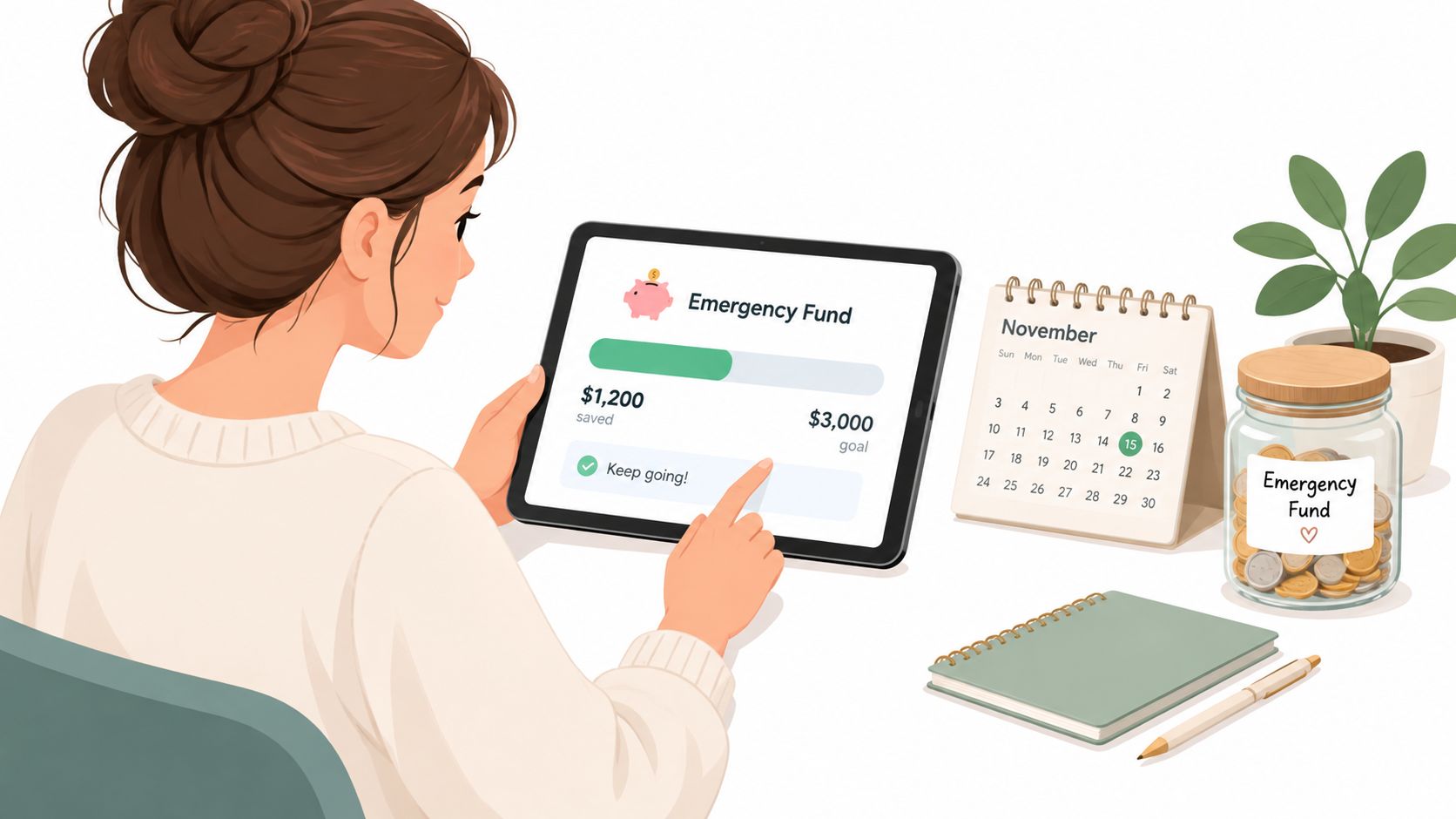
Ask for current liquid savings, monthly essential expenses, reliable net monthly income, monthly surplus, household size, and a flag for variable income. Cap the assumed monthly contribution at the surplus the person sustained over the previous three to six months. Aspirational contributions produce fantasy timelines.
California's history justifies asking about income interruption directly. The Legislative Analyst's Office reported California's average unemployment spell lasted 35 weeks in 2010, versus 33 weeks nationally, and 46% had been unemployed for more than 26 weeks. You don't need to save for the worst year on record, but you shouldn't pretend every job returns in a month.
Outputs people can act on
Show the dollar target broken into the four milestones, a months to target estimate, and a readiness status for each one. Use (target minus current liquid savings) divided by sustainable monthly surplus, with a floor of zero. Flag negative cash flow plainly, don't bury it.
Put the next milestone first, large and clear. A financial goals calculator approach works well here because it ties the target to a date and a monthly amount, not just a total.
Avoid two engineering errors. First, never use gross income, it overstates saving capacity. Second, never count total savings without subtracting earmarked funds, pending bills, and credit card balances that reduce what's available. A calculator inside a budgeting tool beats a standalone page, because your essentials update when your spending changes instead of going stale after one visit.
Common Shortcuts That Produce the Wrong Number
These mistakes are common, understandable, and fixable in one line each.
Five shortcuts, five corrections
- Using gross income: It inflates both the target and your saving capacity. Fix, calculate from essential expenses and net surplus only.
- Counting retirement accounts: They're not liquid reserves and raiding them creates new problems. Fix, count only cash you can access quickly without penalty driven decisions.
- Treating credit as cash: A card limit is borrowed money at the worst moment. Fix, available credit is zero in this calculation.
- Padding essentials with discretionary spending: It inflates the target until you quit. Fix, fund the lean month first.
- Forgetting annual costs: Insurance premiums and registration still arrive during a crisis. Fix, convert them to a monthly equivalent.
If money isn't liquid, available this week, and yours without borrowing, it isn't an emergency reserve.
California vulnerability data underlines why small, real cash matters. PPIC reports approximately 19% of adults say paying a $1,000 emergency would be very difficult or nearly impossible. A smaller honest buffer beats a larger imaginary one every time.
Rerun the whole calculation after a rent change, a new dependent, a job switch, a pay change, a deductible shift, or a new minimum debt payment. Those events change either your lean month or your risk. Don't adjust by feel.
Where to Keep the Money and How to Stay on Track
Keep the reserve boring. A high-interest savings account with same-week or instant withdrawal is the right home for many. If you're comparing rates, understand how interest works on a savings account so a teaser rate doesn't distract you from access and fees.
Deposit protection and access
For Canadians, check deposit protection before you pile up a large balance. CDIC automatically insures eligible deposits at member institutions up to $100,000 per depositor, per insurance category, including principal and interest. Multiple accounts in one name at the same institution generally share that category limit, they don't each get a fresh one. Split larger reserves across categories or institutions, and don't lock emergency cash into a GIC you can't reach before maturity.
Inflation is why you revisit the number yearly. The Bank of Canada targets 2% inflation, within a 1% to 3% range, so a fixed $10,000 balance has purchasing power of roughly $9,804 after one year at that rate, before interest or taxes. Update essentials, compare your interest rate with rising costs, and top up the target.
If a disaster, not just a job loss, is your scenario, this disaster recovery funding guide covers funding routes beyond personal savings. For day to day discipline, automate the transfer on payday, keep the account separate from spending, and review once a year. Fintrack's savings goals and strategies feature lets you set the four milestones as separate targets with deadlines and progress tracking, which keeps the starter buffer from leaking into regular spending.
Run your lean month through the staged formula today, set the $1,000 starter buffer as your first target, and automate the monthly amount your last few months prove you can sustain. Fintrack helps you track those essentials without a bank connection, watch each milestone close, and adjust the target when rent, income, or family costs change.