Your offer letter includes 1,200 RSUs and 4,000 stock options, but the salary is the only part you can confidently explain. You're wondering whether the equity could help fund a home deposit, whether you'll have to pay to receive it, and what happens if you leave.
Choosing between RSUs or stock options starts with separating a promise of shares from a right to buy shares. For employees in Canada and the United States, the next questions are just as important: when you earn the award, when you can sell it, and how much cash you'll need for taxes.
RSUs and Stock Options at a Glance
A restricted stock unit, or RSU, is a promise to deliver shares, or their cash value, once the award's conditions are satisfied, without charging you a purchase price. A stock option gives you the right to buy shares at a fixed exercise price, so its immediate exercise payoff comes from the share price exceeding that price.
Those are different promises. In the hypothetical offer above, the larger option count doesn't automatically make the options more valuable.
RSUs and stock options compared on the criteria that matter
| Feature | RSU | Stock option |
|---|---|---|
| What you receive | Shares, or their cash value, when units vest and settle | Right to buy shares at a fixed exercise price |
| Cost to receive it | No purchase price | Exercise price paid when you buy the shares |
| Value at grant | Linked to the full underlying share value, subject to earning the award | Immediate exercise value is only the amount above the exercise price |
| Typical vesting | Set schedule, often four years with a one-year cliff | Set schedule, often four years with a one-year cliff |
| Usual taxable point | Vesting and settlement, subject to the plan and country | Exercise date, or sale date for some option types |
| Main downside | Value falls with the share price and can reach zero | Can expire worthless if the price stays at or below the exercise price |
The vesting pattern in the table is a common example, not a promise about your employer's plan. Your grant agreement sets the actual dates and conditions.
Compare the promise, not just the count
An RSU represents the underlying share's value once earned and delivered. An option represents an opportunity to buy, which means you must subtract the purchase cost before describing your potential gain.
There's another distinction: immediate exercise value isn't the same as an option's overall economic value. An option without an exercise gain today may still offer a future opportunity before it expires, but that opportunity isn't spendable cash.
If you're still discussing an offer, Underdog.io's guide to negotiating equity in a startup offer provides useful context for asking about the award rather than accepting a headline share count.
Quick identification test: Units with no purchase price usually indicate RSUs. An exercise price or strike price indicates stock options.
Don't treat either award as guaranteed savings. Before assigning it a role in your financial plan, establish what you must do to earn it and whether there will be a practical way to sell the resulting shares.
How Vesting Decides When You Own Value
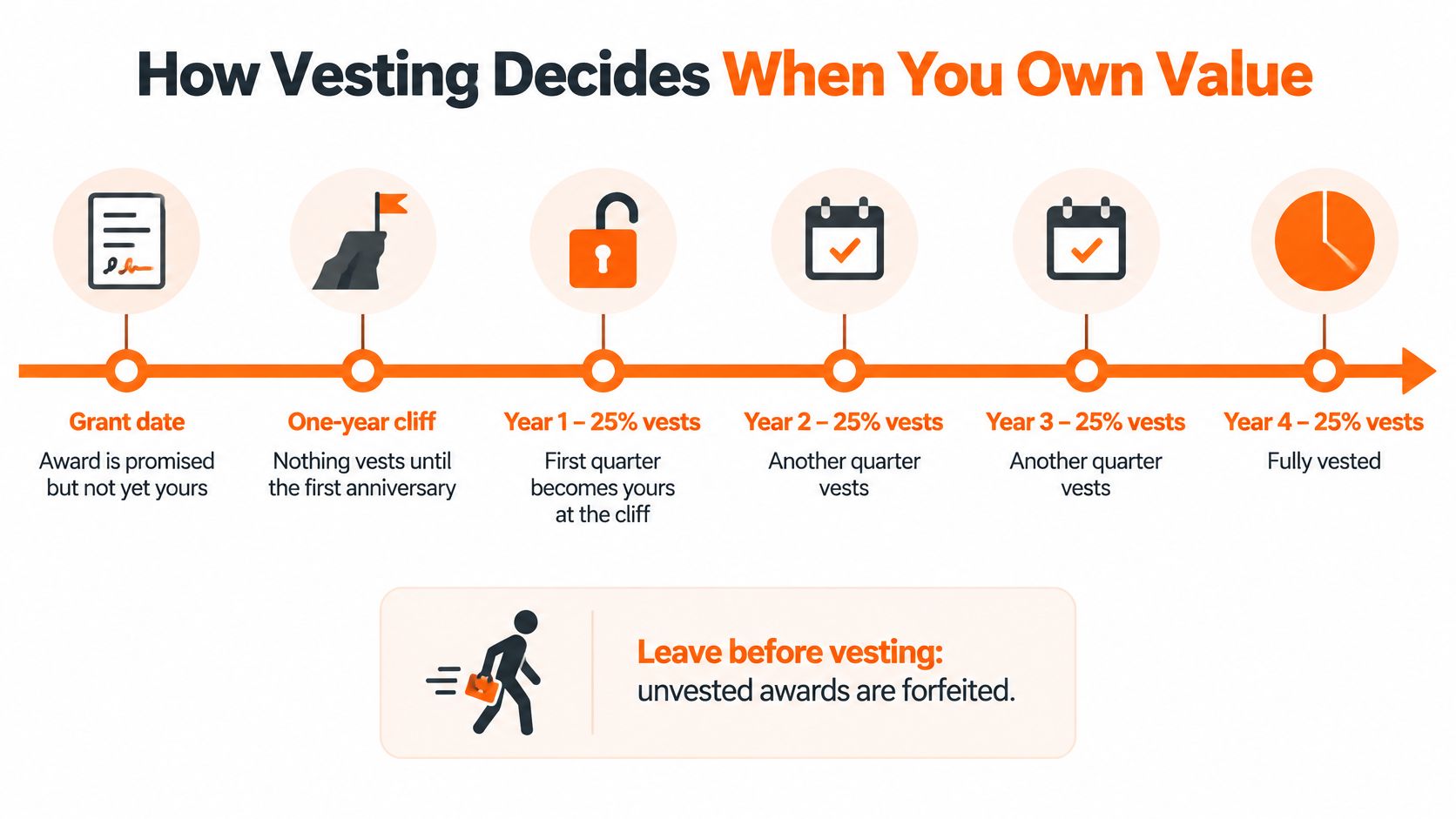
Suppose your 1,200-RSU grant follows a hypothetical four-year schedule with a one-year cliff. Nothing vests during the first 12 months; on the first anniversary, 300 units vest, followed by 25 units each month for the next 36 months.
That's the arithmetic behind this example: the cliff releases the first quarter, and the remaining units are spread across the rest of the schedule. A quarterly schedule would release larger batches less frequently.
Vesting means satisfying the conditions required to earn an award. If you leave before satisfying them, you generally forfeit the unvested portion, subject to the agreement and any applicable exceptions.
Earning an award isn't always receiving shares
Private-company double-trigger RSUs usually require both a service condition and a qualifying event, such as an IPO or acquisition, before settlement. Completing the service requirement alone may not mean shares arrive in your account.
Read what happens if you leave after completing the service condition but before the liquidity event. Some agreements impose continued-employment requirements or expiration provisions that can affect whether you receive anything.
Options introduce a different separation. Vesting earns the right to buy; exercising means using that right and purchasing shares. You can therefore hold vested options without owning the underlying shares.
A post-departure exercise window limits how long you can act after leaving. For example, if your agreement specifies a 90-day window, you must assess the purchase cost, tax and deadline within that period rather than assuming vested options remain available indefinitely.
Mark the dates that affect your decision
Check these terms directly in the grant documents:
- Cliff date: Identify when the first portion becomes earned.
- Vesting frequency: Record whether later portions vest monthly, quarterly or on another schedule.
- Double-trigger conditions: Identify the qualifying event, settlement deadline and any continued-service requirement.
- Departure window: Find the deadline for exercising vested options after employment ends, plus the award's overall expiry date.
For the sample grant, a calendar would show grant date → first anniversary and 300 units → monthly releases of 25 units → final release at the fourth anniversary. Add your actual dates rather than relying on the date you signed the offer.
Keep the grant agreement and equity-plan document together. The offer letter may summarise the award without including the rules that determine what you keep.
How RSUs and Stock Options Are Taxed
When each award is taxed in the US and Canada
| Case | When it is taxed | What to check |
|---|---|---|
| US RSU | Generally ordinary income at vest and settlement, based on fair market value | Withholding and whether shares are sold or withheld to cover it |
| US nonqualified stock option | Ordinary income at exercise on the spread above the price paid | Withholding at exercise and capital gains or losses on a later sale |
| US incentive stock option | Generally no regular income tax at exercise, but the spread can trigger AMT | Qualifying-sale holding periods of one year after exercise and two years after grant |
| Canadian stock option | Generally an employment benefit at acquisition, with special timing rules for some arrangements | T4 code 38 and eligibility for the stock-option deduction |
| Canadian RSU | Generally employment income when shares or cash are delivered | Delivery timing and how payroll covers the tax |
These are starting points, not a complete filing guide. Deferred settlement, special option arrangements and cross-border employment can change the result.
US employees must identify the option type
For ordinary US RSUs that vest and settle together, the fair market value becomes wage income even if you keep the shares. Your employer's withholding is a payment towards your tax liability, not confirmation that the final bill is fully covered.
A nonqualified stock option, also called an NSO or NQSO, generally creates ordinary income on the exercise spread. After you own the shares, subsequent price changes generally produce capital gains or losses when you sell.
An incentive stock option, or ISO, requires a separate calculation. Exercising can create alternative minimum tax exposure even without regular income tax at that point, and selling before the required holding periods can change the treatment.
Keep payroll records, exercise confirmations and brokerage statements together. Fintrack's explanation of a capital gains tax calculator can help you distinguish investment gains from compensation already recognised as income.
Canadian employees must separate benefit and sale
The Canada Revenue Agency's taxable-benefits guide explains that an option benefit generally equals fair market value at acquisition minus what you paid for the shares and option rights, and is reported as employment income using T4 code 38. In its example, paying $10 for a share worth $25 produces a $15 employment benefit.
The CRA treats stock options as a non-cash benefit that isn't subject to Employment Insurance premiums. Certain Canadian-controlled private corporation arrangements have special timing or payroll treatment, so don't assume every Canadian option follows the same acquisition-year result.
Canadian RSUs generally create employment income on delivery. If shares arrive without enough being sold or withheld for tax, you may need cash from elsewhere.
Moving doesn't necessarily remove California tax
The California Franchise Tax Board states that California taxes RSU wage income on the vesting date. Keeping the shares doesn't turn that compensation into untaxed investment income.
For options, California-source compensation can reflect services performed in the state before you move. The FTB's residency and sourcing technical manual describes allocation using California workdays between grant and exercise in relevant cases.
Track grant dates, California workdays, relocation dates, vesting or exercise dates, and sale dates. Ask a qualified tax professional to distinguish California-source wages from later investment gains, and confirm the rules for your award type before timing a move.
The Canadian Stock Option Deduction Explained
A Canadian stock-option deduction can reduce the employment benefit included in taxable income. It doesn't reduce what you must pay to exercise, and it doesn't automatically apply because your employer calls an award a stock option.
Finance Canada's explanation of qualifying employee stock options describes a deduction generally equal to 50% of the eligible employment benefit, subject to conditions including an arm's-length relationship, the grant-date exercise price and prescribed-share requirements.
Check eligibility before calculating savings
Find the grant date and grant-date fair market value. Use the formal grant records rather than the latest financing announcement. You need the value relevant to the option grant, not an unrelated investor share price.
Compare the exercise price with that value. For the eligibility route described here, the exercise price must be no lower than fair market value when granted. A later increase in share value doesn't fix a grant that failed this condition.
Confirm the relationship and share requirements. Check that you dealt at arm's length with the employer at grant and that the acquired share meets the prescribed-share requirements. A common share is typical, but the share's legal terms still matter.
Calculate the employment benefit. Subtract the amount paid for the shares and option rights from fair market value when acquired. Don't confuse the benefit with the total value of the shares.
Apply the deduction only to eligible benefits. Check the conditions and any applicable annual limit before assuming the entire award qualifies. Have payroll or your tax adviser confirm the treatment rather than building a budget around an unverified deduction.
What the deduction changes
Using the earlier acquisition example purely as arithmetic, a $15 benefit with a 50% deduction leaves $7.50 per share included in taxable income. That isn't a $7.50 tax bill; you still apply the relevant tax rate to the taxable amount.
A deduction reduces taxable income. A deferral changes when income is taxed. Neither removes the exercise cost.
Fintrack's guide to the meaning of tax deferral helps separate those ideas when comparing grants. Missing an eligibility condition can remove the expected deduction, while large awards may also require a qualifying and non-qualifying split.
Risk, Cash Flow and Payoff Scenarios
Illustrative value of 100 RSUs and 100 options at a $10 strike
| Share price at vest or exercise | RSU value (100 units) | Option gain (100 options at $10 strike) |
|---|---|---|
| $5 | $500 | $0 |
| $10 | $1,000 | $0 |
| $20 | $2,000 | $1,000 |
These are hypothetical pre-tax values, before fees and any vesting, settlement or exercise restrictions. Option gain means the share value less the exercise cost, not the gross value of purchased shares.
At the lower hypothetical price, the RSUs retain value while exercising the options offers no immediate gain. At the higher price, both awards have value, but the option holder must account for the purchase price.

Compare after-tax proceeds, not share value
Consider separate hypothetical US and Canadian employees receiving 1,000 awards, with shares valued at $25 at vesting or exercise and an option strike of $10. Use local currency in each case, with no currency conversion.
For illustration only, assume a 30% US tax rate and a 40% Canadian marginal rate. These aren't actual employee rates: the simplified calculations exclude additional state or provincial tax, payroll charges, fees and restrictions.
| Hypothetical award | Gross compensation benefit | Exercise cost | Illustrative income tax | Value remaining after exercise cost and illustrated tax |
|---|---|---|---|---|
| US RSUs | $25,000 | $0 | $7,500 | $17,500 |
| US nonqualified options | $15,000 | $10,000 | $4,500 | $10,500 |
| Canadian RSUs | $25,000 | $0 | $10,000 | $15,000 |
| Canadian options with qualifying deduction | $15,000 | $10,000 | $3,000 | $12,000 |
| Canadian options without deduction | $15,000 | $10,000 | $6,000 | $9,000 |
For the US RSUs, the assumed tax may be covered through shares withheld or sold. The US option holder instead faces an exercise cost plus tax on the spread, although an available same-day sale could fund those amounts.
For the Canadian options, the qualifying deduction leaves $7,500 taxable in this hypothetical calculation, producing the illustrated tax. The purchase cost doesn't shrink just because the taxable benefit does.
These remaining values aren't necessarily cash in your bank account. They assume the shares can be valued at the stated price; an actual sale may be restricted or occur at another price.
Test whether you can carry the risk
- Exercise cash: In the smaller example, buying 100 shares at the hypothetical $10 strike requires $1,000 before tax. Don't commit money needed for rent or emergency savings.
- Tax without sale proceeds: Map the payment deadline against available cash. A cash-flow management plan is more useful than an optimistic exit valuation.
- Employer concentration: Decide how much of your net worth you're comfortable holding in company stock. Consider reducing the position when it exceeds your chosen limit, subject to trading restrictions.
Private-company ownership also raises dilution questions. Coto & Waddington, Attorneys at Law's guide to preemptive rights explained for startups provides context on ownership protections, but don't assume employee shares include those rights.
Which Equity Pay Fits Your Situation
The better award is the one that fits your cash needs, realistic expectations and actual grant terms. A generous-looking award can be a poor fit if accessing it requires money you can't afford to risk.
Public-company employee seeking usable compensation
RSUs are usually easier to evaluate because there's no exercise price to fund. That can make them a better fit when you want compensation that can support savings goals after tax and permitted sales.
The check that could change the verdict is the relative size of the awards. A substantially larger option grant may offer more upside, but test it against a realistic share price rather than assuming strong growth.
Private-startup employee before an IPO
Options may cost nothing to accept, but acceptance isn't ownership. The important question is whether you can eventually afford to exercise and hold shares without a predictable buyer.
Double-trigger RSUs may avoid immediate settlement before a qualifying event, but inspect the event definition and departure provisions. Prefer the grant whose conditions you understand and whose downside you can carry.
Employee considering an early departure
Start with the departure date and the agreement, not the headline grant value. If you expect to leave before a cliff, the equity may contribute little to the offer's practical value.
For a broader view of the decision, Acheloa Wellness on quitting your job considers factors beyond compensation. Financially, the check that changes the answer is whether earned awards survive departure and whether you can meet any exercise deadline.
Canadian employee receiving a large option grant
Don't assume the entire benefit qualifies for the deduction. The Department of Finance's federal tax-expenditure report describes a $200,000 annual limit, based on underlying shares' fair market value, for qualifying grants made after June 2021.
Options from Canadian-controlled private corporations, and non-CCPC employers with annual gross revenue of $500 million or less, are generally excluded from that limit. Employer status can therefore change the result, and large public-company awards may need to be separated into qualifying and non-qualifying portions.
Compare after-tax value at a realistic share price, not the headline grant size.
Treat employer equity as part of your long-term investment plan, alongside other assets and near-term obligations. It shouldn't replace a dependable plan for everyday bills.
Check Your Grant Terms Before You Decide
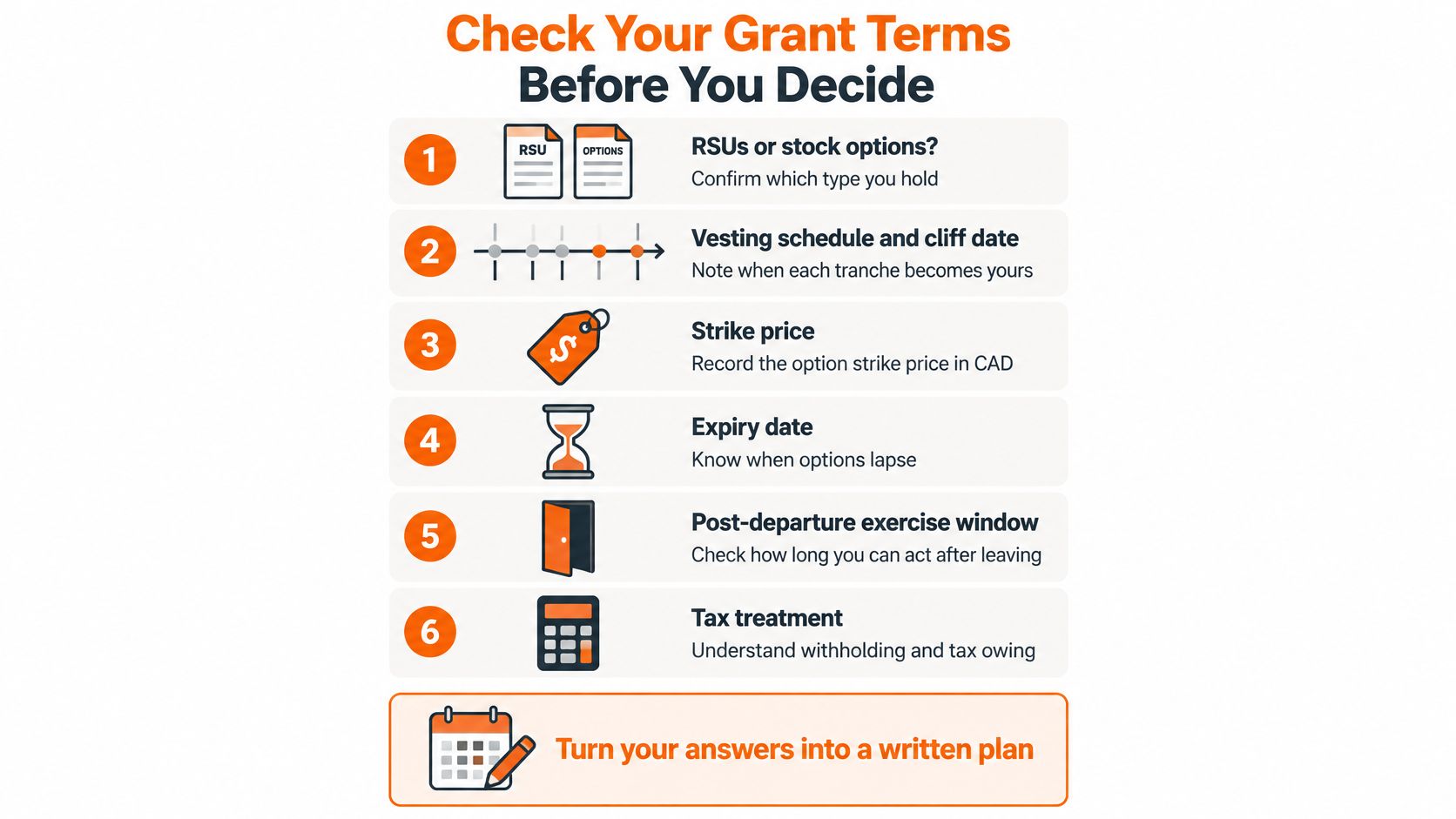
Open the grant agreement, equity-plan document and latest award statement together. Create a short record you can update when an award vests, you exercise, or your work location changes.
The visual checklist highlights the document terms; your written plan should also include cash reserves and employer-stock exposure.
Build your grant record
Confirm the award type. Record RSUs or options and, for US options, the specific tax classification. Keep separate grants separate.
Write down the earning conditions. Include the vesting schedule, cliff date, settlement terms and any double-trigger condition. Add reminders for the actual dates.
Record the option pricing. Save the exercise price and fair market value at grant, including the currency. Don't mix CAD and USD figures.
Find both exercise deadlines. Record the overall expiry date and the post-departure exercise window. Save the relevant agreement language with your notes.
Estimate the cash requirement. Separate the purchase cost, expected withholding and any additional tax reserve. Identify how you would fund each amount without relying on an uncertain sale.
Measure company-stock exposure. Compare employer shares with your other savings and investments. Use a risk tolerance assessment to connect that exposure with your goals and ability to absorb a loss.
Document work-location changes. Keep residency dates and workday records, then ask a qualified tax professional whether a move changes sourcing, withholding or filing obligations.
Turn the record into a budget
Keep expected equity proceeds separate from dependable salary income. Add an anticipated sale to your plan only with a clear note about timing, restrictions and uncertainty, and assign the related tax reserve its own category.
Don't count the gross grant value as available spending money. Reconcile what reaches your account against exercise costs, withholding and the amount you still need to reserve.
Our Budget Planning feature can help you plan that reserve, and manual entry works without a bank connection when equity proceeds arrive in lumps.
Start by recording your next award event and the cash it could require. This is general educational information, not personalised investment or tax advice.
Fintrack brings income, expenses, budgets and goals into one view, so you can plan around uneven equity proceeds without treating them like regular salary. Finny answers using your real financial data, not generic advice. Visit Fintrack to build a budget that separates everyday spending from your equity-related tax reserve.