
You check your pay stub after joining a new job and notice your take-home pay is a bit lower than expected. Then someone in HR mentions your RRSP contribution is helping at tax time. That is often the first moment tax deferral starts to matter, not as a theory, but as something that changes your monthly cash flow.
Tax deferral means putting off tax on certain income or investment growth until later, often retirement. In Canada, an RRSP is a common example. Money goes in now, your taxable income can go down now, and the tax is paid when you take the money out in the future.
The practical question is simple. What does that timing change do to your budget today, and what might it mean for your future withdrawals?
A good way to frame it is as a timing tool for your money. Deferring tax can leave more dollars working for you now, but it also means you need to plan for the tax bill later. If terms like taxable income and gross income tend to blur together, this guide to how annual gross income works can help clarify the starting point.
Your First Encounter with Tax Deferral
Your first real encounter with tax deferral often happens in a very ordinary moment. You’re reviewing a job offer, feeling good about the salary, and then you hit a line about an employer RRSP program. Maybe there’s matching. Maybe there’s a payroll contribution option. Maybe there’s just a benefits package full of terms nobody explained in school.
At that point, many individuals have the same reaction. “Is this good for me right now, or is this just one more finance thing I’m supposed to understand later?”
Here’s the plain answer. Tax deferral means you delay paying tax now, so that money can stay invested until you withdraw it later. In Canada, the most common example is an RRSP.
That’s why an RRSP can feel confusing at first. Money goes in now, your taxable income goes down now, but the tax bill doesn’t disappear forever. It’s pushed into the future.
Simple way to think about it: tax deferral is not a tax discount. It’s a tax timing choice.
A key aspect is that “later” can be better than “now.” If you’re earning a solid salary today and expect to withdraw the money when your income is lower in retirement, deferring tax may work in your favour.
A lot of the confusion also comes from payroll language. Terms like gross income, deductions, and taxable income get mixed together. If you want a quick refresher on the starting point, this guide on annual gross income helps make the paycheque side of the equation easier to follow.
What people usually get wrong
Three mix-ups come up again and again:
- They think deferred means free: It doesn’t. You still pay tax later.
- They assume every registered account works the same way: It doesn’t. Some give you a deduction now, others don’t.
- They focus only on tax season: The bigger impact is often on long-term savings and monthly cash flow.
If you keep those three points straight, the concept gets much easier.
How Tax Deferral Actually Works
A good way to understand tax deferral is to stop thinking about forms and start thinking about growth.
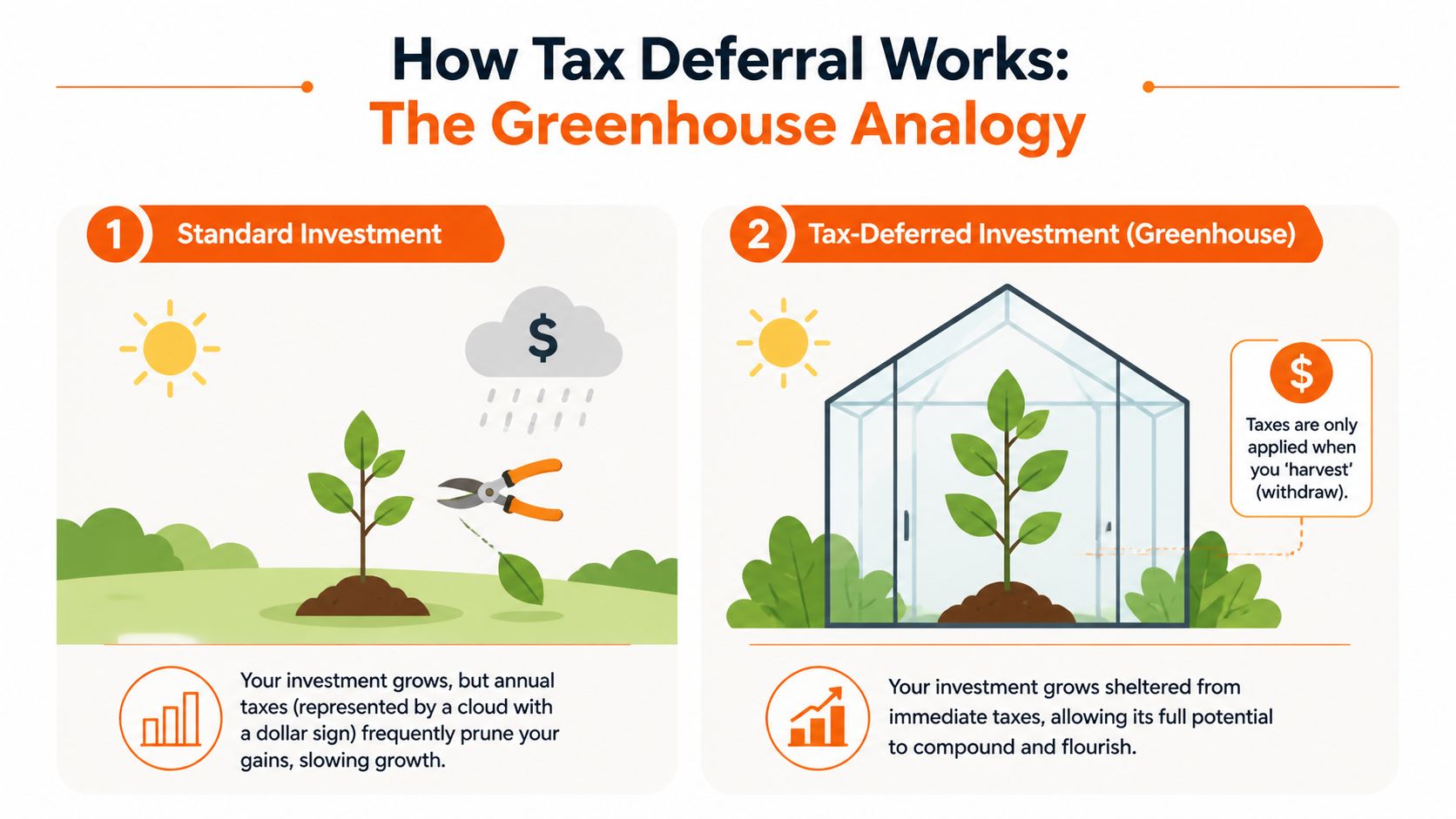
A taxable investment account is like a plant growing outside. Every so often, someone trims it back. Those trims are the taxes you pay along the way on investment income or gains. The plant still grows, but a bit of growth keeps getting cut off.
A tax-deferred account is more like a plant growing inside a greenhouse. It still grows under the same sunlight, but it’s protected from that regular trimming while it’s inside the structure. You only deal with tax when you take the money out.
The basic mechanics
The process usually works like this:
- You contribute money to a tax-deferred account
- That contribution may reduce your taxable income now
- Your investments grow inside the account
- You pay tax when you withdraw the money later
The key benefit is the uninterrupted growth in the middle. Money that would have gone to tax today can stay invested instead.
If you’re new to compounding, it helps to pair this with a basic understanding of rate of return, because the power of tax deferral becomes much clearer when you see how returns build on themselves over time.
What tax deferral does not mean
It helps to draw a clear line between three different ideas:
| Term | What it means |
|---|---|
| Tax-deferred | You pay tax later |
| Tax-free | You don’t pay tax on qualifying growth or withdrawals |
| Taxable | You pay tax under regular rules as income or gains arise |
That middle distinction matters a lot. A deferred account gives you breathing room. It does not erase the tax obligation.
The practical win is timing. You keep more money working for you today, instead of sending part of it to taxes right away.
For many people, that timing advantage is the whole point. It can lower today’s taxable income while giving investments a cleaner runway to grow.
Common Ways Canadians Use Tax Deferral
In Canada, tax deferral isn’t an abstract strategy. It shows up in a few familiar places, especially around retirement saving.
RRSPs
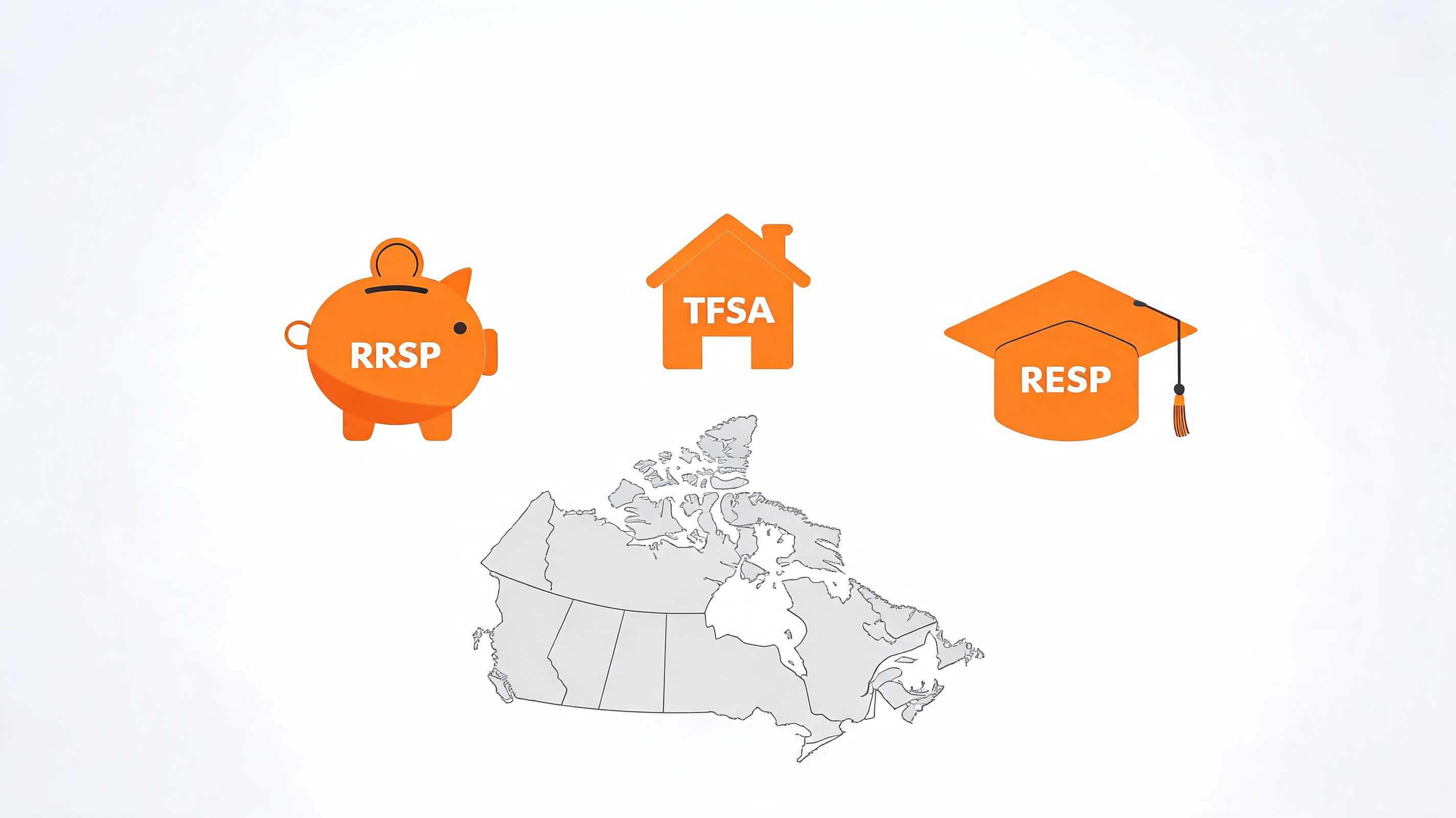
An RRSP is the most common example in a tax deferral definition article because it fits the concept so neatly. You contribute money, claim a deduction, and the investments grow inside the account until withdrawal.
The long-term effect can be significant. In Canada, a $10,000 annual RRSP contribution at a 6% annual return grows to $1,083,000 after 35 years pre-tax, versus $688,000 in a non-registered account where gains are taxed annually at a 40% marginal rate, yielding 57% more wealth through uninterrupted, tax-deferred compounding, according to the Canada Revenue Agency RRSP guidance.
That’s the clearest “why” behind RRSPs. Deferral gives compounding more room to work.
If your workplace mentions matching contributions, this explainer on RRSP matching can help you see how the employer side fits in.
Employer pension plans
Some Canadians get tax deferral through work without doing much setup themselves. Employer-sponsored pension plans often build the tax treatment into payroll and plan administration.
This can make the experience feel smoother because contributions may happen automatically. The trade-off is that pension plans usually offer less flexibility than a self-directed account.
Capital gains deferral in limited situations
Outside retirement accounts, some tax timing strategies can delay when gains become taxable. These situations are more specific and often depend on the type of asset and transaction.
For most readers, the practical takeaway is simple:
- RRSPs are the main everyday tool for personal tax deferral
- Workplace plans can create deferral automatically
- Other deferral situations exist, but they’re usually more complex and less common in day-to-day budgeting
What about TFSAs
A TFSA belongs in the same conversation, but not in the same category. It’s a registered account, yet it works differently.
That distinction matters because many people hear “registered” and assume “tax-deferred.” That’s not always true. Some accounts defer tax. Others avoid tax on qualifying growth and withdrawals altogether.
If you only remember one thing, remember this: RRSPs defer tax. TFSAs handle tax in a different way.
The Pros and Cons of Deferring Taxes
Tax deferral can be useful, but it isn’t automatically the best move in every situation. The value depends on your current income, your likely future income, and how much flexibility you need.
The upside
The first advantage is immediate. A qualifying contribution can reduce your taxable income now, which may lower your tax bill for the year.
The second advantage is behavioural. When money moves into a registered account, many people are less tempted to spend it casually. That structure can be helpful if retirement saving always gets pushed behind shorter-term priorities.
There’s also the compounding benefit. When investment growth stays inside a tax-deferred account, it isn’t interrupted by annual tax drag in the same way as a regular non-registered account.
- Current-year relief: You may owe less tax now.
- More money stays invested: That can support stronger long-term growth.
- Useful for higher-earning years: Deferral can be especially appealing when your current tax rate is relatively high.
The potential downsides
The biggest downside is straightforward. Deferred doesn’t mean forgiven. Withdrawals from an RRSP are taxed.
There’s also a planning risk. If your tax rate is higher when you withdraw than when you contributed, the benefit of deferring may be smaller than you expected.
The CRA also makes an important distinction between RRSPs and TFSAs. A key difference between tax deferral (RRSP) and tax exemption (TFSA) is the treatment of withdrawals. While an RRSP offers an upfront deduction, withdrawals are fully taxed. A TFSA offers no upfront deduction, but all investment growth and withdrawals are permanently tax-free, making it superior if your tax rate is expected to be higher in the future, as explained in the CRA TFSA overview.
Practical rule: RRSPs often make more sense when your tax rate is higher today than you expect it to be later. TFSAs often look better when the opposite is true.
A simple comparison
| Question | RRSP | TFSA |
|---|---|---|
| Tax deduction today | Yes | No |
| Tax on withdrawal | Yes | No |
| Main strength | Lower taxable income now | Tax-free access later |
That doesn’t mean you must choose only one. Many Canadians use both, but for different jobs.
How Deferral Choices Affect Your Budget
It’s the middle of the month. Your rent is paid, your grocery bill was higher than expected, and you’re deciding whether to send money to your RRSP or keep more cash in chequing. That choice affects more than retirement. It changes how much breathing room you have before your next paycheque.
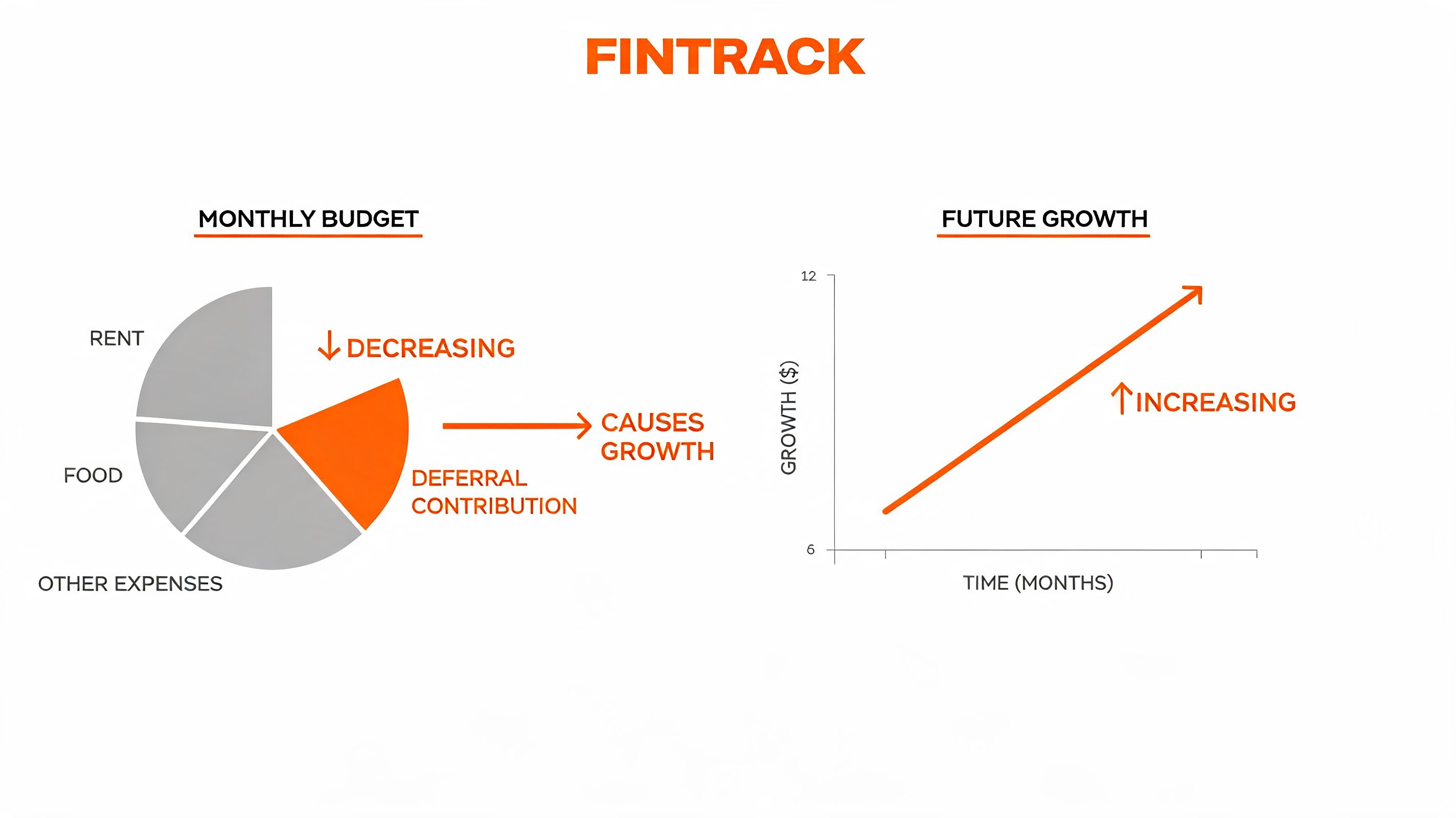
Tax deferral works a bit like shifting part of today’s income into a later tax year. The money is still yours, but once it goes into a deferred account such as an RRSP, it is no longer available for everyday spending without consequences. That is why the budget impact feels very real, even if the tax benefit shows up later.
If you contribute through payroll, your take-home pay may be lower right away. If you contribute from your bank account, your monthly budget might feel tighter now, then easier at tax time if you receive a refund or owe less. Same tax idea, different cash flow pattern.
A simple way to look at it is this. Deferral choices change the timing of your money.
What this means in real life
For many Canadians, the essential question is not “Will this help at tax time?” It is “Can I still cover regular bills and surprises without stress?”
Start with these three buckets:
- Required costs: rent or mortgage, utilities, insurance, debt payments
- Everyday spending: groceries, fuel, transit, child costs, dining out
- Cash buffer: savings for emergencies, annual bills, and uneven months
If RRSP contributions leave the first two buckets too tight, the tax deduction may not feel worthwhile in day-to-day life. A refund next spring does not help much if you need to use a credit card next week. If your buffer is thin, building an emergency fund in Canada may be the better first move before increasing deferred contributions.
Here’s a practical example. Suppose you increase your RRSP contribution by $200 a month. On paper, that may improve your tax position. In your actual budget, it means $200 less available for gas, school costs, or irregular home expenses unless your payroll withholding adjusts right away. The tax benefit matters, but the monthly trade-off matters just as much.
This is why contribution method matters. Payroll contributions often spread the impact more evenly across the year. Lump-sum contributions can be useful too, but they require more discipline because you need enough cash on hand first.
If you like tracking planned spending against what occurred, tools used for automating financial reporting with QuickBooks can be helpful in a broader budgeting workflow.
A tax deduction helps your overall plan only if your monthly cash flow can support it comfortably.
The practical takeaway is simple. Choose a deferral amount your budget can carry in ordinary months, not just in your best month. That keeps tax planning from creating cash stress.
Practical Tips for Planning Your Deferred Taxes
The best use of tax deferral is usually planned, not improvised in late February.
A short checklist
- Check your RRSP room: Use CRA My Account so you’re working from actual contribution room, not a guess.
- Review workplace matching first: If your employer offers matching, that often deserves early attention.
- Decide what job the account should do: Lower tax today, save for retirement, or balance both with other goals.
- Plan for the future tax bill: Withdrawals are taxable, so think ahead rather than treating the account as permanently tax-free.
- Match your contribution pace to your budget: A smaller automated amount you can sustain is usually better than a larger amount you stop after two months.
A note for self-employed Canadians
Self-employed workers need to be especially organised because income can swing through the year. The CRA says prior-year RRSP contributions must be made by March 1, and over-contributions can trigger a penalty tax of 1% per month on excess amounts, as explained in the CRA guidance on going over your RRSP deduction limit.
That means freelance income spikes can create a planning problem. If your earnings jump late in the year or early in the next one, don’t assume your old contribution pattern still fits.
For a broader system that ties savings, taxes, and spending together, this guide to planning personal finance is a good next read.
Keep a simple rule for yourself: contribution room first, deadline second, budget third. If any one of those is unclear, pause before adding more money.
Tax deferral works best when it supports your whole financial life, not just your tax return.
If you want help turning these ideas into a workable plan, Fintrack can help you see your budget, savings, and cash flow in one place so you can decide how much tax-deferred saving fits your real life.