
You've sold an investment and the profit looks real, but the tax question is the part that makes people pause. A capital gains tax calculator helps you turn that vague “I made money” feeling into a clear estimate, so you can see what the sale might mean before the tax bill shows up.
That matters whether you're holding shares in the U.S. or assets in Canada. The tax rules aren't the same, but the basic idea is simple, profit from selling an asset can be taxable, and the outcome depends on your purchase price, sale price, holding period, and any eligible costs. For a plain-language look at long-term investing decisions more broadly, Action Accountants' BRRRR insights are a useful companion read.
Your Investments Are Up Should You Sell
A first-time seller usually starts with excitement, then gets stuck on one question. You open your brokerage app, see that a stock or crypto holding has gone up, and wonder whether selling now is smart or whether taxes will eat too much of the gain.
That's where the term capital asset comes in. In everyday language, it means something you own that can rise or fall in value, such as shares, funds, crypto, or property. When you sell one of those assets for more than you paid, the difference is a capital gain.
Practical rule: Tax only becomes part of the conversation after the gain is realised, meaning the asset has actually been sold.
A good mental model is simple. You are not taxing the whole sale amount, you're taxing the gain after the original purchase cost and eligible selling or acquisition costs are taken into account. That's why two investors can sell for the same price and end up with very different tax results.
For a longer look at how patient holding can change outcomes, Fintrack's guide to long-term investing is a helpful companion. It pairs nicely with the idea that timing matters almost as much as the return itself.
The tricky part is that the rules change by country. In the U.S., a stock sale might be short-term or long-term depending on how long you held it. In Canada, the big question is how much of the gain is included in taxable income, and that changes the final bill in a different way.
The 5 Key Numbers You Need Before You Calculate
Before you touch a calculator, gather the same basic documents a tax preparer would want. Often, only the sale price comes to mind, but that's usually the least useful number on its own.
Start with your cost base
Your cost base is more than the original purchase price. The IRS and tax-prep guidance say it generally includes the amount paid for the asset plus commissions or fees, and it can also increase with reinvested dividends or qualifying acquisition costs, which makes a difference when you're figuring out gain or loss. That same logic appears in Canadian records as adjusted cost base, which is why old trade confirmations matter so much.
Your real profit starts with what you actually paid all in, not just the headline share price.
Then find your net proceeds
Your sale price is also not always the full number you see on the trade ticket. Selling commissions and related fees reduce what you really received, so the figure you want is the net amount after those costs.
Keep the dates in order
Purchase date and sale date tell you whether the gain is short-term or long-term in the U.S. They also help you avoid simple record-keeping mistakes, like confusing a buy date with a settlement date or mixing up multiple lots.
Don't ignore your income picture
Your income matters because tax brackets and marginal rates change the result. A calculator that ignores income can only give a rough guess, not a reliable estimate.
For a practical comparison between income concepts and tax planning, Fintrack's explanation of annual gross income can help you see where this number fits in the bigger picture.
Keep one simple checklist
- Purchase records: Save the confirmation showing what you paid and when.
- Fees and commissions: Add brokerage or transaction charges to the basis.
- Sale records: Keep the amount you received after selling costs.
- Holding period: Note the exact dates so you can tell whether the gain is short-term or long-term.
- Income context: Know whether the gain will be stacked onto other income for the year.

How to Calculate Capital Gains Tax in the United States
The U.S. calculation gets easier once you separate the sale into two questions. First, did you make a gain or a loss? Second, is that gain short-term or long-term?
Step 1 Find the taxable gain
Start with net proceeds, then subtract your basis. For a simple stock sale, that means the sale amount after fees minus what you paid to buy the shares, including eligible commissions or other basis adjustments. If the result is positive, you've got a gain.
The key mistake people make is skipping the cost side and looking only at the sale price. That can make the gain look larger than it really is.
Step 2 Check the holding period
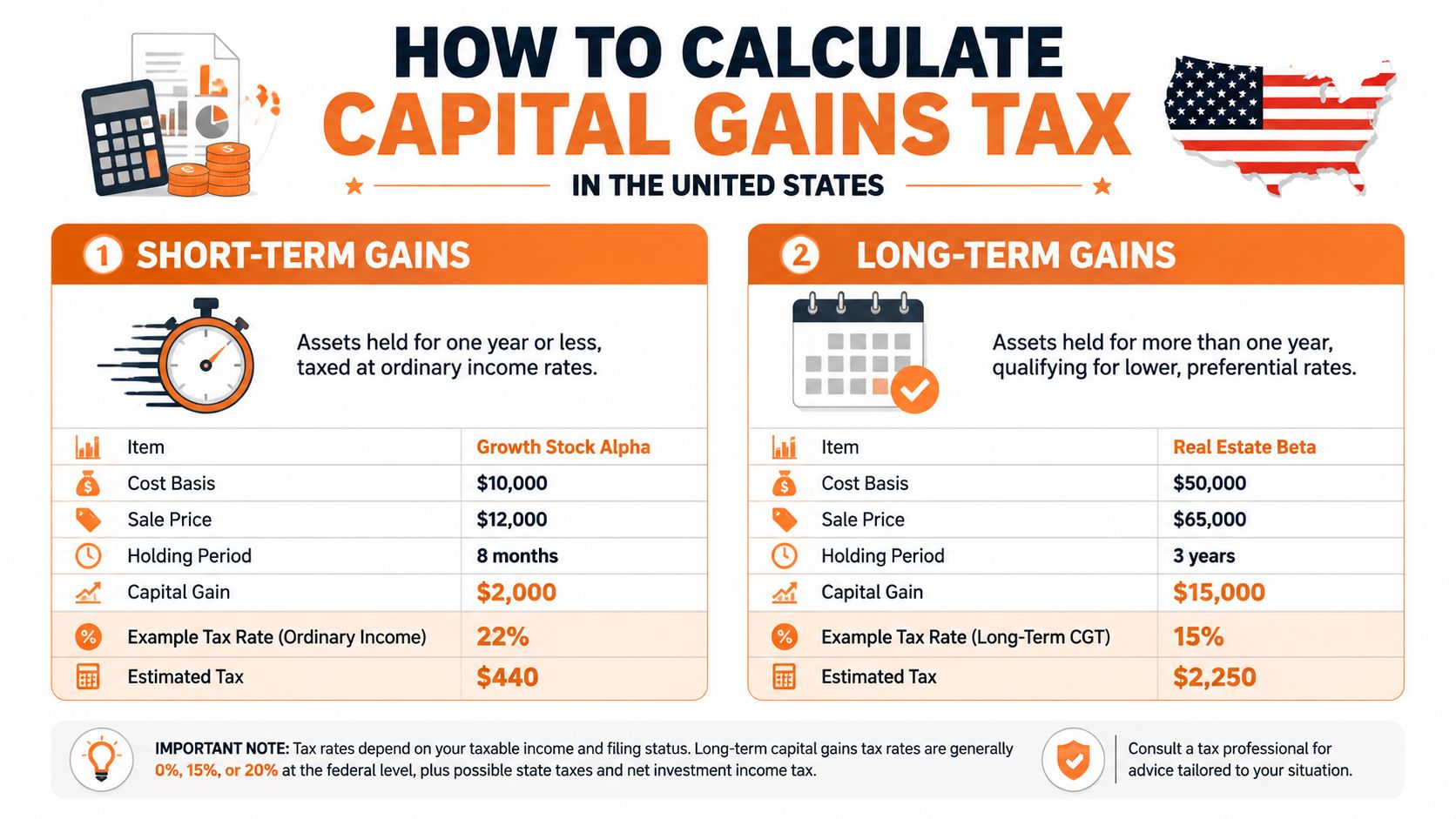
If you held the asset for one year or less, the gain is short-term. If you held it for more than one year, it's long-term. That one distinction matters because short-term gains are taxed as ordinary income, while long-term gains may qualify for preferential federal rates.
Step 3 Match the gain to the right federal rate
For long-term gains reported in 2026, the federal brackets are commonly summarised like this, based on taxable income and filing status, with rates of 0%, 15%, and 20% for long-term gains (NerdWallet long-term capital gains brackets for 2026).
| Federal long-term rate for 2026 | Single | Married filing jointly | Married filing separately | Head of household |
|---|---|---|---|---|
| 0% | $0 to $49,450 | $0 to $98,900 | $0 to $49,450 | $0 to $66,200 |
| 15% | $49,451 to $545,500 | $98,901 to $613,700 | $49,451 to $306,850 | $66,201 to $579,600 |
| 20% | $545,501 or more | $613,701 or more | $306,851 or more | $579,601 or more |
A simple example helps. If you bought stock for $8,000 and sold it for $10,000, your gain is $2,000 before any extra adjustments. If you held it for more than one year, that gain is long-term and gets taxed using the federal long-term system, not ordinary income rates.
Step 4 Watch for surtaxes and state tax
Some higher-income taxpayers may also face the Net Investment Income Tax, and state tax can change the result even more. California is the clearest example, because capital gains are taxed there as ordinary income at rates up to 13.3%, which means a calculator that only shows federal long-term bands can materially understate what a California resident owes (UseCache capital gains tax calculator overview).
That's why a federal-only result is not the full answer. A useful calculator should show the federal layer and make room for state tax too.
How to Calculate Capital Gains Tax in Canada
Canada uses a different system, so the number that matters most is not a special capital gains tax rate. Instead, you work out the gain, then include part of it in taxable income.
Step 1 Work out the capital gain
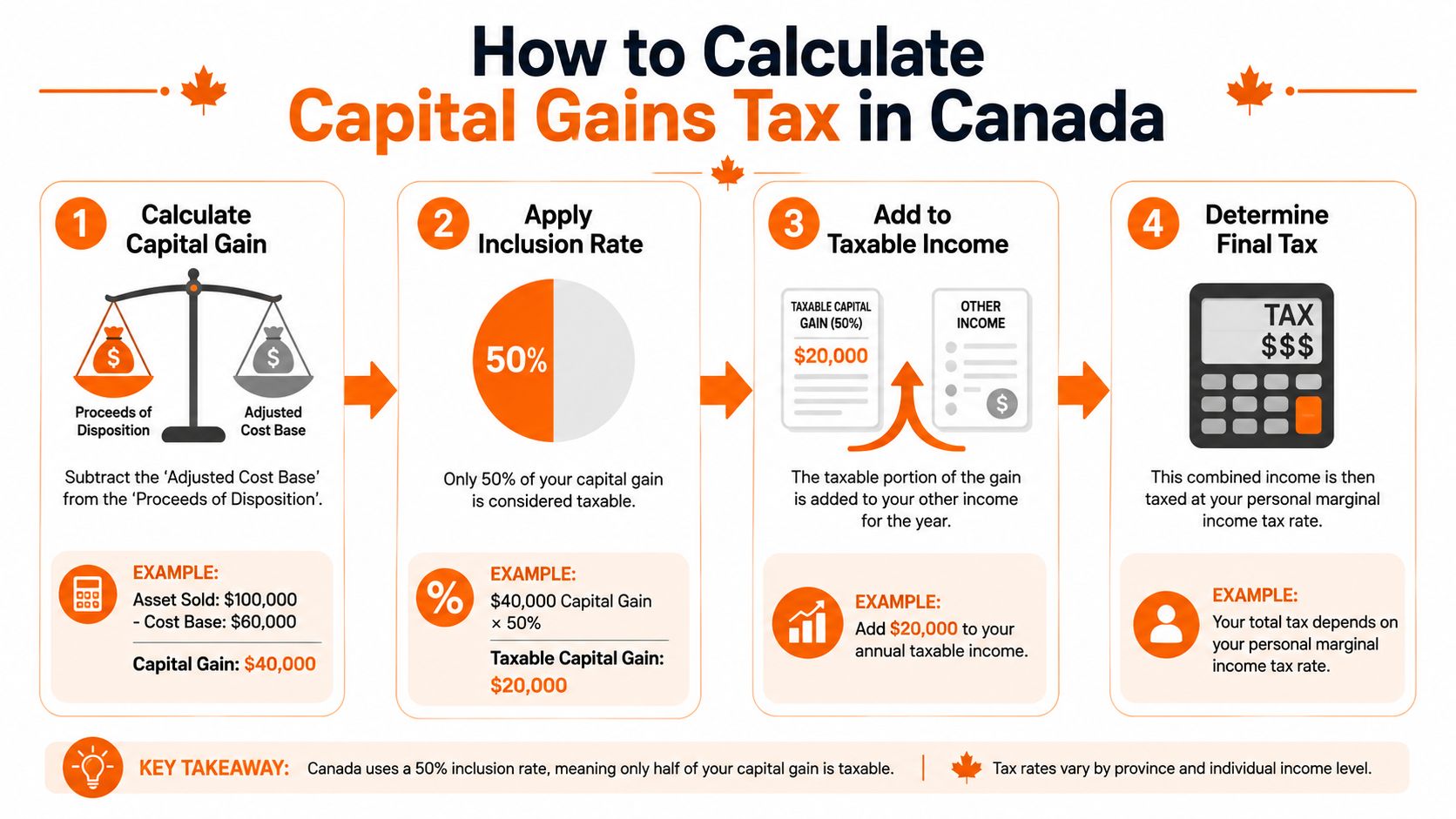
Start with the proceeds of disposition, then subtract your adjusted cost base. That gives you the capital gain before any inclusion rules are applied. If you sold for more than you paid, after accounting for purchase costs and selling costs, the difference is the gain.
Step 2 Apply the inclusion rate
For many readers, the big Canadian rule is the 50% inclusion rate. That means only half of the capital gain is generally included in taxable income under the discount method described in Australian-style materials, but in Canada the idea is similar in spirit, your taxable amount is only part of the gain.
The number on your sales statement is not the number that gets taxed.
For a plain example, if your gain is $40,000, the taxable portion is $20,000. That $20,000 then gets added to the rest of your income for the year.
Step 3 Add it to your regular income
Many people often find this confusing. Canada doesn't tax the capital gain in a separate bucket the same way U.S. long-term gains are often discussed. The taxable portion is added into your income and taxed at your marginal rate, so the final result depends on the rest of your earnings.
That's why two Canadians with the same gain can owe different amounts. One person may already have enough income to push the taxable portion into a higher marginal bracket, while another may not.
Step 4 Use the right records
If you sold shares, you'll want the trade confirmations, not just the annual tax slip. If you sold real estate, your adjusted cost base and eligible selling expenses matter even more because the gain can be much larger and the record trail is easier to miss.
For a broader discussion of timing and delayed tax consequences, Fintrack's tax deferral definition gives a good plain-English foundation.
Smart Strategies to Reduce Your Capital Gains Tax Bill
The best tax result usually starts before you sell. Once the trade is done, your options shrink, so the smartest moves are the ones that shape the gain before it becomes taxable.
A good capital gains tax calculator helps you estimate the bill, but significant savings often come from choices you make first. In both the U.S. and Canada, the rules reward planning, and the details matter more than the headline gain.
Hold long enough when the rules reward patience
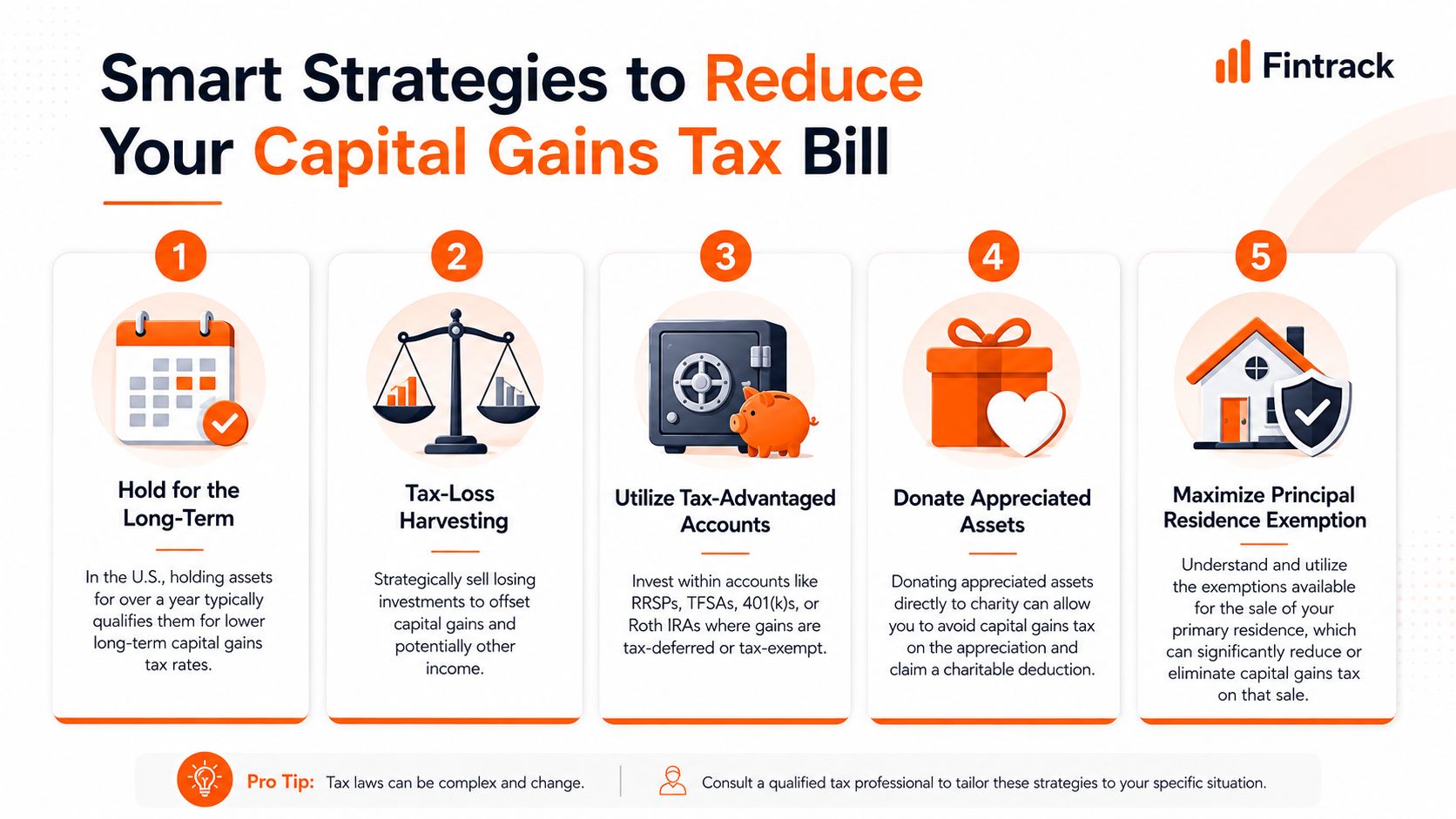
In the U.S., holding an asset for more than one year can move it from short-term treatment into the long-term system, which is usually easier on the tax bill. That change in treatment can matter more than the market move itself.
Canada works differently, so the holding period does not create the same short-term versus long-term split. Still, timing matters because the taxable portion of a gain depends on how the gain is reported and where it sits in your overall return. If you want a plain-language overview of how holding periods and gain types fit together, see this guide to short and long-term gains.
Use losses with intention
Tax-loss harvesting means selling something at a loss to offset gains elsewhere. Losses can reduce the amount of gain you report, and in the U.S. excess losses can also help reduce ordinary income under IRS rules, while the remaining loss carries forward as allowed.
That strategy is like using a refund from one part of your portfolio to soften the tax bill from another part. It does not erase the loss, but it can make the overall year less painful.
Keep tax-advantaged accounts in mind
Accounts such as RRSPs, TFSAs, 401(k)s, and IRAs can change the tax picture because gains inside them are often sheltered or deferred depending on the account type. That does not make every account identical, but it does make the account wrapper part of the tax plan, not just the investment choice.
The same idea applies to health-related accounts that are built for tax treatment, which is why a plain explanation of what is an HSA account can help when you are comparing account types. Once you see whether the gain is inside a shelter or outside it, the calculator becomes much easier to read.
Don't forget charity and your home
Donating appreciated assets can reduce taxable gain in the right situation, and the sale of a main home may qualify for special treatment in both countries. Those rules are separate from ordinary stock sales, but they are often the biggest exception people forget to check.
A home sale can also change the whole calculation, because the primary home rules in the U.S. and the principal residence exemption in Canada can take part or all of the gain out of the taxable column. That is why the same calculator input can lead to very different results depending on what asset you sold.
Handling Common Scenarios and Exceptions
A basic calculator handles a simple stock sale well enough. Real tax situations are messier, because some transactions get special treatment and some losses do more than first appear.
Your main home may follow different rules
A home sale can change the calculation before you even get to the usual capital gains steps. In the U.S., a primary home may qualify for a home sale exclusion if the ownership and use tests are met. In Canada, the principal residence exemption can make part or all of the gain on a main home non-taxable. Those rules are not small add-ons, they decide whether the calculator should treat the sale as taxable in the first place.
Losses aren't wasted
A capital loss can sting in the moment, but it still has value. In the U.S., losses can offset gains, and if losses are larger than gains, the extra amount may carry forward. The annual deduction against ordinary income remains limited under IRS rules, as explained in IRS Topic no. 409.
Watch the wash sale rule
The U.S. wash sale rule can block a loss if you buy a substantially identical investment too soon after selling it at a loss. That means the tax result depends on what you sold, what you bought next, and how soon you bought it.
For a simple example, selling one fund and buying back the same fund right away can leave the loss unavailable for now. A different purchase pattern can lead to a different result, so the timing matters as much as the sale itself.
Keep reporting separate from estimating
Sales are reported on Form 8949 and Schedule D in the U.S. The estimate from a calculator still has to match the records, so the tax return should follow the same purchase date, sale date, cost base, and fees you used for the calculation.
People dealing with equity compensation often run into extra timing questions. Fintrack's restricted share units guide is a useful next read because vesting and sale timing can create gain questions that a standard calculator may not capture cleanly.
From Calculation to Clarity
A tax estimate is only as good as the records behind it. If you don't know the exact purchase price, sale price, dates, and fees, the calculator can't give you a clean answer.
That's why keeping a running record beats scrambling through old emails in April. If you want a plain-language refresher on how gains and losses fit together, the guide to capital gains tax is a solid companion read, but the key advantage is having your own numbers organised before tax season arrives.
If you want to make the next sale easier to handle, keep your investment transactions and fees in one place as you go. Fintrack helps you track money clearly, so your cost base, holding period, and sale details are ready when you need them, not buried in old statements.