With 67% of Canadians planning to reduce spending in 2026, statement analysis gives you a practical way to find where money leaks before making another vague budget. It means reading your bank and credit statements for patterns, then replacing each confirmed leak with a targeted action.
You check your account and everything looks reasonable. Groceries are within range, the rent has cleared, and there isn't one dramatic purchase to explain the shortfall. A few days later, though, the balance feels too low again. The problem is often buried in recurring charges, bundled bills, duplicate transactions, and fees that a bank feed places in an unhelpful category.
What Statement Analysis Actually Means
Statement analysis is the habit of reading bank and credit statements to find where money leaks, then changing the budget based on what you find. It isn't the same as recording transactions and hoping a category chart reveals the answer.
A useful review compares the current statement with previous months. You're looking for changes in frequency, amount, timing, and merchant description. A streaming charge that appears every month, a telecom bill that includes device financing, or a duplicate payment can be more important than a single large purchase because each one affects future cash flow.
That distinction matters in Canada, where many households manage several providers through a single account. A bank feed may show one telecom merchant and one total, while the invoice separates a wireless plan, device add-on, home internet, streaming package, and administrative fee. The statement tells you that money left. The invoice often tells you whether the charge is still justified.
What to compare
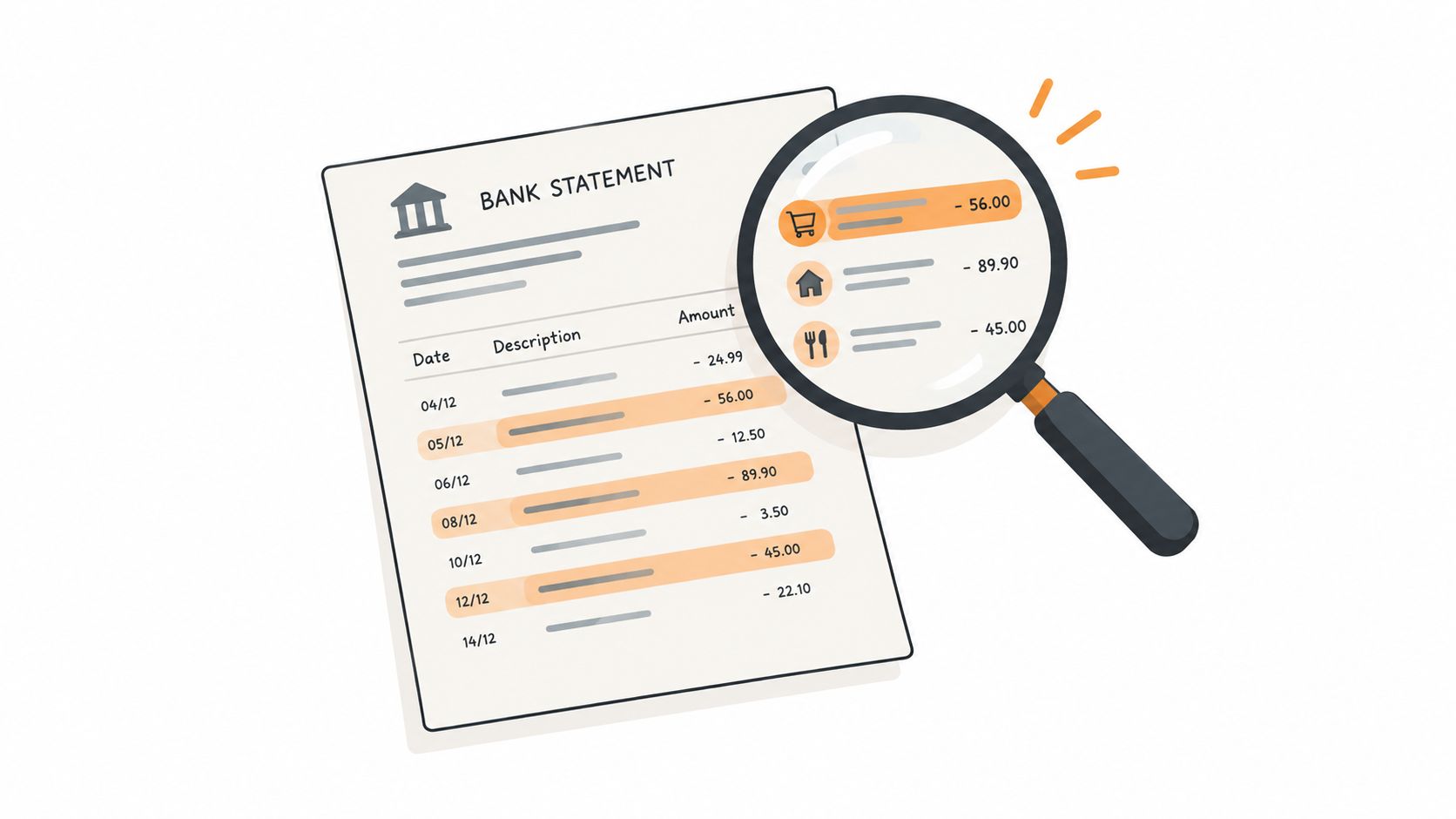
Start with one consistent review period and compare like with like. Don't compare a partial current month with a complete previous month, or a credit-card statement with a chequing-account period that uses different closing dates.
Check these areas:
- Recurring merchants: Find charges that repeat, even when the amount changes.
- Merchant descriptions: Look beyond broad categories such as entertainment or utilities.
- Timing: Note charges arriving before payday, annual renewals, and clustered withdrawals.
- Cash flow: Compare outgoing payments with the income available during the same period.
- Exceptions: Investigate duplicates, reversals, refunds, and unusually high fees.
A general guide to understand financial statements beginner can help if terms such as assets, liabilities, and cash flow are unfamiliar. For everyday budgeting, you don't need to become an accountant. You need enough structure to connect a line item to a decision.
Canadian consumers often use statements reactively. The Financial Consumer Agency of Canada reports that only about 55% of Canadians have a household budget, about 60% have trouble keeping up with bills and financial commitments, and about 49% haven't done financial self-study in the past five years. FCAC's budgeting research helps explain why a statement review should focus on the next cash-flow pressure point, not just a retrospective pie chart.
For a practical foundation, use this transaction history guide to organise the raw record before you interpret it. More automation can save time, but automation without invoices, merchant context, or a consistent comparison window can make a messy financial picture look neatly organised.
Forensic Versus Financial Statement Analysis
The word statement analysis describes two different activities. A forensic approach tests whether an account appears truthful or internally consistent. A financial approach tests how money moves, where pressure is building, and whether spending matches the plan.
Forensic statement analysis is associated with methods such as Criteria-Based Content Analysis, Reality Monitoring, and SCAN. These methods examine features including logical structure, detail, references to mental states, missing links, and spontaneous corrections. They can help an investigator decide what deserves further checking, but they aren't a reliable way to decide whether a household can afford a new subscription.
The FBI's investigative guidance uses a memorable 20-60-20 structure, with about 20% of a statement devoted to the introduction, 60% to the event, and 20% to the conclusion. The guidance also discusses verb tense, equivocation, minimizing or intensifying adverbs, and extraneous information as possible cues. The FBI's statement-analysis guidance is useful as an analogy: a review needs a clear beginning, a substantial middle, and a conclusion that leads to action.
For personal finances, the equivalent failure is often a review with too much setup and categorisation, but no decision. You spend time importing transactions, correcting labels, and looking at charts, then never cancel the charge, contact the provider, or change the next payment.
Choose the lens that matches the question
| Method | Best For | Key Signal | Limitation |
|---|---|---|---|
| Forensic analysis | Testing an account or investigating possible deception | Contradictions, unusual wording, missing context | A cue doesn't prove that someone is lying |
| Financial analysis | Understanding household cash flow and spending discipline | Trends, recurring charges, variances, operating cash flow | Categories can hide the reason behind a charge |
| Hybrid review | Checking a suspicious transaction before changing the budget | Statement line, invoice, merchant history, and related evidence | Takes more effort than relying on a bank feed alone |
A forensic lens becomes relevant when a transaction conflicts with the account holder's explanation, when records don't reconcile, or when a business statement requires investigation. Even then, verbal cues are not enough on their own. Research reviewed by NIH on verbal and nonverbal deception cues recommends judging a statement against other evidence and prior statements, while noting that liars tend to provide fewer details and more contradictions than truth tellers.
A financial lens is stronger for a monthly household review. Public companies in Canada generally report under IFRS, while private enterprises may use ASPE. Those regimes affect recognition timing, ratios, and note disclosures, so comparisons should use like-for-like entities and reconcile earnings with operating cash flow rather than relying on net income alone. Canadian guidance on interpreting financial statements outlines why the reporting framework matters.
Use trend analysis, peer or household benchmarks where appropriate, and variance analysis against a budget or prior period. A single statement can miss working-capital deterioration, liquidity stress, or a one-time item. If you want the legal and investigative background, this explanation of how financial statement fraud works provides useful context, but it shouldn't turn an ordinary budget review into an accusation.
Main Approaches and Tools for Personal Statement Analysis
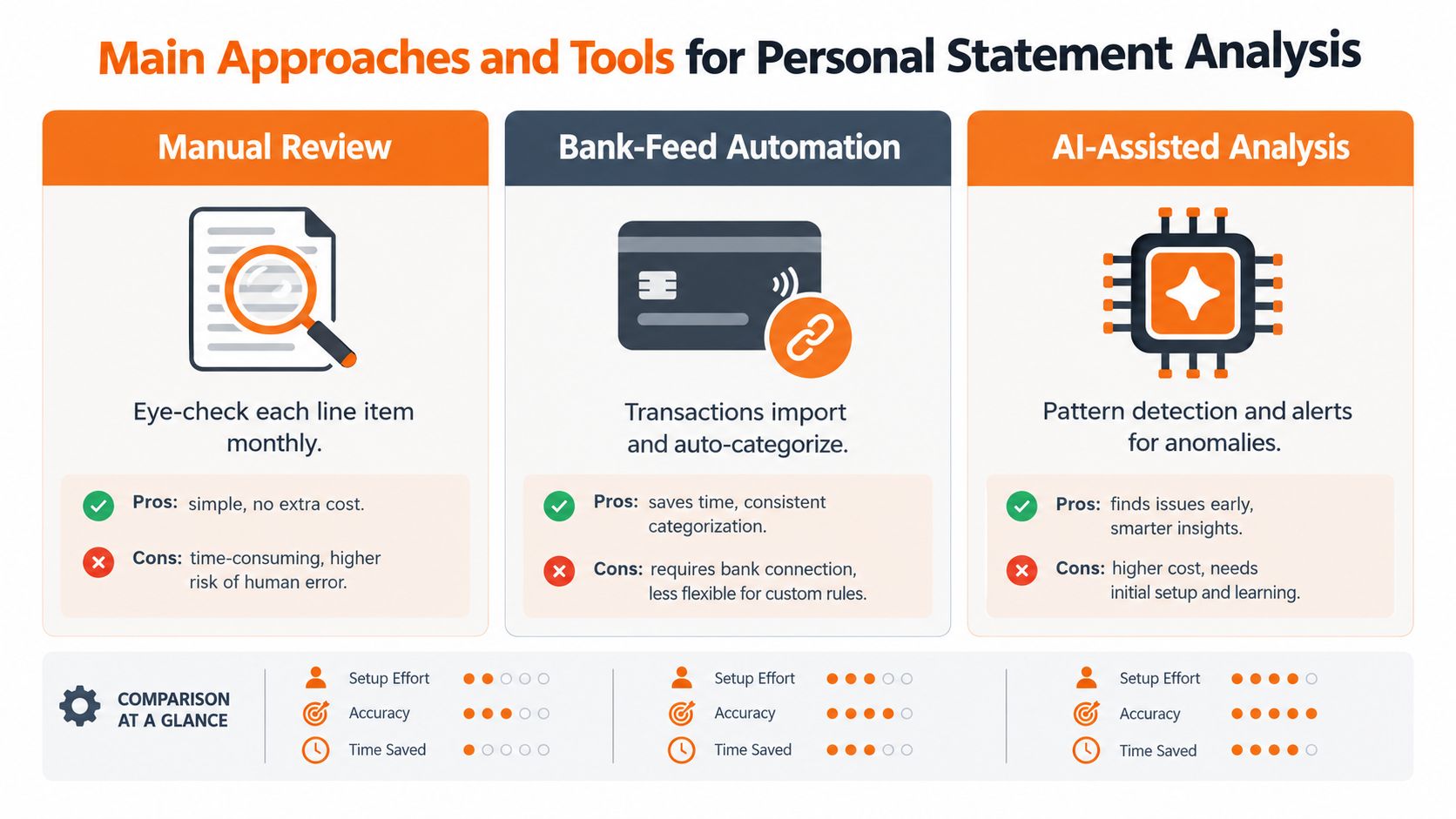
There are three workable ways to analyse personal statements. The right choice depends less on your technical skill than on how much context your transactions need.
Manual review works when your accounts are simple and you can download clear statements. You inspect each line, mark recurring charges, and write down questions beside anything unclear. It gives you strong control over context, but it becomes tedious when you use several cards, share expenses, or have bundled bills.
Bank-feed automation imports transactions and applies categories. It reduces data entry and can make spending visible sooner, but a feed may rename merchants, merge related charges, lose invoice detail, or fail to connect consistently with a Canadian institution. Automation is useful for collection, not necessarily interpretation.
A hybrid workflow usually works better for households with complex bills. Import the transaction record, then add invoice details manually for telecom, insurance, utilities, memberships, and any merchant that combines several services. That extra context is where many recurring-charge mistakes become visible.
Compare the trade-offs
| Approach | Automation depth | Recurring-charge visibility | Household planning | Canadian connectivity |
|---|---|---|---|---|
| Manual review | Low | High when invoices are included | Depends on your spreadsheet or process | Works regardless of bank connection |
| Bank-feed automation | High for importing | Moderate, depending on merchant data | Varies by tool | Can be inconsistent across institutions |
| AI-assisted analysis | High for classification and pattern detection | Stronger when manual context is available | Useful for trends and alerts | Bank-free or import-based options reduce connection dependence |
An AI-assisted option can classify imported rows, flag anomalies, identify possible duplicates, and highlight repeated charges. It still needs human verification. A tool can notice that two payments resemble each other, but only you can confirm whether one was a legitimate instalment, a refund reversal, or a duplicate.
A useful comparison principle also applies outside personal finance. Summaries can fail when they remove the source context, which is why this Artul.ai financial research is a helpful reminder to check the underlying detail rather than trusting a polished output.
For Canadians, a bank-free workflow has a practical advantage. You can enter a charge manually, attach invoice context, and continue reviewing even when a connection isn't available or doesn't import the detail you need. The approach is slower at the point of entry, but it can produce a more accurate recurring-charge map.
You can learn more about what data aggregation means before choosing between a connected account, CSV import, or manual entry. The aim isn't to maximise automation. It's to capture enough reliable detail to make the next budget decision.
Step-by-Step Statement Analysis Workflow
A good monthly review follows the same logic as the FBI's 20-60-20 analogy. Spend a focused portion setting the period and purpose, give most of your attention to the actual transactions, then reserve the end for decisions. Most failed reviews invert that balance by spending nearly all their time preparing data and none on changing behaviour.
Start with a clean evidence set
Choose a complete statement period from one account or card. Download the statement as a PDF for reference and use a CSV where available for sorting, filtering, and importing. Keep the closing date visible, especially when credit-card charges and chequing-account payments appear in different periods.
Write one question before you begin. Examples include, “Why is cash tight before payday?” or “Which recurring charges can I remove?” A specific question stops the review from becoming an endless audit of every coffee and grocery item.
Map charges before assigning blame
Create a recurring-charge list with the merchant, usual amount, billing frequency, payment account, and service covered. Add a note when one provider charge includes multiple products. The merchant name is only the starting point, not the explanation.
Use invoice details, email receipts, loyalty accounts, and provider portals to fill gaps. A bank-feed-only review can miss a bundled telecom charge because the line item doesn't separate the device payment from the service plan. Subscription-focused tools also recognise that manual invoice entry may be needed to capture the actual monthly total, as explained by SubSavvy's recurring-charge guidance.
Investigate red flags
Flag transactions that deserve verification rather than immediately calling them waste. Look for duplicate amounts, near-duplicate merchant names, charges that move between categories, subscription renewals, and fees that appear after a plan change.
One small recurring payment may be legitimate. Several small payments can also reveal a service you forgot to cancel, a trial that converted, or a package that no longer matches how you use it. Check the provider's invoice and your own calendar before changing the budget.
Turn findings into actions
Every confirmed issue needs a named action and a review date. The action might be cancelling a service, changing a plan, requesting a refund, moving a payment date, or creating a sinking fund for an annual renewal.
| Step | Action | Output | Common Mistake |
|---|---|---|---|
| Choose the period | Use complete, matching statement dates | A comparable review window | Comparing partial and full months |
| Build the map | Record merchants, frequency, and invoice context | A recurring-charge register | Trusting broad categories |
| Verify anomalies | Check duplicates, renewals, refunds, and bundled fees | Confirmed issues, not guesses | Treating every unusual item as waste |
| Change the budget | Assign one action and a follow-up date | A practical next step | Saving observations without acting |
Use income and expense tracking to keep the cash-flow picture connected to the transaction record. Review the same measures next period: recurring total, unusual fees, cash available before the next income deposit, and actions completed.
Red Flags and Real-World Examples
The most useful patterns are ordinary. They appear in households that aren't reckless, which is why a clean-looking bank feed can be misleading.
A Canadian household may see one monthly telecom payment and assume the amount is stable. The invoice may show a base plan, a device add-on, a streaming package, and a fee introduced after a plan change. The red flag isn't necessarily the total. It's the loss of visibility inside the total.
Verify the provider invoice against the bank line. Separate the service components in your recurring-charge map, then decide whether each one still earns its place. If the bank feed continues to show one merchant, keep your own internal labels so the next review doesn't lose that distinction.
Four patterns worth checking
- Duplicate telecom charges: A person changes a plan and sees the old and new amounts during the same statement period. Check the effective date, prorated amount, and next invoice before disputing either charge. The apparent duplicate may be a transition item, or it may be a billing error.
- Subscription drift: A service begins as a useful trial, then continues after the original need has disappeared. Search statements by merchant and compare the billing date with your subscription emails. A charge that looks small can remain invisible when each review focuses only on the largest purchases.
- Misleading categories: A marketplace transaction may contain household goods, software, and a personal purchase, while the bank feed labels the whole amount as shopping. Open the receipt and split the transaction so the budget reflects the actual decision.
- One-time fee distortion: A late fee, annual renewal, installation fee, or foreign-exchange charge can make one month look permanently unaffordable. Mark it as non-recurring only after confirming the reason and checking whether another charge will follow.
Follow the charge across statements
Some red flags don't appear in the same place every month. A provider may use different merchant descriptions, a fee may disappear after a reversal and return later, or a subscription may shift from entertainment to software when the billing processor changes.
Search by amount, merchant, and date rather than category alone. Then ask three questions:
- Did I authorise this payment?
- Does it match an invoice or receipt?
- What will happen next month if I do nothing?
This process protects you from two opposite mistakes. You won't ignore genuine waste because the category looks ordinary, and you won't cancel a legitimate charge merely because the description changed.
When the review shows that spending rose because of a real cash-flow habit rather than a billing error, use a targeted response. This guide to stopping overspending is more useful after you've identified the specific trigger, amount, and timing instead of treating every purchase as the same problem.
How Fintrack Simplifies Ongoing Statement Analysis
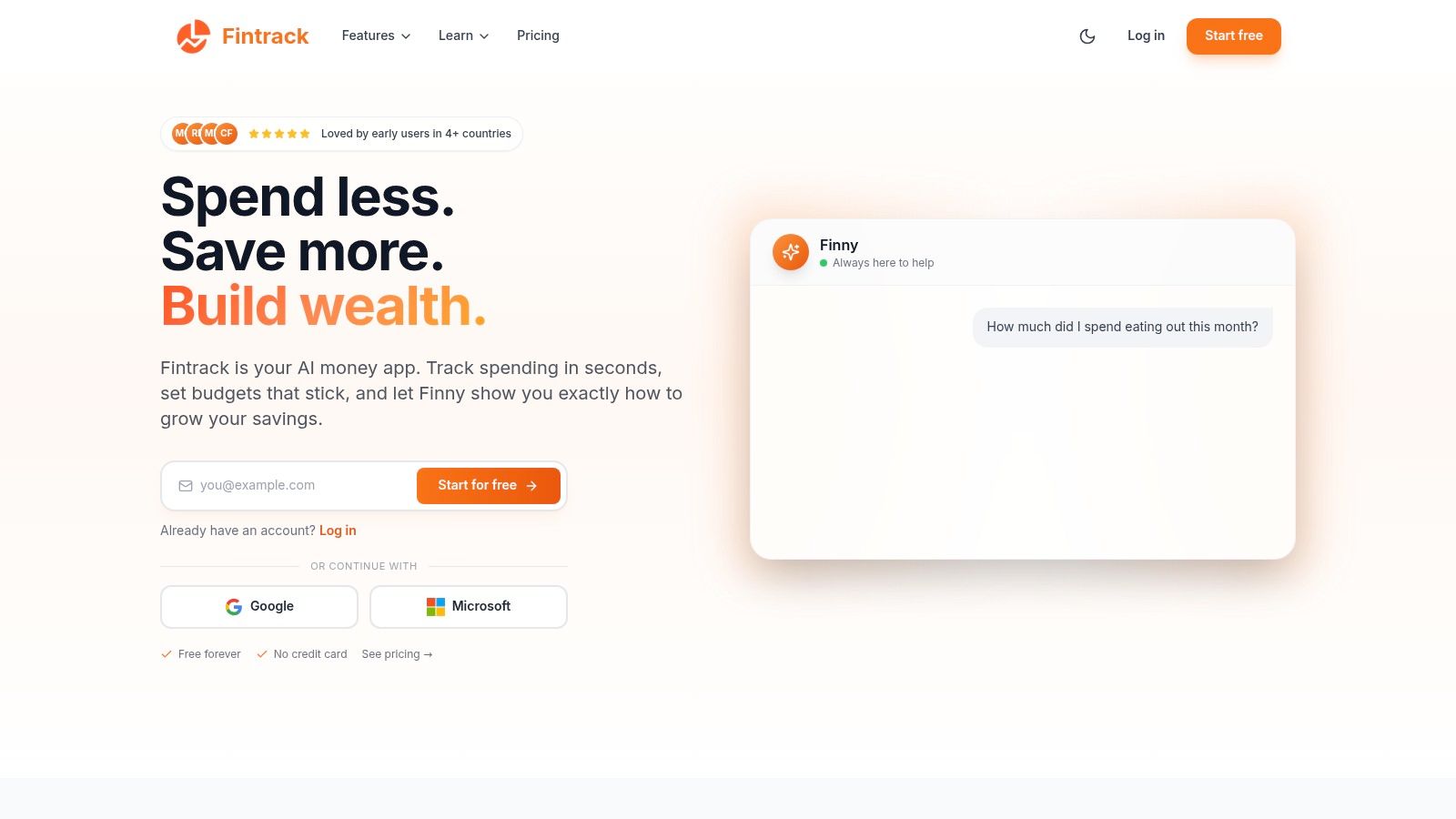
A monthly review works best when the signals remain visible between statement dates. The app can import CSV bank statements, classify each imported row, and help you organise transactions without requiring a live bank connection. That matters when a Canadian institution doesn't sync reliably or when a bank feed hides invoice-level detail.
Use a simple operating routine:
- Import or enter transactions: Bring in the latest statement, then manually add charges that need invoice context.
- Review classifications: Correct merchants and categories before drawing conclusions from totals.
- Check recurring activity: Look for repeated charges, changed amounts, and possible duplicates.
- Watch alerts: Review unusual spending while the transaction is still easy to verify.
- Apply the budget action: Cancel, renegotiate, dispute, reclassify, or fund the next payment.
The product's Benefits Wallet can also keep cashback, unused credits, loyalty points, discounts, and expiring offers in the same financial review. That doesn't replace statement analysis. It adds a second question to the review: is there value already available that you haven't used?
Real-time spending alerts are useful for early detection, but they shouldn't become another stream of noise. Set a personal rule for investigating an alert, such as checking the receipt, confirming the merchant, and deciding whether the transaction belongs in a recurring or discretionary pattern.
Match the capability to the job
| Feature | Benefit | Best For |
|---|---|---|
| CSV statement import | Brings statement rows into one reviewable record | People who prefer bank-free tracking |
| AI transaction classification | Sorts imported activity into usable categories | Households with many transactions |
| Recurring-charge detection | Highlights repeated merchants and changing amounts | Finding subscription drift and bundled bills |
| Spending alerts | Surfaces unusual or duplicate-looking activity earlier | Checking transactions before the next statement |
| Benefits Wallet | Organises rewards, credits, and offers | People who may leave earned value unused |
For a focused transaction workflow, explore AI transaction tracking and use it alongside invoices for charges that need more explanation. The best result comes from combining automated pattern detection with a human decision about what the charge means.
Statement analysis isn't about doing every task manually. It isn't about trusting every automated category, either. It works when you use a consistent review window, preserve merchant context, identify recurring pressure, and turn each confirmed finding into one clear budget action.
Use Fintrack to import or manually record your next statement, check recurring charges and unusual activity, and connect confirmed findings to your budget. Visit Fintrack when you're ready to make your next review more organised and actionable.