
You're looking at several credit card balances, a line of credit, and perhaps a student loan, while every lender expects a payment before the month is over. You've finally found room in the budget for extra debt repayment, but one question stops you: should that extra money go to the smallest balance or the highest interest rate?
That's the central choice behind the avalanche vs snowball method. Both approaches require minimum payments on every debt, but they use your remaining cash differently. The avalanche prioritises mathematical efficiency. The snowball prioritises visible progress and behavioural momentum.
| Feature | Debt avalanche | Debt snowball |
|---|---|---|
| First target | Debt with the highest interest rate | Debt with the smallest balance |
| Main advantage | Reduces interest accumulation faster | Creates quicker payoff milestones |
| Best suited to | People focused on total repayment cost | People who need early wins to stay consistent |
| Main risk | Progress may feel slow at first | You may pay more interest overall |
| Non-negotiable rule | Keep making minimum payments on every other debt | Keep making minimum payments on every other debt |
The right choice isn't the one that looks smartest in a spreadsheet. It's the one you can follow when rent rises, an unexpected bill arrives, or motivation drops. For broader practical ideas on staying organised while paying down balances, this guide to getting out of debt faster in the UK offers useful context, although the debt strategy itself applies across both Canada and the United States.
The Reality of Choosing a Debt Payoff Strategy
At the end of the month, you have enough money to cover every minimum payment and a little more. One card has a small balance but a moderate rate. Another has a much larger balance and a painful interest rate. A personal line of credit sits somewhere in the middle, and the list feels more complicated than the amount of money available to attack it.
This is the point where people often freeze. They know that paying extra is the right move, but they don't know which account deserves the extra payment. Delaying the decision usually means the surplus gets absorbed by everyday spending, leaving the debt plan unchanged.
Two paths to the same destination
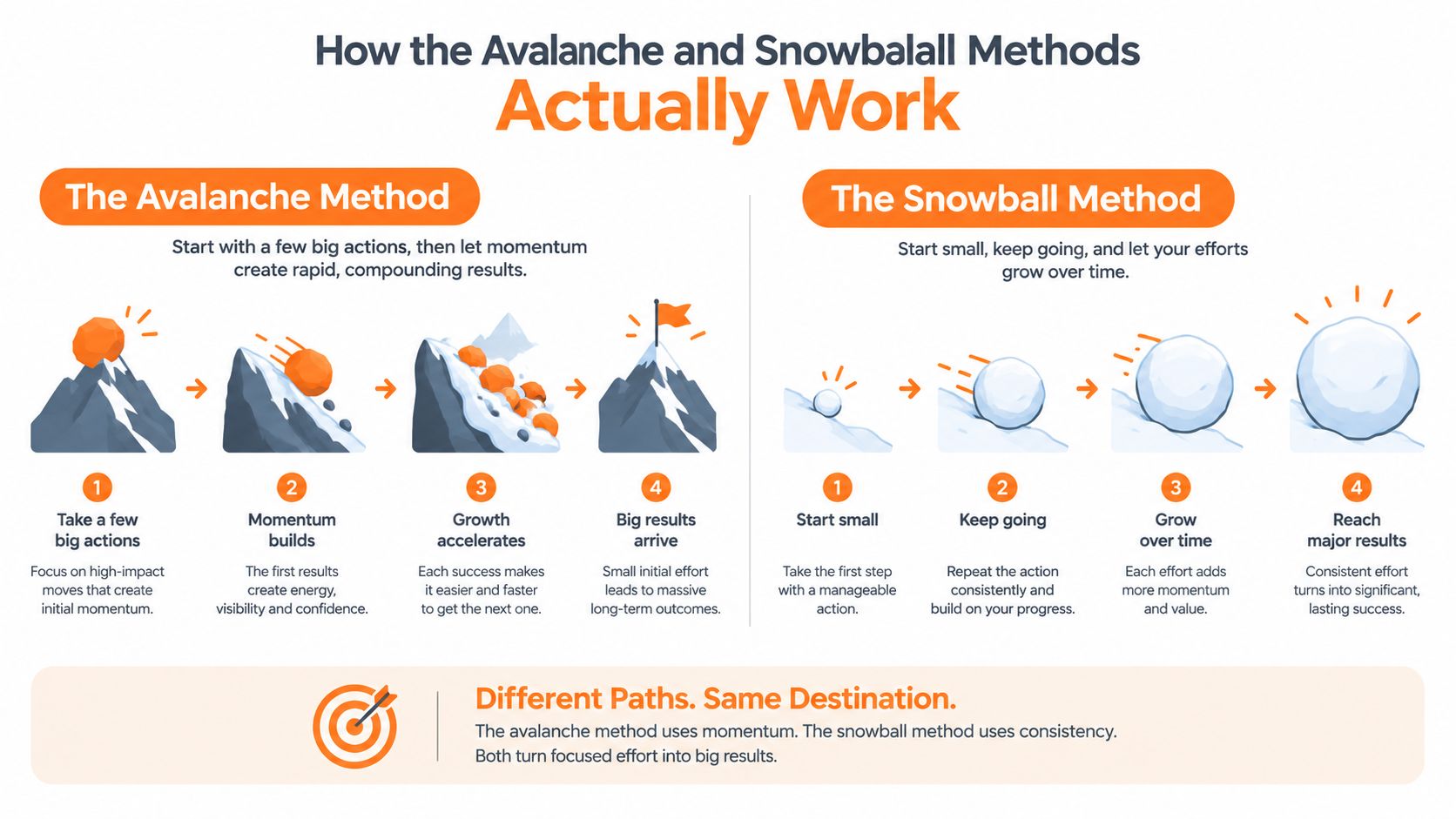
The debt avalanche tells you to rank debts by interest rate, then direct all available extra cash to the highest-rate debt. The debt snowball tells you to rank debts by balance, then eliminate the smallest one first.
Both methods protect the rest of your accounts by keeping minimum payments current. Neither strategy gives you permission to ignore a due date or send all your money to one account while another falls behind.
The difference is what each method treats as the scarce resource. Avalanche treats interest as the main problem. Snowball treats motivation, attention, and follow-through as the main problems.
Practical rule: A mathematically efficient plan that you abandon is less useful than a slightly more expensive plan you follow every month.
Why cash flow matters more than theory
A debt plan has to fit inside your actual household budget. If your available surplus changes regularly, choose an ordering system that's easy to repeat after every paycheque. If you're already missing payments or using one card to cover another bill, stabilise the payment schedule before focusing on optimisation.
That distinction matters in both Canada and the United States. A household with predictable income and strong patience may prefer avalanche. A household managing several small balances and constant financial pressure may need the snowball's early closure of accounts to stay engaged.
The goal isn't to select a method once and forget it. The goal is to create a clear target, protect every account from falling behind, and make the next payment obvious.
How the Avalanche and Snowball Methods Actually Work
The mechanics are simple. The discipline comes from applying them without changing the order every time a different balance catches your attention.
The avalanche method
The avalanche method targets the debt with the highest interest rate while you make minimum payments on every other debt. Canadian bank guidance describes the process as sorting debts from the highest interest rate to the lowest, then directing extra monthly repayment to the top debt until it's cleared. You can review the Scotiabank explanation of debt repayment strategies for the same rate-first framework.
Use these steps:
- List every debt: Record the balance, interest rate, minimum payment, and due date.
- Rank by rate: Put the highest interest rate at the top, regardless of balance size.
- Protect every account: Pay at least the required minimum on all other debts.
- Attack one target: Send all remaining repayment money to the highest-rate debt.
- Roll the payment forward: Once that debt is cleared, add its former payment to the next debt on the rate-ranked list.
The strength of avalanche comes from reducing the balance that generates the greatest finance charge first. It can feel unrewarding if that balance is large, but the order is designed to reduce the cost of carrying debt.
The snowball method
The snowball method reverses the priority. You sort debts from the smallest balance to the largest, make minimum payments on all of them, and direct extra cash to the smallest balance first. Canadian bank guidance also describes rolling the freed-up payment into the next-smallest debt after the first one is paid off. The RBC guide to paying off debt faster provides this balance-first structure.
The process looks like this:
- Start with the smallest balance: Don't let a higher interest rate on another account change the order.
- Maintain minimums elsewhere: Every other lender still receives its required payment.
- Create the first win: Put all extra money toward the smallest account until the balance reaches zero.
- Reuse the freed payment: Add the old minimum payment and your extra cash to the next-smallest debt.
- Repeat without resetting: Each cleared balance gives the next target more monthly cash flow.
If a balance transfer or another repayment option is part of your plan, understand the terms before changing your payoff order. Fintrack's guide on how to transfer a balance on a credit card can help you think through that separate decision.
Comparing Mathematical Efficiency and Behavioural Momentum
The avalanche method is the mathematically more efficient strategy because it targets the highest interest rate first. That reduces interest accumulation fastest and therefore lowers total repayment cost, as explained in this debt repayment comparison from Better With Money Club.
That advantage is real. If two borrowers make the same payments and follow their plans equally well, the rate-first borrower generally spends less on interest when the highest-rate debt is substantially more expensive to carry.
The problem is that borrowers aren't spreadsheets. They get discouraged. They forget the reason for a payment. They see a large balance barely move and decide that the plan isn't working, even when it is.
Where avalanche wins
Choose avalanche when:
- Interest cost is your priority: You want to minimise the total amount paid over the life of the debt.
- Your income is reliable: You can make consistent payments without needing frequent changes.
- You can tolerate delayed rewards: You won't abandon the plan because the first target takes time to clear.
- Your rates differ sharply: One debt is clearly more expensive than the others.
Avalanche is especially compelling when your highest-rate debt also has a manageable balance. You get the financial efficiency of rate-first repayment without waiting indefinitely for a visible result.
Where snowball wins
Choose snowball when:
- You need proof of progress: A cleared account will help you stay involved.
- You have several small balances: Removing accounts can simplify your monthly obligations.
- Your cash flow is tight: Eliminating a minimum payment creates more room for the next target.
- You've abandoned plans before: A simpler, emotionally rewarding sequence may improve adherence.
Snowball isn't irrational. It deliberately trades some interest efficiency for a better chance of continued execution. If the alternative is giving up, missing payments, or adding new debt, the strategy that keeps you engaged may produce the better real-world result.
| Feature | Debt Avalanche | Debt Snowball |
|---|---|---|
| Priority | Highest interest rate | Smallest balance |
| Psychological experience | Slower visible progress can be common | Early account closures feel rewarding |
| Cost focus | Total interest reduction | Behavioural consistency |
| Cash-flow effect | Payment relief may arrive later | Minimum payments can disappear sooner |
| Use it when | You can stay patient and want lower interest cost | You need momentum and a clear sequence |
Write down your reason before choosing. A goal such as setting financial goals with a clear system is more useful when it includes the behaviour you need to maintain, not just the final balance you want to reach.
The best method is the one that protects your future payments from your present frustration.
Why Local Debt Burdens Change the Payoff Calculation
Generic comparisons often assume that borrowers have comfortable room between income and expenses. That assumption breaks down in expensive cities, where housing, transport, food, and insurance can absorb most of a household's monthly cash flow before debt repayment begins.
Large balances create a second problem. The interest advantage of avalanche may be financially meaningful, but the first visible milestone can remain far away. During that period, a borrower may face a car repair, reduced hours, or an unusually expensive month and decide that the plan is impossible.
California shows why location can change the practical answer. Recent 2026 reporting placed Santa Clarita's credit card debt at $23,714 per household and Chula Vista's at $20,778, while the same reporting said the typical Californian had about $1,900 in debt 90 days or more past due at mid-2026. Those figures are reported by USA Today in its coverage of high-debt US markets.
The delinquency question
When an account is close to becoming seriously past due, the priority isn't a perfect interest calculation. It's keeping the account current and stopping the situation from worsening. A borrower in that position should contact the lender, review hardship options, and make a realistic payment plan before choosing between avalanche and snowball.
Snowball can help when a quick account closure releases cash flow that you need to keep other obligations current. Avalanche can help when the highest-rate account is driving the largest cost and you have enough room to maintain every minimum payment without strain.
Neither method replaces a basic cash-flow assessment. Before sending extra money anywhere, identify essential bills, upcoming payment dates, and the smallest amount you need to avoid creating new debt during the payoff process.
Expensive markets require a sustainable sequence
A household in a high-cost California city may have less flexibility than a household with the same balances elsewhere. That doesn't automatically make snowball the right choice, but it raises the cost of choosing a plan that feels impossible to maintain.
Use the same logic when reviewing a cost-of-living adjustment and your monthly budget. If living costs rise, reduce the extra payment temporarily rather than abandoning the order entirely. A smaller consistent payment is more useful than an ambitious payment that forces you back onto a credit card.
For borrowers facing late-payment risk, I'd prioritise stability first. Bring every account current if possible, stop new borrowing, and then choose avalanche or snowball based on what keeps the budget workable.
A Practical Decision Framework and Hybrid Approaches
You don't need to spend weeks calculating every possible order. Make the decision using your rates, balances, cash flow, and history with follow-through.
Use this decision path
- Are you missing minimum payments? If yes, address payment stability first. Contact lenders and seek qualified advice where necessary.
- Can you pay every minimum and still have extra cash? If no, neither payoff method can solve the immediate shortfall on its own.
- Is one interest rate clearly the most expensive? If yes, avalanche is the default choice, provided you can stay committed.
- Would clearing a small balance release useful monthly cash flow? If yes, snowball may offer the practical relief you need.
- Have you repeatedly stopped long-term plans? If yes, choose the method with the stronger behavioural reward, usually snowball.
- Can you accept a slower first milestone? If yes, avalanche is likely to fit your temperament.
The method should match the problem causing your debt plan to fail. If interest cost is the problem, attack the rate. If avoidance and discouragement are the problem, create a result you can see.
When a hybrid makes sense
A hybrid plan can be sensible when your debt list contains one small, emotionally distracting balance and one expensive high-rate balance. You might clear the small account first, then switch to avalanche for the remaining debts.
Another option is to choose snowball until you remove enough monthly minimum payments to create breathing room. Then reorder the remaining accounts by interest rate and continue with avalanche.
Don't call a plan “hybrid” just to avoid making a decision. Write down the trigger for switching, such as clearing a particular account or reaching a stable monthly surplus. Without a defined trigger, you'll end up changing targets whenever you feel anxious.
Decision rule: Choose one order, record it, and review it only when your income, rates, or household obligations materially change.
Setting Up and Tracking Your Payoff Plan in Fintrack
A debt strategy only works if you can see the target, record the payment, and remember what happens after an account is cleared. Manual tracking can be useful when you don't want to rely on a bank connection or when some accounts aren't available through automatic syncing.
Build the debt list first
Create a simple record for each debt with:
- Account name: Use a clear label such as “Visa,” “line of credit,” or “student loan.”
- Current balance: Update it from the latest statement.
- Interest rate: This determines the avalanche order.
- Minimum payment: Keep this visible so you don't accidentally redirect it.
- Due date: Record when the payment must be made.
- Chosen priority: Mark the account as first, second, or later according to your method.
For avalanche, sort the list from the highest interest rate to the lowest. For snowball, sort it from the smallest balance to the largest. Keep the alternative order in a note if you want to compare the trade-off, but don't keep switching your live payment plan.
Give the extra payment a job
Set a budget category for the amount you intend to send beyond minimum payments. If your income varies, use a conservative amount you can maintain rather than budgeting every dollar of an unusually strong month.
You can also create a dedicated goal for the current target through Fintrack's savings goals and planning tools. Although the target is debt reduction rather than traditional saving, a visible progress line can make the next action easier to identify.
Review the plan on a regular schedule
Enter payments after they clear, then update the balance from the lender's statement. Check whether the payment was applied correctly, whether interest changed the balance, and whether your next target remains in the right order.
Fintrack supports manual entry, budgeting, goals, and an AI assistant for reviewing your financial information. Use those features to answer practical questions such as whether your extra payment was recorded, how much room remains in the budget, and whether spending in another category is reducing your debt payment.
Don't turn tracking into another source of stress. A brief review on a consistent schedule is enough to catch missed entries and make the rollover action visible when a balance reaches zero.
Common Payoff Mistakes and How to Avoid Them
The biggest debt payoff mistake isn't choosing snowball instead of avalanche. It's creating a plan that looks impressive and then failing to operate it.
Forgetting the rollover
A cleared debt frees up the payment you were making, but the lender won't automatically redirect that money to another account. Schedule the next payment before the first account reaches zero, and update your target as soon as the payment has cleared.
Treating a lower minimum as permission to spend
When one account closes, your monthly obligations may feel lighter. That money belongs to the next debt unless you've deliberately changed the plan. Move it into the next target before lifestyle spending absorbs it.
Changing methods every month
You can compare avalanche and snowball before you begin. Constantly changing the target after every statement destroys the advantage of either method. Choose an order, write down why you chose it, and set a review point for genuine changes in income, rates, or household expenses.
Ignoring a missed month
One missed extra payment doesn't erase your progress. Make the required minimums, understand why the month failed, adjust the budget, and resume the same order. If a missed payment creates a larger problem, consider whether consolidation could simplify the schedule, but review the credit implications first with this guide to whether consolidating debt can hurt your credit.
Using new credit to maintain the plan
If extra debt payments leave you unable to cover groceries, transport, or a necessary repair, the payment amount is too high. Reduce the extra payment to a sustainable level, build a workable cash-flow plan, and avoid turning repayment into another reason to borrow.
The most reliable plan is organised, visible, and forgiving enough to survive an imperfect month. Keep every account current, protect the extra payment, and let consistency do the heavy lifting.
Fintrack lets you organise debt payments with manual entry, budget categories, goals, and progress reviews without requiring a bank connection. Use it to record every balance, assign your extra cash to either an avalanche or snowball target, and visit Fintrack to put your chosen payoff plan into practice.