A cost of living adjustment is a periodic increase in payments or wages tied to inflation, most often based on changes in the Consumer Price Index. If your Social Security payment only moved a little while your grocery bill jumped, that doesn't necessarily mean the adjustment was wrong. It means the formula, timing, and index behind your COLA may not match the prices rising fastest in your own life.
You feel that gap in ordinary moments. You open your benefit notice, see a modest increase, and then head to the supermarket where the total still feels higher than expected. That's where many get stuck. They hear “inflation adjustment” and assume it should cover whatever their household is paying now.
Often, it doesn't work that neatly.
What Your Monthly Check Actually Tells You About COLA
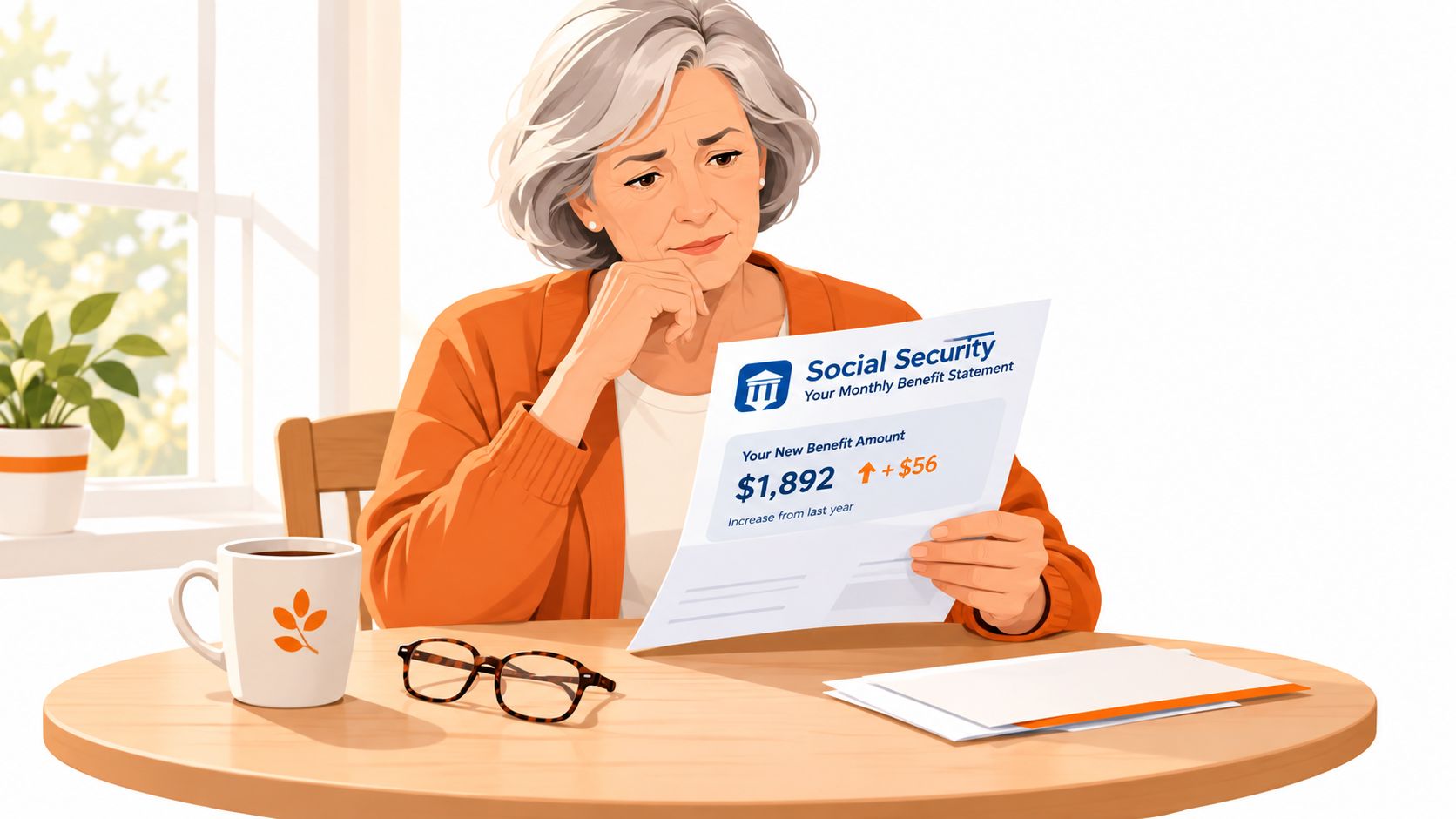
The moment usually looks the same. You open your new benefit notice, see that your monthly check went up a little, then pay for groceries, prescriptions, or rent and wonder why that increase already feels spent.
That reaction is reasonable.
A monthly check does tell you something useful about COLA, but not what many people assume. It shows the result of a formula applied to a broad inflation measure. It does not show how much your own household costs rose, and it does not prove your budget should now feel caught up.
Why that increase matters
For anyone living on a fixed income, even a modest change in a monthly benefit matters because prices keep moving. If your payment stayed the same year after year, it would buy less over time. The increase is meant to slow that loss of buying power.
Your check is a little like a thermostat reading from the whole building when you only care about your own apartment. It gives a real signal, but it may not match the room you are standing in. A national COLA can rise even if your own biggest bills barely changed. The opposite can also happen, and that is the version people notice most. Your food, insurance, or medical costs jump, while your payment rises by much less.
What your check does and does not show
Your new payment amount confirms that an adjustment was applied. It does not explain three parts that often create the gap people feel.
First, the index may not match your household. Social Security COLA is tied to CPI-W, while many news stories quote CPI-U. Those indexes are similar, but they are not the same basket.
Second, the measurement is national, not local. Prices in your city can rise faster than the national average.
Third, the timing is delayed. COLA is based on a past measurement window, so your January payment can reflect inflation from months earlier rather than what you are paying right now.
That is why a person can get a larger check and still feel behind by the second week of the month.
Practical rule: A COLA adjusts income. It does not promise that your personal budget will feel balanced.
That gap is hardest on households with very little room to absorb a surprise bill. If you are trying to steady essentials while prices keep changing, this cash flow support guide can help with short-term budgeting pressure.
A smart next step is to compare your new benefit amount with your recent spending by category instead of relying on memory. Reviewing your transaction history by category can show whether food, utilities, transportation, or medical costs rose faster than your monthly increase.
What Cost of Living Adjustment Actually Means
People often use COLA as if it means “the cost of living itself.” That's not quite right.
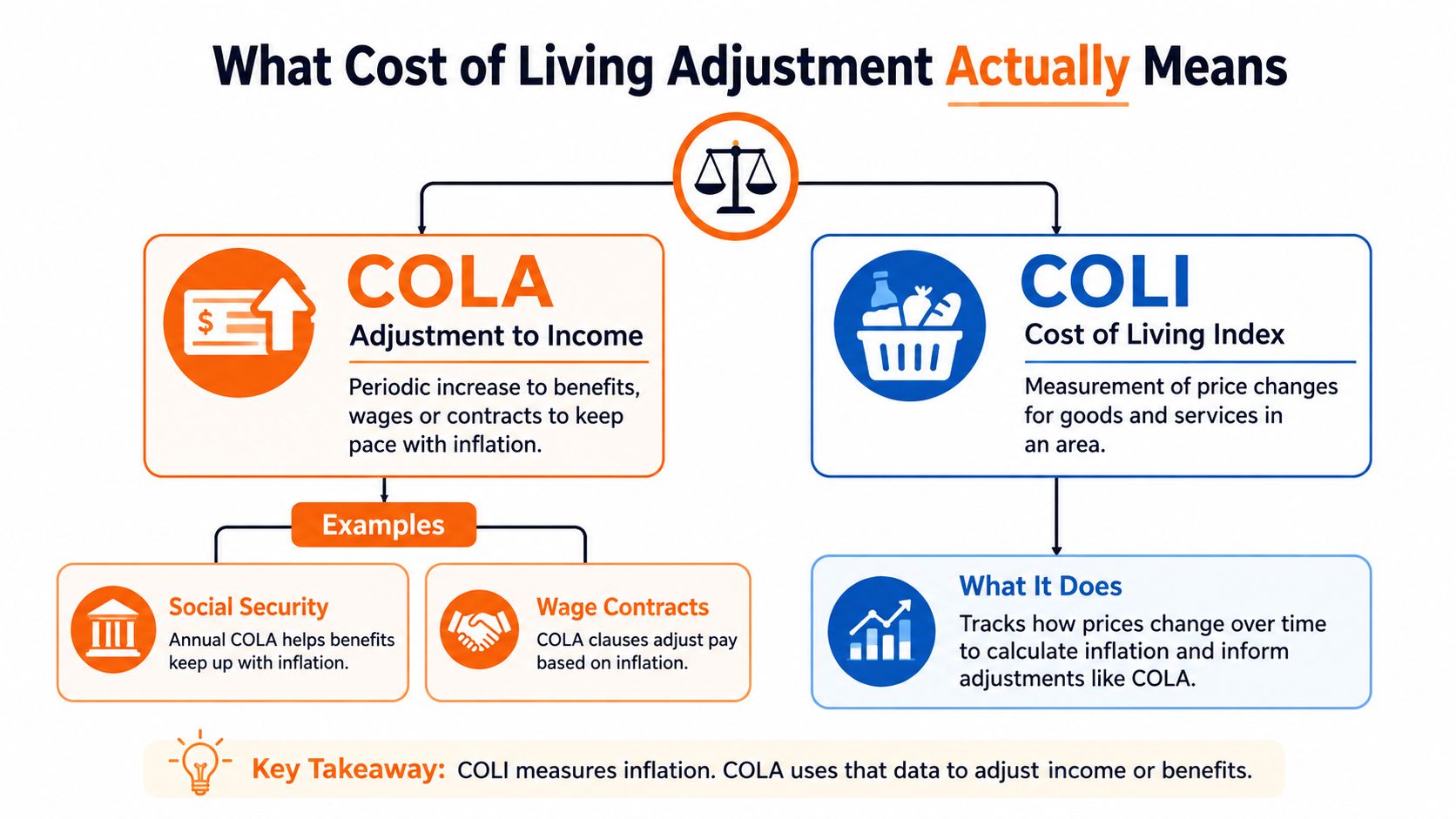
A cost of living adjustment is the increase applied to a payment, wage, pension, or contract. It's the action. A cost of living index, often shortened to COLI, is the idea of measuring what it costs to maintain a standard of living in a place. That's the measurement concept.
COLA is the adjustment
When a government benefit rises each year under a formula, that's COLA. When a pension plan or employment agreement includes annual inflation indexing, that's also COLA.
It's the amount added to income.
COLI is the underlying idea
A true cost of living index aims to capture what people must spend to maintain their standard of living. But in practice, many systems don't use a true COLI. They use CPI instead, because CPI is published regularly and is easier to apply in formulas.
Statistics Canada makes this distinction clearly. It notes that the Consumer Price Index is not the same as a cost-of-living index, even though CPI is often used to approximate living-cost changes and to index payments (Statistics Canada FAQ).
COLA is usually a practical indexing tool. It is not a perfect mirror of what your household needs to spend.
Why CPI gets used anyway
CPI is widely available, published on a schedule, and built for consistency over time. That makes it useful for benefit systems, pension formulas, and public contracts that need a rule everyone can apply.
In California, for example, the state publishes a long-run CPI history from 1955 to 2026, including 2025 annual California CPI values of 352.508 for All Urban Consumers and 340.977 for Urban Wage Earners and Clerical Workers, with April 2026 monthly values of 364.746 and 353.201. The state also notes that CPI data are available by geography and that percentage-change tools support 1989 to 2026 comparisons, which is why California agencies use these tables to anchor inflation adjustments to local price changes rather than national averages (California Department of Industrial Relations CPI tables).
That doesn't make CPI perfect. It makes CPI usable.
How COLA Is Calculated Using CPI and Contract Caps
You can get a COLA and still feel behind. The reason is usually in the fine print of the formula.
A COLA is built from two parts. First, the plan chooses a price index. Second, it may place a ceiling on how much of that inflation you receive. That is why the same word, COLA, can mean different outcomes for Social Security, a public pension, or a union contract.
The two decisions that shape your COLA
Start with the index.
Social Security uses CPI-W, which tracks spending patterns for urban wage earners and clerical workers. Other systems may use CPI-U, a local California CPI series, or another contract-defined measure. That difference matters because these indexes do not move in perfect lockstep. Your household may spend heavily on rent, groceries, or medical care, while the index tied to your benefit gives those categories a different weight. That is one reason your increase can feel smaller than your real-world costs.
Then there is timing. Social Security's 2026 COLA was based on CPI-W growth from the third quarter of 2024 through the third quarter of 2025 (California Department of Rehabilitation). In plain English, the government is not looking at what prices are doing right now at the checkout line. It is looking at a past measurement window, then applying that result later. If prices jumped after that window, your COLA would not catch it yet.
This timing gap is easy to miss. It helps to treat COLA the way you would treat a budget trend line instead of a single receipt. If you want a practical way to spot whether your own expenses are rising for one month or drifting up over time, learn how trend analysis can reveal spending patterns.
Where caps change the result
Caps are the second reason a COLA can feel disappointing.
CalPERS shows how this works in practice. The system says its COLA is tied to the California Consumer Price Index, starts in the second calendar year after retirement, and is limited by the cap written into the employer's contract, often 2%, 3%, 4%, or 5%. CalPERS also reports that the 2025 annual CPI was 964.398 and the implied inflation rate was 2.63% (CalPERS COLA page).
Here is the plain-language version. If inflation for the formula year is 2.63% and your plan cap is 2%, your benefit does not rise by the full inflation rate. It stops at 2%. If your cap is 3%, you can receive the full 2.63% because the formula result stays under the ceiling.
A cap works like a lid on a pot. The water can keep heating up, but the lid sets the limit on what can spill over into your monthly check.
COLA calculation methods compared
| System | Index Used | Typical Cap | Lag Window |
|---|---|---|---|
| Social Security and SSI | CPI-W | No contract cap stated in this article | Third quarter of one year compared with the third quarter of the next measurement year |
| California public pension example through CalPERS | California CPI | Often capped by plan terms such as 2%, 3%, 4%, or 5% | Starts in the second calendar year after retirement |
| Contract-based or plan-based arrangements | Varies by agreement, often CPI-linked | Often capped or limited by contract language | Varies by agreement |
The same kind of disconnect shows up in housing. Rule-based increases can be technically correct and still feel out of touch with a household budget. If that applies to you, this guide on what NYC tenants should know about RGB explains a similar gap between a formal adjustment rule and lived costs.
Who Receives COLA and When It Takes Effect
You check your deposit, see a small increase, and wonder why it barely touches what happened at the grocery store. Part of the answer is simple. “COLA” is not one system. It is a label used by several systems, and each one has its own schedule, index, and rules.
In the United States
Social Security and SSI recipients receive a federal COLA that is announced by the Social Security Administration and applied automatically to benefits. For 2026, the Social Security Administration announced a 2.8% COLA. The same announcement says the change affects nearly 69 million Social Security beneficiaries, and SSI payments usually begin reflecting the new amount at the end of December for January benefits (Social Security Administration COLA announcement).
That timing matters more than it sounds. A COLA can be accurate under the program's rules and still feel late in real life. Your bills may have risen for months before the new amount shows up in your check.
Public pensions often follow a different clock. CalPERS, for example, does not start COLA payments right after retirement. As noted earlier, the increase generally begins in the second calendar year after retirement, and the final amount depends on both the CPI calculation and the cap written into the plan.
Other government budgets also use the term COLA, but they are talking about a different audience. California's 2025-26 budget cut the planned education cost-of-living adjustment from 2.43% to 2.3%, which shows that a COLA for school funding is separate from a COLA for retirees or Social Security recipients (California Budget Summary).
In Canada
Canada also adjusts some benefits for inflation, but the rules are not the same as the U.S. rules.
The Canada Pension Plan adjusts benefits once a year using the CPI All-Items Index. The government explains that the calculation compares one 12-month average with the previous 12-month average, so the increase is based on prices that have already been measured, not on what households are paying this week (Government of Canada CPP CPI explanation).
For retired federal public service pensions, the indexing rate effective January 1, 2026 is 2.0%. The method compares the average CPI from one October-to-September period with the next October-to-September period using Canada's national all-items CPI (Treasury Board of Canada pension indexing rate).
That is a good example of the larger problem this article is trying to clear up. Two people can both say they “got a COLA” and still be talking about different inflation measures, different time windows, and different start dates.
A simple checklist
If you are not sure which COLA applies to you, check four things:
- Your benefit type: Social Security, SSI, CPP, a public pension, or an employment contract
- Your effective date: Some increases begin in January. Others start later or are delayed after retirement
- Your formula: The adjustment may use CPI-W, CPI-U, a state index, or a plan-specific measure
- Your plan language: Caps, floors, and special timing rules are often buried in the documents
If you are sorting out retirement income sources, this overview of what a pension plan is can help you see where COLA fits.
Why Your COLA Might Feel Smaller Than Inflation
This is the question people usually mean when they ask about cost of living adjustment.
They're not asking how the formula works. They're asking why their payment increase feels too small.
Local prices can rise faster than the COLA formula
In California, that gap can be very real. The Los Angeles CPI-U was up 3.6% over the 12 months ending August 2026, while energy prices were up 17.6% and food was up 2.8% (BLS Los Angeles CPI release). If your household spends a lot on utilities, fuel, or driving, your budget may feel much tighter than someone whose main costs rose more slowly.
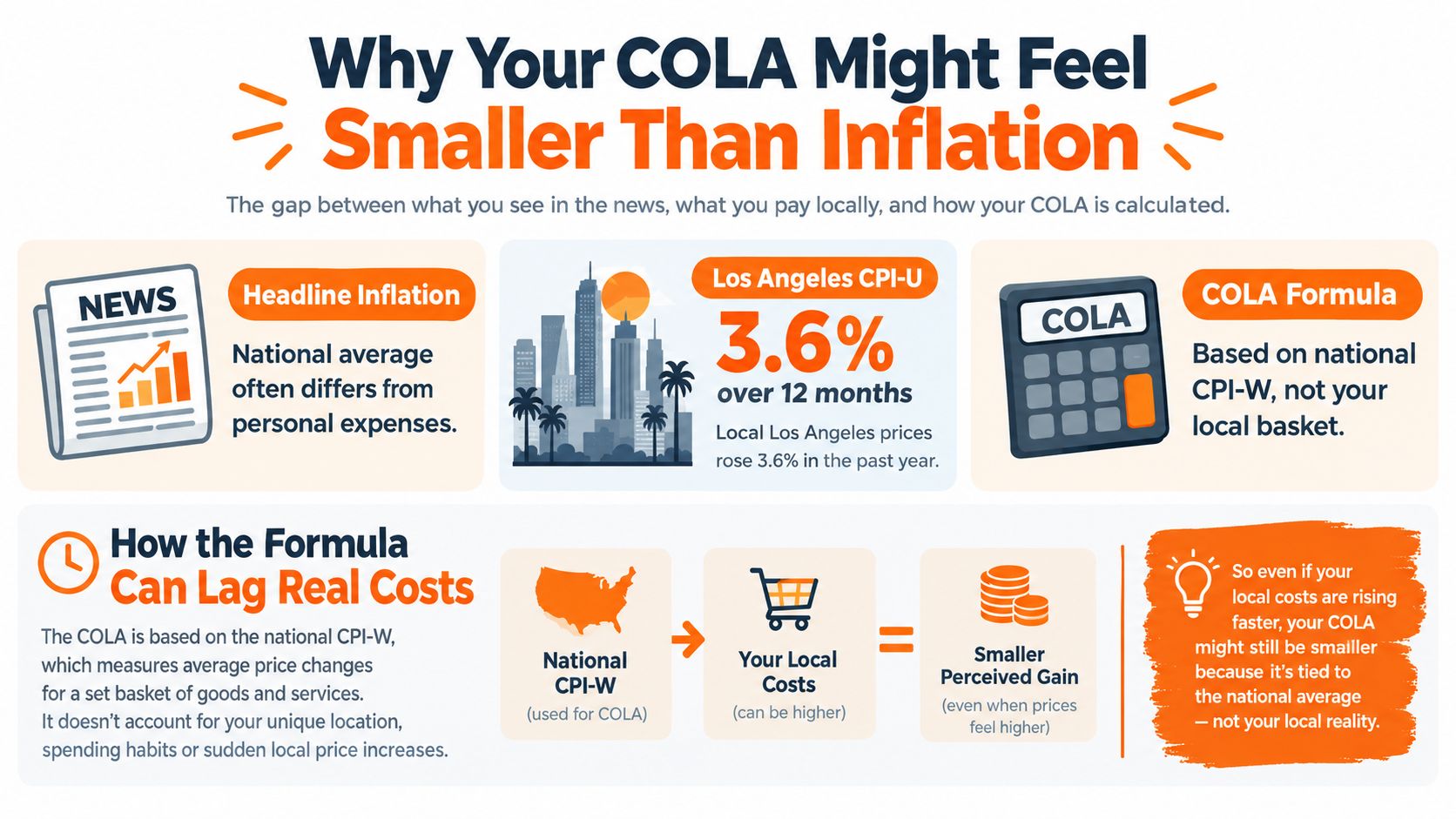
That's one reason a national adjustment can feel disconnected from local life. The formula may be working exactly as designed while your personal expenses still outrun it.
The formula looks backward
Another reason is timing. A COLA is often based on an earlier measurement period, then applied later. If prices accelerate after that window closes, your increase won't immediately reflect the newer pressure.
Bottom line: A COLA is an adjustment formula, not a promise that purchasing power will be preserved equally across every region and spending category.
Your own budget basket matters more than the headline
Two neighbours can get the same percentage increase and have very different experiences. One may spend heavily on categories that stayed relatively steady. The other may face sharp jumps in transport, home energy, or food.
That's why broad inflation headlines only tell part of the story. Your real test is whether the categories you buy rose faster than your income. A practical way to see that clearly is to review a working budget categories list and compare your own essentials against the categories absorbing the biggest increases.
Practical Steps to Protect Your Budget When COLA Lags
When your COLA doesn't keep pace with what you're paying, the goal isn't to panic. It's to make the gap visible early and adjust before it grows.
Track your actual spending, not the average
Start with your own numbers. National and regional inflation measures are useful, but your household lives inside its own basket of expenses.
Look at recent spending in categories like groceries, utilities, transport, housing, insurance, and medical costs. If one category is driving the problem, you'll make better decisions faster.

Check whether your plan has a cap
Some people assume “inflation-linked” means “fully inflation-protected.” It might not.
Read the benefit notice, pension booklet, or employment agreement closely. If there's a cap, that cap can limit the increase even in years when prices rise faster.
Plan for the lag
A COLA often arrives after prices have already moved. Build your budget as if there may be a delay between rising bills and the next adjustment.
That can mean holding a small buffer in your chequing account, reviewing recurring bills more often, or trimming lower-priority spending before the squeeze shows up in missed payments.
A steady habit beats a perfect forecast. Monthly check-ins usually work better than trying to predict every inflation move in advance.
Review your budget after each COLA notice
When a new adjustment is announced, don't stop at the percentage. Translate it into your monthly cash flow and compare that with what changed in your real spending.
A simple review can include:
- Your new net monthly amount: Note the actual dollars available to spend.
- Your top three rising categories: Focus on the places where prices are biting first.
- Any fixed payments that won't shrink: Rent, insurance, loan payments, and prescriptions often leave less room to adapt.
- Your next adjustment choices: Cut, postpone, renegotiate, or rebalance.
If your income feels tighter than it should, reviewing ways to improve cash flow can help you close smaller monthly gaps before they turn into larger ones.
A cost of living adjustment helps. It just isn't a complete shield. The more clearly you can see where your own spending is drifting, the more control you keep.
Fintrack gives you a practical way to watch that drift in one place, especially after a COLA notice changes your monthly income but your bills keep moving. You can use Fintrack to review your budget, spot categories rising faster than expected, and make small adjustments before a lagging COLA turns into a bigger cash flow problem.