
Consolidating debt does not ruin your credit in most cases, and the usual hit is small and temporary, often about 5 points from a hard inquiry. If you keep making on-time payments and your balances go down, the score can recover and often improve over time.
That's the part many people miss when they're staring at three credit card bills and one consolidation offer. The fear is understandable, because one wrong move can make things worse, but the scoring rules are more predictable than they feel in the moment.
The key question isn't whether consolidation is automatically bad. It's whether your version of consolidation lowers what you owe on revolving credit, or whether it just adds a new account without changing the parts of your score that matter most.
The Honest Answer About Consolidation and Your Credit Score
A single monthly payment can feel like a relief when the rest of the month is already crowded with bills. The concern shows up right away too, because people want to know whether one new loan or card will cancel out years of careful credit habits.
The honest answer is no, consolidating debt does not ruin your credit in most cases. A new consolidation loan or balance-transfer card can trigger a hard inquiry, and that can cause a small, temporary dip, but the effect is usually short-lived and may recover as you keep paying on time. Credit scoring models react to what changes on the report, not to the fact that you chose consolidation. Experian's explanation of debt consolidation and credit score changes and CNET's credit breakdown both describe that short-term pattern.
The bigger question is what consolidation changes underneath the surface. If the new account helps you lower revolving balances and you stop piling new charges onto old cards, your score can move in a better direction. If the new loan becomes one more bill while the original balances stay high, the score benefit is limited.
A concrete example helps. Someone consolidating several cards into one payment may see a brief dip from the application, then a clearer path to improvement if the old cards are left alone and the new balance keeps falling. Someone who consolidates and then runs the cards back up may end up with less available credit and more pressure on the score than before.
That difference is why the payment structure matters so much. For readers who are trying to keep monthly obligations organized and avoid late fees, managing debt with no late fees is a useful companion read.
Practical rule: consolidation usually helps when it lowers pressure on your revolving balances and hurts when it only adds another account to the pile.
How Credit Scoring Factors React to Consolidation
The three score parts that move first
A debt consolidation application usually affects three credit scoring factors before anything else, and each one behaves differently. The first is the hard inquiry, which lenders usually make when you apply. That inquiry can trim your score for a short period, and the effect usually fades over time. A plain-language overview from CNET's consolidation credit overview explains that short-term dip.
The second factor is credit utilization, which is one of the biggest parts of a FICO score according to Bankrate's explanation of utilisation and scoring. A useful way to picture it is a set of buckets. If several smaller buckets are emptied into one larger bucket and the total fill level drops, the scoring model can view that more favorably. If the new bucket is nearly full, the score can suffer even though the balances now sit under one payment. If you want to test your own numbers before applying, Fintrack's credit utilisation calculator can help you see how close your balances are to the limits.
The third factor is average age of accounts. Opening a new consolidation loan or card lowers the average age of your credit history for a while, because the new account is much younger than the ones it replaces. That can put pressure on the length-of-history part of the score, as noted in Experian's consolidation guidance.
What matters more than the temporary dip
The short-term inquiry matters less than the way utilization changes after the new account is opened. If the old revolving balances fall a lot and stay low, the utilization benefit can outweigh the initial dip from the application. That is why some people see their scores improve after consolidation, even when they expected the opposite.
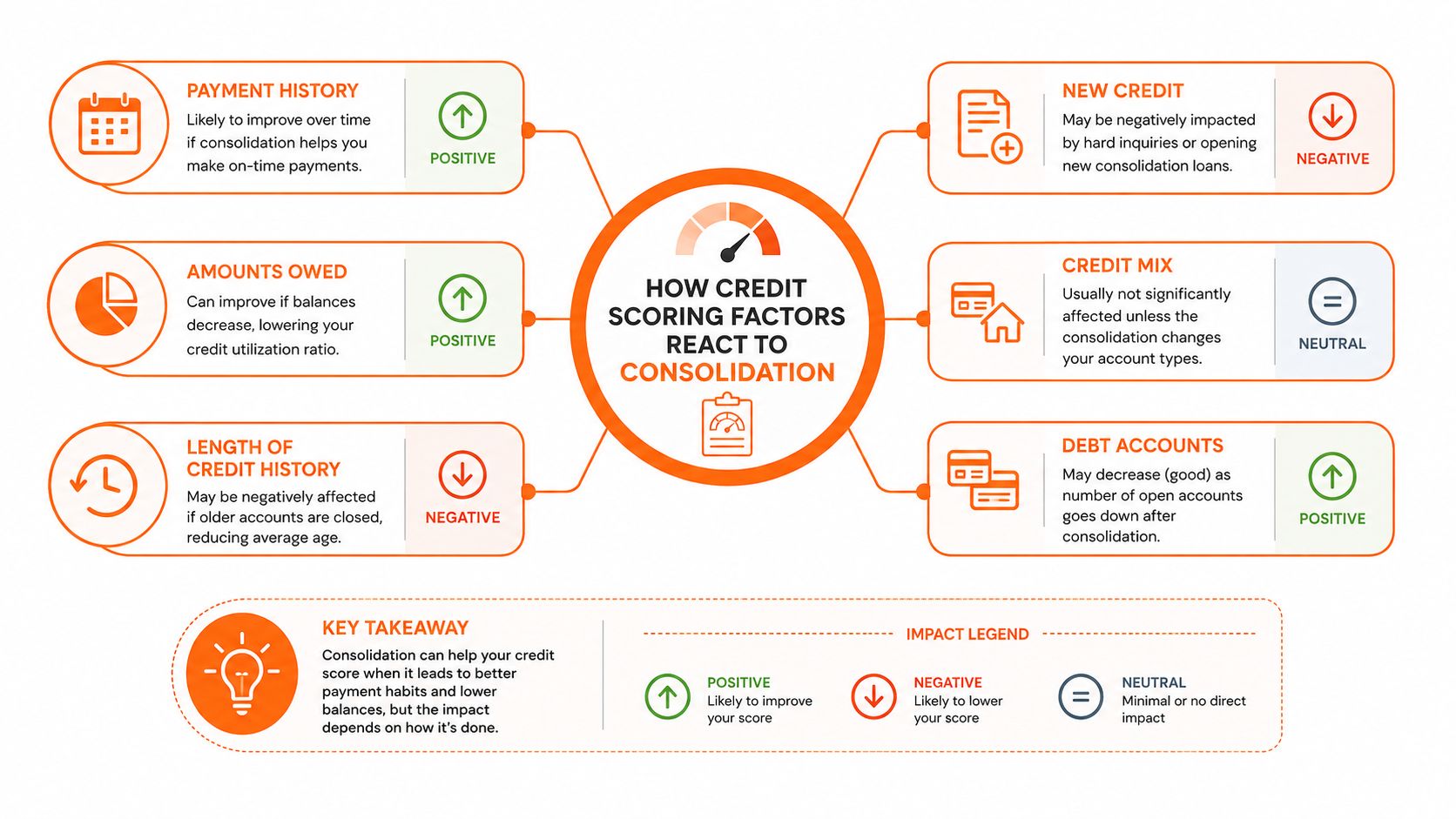
If you are trying to compare how credit scores work in different markets, Nomu Finance Limited NZ credit scores gives useful context. It also makes the main point clearer, the three mechanics above are what drive the result here.
A new account can shave off a little score. A lower balance can do much more.
Comparing the Three Main Consolidation Methods
Why the method changes the credit outcome
Not every consolidation route behaves the same way. A personal consolidation loan replaces revolving balances with an instalment loan, a balance transfer card shifts the debt onto a new card, and a debt management plan changes how you repay existing debts through a structured programme. The credit effect depends on which score factors improve and which ones get touched in the process.
A personal loan can be cleaner for scoring because it may lower revolving utilisation right away if the old balances are paid off. A balance-transfer card can also reduce utilisation on the old cards, but only if the new card's limit isn't too tight and the balance doesn't sit too close to maxed out. A debt management plan can simplify repayment, but some lenders may view the account notation less favourably, even though it isn't the same thing as debt settlement.
This balance transfer walkthrough is helpful if you're trying to understand the card-to-card version of consolidation before you choose.
Consolidation Methods and Credit Impact
| Method | Short-Term Credit Impact | Long-Term Credit Impact | Best For |
|---|---|---|---|
| Personal consolidation loan | Possible small dip from a hard inquiry and a new account | Can help if revolving balances fall and payments stay on time | People with multiple card balances who want one fixed payment |
| Balance transfer credit card | Inquiry plus possible utilisation shift on the new card | Can help if the transferred balance is paid down quickly | Borrowers who can manage a promotional card and avoid reusing old credit |
| Debt management plan | May affect how lenders view the account and can change report notes | Can help if it leads to steady repayment and less revolving stress | People who need structure and support to avoid missed payments |
The method matters because the scoring model does not care about your intention, only the reported account changes. That's why two people can consolidate the same amount of debt and see very different score results.
The Short-Term vs Long-Term Credit Timeline
A consolidation decision can feel confusing because the score does not react all at once. One part of the report may move in your favour, while another part pulls the other way.
What usually happens in the first month
Right after consolidation, a small score dip is common. A hard inquiry can shave a little off the score, and the new account has not had time to build a helpful payment history yet. If your revolving balances were already close to maxed out, the early benefit from lower utilisation may be slow to show up.
That first month is where many people overreact. They close old cards, miss payments on accounts that were not included in the new loan, or rush into another application because they want the score to bounce back immediately. Those moves usually create more harm than the consolidation itself. If a balance still needs to be cleared from a credit report, credit report item removal steps can help explain the difference between fixing the report and taking out another product too soon.
What usually happens by the first quarter
After a few billing cycles, the picture often starts to shift. If the old revolving balances were paid down and stay low, utilisation can begin to help more than the inquiry hurt. That is the part many people miss. Credit scoring gives more weight to what your balances look like over time than to the one-time act of opening a new account.
TransUnion reported that 68% of consumers using debt consolidation loans saw their scores improve by more than 20 points, with the strongest gains after about one quarter and still present one year later. TransUnion's consumer research on debt consolidation shows the pattern clearly. The early dip does not always last. If the balances stay under control, the score can begin to recover as the report reflects lower revolving use.
What happens by the one-year mark
The longer view depends on payment discipline. Payment history carries the most weight in a FICO score, so steady on-time payments usually matter more and more as time passes. Once the new account has several clean payments behind it, the temporary dip from opening it can matter less than the stronger repayment pattern it creates.
That is why the same consolidation can look disappointing at first and helpful later. The first stage is about account changes. The later stage is about whether those changes reduce revolving stress and support consistent payments. That is also why consolidation should be judged across several billing cycles, not just the day the loan is approved.
Credit recovery basics are easier to understand when you treat consolidation as a process that unfolds over time, not a single event.
The score rarely tells the whole story in week one. It often makes more sense after several billing cycles.
Steps to Protect Your Credit During Consolidation
Before you apply
Start by checking your current balances and utilisation. If your revolving credit is already stretched, consolidation has more room to help, because paying those balances down can change the report in a meaningful way. Also, keep rate shopping focused, since multiple applications in a short window can create unnecessary hard inquiries.
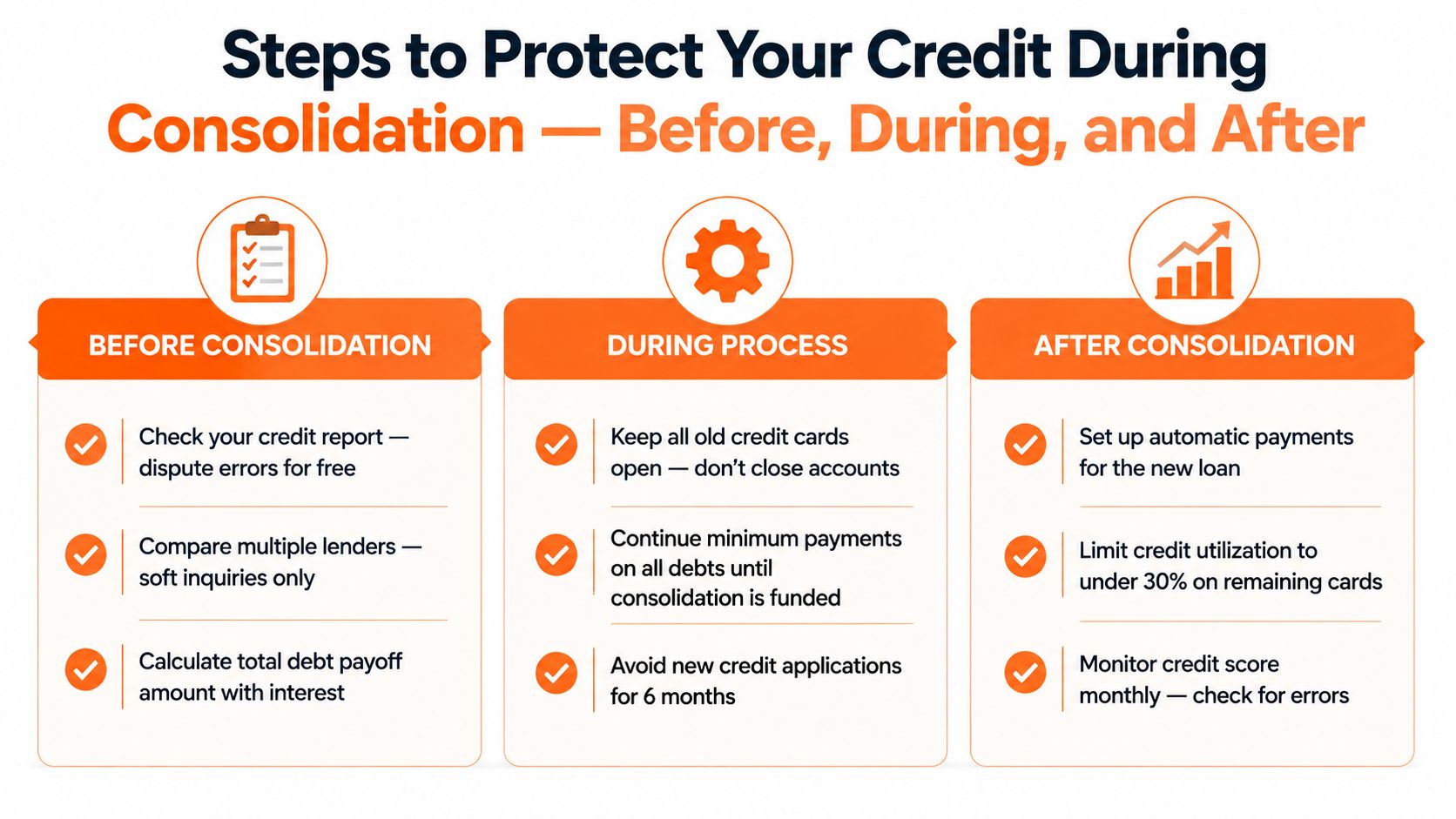
The strongest pre-application habit is simple. Compare offers carefully, make sure the new payment fits your actual monthly cash flow, and avoid treating prequalification like a guarantee. Soft checks are part of shopping around, and they are not the same thing as a formal application inquiry.
During the move
Keep your old cards open unless a lender tells you otherwise. Closing them cuts available credit and can push utilisation in the wrong direction, which is exactly the opposite of what you want after consolidation. It also shortens the history tied to those accounts.
Keep making minimum payments on any debt that hasn't been paid off yet. If the new loan is still pending and you stop paying everything in advance, you can create late marks for no reason. This credit card payment guide is useful for keeping the sequence straight if you're juggling due dates.
After the balances are moved
Set up autopay for at least the minimum on the new account. Payment history drives the score more than almost any other single factor, so missing a due date can erase a lot of the good work consolidation was supposed to do. Then leave the emptied cards alone.
Best habit after consolidation: keep the old cards open, keep the balances low, and let time do the credit repair work.
If a bill has already gone to collections and you're trying to clean up the damage at the same time, how to remove collection items from a credit report gives useful background on a separate issue that can also affect your score.
Common Consolidation Myths and Costly Mistakes
One myth causes a lot of unnecessary fear, consolidation is not the same as debt settlement. Settlement usually means you pay less than what you owe, while consolidation changes the structure of the debt without necessarily changing the amount. That difference matters because the credit consequences are not identical.
Another mistake is closing old credit cards as soon as the consolidation loan pays them off. People do this because they want to feel finished, but it often backfires by reducing available credit and pushing utilisation higher on the remaining accounts. If the goal is to make the score healthier, closing a card at the wrong time can undo that progress.
There's also no reason to fear checking rates the smart way. A soft inquiry for prequalification does not behave like a hard inquiry, so it should not be treated like a score hit. The problem comes from formal applications, not from every look at an offer.
The final trap is the hardest one to fix. If the spending habit stays the same, the old balances come back while the new loan is still there. Consolidation then becomes extra debt on top of old debt, and the score usually reflects that strain sooner or later.
Deciding If Consolidation Is Right for Your Situation
A consolidation decision usually becomes clearer when you look at the score factors one by one. If your credit utilisation is above 30%, you have several revolving balances, and you are confident the cards will stay paid down after the transfer, consolidation often works in your favor because it lowers pressure on the parts of the score that respond most to balance reduction.
The picture changes if your file is thin, if the new rate does not improve your current cost, or if you already know the open credit will be used again. In that situation, the new account inquiry and the added account can matter more than the short-term relief, especially if the balances return.
A useful test is simple. Will this move reduce the revolving debt showing on your report, and can you keep it lower after the switch? If both answers are yes, consolidation is usually a tool for credit recovery planning rather than a gamble, and the basic framework is explained well in credit recovery planning.
Your monthly payment and overall cash flow matter just as much as the score number. That is the part you can control, and it is also the part that makes the biggest difference over time.