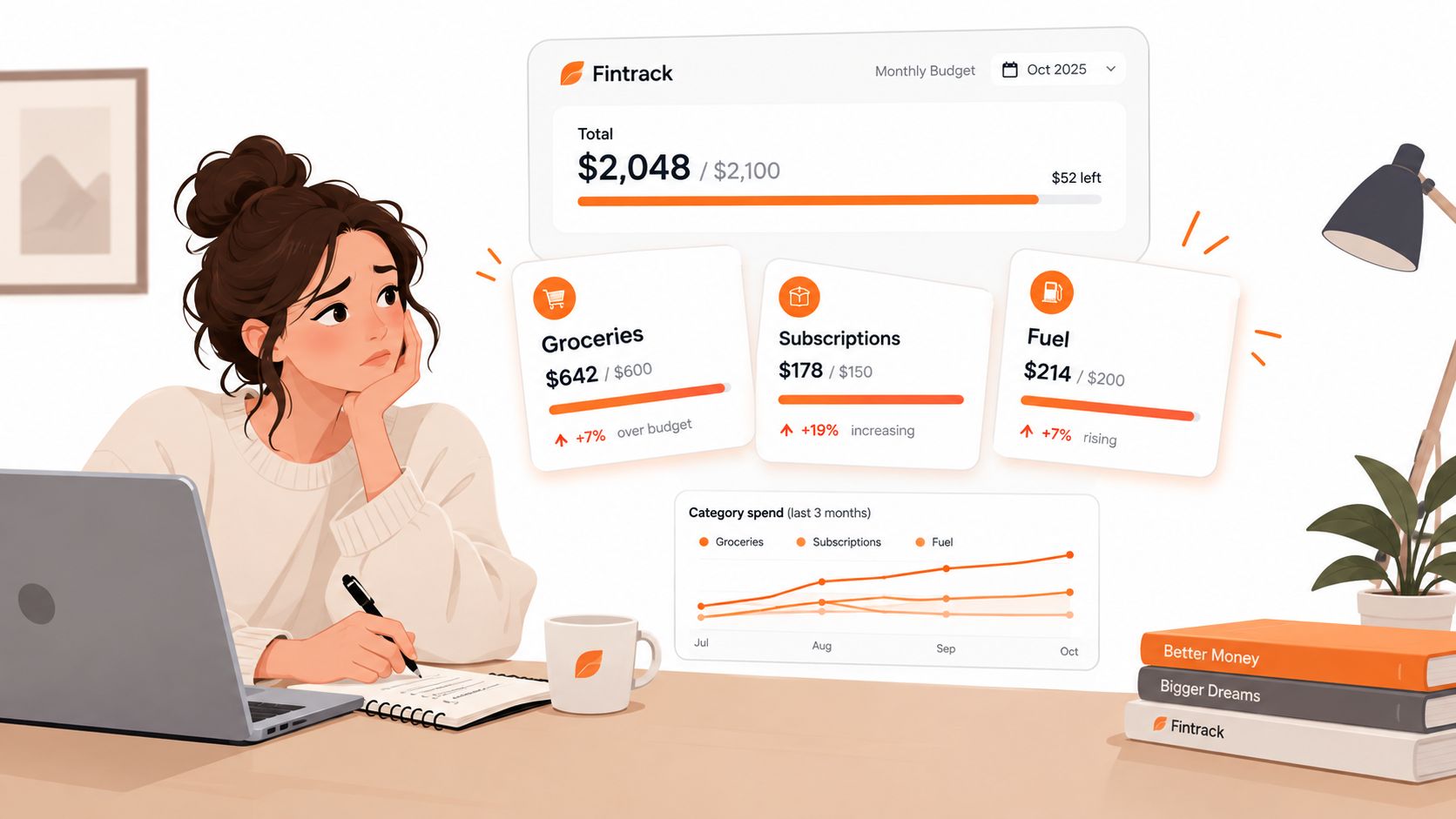
You reach the end of the month, check your spending total, and feel relieved. Then you open the grocery category and realise you spent more than planned, even though the overall budget looked fine.
Budget variance analysis helps you understand that mismatch. Rather than asking whether you were “good with money,” you compare your plan with what happened, investigate the difference, and choose a useful response.
Why Your Budget Total Can Look Fine While One Category Quietly Breaks
You kept the household total near its target by delaying a clothing purchase and cancelling an outing. Meanwhile, food costs rose above plan. Because the cuts elsewhere offset that increase, the monthly total still looks manageable.
Here's a hypothetical example: you budget $800 for food and spend $950. That leaves a $150 unfavourable variance, meaning actual spending exceeded the plan. The overall budget may still appear fine, but the category gap deserves a closer look.
Look underneath the total
A budget variance is the difference between planned and actual results. Analysis means finding out what caused that gap. For a household, the monthly total is only the starting point. Category details show whether a change came from higher prices, the timing of a purchase, or a shift in spending habits.
Ask a few practical questions:
- Which category changed? Find the specific line item instead of guessing from your account balance.
- Why did it change? Check whether prices rose, a purchase happened earlier than planned, or spending choices shifted.
- Was another category offsetting it? A postponed expense can hide an overspend elsewhere.
- What can you control? Adjust a flexible habit if that caused the gap. If a recurring cost changed, update the budget rather than treating the difference as a personal failure.
A gap is a signal to investigate, not a verdict. You don't need to check every receipt equally closely. Give more attention to changes that could affect upcoming bills, savings, or a realistic plan for essential spending.
Practical rule: The total shows where you finished. Category details help explain why.
The goal is a budget that reflects real costs and choices. Decide which assumptions still fit, which need updating, and what you want to change next month.
The Budget Variance Formula and a Worked Example
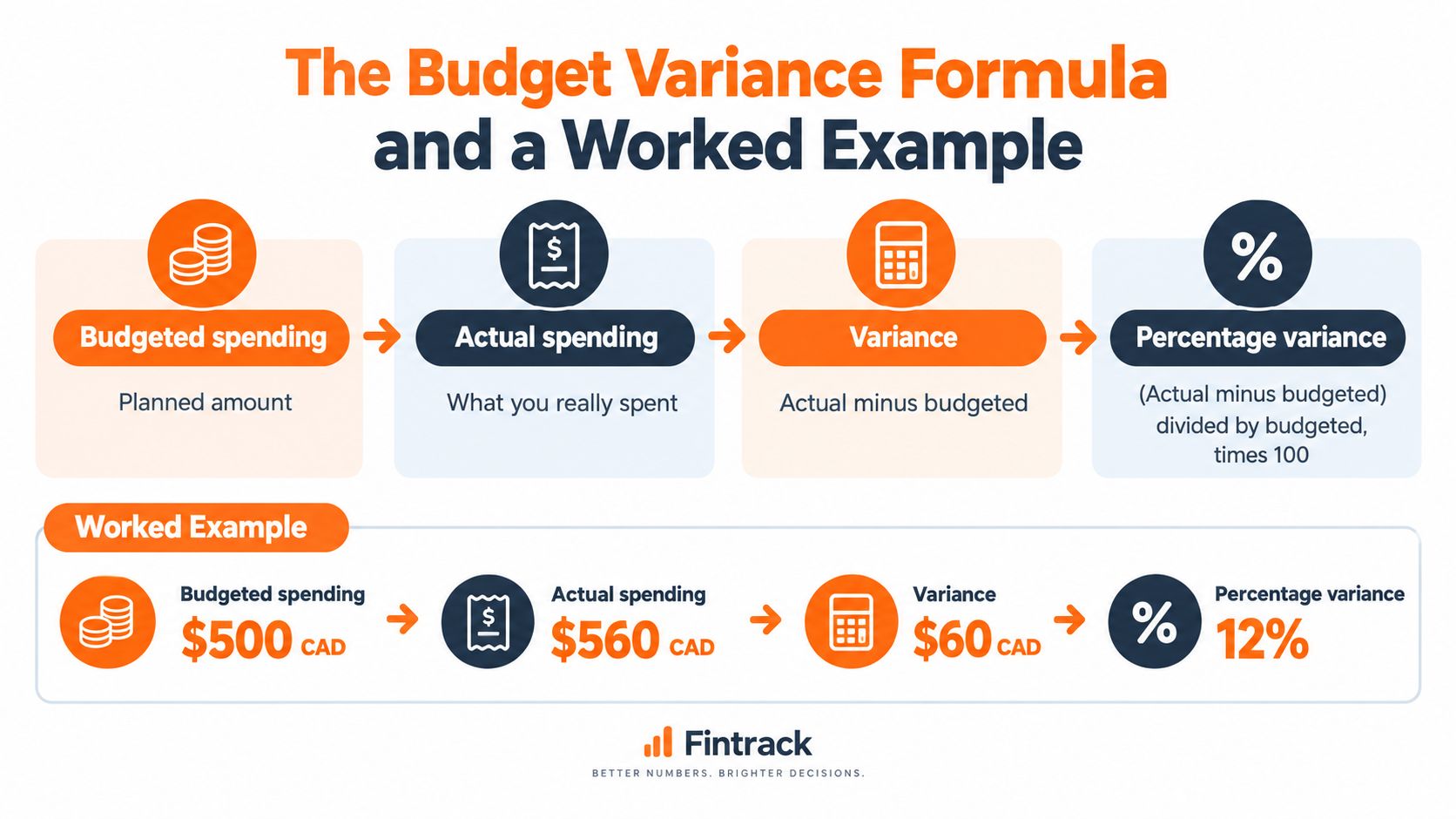
Suppose your food budget is $800 for the month, and your actual spending is $950. These are illustrative numbers for this example, not figures from Statistics Canada. To see how the category changed, subtract the budget from actual spending. Here, the gap is $150 over budget.
Keep the subtraction consistent: actual spending minus budgeted spending. With this convention, a positive expense variance means you spent more than planned; a negative one means you spent less. Some reports reverse the calculation, so check the labels before comparing results.
Calculate the amount, then the proportion
Use these formulas in your budget:
Dollar variance = Actual spending − Budgeted spending
Percentage variance = (Dollar variance ÷ Budgeted spending) × 100
For the food example:
- Subtract $800 from $950 to find the $150 dollar variance.
- Divide $150 by the $800 budget. The result is 0.1875.
- Convert that decimal to a percentage: the category is 18.75% over budget.
Keep both results visible
The dollar amount shows how much cash the difference represents. The percentage shows how large that difference is compared with the category's plan. Together, they give you a clearer picture than either number alone.
For example, a modest dollar gap can be a large change in a small category. A small percentage shift in a large category can still mean a noticeable amount of money.
Use spreadsheet columns labelled Category, Budgeted, Actual, Dollar variance, and Percentage variance. Add a short explanation beside each result, such as “higher grocery prices” or “extra meal out.” That reason helps you decide whether the gap came from price, timing, or a spending choice, and whether it is something you can control or a structural cost change.
If the budgeted amount is zero, a percentage variance cannot be calculated because division by zero is undefined. Record the dollar difference and mark the percentage as not applicable.
Compare matching periods, too. An annual bill belongs beside an annual allowance, not a monthly limit.
What a Real Variance Report Reveals Beyond the Total
A household can finish the month under budget and still face a problem in one category. The total is like a net in a boat: one area's surplus can cover another area's overrun, so the overall result may hide where spending changed.
The Office of the Auditor General of B.C.’s annual report for 2023/24 shows this pattern in its operating expenses. The office budgeted $23.415 million and spent $22.024 million, an underspend of $1.391 million, or about 5.9%. That total is useful, but the category differences explain what lies beneath it.
Salaries and benefits were $151,000 over budget. Professional fees were $836,000 under, IT expenses were $200,000 under, travel was $144,000 under, and depreciation was $247,000 under. Those differences show which categories offset the overspend. Since the individual budgeted and actual amounts aren't provided here, treat each category figure as a dollar gap, not as a measure of how large that category was or how far it moved proportionally.
Try the same reading method at home
Suppose your monthly budget sets groceries at $600 and dining out at $150. At month's end, groceries total $660 while dining out comes to $90. Groceries are $60 over plan, and dining out is $60 under. Together, the categories match the plan, but that does not mean the grocery increase will disappear next month.
Ask what caused each difference:
- Price: Did grocery prices rise, or did you choose more expensive items?
- Timing: Did a bulk purchase happen this month even though it will last into next month?
- Behaviour: Did you eat at home more often, shifting money from dining out to groceries?
That distinction helps separate a lasting cost change from a one-off purchase or a choice you can adjust. Record the cause beside the variance, then decide whether to change the habit or revise the budget. A guide to the benefits of spend analysis can help you examine spending patterns rather than rely on a single over-or-under label.
The same habit can help when reviewing business accounts. ThriveXDNA's resource on how to evaluate financial health before investing offers a related way to understand financial statements beyond their headline totals.
A useful review asks which categories created the overall result, what caused each gap, and whether the cause is likely to continue.
How to Run a Monthly Variance Review in Five Steps
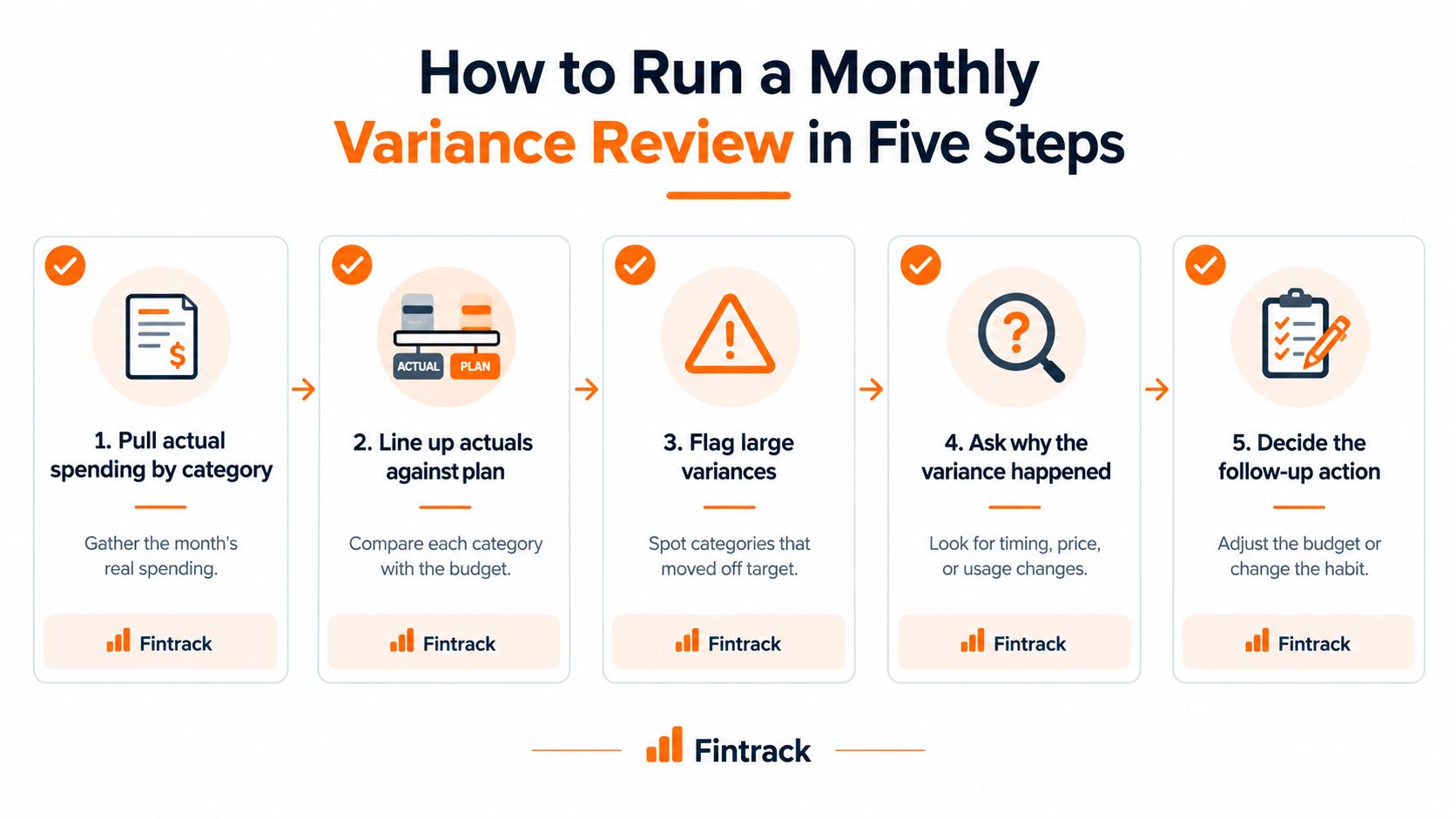
Choose a regular review date after your month's transactions are available. Keep the review bounded: you're looking for decisions, not trying to reconstruct every purchase from memory.
Use the same sequence each month
Pull actual spending by category. Gather transactions from your accounts, cards, receipts, and cash notes. Check that refunds and transfers haven't been mistaken for ordinary spending.
Line up actual spending with the plan. Match category names and date ranges before comparing amounts. If you changed your budget during the month, retain a note explaining the change.
Calculate dollar and percentage variances. Use the formulas consistently across categories. Keep the original planned amount visible so you can understand the comparison later.
Flag differences worth investigating. Choose a dollar threshold and percentage threshold that fit your cash flow. Also flag repeated drift and essential bills, even when they don't cross your usual threshold.
Write a cause and a next action. Describe what happened in a short sentence, then record whether you'll change spending, revise the plan, or prepare for a later bill.
Check the records before changing the budget
A duplicate entry can resemble overspending. A missing transaction can make a category look healthier than it is.
Use account reconciliation, meaning checking your recorded transactions against the account statement, before drawing conclusions from a surprising result.
Keep this closing checklist beside your review:
- Records checked. Missing entries, duplicates, and miscategorised purchases have been corrected.
- Important differences explained. You can describe the cause without relying on the sign alone.
- Follow-up recorded. Each category needing attention has a clear next action.
- Upcoming obligations considered. Money apparently left over isn't already needed for a pending bill.
Don't rebuild your entire budget in response to an isolated exception. Keep the note, watch what happens next, and make larger changes when the evidence supports them.
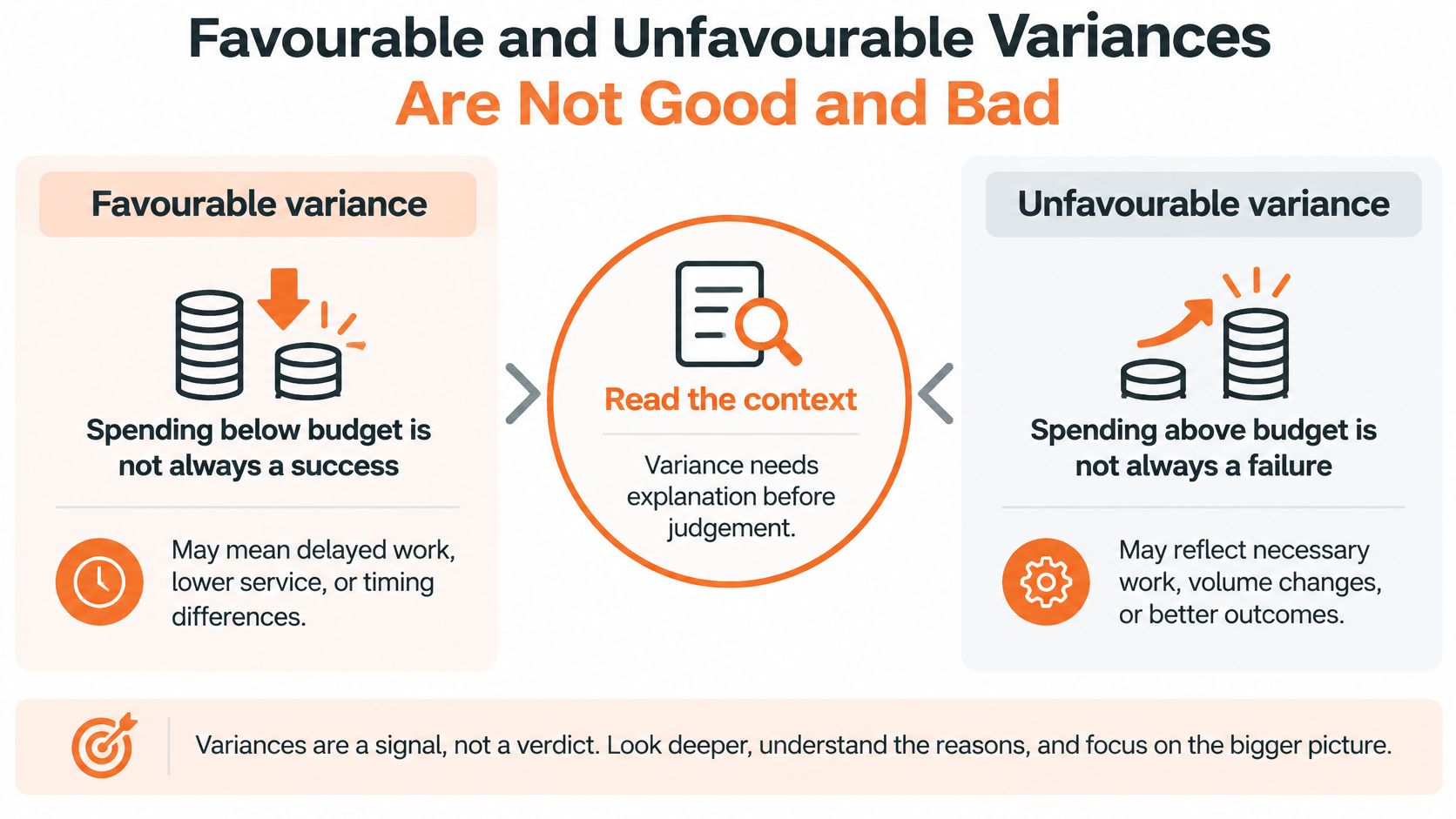
Favorable and Unfavorable Variances Are Not Good and Bad
Favourable and unfavourable describe the direction of a financial difference, not whether you made a wise decision. For expenses, spending below budget is conventionally favourable, but the reason still matters.
A document-based example appears in the Nova Scotia Office of the Auditor General's 2025–26 performance report. It lists government contributions budgeted at $6.766 million against actual contributions of $6.205 million, a reported shortfall of $561,157, or about 8.3%; salaries and benefits were $471,779 below budget, while other services were $30,722 below budget.
Read the cause before assigning meaning
In that report, contributions were tied to actual expenditure. Lower contributions followed lower expenses, rather than representing an independent spending success.
Unexpected vacancies explain the salary underspend, partially offset by a retroactive economic increase and unbudgeted reclassifications. The other-services difference reflects a planned software purchase that didn't proceed.
Those explanations change how you interpret the amounts. Vacant positions and a purchase that didn't happen aren't the same thing as delivering the original plan more efficiently.
Apply the distinction at home
| Household situation | What the variance alone misses |
|---|---|
| Spending less on dental care | You may have postponed a needed appointment |
| Spending less on vehicle maintenance | The repair may still be necessary |
| Spending more on a necessary repair | You may have addressed a safety issue |
| Spending less after cancelling an unused service | You may have removed a cost without losing something useful |
Spending less isn't automatically progress if you're leaving an essential need unmet.
Income needs its own interpretation, too. Lower-than-planned income isn't favourable just because it produces a negative number under an actual-minus-budget calculation.
Make context a required field in your review. Before celebrating an underspend or criticising an overspend, ask whether the household received what it needed and whether any obligation remains.
Common Causes of Budget Variance and How to Fix Each One
A grocery total can rise because prices went up, because you bought more, or both. Start by sorting each gap into price, timing, and behaviour. The categories can overlap, so record every cause that applies before deciding what to change.
The 2025 Financial Stress Index reports that 64% of respondents cited grocery prices as a source of financial stress, 54% cited inflation, and 41% cited gas prices. Those pressures help explain why a variance may reflect changed costs rather than a spending choice. Separate structural costs, such as rent or necessary household expenses, from choices you can adjust. That distinction points you toward a realistic response instead of treating every overspend as a failure.
Price changes need a realistic baseline
If rent rises or your usual grocery basket costs more, the old allowance may no longer reflect what those needs cost. Check current prices, then update the baseline, the amount you normally expect to spend. Where practical, compare lower-cost alternatives. Keep necessary needs in the budget rather than making a category look successful by leaving them unmet.
Timing differences need money set aside
An annual insurance payment or seasonal heating bill can make one month look unusually expensive. Check the due date and the full-year plan before deciding that the cost has permanently increased.
A sinking fund is money set aside gradually for a known future bill. Add to it over time and track it separately from day-to-day spending. That way, cash reserved for an upcoming payment does not look like money available to spend.
Behaviour changes need a specific adjustment
Dining out, optional subscriptions, and impulse purchases may be easier to change than rent or utility rates. Pick one category cap and check it weekly. A specific limit is easier to follow than a general promise to spend less.
Use consistent expense categories so month-to-month comparisons remain meaningful. Moving the same purchase between labels can hide a recurring pattern.
To tell a one-off from a trend:
- Review a rolling average. Compare recent, similar months and update the average as each month closes.
- Check household circumstances. A changed commute or an additional household member may call for a different budget.
- Separate mixed causes. Record both higher prices and increased purchasing when both contributed.
Match the fix to the cause. A habit change will not undo a rent increase, while raising a budget alone will not address a spending habit you want to change.
Choosing the Right Tool to Track and Visualize Variances
Your grocery budget is planned at $500, but actual spending reaches $560. A useful tool should help you see the $60 gap, trace it to the transactions behind it, and note whether prices, timing, or choices caused the difference. The gap is a prompt to investigate, not proof that you failed.
| Approach | What you do | Who it suits | What to watch |
|---|---|---|---|
| Spreadsheet template | Enter transactions, maintain formulas, and build comparison charts | Someone who wants control over the layout | Broken formulas and inconsistent categories |
| Notebook or basic manual log | Write planned and actual amounts beside each other | Someone who prefers a small, hands-on system | Summarising trends requires extra work |
| AI expense tracker | Record transactions and review dashboards or ask questions in plain language | Someone who prefers guided summaries | Check the records and category assignments behind each answer |
A spreadsheet makes the arithmetic visible. Keep formulas separate from the cells where you enter data, and save the original plan before changing future amounts. A notebook has little setup, but it works best when you record purchases consistently instead of trying to remember them later.
An AI expense tracker can group income, expenses, budgets, and goals in one view. For example, the Actual Budget app offers one option to compare while choosing a setup. Whatever tool you use, check its records before accepting an unexpected summary. The tool can sort the information, but you decide whether a variance came from a one-off event, a lasting cost change, or a spending habit.
Check the view, not just the chart
Before committing to a tool, test whether it lets you:
- See budget and actual amounts side by side for each period.
- Open a category and inspect the individual transactions behind its total.
- Edit an entry or category when something is recorded incorrectly.
- Add a note explaining the variance, such as a price increase or an unusually timed bill.
These checks make it easier to separate a controllable change in behaviour from a structural cost increase. A negative variance can reflect either, so the explanation matters as much as the total. Dashboard design can offer ideas for displaying comparisons, as in solar battery performance reporting, though household budgeting requires its own records and categories.
For Canadian users who prefer not to connect a bank account, check that manual entry without a bank connection is available. Choose a method you can keep up with, and make sure it preserves the details you need to explain each gap.
Turning Your Next Variance Review into a Better Budget
A useful review ends with a decision, not just a coloured cell. Choose the category that needs attention and decide whether the next step belongs in your spending habits, your budget assumptions, or your preparation for an upcoming bill.
Carry the decision forward
Keep a short record of:
- What you'll change. Name the specific purchase pattern, allowance, or reserve contribution.
- What you'll leave alone. Don't disrupt a sensible plan because of an explained exception.
- What you'll check next time. Write down the evidence that would confirm whether your adjustment helped.
Then look ahead. These budget forecasting methods can help you turn what you've learned into an estimate of future spending and available cash.
A budget-planning tool provides a place to keep planned amounts alongside recorded spending and remaining category room. The important habit is carrying your explanation into the next plan rather than starting each month as though nothing changed.
Open your budget this week, pick the category that drifted most last month, and record its likely cause. Set a reminder for the first weekend of next month to check whether your response still makes sense.
Fintrack offers budget planning and expense tracking with manual entry, without requiring a bank connection. Use it to record that category's planned amount and actual spending, then return at your next review to decide whether to adjust the allowance or the habit.