You paid the bills, checked your balance, and still wondered where the month went. Maybe a streaming service charged twice, a cancelled flight left an unused credit, and several subscriptions increased their prices without attracting your attention.
That's the everyday value of the benefits of spend analysis. It brings transactions into one view, groups them into useful categories, and shows patterns that are easy to miss when purchases are scattered across bank statements, cards, and email receipts. For Canadian households, it also creates a practical way to focus on the spending areas with the greatest effect, rather than treating every purchase as equally important.
A Quiet Month That Looked Fine but Wasn't
The month looked ordinary on paper. Rent or mortgage payments went out, groceries were bought, the car was fuelled, and no bill was obviously missed. The problem was hidden in the small gaps between those larger transactions.
A streaming service had processed the same $39 charge twice. A cancelled trip had created an $80 credit that nobody remembered to use. Three subscriptions had become more expensive over time, so the household was paying more each month without receiving anything new in return.
None of these transactions looked dramatic on its own. Together, they showed why a bank balance isn't the same as financial understanding. A balance tells you what remains. Spend analysis helps explain what happened and what deserves attention next.
The lens behind the numbers
Think of spend analysis as a monthly checkup for your money. You gather the transactions, organise them into consistent groups, and look for changes, duplication, waste, or unused value.
The process might reveal:
- Recurring charges: Services that renew whether you use them or not.
- Duplicate payments: The same merchant or amount appearing more than once.
- Unclaimed value: Credits, rewards, discounts, or benefits already available to you.
- Growing categories: Areas such as dining, transport, or food that are becoming more expensive over time.
The aim isn't to criticise every purchase. A coffee, a film rental, or a restaurant meal may be entirely reasonable. The point is to see the pattern clearly enough to decide whether the spending still matches your priorities.
For Canadian households, that prioritisation matters because shelter, transportation, and food represented 32.1%, 15.8%, and 15.7% of total household consumption respectively in 2023, according to Statistics Canada's household spending data. Those categories are often more important than a scattered collection of small discretionary purchases.
A useful review turns a vague feeling into a manageable question: Which part of this month deserves a closer look?
What Spend Analysis Actually Means
Spend analysis is the process of collecting your transactions, assigning them to consistent categories, and comparing the results over a defined period. In personal finance, it answers a simple question: Where did the household's money go, and what changed?
It's different from a corporate procurement report. A business may examine suppliers, contracts, departments, and purchasing compliance. A household usually needs a simpler view, such as shelter, transportation, food, subscriptions, debt payments, and flexible spending.
You can think of it as keeping a food journal, but for money. The value doesn't come from recording one meal. It comes from noticing that lunches out appear repeatedly, grocery costs rise during certain weeks, or a recurring service no longer earns its place in the budget.
Four parts make the review useful
1. Consistent categories
Use the same category definitions each time. If one month's restaurant purchases are grouped under food and the next month's are placed under entertainment, the comparison becomes unreliable.
2. A defined time window
Choose a period such as one month or a rolling twelve months. A short window helps you act quickly, while a longer window can reveal annual renewals, seasonal costs, and less frequent obligations.
3. Net amounts
Record your final expenditure after refunds, coupons, and similar adjustments. Statistics Canada's household expenditure definition treats household spending as net spending, which avoids making a refunded or discounted purchase look larger than it was.
4. A comparison
Compare the current period with the previous month, your own past baseline, or a relevant benchmark. A single total is descriptive. A change over time gives you something to investigate.
Practical rule: A category is only useful when you define it the same way, measure it over the same kind of period, and check what changed.
For example, “shopping” may be too broad to guide a decision. Separating clothing, household supplies, gifts, and personal care can show which part is driving results. The right level of detail is enough to support an action, but not so much that every transaction becomes a manual research project.
If you're starting with the basics, this explanation of what expense tracking means can help you distinguish recording transactions from analysing the patterns they create.
The Core Benefits That Show Up in Real Budgets
The benefits of spend analysis become clearer when you connect each one to a decision you might make at home. The analysis isn't the finish line. It's the evidence that helps you choose where to act.
Focus savings where the amounts are largest
A household can spend time cancelling a small app and still miss the bigger opportunity in transportation, food, or shelter. In 2023, Statistics Canada reported average Canadian household spending of $76,750, with shelter, transportation, and food together accounting for 63.6% of consumption. The figures are detailed in Statistics Canada's household spending overview.
The lesson is about prioritisation. A 3% reduction across those three largest categories would theoretically equal about $1,465 annually for an average household, before considering the practical limits of changing each category. You may not be able to reduce rent, but you might compare insurance, review commuting costs, reduce food waste, or plan grocery trips more deliberately.
Find waste that hides in plain sight
Duplicate charges, forgotten memberships, and charges after a service cancellation are difficult to notice when you check transactions one at a time. A grouped view makes repetition easier to see.
Look for the same merchant appearing twice in a short period, two services that serve the same purpose, or a payment that continued after you thought it had stopped.
Spot trends before they become habits
A restaurant total that looks acceptable for one month may become concerning when it rises every month. Trend analysis turns “this feels higher” into a question you can test against previous periods.
You can learn more about using trend analysis for personal spending when you want to separate a one-off event from a direction that deserves attention.
Separate useful subscriptions from forgotten ones
Subscriptions are easy to justify individually because each charge may be modest. The more useful question is whether you used the service, still need it, and would choose it again today at its current price.
Create a short review list:
- Keep: You use it regularly and it supports a clear priority.
- Review: You use it occasionally, but another service may overlap.
- Cancel or pause: You've forgotten it, stopped using it, or no longer value it at the current price.
Reclaim value you already have
Spend analysis can uncover rewards points, cashback, loyalty credits, travel credits, discounts, and unused offers. That value isn't the same as income, but it can reduce the amount you need to pay for a future purchase or prevent a benefit from expiring unused.
The same principle applies to costs outside everyday banking. If you're reviewing travel or relocation expenses, a resource that helps you compare Spanish health cover can help place insurance costs beside other recurring obligations instead of treating them as an isolated decision.
These benefits work better as a monthly habit. A review after every transaction is tedious, while a review once a year arrives too late to correct many recurring patterns.
What a Month of Spend Analysis Looks Like in Practice
Consider a household with $4,800 in monthly spending. Using the Canadian category shares as a planning anchor, shelter represents about $1,541, transportation about $758, and food about $754, with approximately $1,747 remaining for other categories. These are illustrative allocations based on the national shares, not a prediction of what every household spends.
The first useful observation is that the largest categories deserve attention before the household spends an hour searching for tiny purchases. A change in food or transportation may affect the monthly cash flow more than cancelling one minor app.
A practical review sequence
Start with the category totals, then inspect the transactions inside each group. The household might find the following:
- A duplicated streaming payment of $39. The duplicate is a clear correction opportunity, assuming the merchant or card issuer can reverse it.
- A $120 annual subscription renewal. The payment isn't necessarily wasteful, but it deserves a decision because the renewal happened without a current-use check.
- An unused travel credit of $80. The credit may reduce a future cost if its expiry and conditions are checked.
- Dining out rising gradually over three months. The pattern matters more than any individual meal because it points to a habit rather than a one-time event.
The review should also check refunds and discounts before drawing conclusions. A gross transaction total can make spending look higher than the net amount paid.
For a deeper category-by-category approach, use this guide to break down expenses into meaningful groups. It helps turn a long list of transactions into a smaller set of decisions.
The useful finding isn't always the largest charge. It's the transaction or pattern that changes what you do next.
A household report doesn't need to resemble a corporate dashboard. A simple record with the category, total, change from the previous period, and next action is enough. Professionals who need a more formal recurring format may also find monthly report templates for professionals useful for organising review notes, although household analysis should remain easy to maintain.
The example produces several different actions. The duplicate calls for correction, the renewal calls for a keep-or-cancel decision, the credit calls for a reminder, and the dining trend calls for a spending limit or a deliberate change in routine.
How Fintrack Turns Spend Analysis Into an Automated Habit
Manual analysis works when you have time and clean records. The harder part is repeating it consistently, especially when transactions arrive from different accounts and merchants describe similar purchases in different ways.
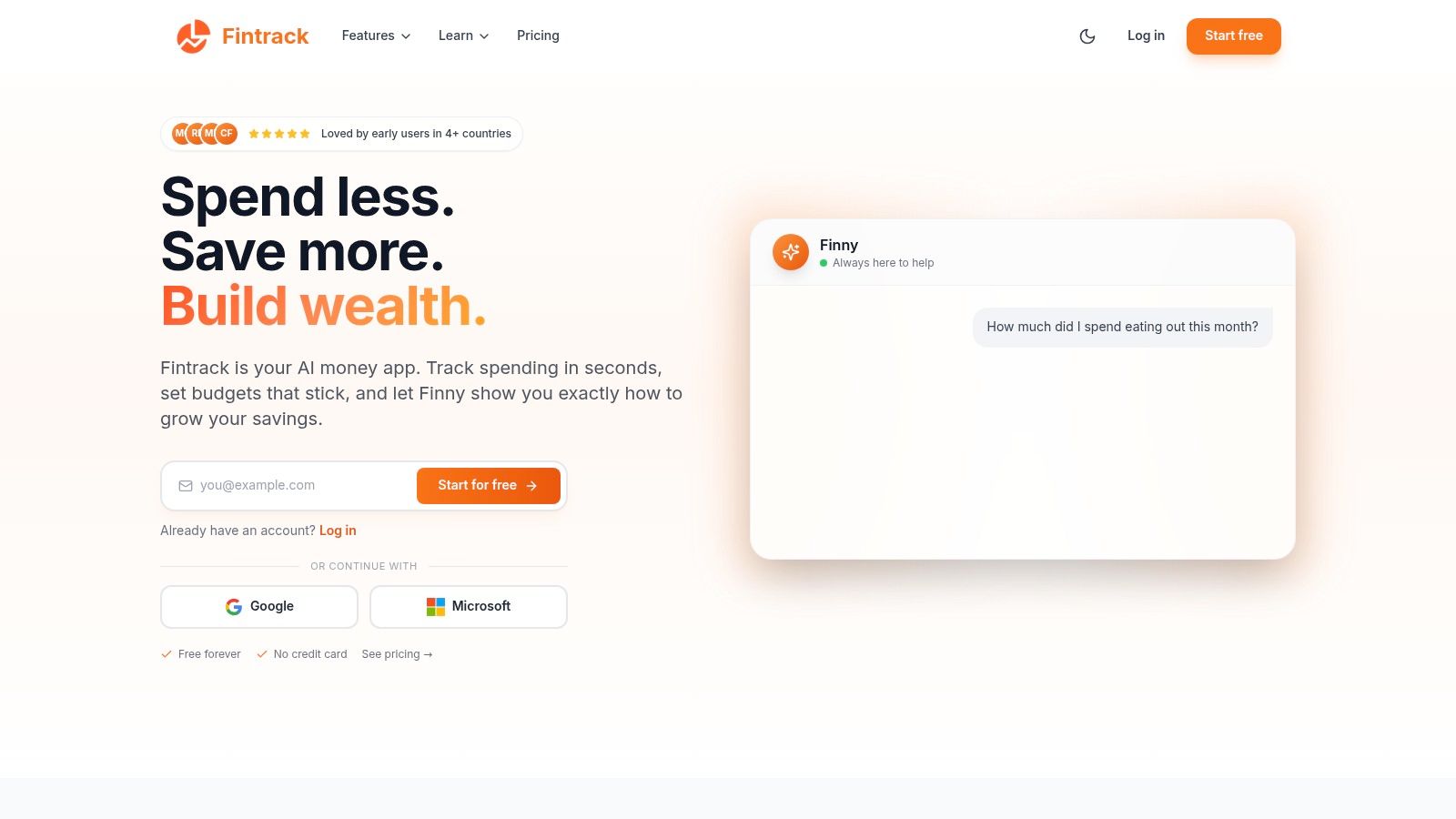
Fintrack acts as an automation layer for the same review. Its Transactions AI helps organise spending into categories, while spending breakdowns and trend views make changes easier to spot without rebuilding a spreadsheet each month.
Each feature supports a different decision
Categorisation gives every transaction a place in the household picture. You can review and correct a category when the original label doesn't reflect what you bought.
Real-time alerts help bring unusual activity and duplicate charges to your attention sooner. That turns a month-end discovery into a possible same-day follow-up.
Subscription detection focuses on recurring payments, which are easy to overlook when they appear as separate monthly or annual charges.
Finny, the conversational assistant, lets you ask practical questions such as how much you spent dining out this month or how the current category compares with a previous period. The benefit is less time spent searching and more time deciding what the result means.
For advice on using automated reviews without losing the human decision, see how automated financial insights work.
The Benefits Wallet is the most direct fit for rewards, credits, discounts, loyalty points, and unused offers. You can explore Fintrack's Benefits Wallet when the next step is finding value that already belongs to you.
Fintrack also supports manual entry without requiring a bank connection, which can matter if you prefer not to share credentials or want to track cash purchases. Automation is most useful when it remains consistent, because a single month can show an event, while repeated months reveal a trend.
Where Spend Analysis Stops Being Useful
Spend analysis isn't a magic instruction to cut whatever category looks high. It becomes less useful when the data is incomplete, the categories are inconsistent, or the recommendations ignore what a household can realistically change.
Privacy is one important boundary. Canada's proposed consumer-driven banking framework would allow consumers to authorise accredited providers to access account, balance, transaction, product, investment, and lending data through standardised APIs. The federal government says about nine million Canadians currently share financial data through screen-scraping by providing confidential banking credentials, as described in its consumer-driven banking framework.
Visibility has a data cost
A complete transaction history can reveal sensitive details about health, religion, relationships, location, and financial stress. Before connecting an account, understand what data is accessed, how permissions can be revoked, whether information is stored, and how you can correct or delete it.
Manual entry remains a reasonable choice for someone who wants analysis without connecting a bank account. Convenience and privacy sit on opposite sides of a decision, so the right choice depends on what you're comfortable sharing.
High essential costs aren't a discipline problem
Recommendations also fail when they treat unavoidable spending as careless spending. Statistics Canada reported that 39% of people aged 15 and older said their household found it difficult or very difficult to meet financial needs in spring 2025. The figure was 53% for households earning less than $41,800, compared with 24% for households earning more than $155,000, according to Statistics Canada's financial difficulty analysis.
For a financially constrained household, the most useful result may be bill timing, overdraft prevention, debt-interest reduction, or identifying irregular obligations. Cutting restaurants won't solve a rent or utility problem when there is little flexible spending left.
Bad categories produce bad conclusions
A refund counted as new spending, a grocery purchase placed in shopping, or a shared bill assigned to one person can distort the result. Use consistent definitions, record net amounts, and correct errors before acting on a pattern.
Spend analysis is a decision aid, not a verdict. It can show where to investigate, but the household still needs context.
Your First Spend Analysis This Week
Set aside a focused review and keep the outcome modest. You don't need to rebuild your entire financial life. You need one clear view of recent spending and one action that follows from it.
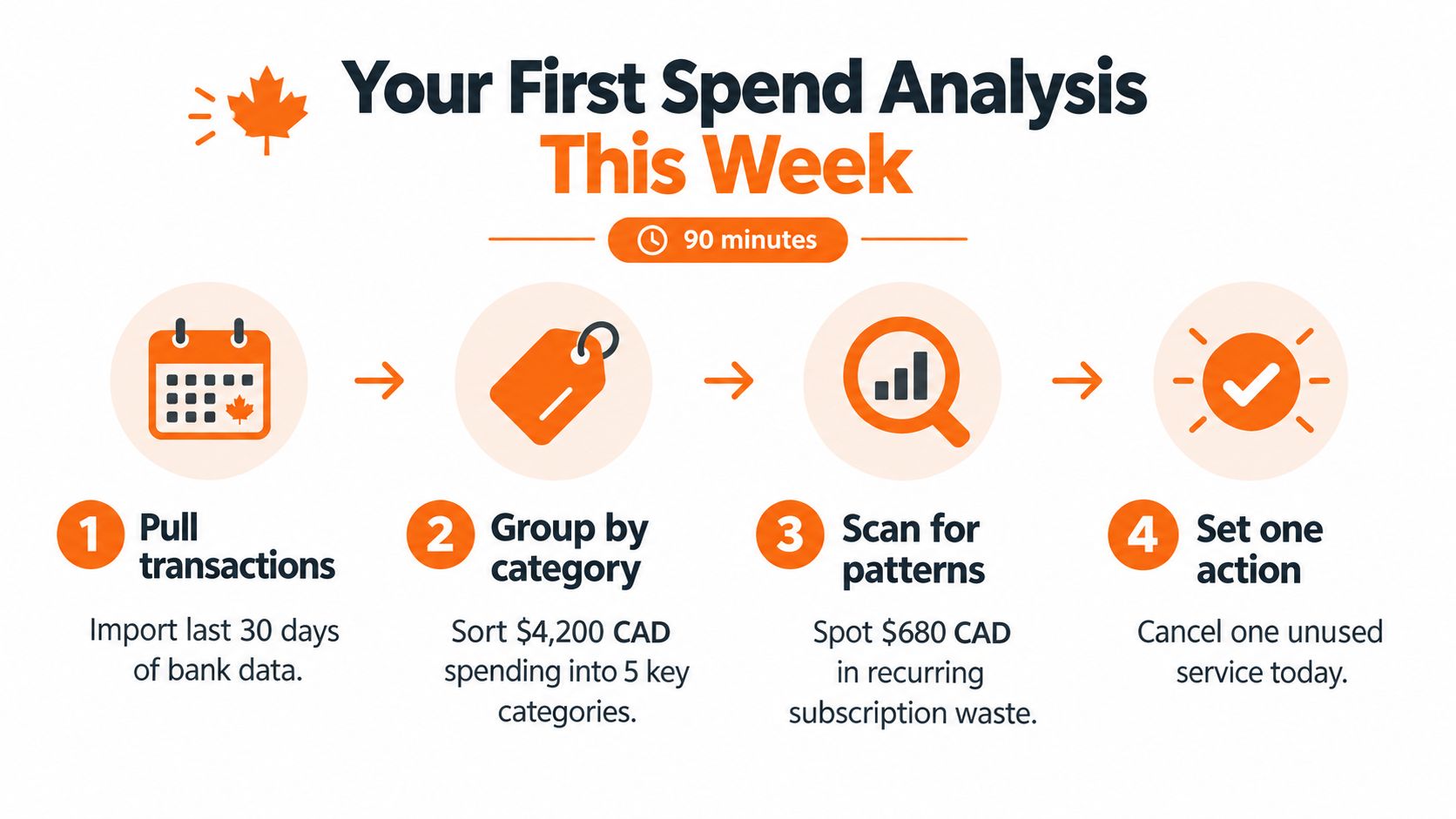
A simple 90-minute routine
First, gather the last 30 days. Put bank, card, cash, and manual records into one view. If transactions are missing, mark the gap rather than pretending the total is complete.
Next, group the spending. Use categories that help you make decisions, such as shelter, transportation, food, subscriptions, debt payments, and flexible purchases. Check that refunds and credits are reflected in the net amount.
Then, scan for patterns. Search for duplicate charges, annual renewals, unused subscriptions, rewards, travel credits, and categories that increased from the previous month. The goal isn't to flag every difference, only the ones that deserve a response.
Finally, choose one action. Cancel one unused service, request a correction for a duplicate charge, schedule a reminder for a credit, or adjust one flexible category for the next month.
Use this daily expense tracking guide if you want to make the next review easier. A small, consistent record gives you a better baseline than trying to remember the month after it ends.
Before you finish, write down:
- One correction: A duplicate, incorrect category, or missing refund.
- One recurring decision: A subscription or renewal to keep, pause, or cancel.
- One value check: A credit, reward, discount, or benefit to use.
- One trend to watch: A category that needs another look next month.
If you want help surfacing rewards, credits, discounts, and unused benefits alongside your spending review, visit Fintrack. Its Benefits Wallet and expense insights give you a practical place to organise those checks without relying on scattered statements and reminders.