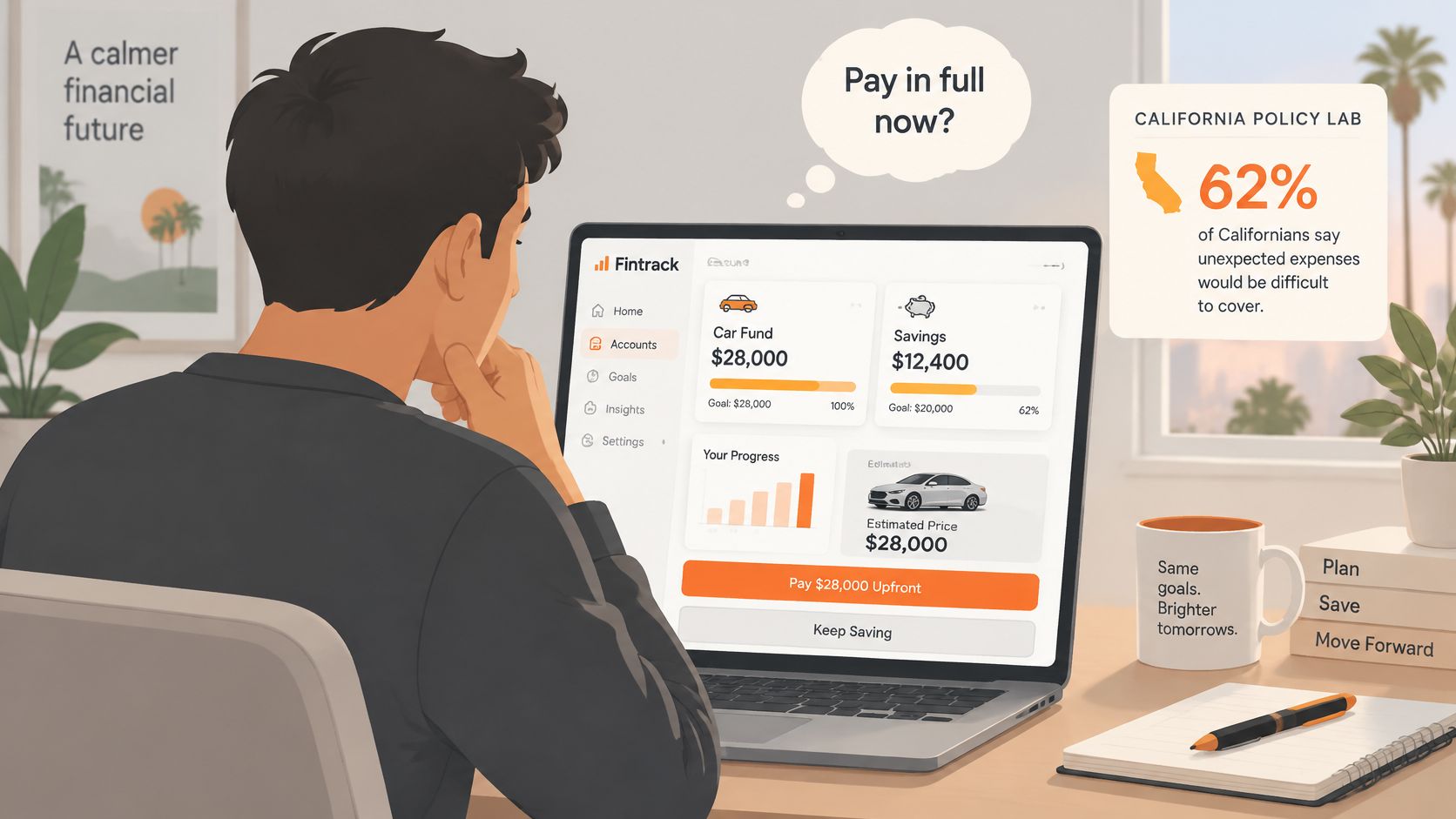
The price and the balance are sitting in the same account, and the tempting move is to pay the whole thing today. That cheque also has to cover tax, plates, insurance, and the repair you have not met yet. If the account is thin the morning after, the car was never affordable, no matter how clean the deal felt.
When you buy a car cash, you skip the lender. You do not skip the rest of the cost. The steps below set a cash ceiling, show when a short loan is safer, and stop the payment until the paperwork is right.
What Paying Cash for a Car Really Saves
Say the car fund and the emergency money share one chequing account. You can write the cheque. You would also be writing away the cushion that covers a job gap or a transmission.
Borrowing has become the usual path, and the bill attached to it has grown. The California Policy Lab reported that the average monthly payment on a newly originated auto loan climbed from $405 in Q4 2012 to $598 in Q4 2022, and the average term lengthened from 60 months to 68 months.
Cash removes the interest on that loan and the mandatory payment. You are not tied to a repayment stretch that now often runs past five years, and no lender sits on the title.
Why you buy a car cash and what you still owe
Pros
- No interest: The purchase price is the financing cost. There is nothing extra for a lender.
- No monthly obligation: A missed paycheque does not put the car at risk of repossession.
- A cleaner negotiation: You can talk about the out-the-door total instead of a payment.
- Simpler ownership: One seller, one bill of sale, no loan contract to unwind.
Cons
- Savings disappear in one transfer: Liquidity is the first thing people underestimate.
- Repairs have nowhere to land: A worn brake job or a failed sensor comes out of what is left.
- Tax, registration, and insurance stay due: Cash is a payment method, not an exemption.
Practical rule: Cash is not proof the car fits. It only proves you can move the money once.
Run what would remain through an emergency fund calculator before you treat the sticker as a budget. The next section builds the full cash figure first, so the cheque you write still leaves a reserve.
How to Calculate Your All-In Cash Budget
The advertised price is never the budget. Your ceiling is savings, minus every charge due at signing and in the first year, minus cash you refuse to spend.
| Cost item | What it covers | Reference value | What to check |
|---|---|---|---|
| Purchase price | Agreed selling price | Your negotiated number | Get it in writing on the bill of sale |
| Sales or provincial tax | Tax on the taxable price | Provincial motor-vehicle tax at registration when GST/HST does not apply | Confirm the seller type and your registration address |
| Registration and vehicle licence | Plate, registration, and vehicle licence fees | California reference: $524 a year in registration, plus a vehicle licence fee of 0.65% of value | Use your local fee calculator |
| Title and transfer | Title and ownership transfer | $28 California title fee as one published reference | Confirm local transfer costs before you pay |
| Insurance | Annual premium on this vehicle | California reference: $1,861 a year | Get quotes before you commit |
| Fuel and maintenance | Running costs over the first year | California reference: $1,801 for fuel and $1,158 for maintenance | Build both into the reserve |
| Emergency reserve | Repairs, a job gap, or another shock | First-year running costs plus a repair buffer, held apart from the purchase | Do not fold this into the car fund |
On a $40,000 vehicle, that 0.65% vehicle licence fee alone is about $260 before sales tax, the base registration fee, and local charges, as the California DMV fee calculator lays out. The yearly registration, insurance, fuel, and maintenance figures above come from MoneyGeek's state cost comparison. The California DMV use-tax handbook lists the $28 title fee beside the other charges that still apply when you pay in full.
Canada does not drop the tax either
The Canada Revenue Agency says GST/HST generally does not apply when a specified motor vehicle is bought in a private sale from someone who is not a GST/HST registrant. You may still owe a provincial motor-vehicle tax when you register, and that tax is separate from GST/HST. Registration, plates, a safety certificate, and transfer charges follow the province or territory, and they follow whether the seller is a dealer or a private owner. Get those amounts from your provincial motor vehicle office before you set a ceiling. Swap the California rows for those local figures. Do not average them.
A realistic asking price starts with comparable sales, not the sticker. A plain walk-through of used vehicle valuation with Sunmax Motors shows how Canadian asking prices sit against recent sales, so the number you write on the bill of sale is not a guess.
The cash ceiling
Savings minus all-in cost minus reserve equals your safe cash ceiling.
All-in cost is the price, tax, title, registration, and the first insurance payment. The reserve is the first year of fuel and maintenance, plus enough for one serious repair. If the result is below the car you want, the car is too expensive for cash. A smaller vehicle, or a saved gap, is the fix.
The 20/4/10 rule is a useful cross-check if you later compare a loan, because it caps payment size against income. For the cash path, the ceiling above is the harder limit. AI-recommended budgets analyze spending history to suggest realistic limits, which keeps the monthly transfer into the car fund from eating rent and groceries.
Cash Versus Financing and When Each Makes Sense
Plenty of buyers can pay in full and still should not. The test is the balance the day after, not the pride of a clear title.
| Route | Interest paid | Cash left after purchase | Best fit |
|---|---|---|---|
| Pay the full price in cash | None on a loan | Lowest, so the reserve must be set aside first | Savings cover the price plus a defined emergency reserve |
| Modest down payment and shortest affordable loan | Interest only on the financed balance | Moderate | Savings are limited but a cushion must stay in place |
| Low down payment and long loan | Highest total interest, with a real risk of negative equity | Highest on day one | Rarely the best fit when cash is available |
One test for each route
Cash works when the reserve is already funded and stays funded. You give up interest savings the moment a repair forces a credit-card balance.
A short loan works when the cushion is real but the car would consume it. You pay interest on a smaller balance, and you keep cash for insurance, fuel, and a job interruption.
A long loan fails the test for individuals who already have savings. You keep the most cash on day one and pay for that comfort with interest, faster depreciation than the balance, and a trade-in that can be worth less than what you owe.
The Financial Consumer Agency of Canada tells buyers to compare interest rates, payment schedules, financing fees, the total amount financed, and the loan term. It also says to choose the shortest term you can afford, and it flags long loans, depreciation, negative equity, and trading in a vehicle worth less than the balance.
If paying in full would drain the reserve, choose a smaller vehicle, save a larger buffer, or compare a short loan. Zero auto debt is not automatically the lowest-risk choice.
Cash is the clear winner only when three things are already true. Savings cover the all-in price. A separate reserve is in place. You are not carrying high-interest debt that costs more than a car loan would.
A lease is a third path, and it is not a cheaper version of cash. The lease or buy comparison is worth reading if a dealer pivots from price to a monthly figure. Bring the conversation back to total cost and to the cash you would still hold.
Negotiate a Lower Price Without Losing the Deal
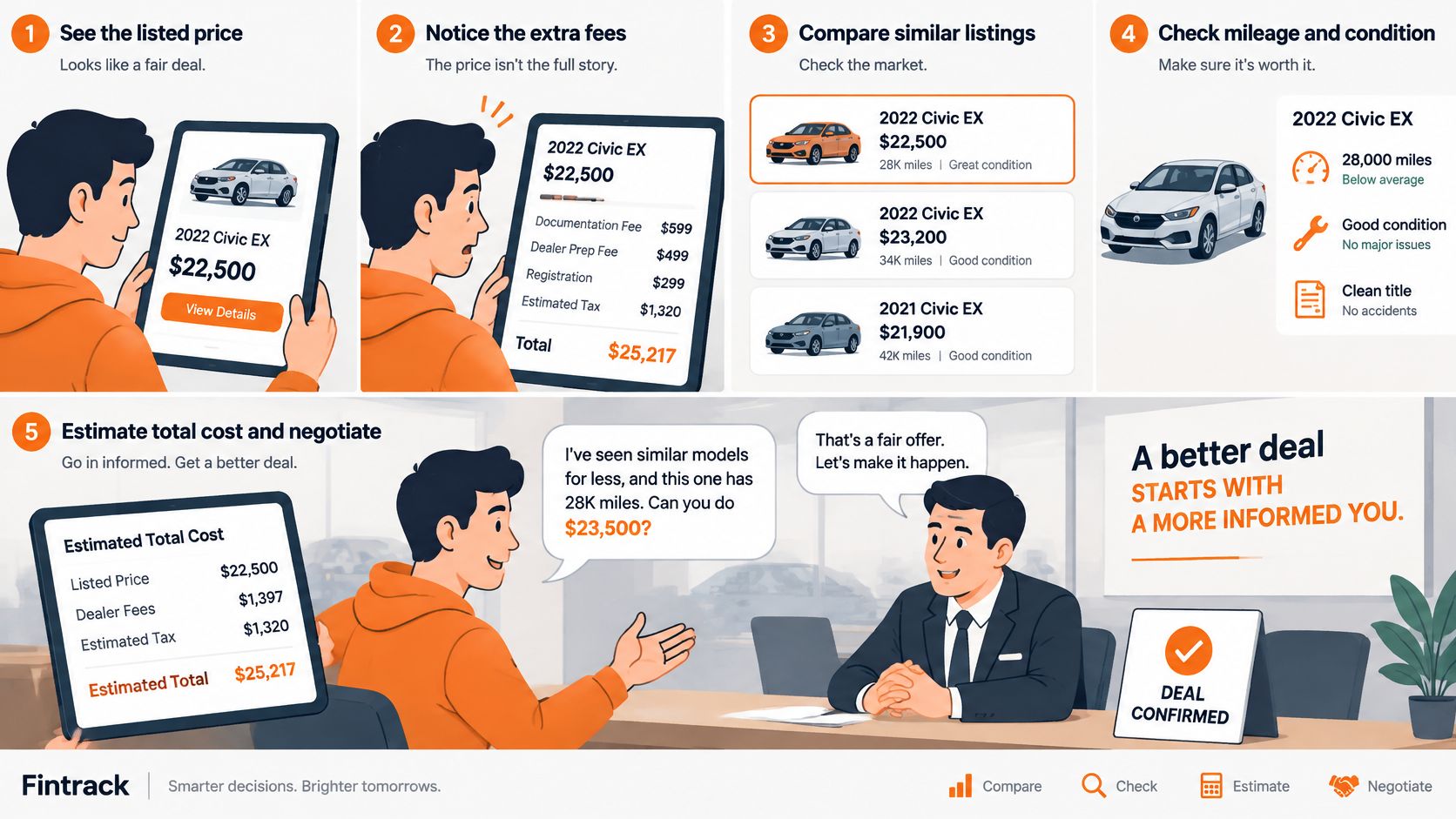
A listing can look fair until documentation fees, protection packages, and a delivery charge land on the worksheet. Negotiate the total that leaves your account, not a payment that hides it.
Work in this order
- Check comparable listings for the same year, model, trim, and mileage in your area. Write down a realistic range before you talk to anyone. One low outlier is not the market.
- Set an out-the-door target under your cash ceiling. A monthly figure is how add-ons sneak back in.
- Ask for an itemized quote before you name a number. You want the selling price, tax, title, registration, and every dealer fee on separate lines.
- Make the offer on that total. Say the out-the-door figure you will pay and stop talking. Silence is part of the offer.
A cash offer can help because the dealer is not waiting on a lender. It is not a guaranteed discount. Ask for a price. Do not ask for a favour, and do not announce your ceiling.
While you wait on the counter
- Decline unplanned add-ons. Nitrogen, etching, and fabric protection belong in the quote only if you already wanted them.
- Question every fee line. A documentation charge can be real. A vague "dealer fee" with no description is a place to push.
- Leave same-day pressure. A car that only exists until tonight is a tactic. Your ceiling does not expire at closing time.
How to counter, and when to stop
If the counter is close, trade one concession for one concession. You might accept their price if they remove a fee, or accept a fee if they move the price. Do not reopen items you already settled.
Stop when the out-the-door number crosses the cash ceiling, or when the seller will not put the itemized total in writing. Walking away is the negotiation. Side-by-side cost comparison tools keep the offers in one place so a friendly salesperson cannot turn a higher total into a story about monthly savings.
Verify the Car and Paperwork Before You Pay
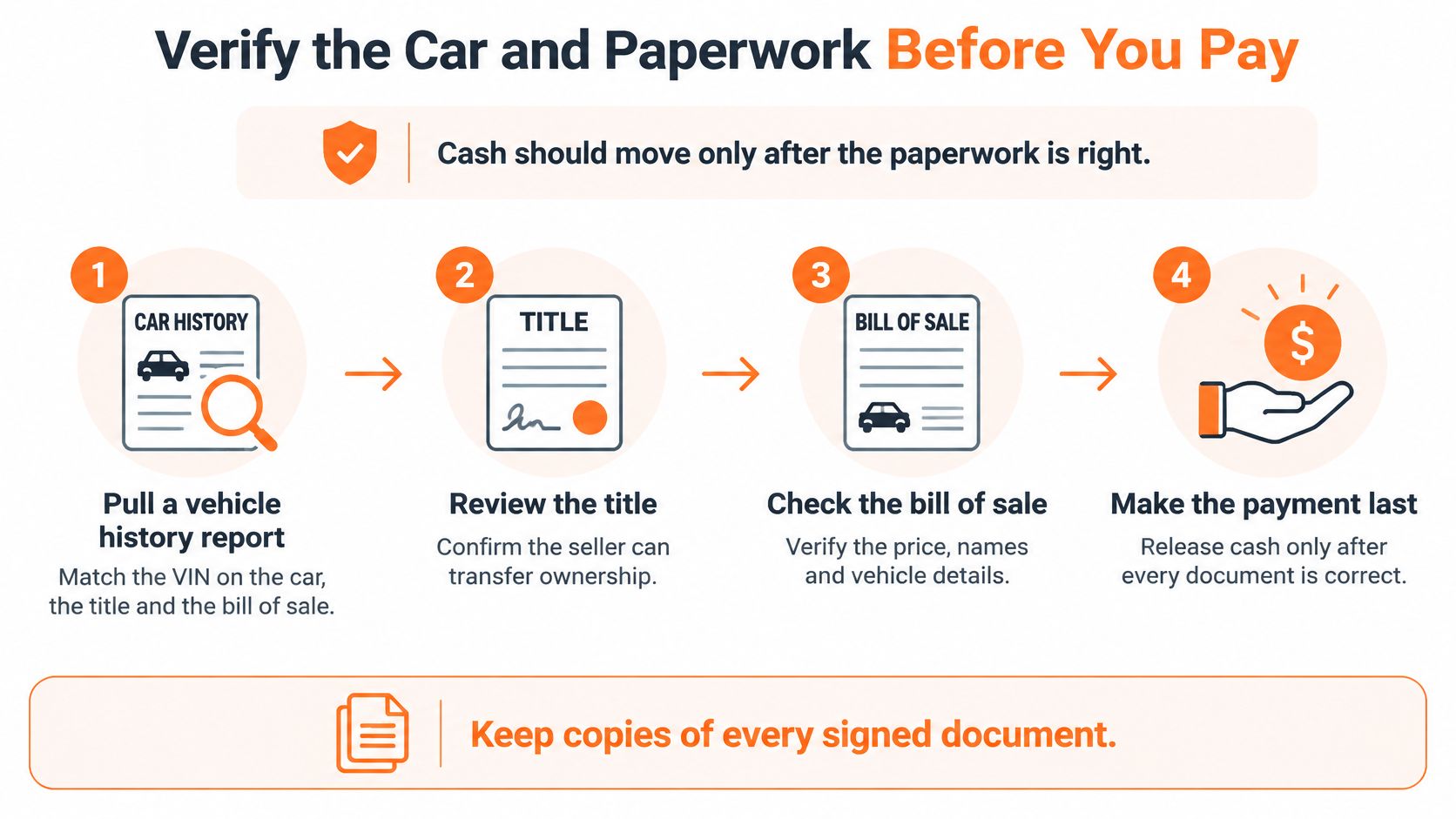
Cash should move only after the paperwork is right. A friendly seller and a tidy car are not a title.
The California DMV private-party guide is a clear model even if you live elsewhere. Match its sequence to your province or state, and do not skip a step because you are paying cash.
- Pull a vehicle history report and match the VIN on the car, the title, and the bill of sale. A single-character mismatch is a reason to stop, not a typo to fix later.
- Confirm the seller is the titled owner. Photo identification should match the name on the title. A cousin "helping with the sale" cannot sign for the owner.
- Check for liens. A clear verbal promise is not a lien release. You want the release, or a title with no lienholder, before any transfer.
- Confirm the odometer and the required disclosure. In California, odometer information is part of the private-party transfer for vehicles under 10 years old.
- Book an independent pre-purchase inspection. Use a shop the seller does not choose. You are buying condition, not a story about highway kilometres.
- Confirm smog, emissions, or a safety certificate. California private-party transfers call for smog certification where the rules require it. Many Canadian provinces want a safety standards certificate before plates go on.
- Get an itemized bill of sale with the VIN, the price, the names, and every fee. An inconsistent price can push a motor vehicle office to use a higher value.
- Pay only after you hold the signed title, the bill of sale, and the keys. A bank draft or escrow beats a bag of cash. Get a receipt either way.
Where cash deals go wrong
- The seller is not the owner. You cannot register what they cannot sign over.
- Mileage paperwork is missing. That gap becomes your problem at the counter.
- You assume dealer-style protection. A private cash sale does not include a lender's checks or a financing disclosure.
In California, the seller must report the transfer within five days, and the buyer has 10 days to transfer ownership. Miss the buyer's window and you can owe penalties on a car you already paid for.
For a Canadian private sale, confirm the bill of sale lists the VIN, the price, and any fees, and search for liens before you pay. If the seller is a dealer and the paperwork does not match the deal, contact your provincial or territorial consumer affairs office. Provincial rules govern dealer sales.
Title branding belongs in that same pause. Learning to compare clean and salvage titles shows why a low price on a branded title can cost more once insurance and resale are included. Keep copies of every signed document. You will need them at the licensing office and if the story changes later.
Set Your Cash Purchase Plan Before You Shop
Do this before you book a test drive. A ceiling you write down on Sunday is harder to bend on Saturday.
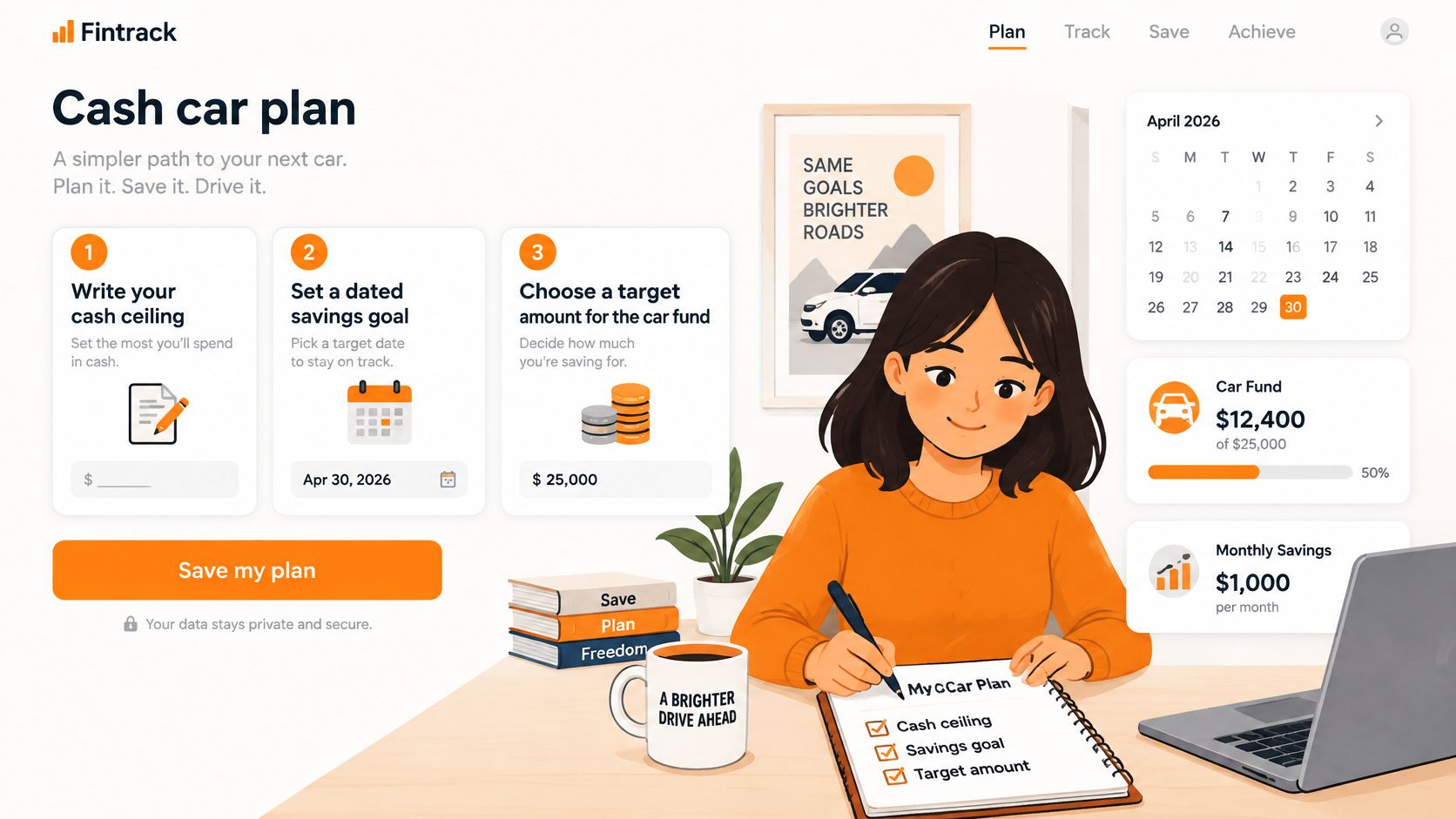
- Write the cash ceiling from your all-in budget. One number, on paper, with tax and fees already inside it.
- Set a dated savings goal with a target amount, a deadline, or both. That is how the fund gets a finish line instead of a vague "when I can."
- Link the car budget to that goal so the money stays earmarked and out of groceries and weekends.
- Save the walk-away price beside the goal. If an offer crosses it, the visit is over.
- Keep the paperwork checklist open when a car appears, so every check happens before any payment.
Fintrack can hold that plan in one place. Savings goals can be set with deadlines, target amounts, or both, and budgets can be linked to savings goals so the transfer is not just a note in your phone. AI-recommended budgets analyze spending history to suggest realistic limits, which stops the car fund from pretending your rent is optional. A practical walk-through on how to save money for a car pairs well with a savings goal that has a target and a deadline.
This week's setup, nothing else
- Ceiling written down, with the reserve excluded from it.
- Goal named, with an amount and a date.
- Budget linked so everyday spending cannot drain the fund.
- Walk-away price stored next to the goal.
- Checklist saved where you will open it at the seller's kitchen table.
The cash you keep matters as much as the price you pay.
Fintrack is a budget planner where you can track the car fund, link it to a savings goal, and see whether everyday spending is eating the reserve. Set the ceiling and the target in one place, then check the balance before you shop rather than after you have fallen for a listing. Visit Fintrack and put the cash purchase plan where you will use it.