
You get a job offer, or open a compensation statement from your employer, and there it is: restricted share units.
You know it's supposed to be a good thing. It sounds valuable. But it also feels a bit slippery. Are these actual shares? Can you sell them? Why does everyone keep talking about vesting? And in Canada, the question usually gets practical very quickly: when do I pay tax, and how much cash do I need to have ready?
That confusion is normal. Restricted share units can be a meaningful part of your pay, but they're often explained in company language instead of plain language.
If your grant is part of a new offer, it's also worth slowing down before you sign. Along with understanding the equity terms, many employees benefit from a legal review of the broader offer package, especially around termination clauses, bonuses, and equity wording. A resource like UL Lawyers employment contract review can help you see the contract more clearly.
You'll also make better decisions if you can see your whole financial picture in one place. A personal finance dashboard can be useful when you're trying to weigh salary, tax, savings goals, and equity together.
Your Guide to Understanding Restricted Share Units
A simple way to think about restricted share units is this: your employer is promising to give you shares later, if you meet the conditions first.
Usually, that condition is time. You stay employed long enough, and some of the units “vest.” Once they vest, the company delivers the shares to you. Before that point, they're more like a future benefit than something you can spend.
Restricted share units often look straightforward on paper, but the real decisions happen at vesting, when tax, timing, and cash flow all show up at once.
For Canadian employees, that matters because RSUs don't just affect your compensation package. They affect your tax return, your monthly cash flow, and sometimes your risk level if too much of your wealth ends up tied to your employer's stock.
The questions most people actually have
Most readers aren't looking for a legal definition. They want answers to practical questions like these:
- What do I own: Is an RSU a share right now, or only later?
- When do I get it: What does vesting mean in real life?
- When do I pay tax: Is tax due when the grant is awarded, when it vests, or when I sell?
- What should I do next: Should I hold the shares, sell them, or use them for another goal?
Those are the right questions.
What this means for you
If you understand four ideas, restricted share units become much easier to manage:
- Grant means the company promises shares.
- Vesting means you've earned the right to receive them.
- Tax in Canada usually shows up when the RSUs vest.
- Your decision after vesting affects risk, diversification, and future tax on price changes.
Once those pieces click, the rest gets much less intimidating.
What Exactly Are Restricted Share Units
Restricted share units are a form of equity compensation. Your employer promises to give you company shares in the future, but only after certain conditions are met.
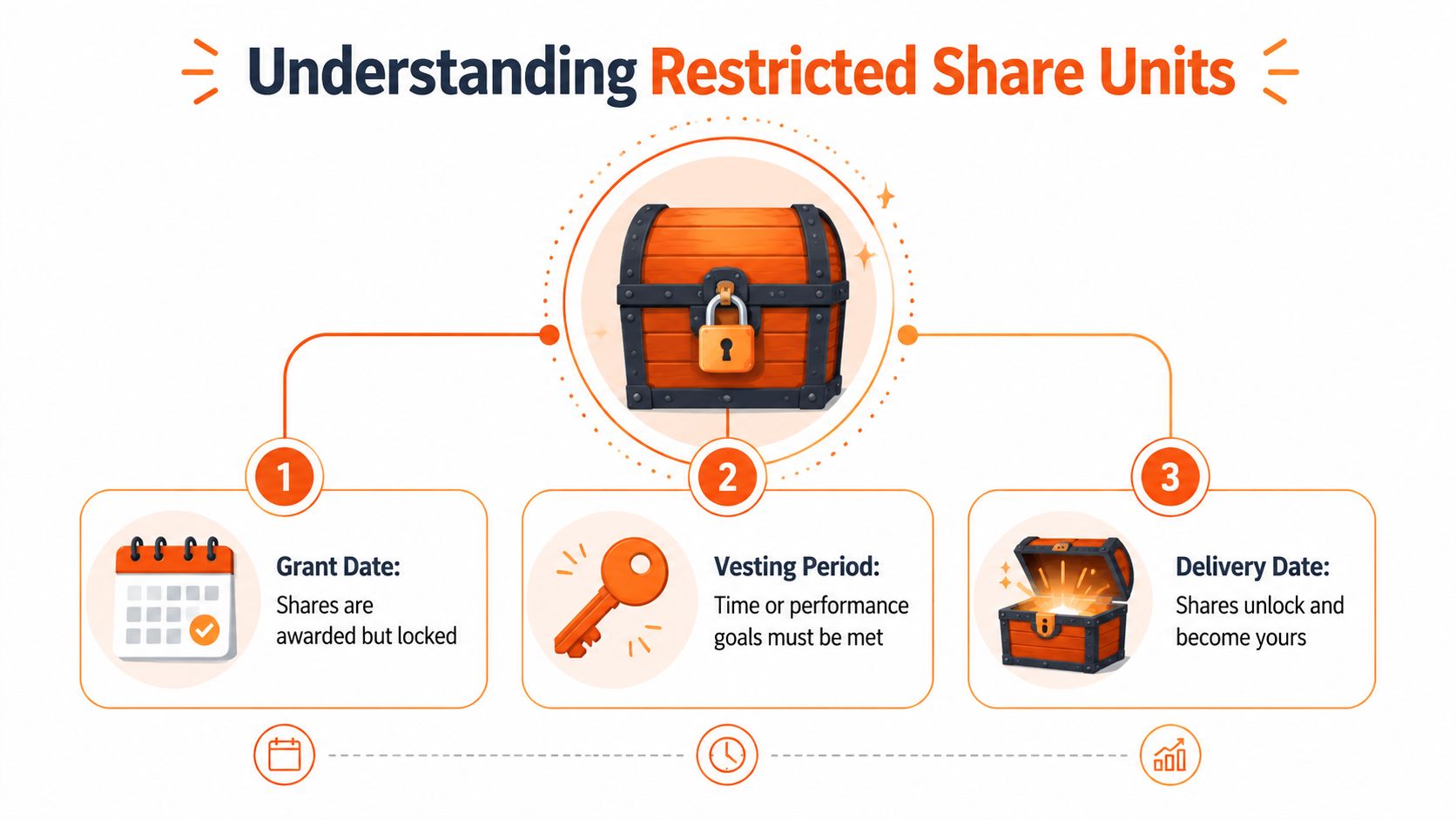
The easiest mental model is a locked treasure chest. The chest has value, but you can't open it yet. The grant date is when your employer hands you the chest. The vesting schedule tells you when you'll get the key. The delivery date is when the chest finally opens and the shares become yours.
Three terms to know
These are the words that trip people up most often.
Grant date
This is the date your employer awards the RSUs. It does not usually mean you own shares yet.Vesting schedule
This is the timetable for earning the shares. It may be based on time, and sometimes on other conditions set by the company.Vesting date
This is the day a portion of your RSUs becomes yours and is delivered as actual shares.
A common vesting pattern
One common design is a 4-year vesting schedule with a 1-year cliff, where 25% of the shares vest after the first year, and the rest vest in equal monthly or quarterly instalments over the remaining three years, according to Oakworth's RSU guide.
That first cliff is important. If you leave before it, you may receive nothing from that grant. Once you pass it, vesting often becomes more gradual and easier to plan around.
Practical rule: Don't treat your full RSU grant as money you already have. Treat only vested shares as part of your usable net worth.
Why employers use RSUs
From an employee's point of view, RSUs are simpler than some other forms of stock compensation because you don't have to buy the shares with your own money when they vest. You receive them if you stay long enough and meet the plan terms.
That's why they're common in public-company compensation packages. They give employees a reason to stay, and they give you a potential upside tied to the company's share price.
A few details still matter, though:
- Unvested RSUs aren't the same as cash
- Your vesting dates matter more than the grant date
- Leaving the company can affect unvested units
- The first vesting date is often the biggest financial moment
If you remember nothing else from this section, remember this: an RSU starts as a promise, then becomes a share only when it vests.
How RSUs Are Taxed in Canada
For Canadian employees, the big tax moment is usually vesting.
In Canada, RSUs are taxed as employment income when they vest. Employers may withhold tax, CPP, and EI, but that withholding can be inaccurate if your income fluctuates, which can lead to a surprise balance owing at tax time, as explained in Wall Street Prep's RSU overview.
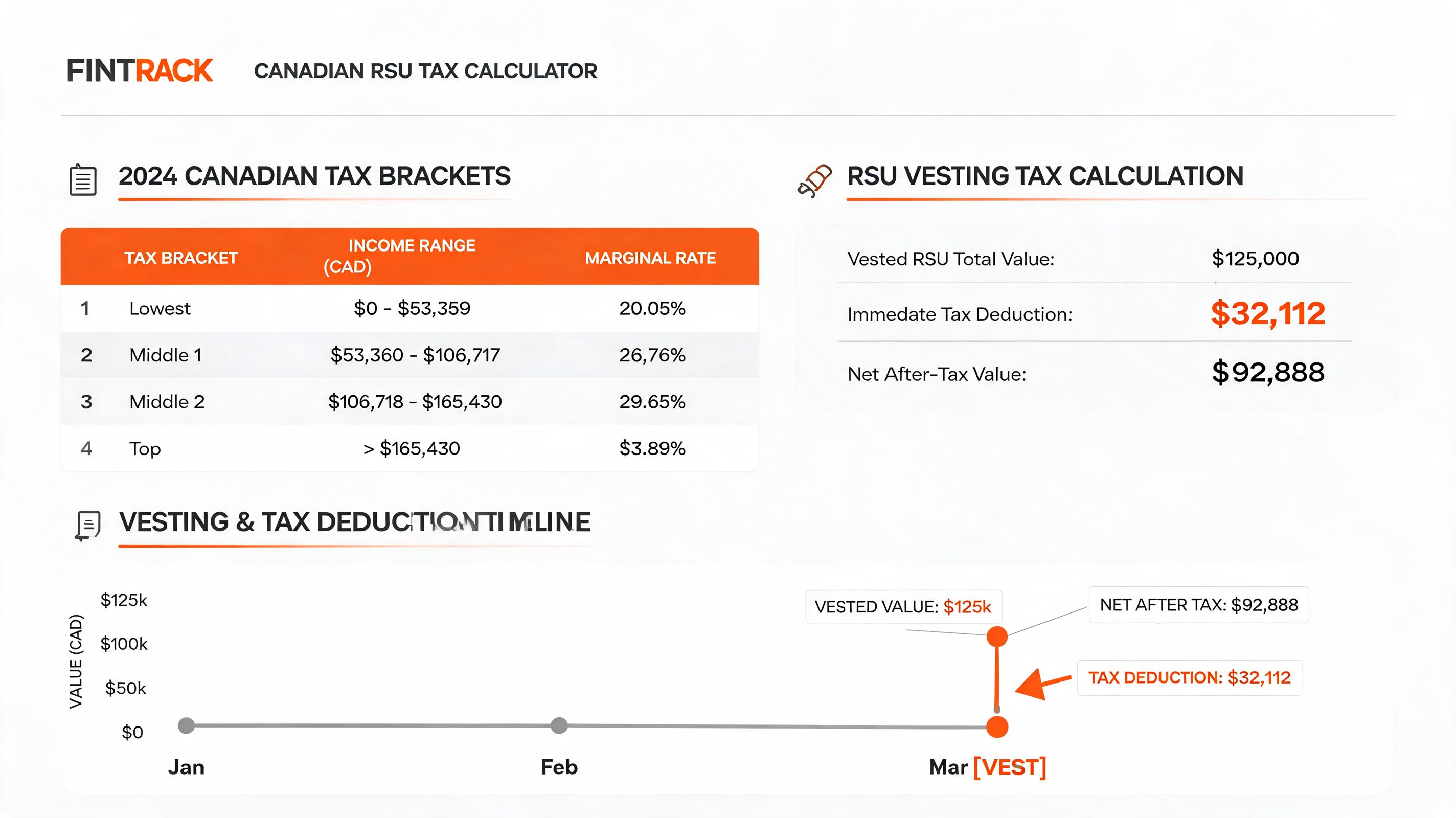
That sentence carries most of the practical story. Even if you don't sell anything, a vesting event can create taxable income for the year.
What happens on the vesting date
When your RSUs vest, your employer looks at the fair market value of the shares at that time. That value is treated like employment compensation.
In plain language, your payroll system often treats it a lot like a bonus. The employer may withhold part of the value for tax-related deductions before you receive the net shares.
A typical process looks like this:
Your shares vest
A portion of your RSU grant becomes payable to you.Your employer calculates the value
The company uses the share value on the vesting date.Payroll withholding happens
The employer may hold back value for income tax, CPP, and EI.You receive the remainder
That may be delivered as net shares, or handled through a sell-to-cover process depending on the plan.
Why the withholding can still fall short
Many employees get caught off guard at this point.
Employer withholding is helpful, but it isn't always a perfect match for your final tax bill. If you also received a bonus, had other income, or the vesting value was larger than expected, your return may show that you still owe more.
If your RSUs vest during a strong income year, don't assume payroll withholding solved the whole problem.
That's one reason it helps to keep a running estimate of taxes and large compensation events. If you've ever read about tax deferral, you already know timing matters. With RSUs, the timing issue is especially important because tax can appear before you've turned the shares into usable cash.
Questions to ask your employer or payroll team
If you want fewer surprises, ask for specifics before the next vesting date:
- What method is used for withholding: Net settlement, sell-to-cover, or another process?
- Where will I see this on my pay records: Payslip, equity portal, or year-end tax slip?
- What happens if I'm on leave or changing roles: Will the vesting treatment change?
- Are blackout periods relevant: If I want to sell after delivery, can I do that right away?
Those questions won't eliminate tax, but they can remove uncertainty.
A Practical RSU Vesting and Tax Example
A lot of RSU confusion disappears once you walk through a real example.
Let's say your company grants you a block of restricted share units under a schedule that vests over time. One vesting date arrives, and a portion of that grant becomes payable to you as shares.
At that moment, a taxable event can happen even if you haven't sold anything. A vesting event creates a taxable income spike because the fair market value of the vested shares is treated as ordinary wage income at that moment, as noted by TaxSlayer's RSU explanation.
Step by step example
Suppose this happens on your vest date:
- A portion of your RSUs vests
- The company share price on that day is the value used for payroll
- Your employer withholds some value to cover tax-related deductions
- You receive the remaining shares in your account
The important part is the flow, not a made-up number.
Here's how to think about it:
| Step | What happens | Why it matters |
|---|---|---|
| Vesting | Shares become yours | This is the employment income event |
| Valuation | Employer uses the share value on the vest date | This determines the income amount added to payroll |
| Withholding | Part of the value may be kept back | You may receive fewer net shares than vested shares |
| Delivery | Net shares land in your brokerage account | These are now yours to hold or sell |
What you'll likely notice in real life
The first surprise is often emotional, not technical. You see shares arrive, but fewer than expected.
That usually means the employer used part of the value to cover payroll withholding. So if your statement says a certain number vested, the number deposited into your account may be lower.
The second surprise is timing. You may feel like you “didn't get cash,” but the tax system still sees the vesting as compensation income.
When RSUs vest, think of it as getting paid in shares first, then having part of that pay used for withholding.
A simple checklist after each vest
After every vesting event, review these items:
- Check the vest date value: That tells you what amount likely entered your employment income.
- Review your pay records: Confirm how much was withheld and how it was handled.
- Track the shares you received: This is what you now control.
- Decide whether to hold or sell: That's an investment decision, not just a payroll detail.
If you're trying to judge whether holding the shares makes sense, it can help to think in terms of expected risk and possible reward, much like any other investment choice. A basic understanding of rate of return can make that decision more grounded.
RSUs vs Stock Options vs Restricted Stock
People often bundle all equity compensation together, but the details matter. Restricted share units, stock options, and restricted stock awards don't work the same way.
One of the biggest differences is this: employees receive RSU shares after vesting without paying an exercise price. That's a key contrast with stock options, according to Beyond Wealth's RSU guide.
Equity Compensation at a Glance
| Feature | Restricted Share Units (RSUs) | Stock Options | Restricted Stock Awards (RSAs) |
|---|---|---|---|
| Upfront cost to employee | No exercise price | Usually involves an exercise price | May involve share ownership from the start, depending on the plan |
| What you receive at grant | A promise of future shares | The right to buy shares later | Actual shares, but with restrictions |
| When ownership usually starts | At vesting and delivery | After exercise and any required steps | Earlier than RSUs |
| Main employee concern | Tax and concentration risk after vesting | Whether the stock price makes exercise worthwhile | Ownership restrictions and tax timing |
| Typical mental model | Delayed stock delivery | Opportunity to buy later | Restricted ownership now |
Why RSUs often feel simpler
With stock options, you usually need to understand an exercise price. You have to ask whether buying the shares is worth it.
With RSUs, that problem usually doesn't exist. If they vest, shares are delivered to you. That's why many employees find RSUs easier to understand once the vesting concept clicks.
Here's the practical difference:
- RSUs can still have value at vesting as long as the share price is above zero.
- Stock options can become much less attractive if the market price doesn't beat the exercise price.
- RSAs involve a different ownership structure, which can change how people think about tax and control.
How to confirm what you actually have
If your plan documents use several terms, slow down and verify the award type.
Look for wording such as:
Exercise price
If you see that, you may be looking at options rather than RSUs.Shares issued at grant
That may point toward restricted stock, not restricted share units.Shares delivered on vesting
That language often signals RSUs.
If your compensation package includes multiple employer benefits, it can also help to separate them mentally. For example, an equity grant and RRSP matching are both valuable, but they behave very differently for planning purposes.
The label on your equity award matters. A good financial decision on RSUs can be a bad one for options, and vice versa.
Creating Your Financial Plan for Vested RSUs
Once your RSUs vest, the next question is usually the hardest one: should you keep the shares or sell them?
There isn't one correct answer for everyone. What matters is how the decision fits into the rest of your financial life.
The tax treatment comes in two parts. The value of vested RSUs is taxed as ordinary income at vesting, and any later change in the stock's value before you sell is treated separately as a capital gain or loss, according to Carta's RSU guide.

The sell or hold decision
A helpful way to frame this is to ask a different question:
If your employer had paid you the same value in cash today, would you use that cash to buy your employer's stock?
If the answer is no, that tells you something.
Holding shares after vesting can make sense if it fits your investment plan and risk tolerance. Selling right away can also make sense if you want to diversify, reduce concentration risk, or free up cash for other goals.
Common uses for vested RSUs
People often use vested shares or sale proceeds for one of a few practical purposes:
Diversifying investments
If too much of your net worth is tied to the company that also pays your salary, your risk may be more concentrated than you realise.Paying down expensive debt
Using vested shares to clear high-interest balances can improve cash flow quickly.Building savings goals
Some employees direct RSU proceeds toward an emergency fund, a home goal, or long-term investing.Funding tax reserves
If prior withholding came up short, setting aside some proceeds for taxes can reduce stress later.
A concentrated stock position can affect both your income and your investments at the same time. That's why RSU planning is more than a tax question.
A simple framework for your decision
Try this three-part check before every vesting event or sale decision.
Check your concentration
Ask how much of your financial life already depends on your employer. Your salary, bonus, benefits, and unvested RSUs may already create a heavy link to one company.
Check your timeline
If you need money soon for a house move, tuition, debt repayment, or a major life change, liquidity may matter more than upside.
Check your tax records
Once shares have vested, later price movement affects capital gains or losses when you sell. Good records matter. If you want a deeper look at cost basis and related strategies to reduce capital gains tax, that resource can help you think through the record-keeping side of the decision.
What a sensible plan often looks like
For many employees, a balanced plan is easier to stick with than an all-or-nothing approach.
That might mean:
- selling some vested shares and keeping some
- using part of the proceeds for a specific goal
- setting a personal rule for future vest dates
- reviewing RSUs alongside the rest of your accounts, debts, and savings targets
If you need a broader reset, a guide to planning personal finance can help you connect RSU decisions to the rest of your money life instead of treating them as a separate puzzle.
The best RSU plan is usually boring in a good way. It's clear, repeatable, and matched to your actual goals.
If you want to put this into action, Fintrack can help you organise the moving parts in one place. You can review cash flow, track savings goals, and see how a vesting event fits into your broader plan so your restricted share units become part of a clear financial strategy, not a yearly surprise.