
A household can earn a solid income and still reach the end of the month wondering where the money went. The rent or mortgage is paid, the credit card balance is higher than expected, and an annual renewal or irregular bill arrives just as the chequing account is running low. That situation is frustrating, but it isn't always an income problem.
Cash flow is the timing and visibility of money coming in and going out. Improving it means reducing avoidable outflows, capturing value you've already earned, and making sure income arrives before obligations become urgent. The process below focuses on the leaks that generic “spend less” advice often misses, including unused credits, expiring rewards, duplicate subscriptions, and assets that aren't producing usable monthly liquidity.
Why Your Cash Flow Feels Tight Even When Income Is Fine
A couple paid twice a month can cover every regular obligation and still reach the final week with almost no usable cash. The first paycheque goes to housing, insurance, debt payments, and groceries. Before the second arrives, smaller purchases accumulate, then an annual software renewal or vehicle expense drains the remaining balance. The problem is often timing, not reckless spending.
Monthly totals can hide that pressure. A budget may appear reasonable while several withdrawals cluster in one week. Meanwhile, unused rewards, forgotten account credits, and savings held somewhere inconvenient remain unavailable when a bill is due. Cash flow improves when you manage both the amount and the timing of money.
Practical rule: Ask, “What leaves the account first, what arrives later, and what value are we failing to use?” Then decide which outflow to remove, delay, or fund in advance.
Canadian households are carrying substantial financial pressure. Statistics Canada reported that the seasonally adjusted stock of household credit market debt reached $3,253.4 billion in the first quarter of 2026 (Statistics Canada household credit market debt release). The same release referenced emergency-savings data showing that 27% of Canadians had one month or less in emergency savings, with an average fund of $2,051 for that group, while 52% had less than $10,000 saved. Those figures describe limited liquidity, not just low income.
The United States faces comparable household timing problems. A salary can look adequate on paper while fixed commitments, debt payments, irregular bills, and delayed reimbursements consume cash on different schedules. Duplicate subscriptions, expiring rewards, and unused credits can create small leaks that become noticeable when the account is already tight. If you feel as though you're living paycheck to paycheck, start by making those timing gaps visible rather than imposing immediate deprivation.
Use three controls:
- Reduce outflows: Cancel duplicate subscriptions, lower fixed costs, and stop paying for benefits you do not use.
- Accelerate inflows: Invoice promptly, claim eligible credits, redeem rewards before they expire, and improve the timing of irregular income.
- Protect liquidity: Keep accessible cash available before increasing discretionary spending or adding new commitments. Asset-rich households may still need this step when property, investments, or other assets cannot be converted quickly enough to cover a near-term bill.
Map Your 30-Day Cash Flow to Find the Hidden Leaks
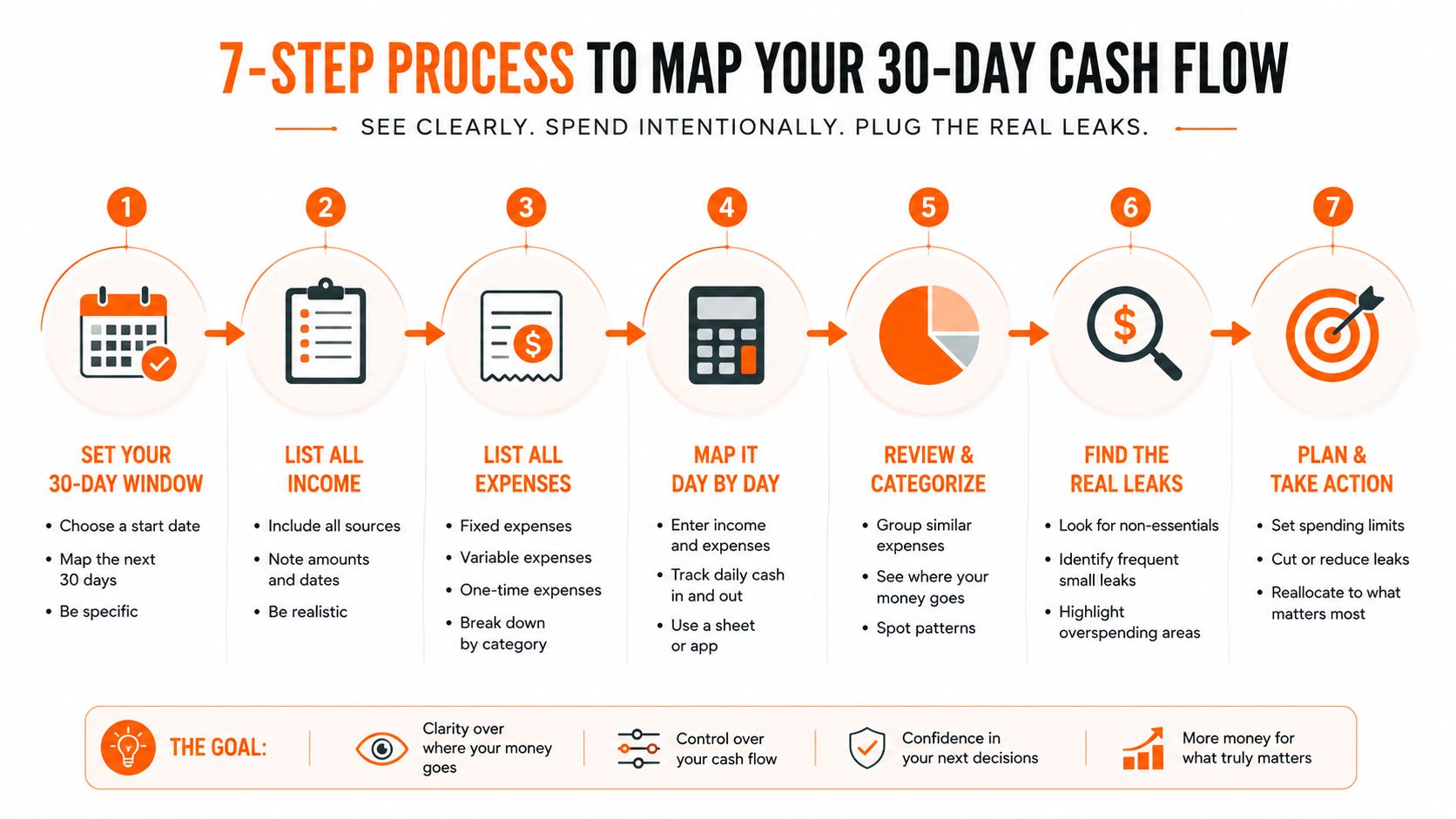
A rolling 30-day cash-flow map exposes problems a monthly budget can hide. Put every expected inflow and outflow on a calendar, then check the balance after each event. This shows whether cash is disappearing through spending, arriving too late, or sitting in value you have not recovered.
Build the map in seven passes
List confirmed income dates. Include pay, benefits, freelance invoices you realistically expect to collect, and other regular inflows. Keep uncertain income separate so an optimistic assumption does not fund a bill you cannot yet cover.
Add fixed obligations. Record rent or mortgage payments, insurance, minimum debt payments, utilities, and other commitments. Mark the actual withdrawal date, not only the month assigned to the bill.
Estimate variable essentials. Use recent transactions for groceries, fuel, medication, and household supplies. A realistic estimate is more useful than a target that does not match your routine.
Add discretionary spending. Dining, entertainment, clothing, hobbies, and convenience purchases belong on the map. Their purpose is to show when they compete with fixed obligations, not to label every purchase as a problem.
Enter annual and irregular costs. Add renewals, registration, gifts, repairs, school expenses, and travel. Divide each cost into regular contributions so it does not arrive as an apparent surprise.
Mark the lowest projected balance. The month-end balance can look healthy while a bill creates a shortfall earlier. Identify the tightest date, then decide whether poor timing, overspending, or both cause the gap.
Name the fastest-growing categories. Compare current transactions with earlier periods and investigate categories that are expanding quickly. Statistics Canada reported that in Q3 2025, household consumption expenditures rose 3.7% while disposable income grew 2.7%, and the bottom 20% of the income distribution saw net saving worsen by 7.9% year over year (Statistics Canada household income and saving release).
Separate leakage from unavoidable spending
Use three labels: fixed, flexible, and recoverable. Fixed costs may not change immediately, but they can be reviewed later. Flexible costs can be adjusted this month. Recoverable value includes refunds, unused credits, loyalty balances, cashback, expiring rewards, and duplicate charges that do not require more income.
Look for repeated patterns. A single restaurant bill may not matter, while delivery fees, overlapping subscriptions, or a renewal before payday can empty an account. Also check for asset-rich but cash-poor timing problems, such as investments or property that cannot be converted quickly enough for a near-term bill.
A spreadsheet works, as does income and expense tracking with a tool that supports manual transaction entry. Manual tracking suits Canadians who prefer not to connect a bank account, provided updates are consistent. Review the map during the month, especially before the lowest projected balance date.
Cut Recurring Costs That Drain Cash Every Month
A household can earn enough on paper and still run short before payday because recurring charges renew in the background. Telecom plans, insurance, subscriptions, memberships, and bundled services deserve review before small discretionary purchases. One decision can improve every future month.
The CRTC reported that Canadian households spent an average of $233.00 per month on communications services in 2017, up $10.17, or 4.6%, from 2016. The average monthly amounts were $101.00 for mobile service, $54.17 for internet, $52.58 for television distribution, and $25.25 for landline service (CRTC communications services data).
These are historical averages, not targets for current household spending. They identify a useful audit category. Check the plan, data allowance, equipment fees, add-ons, and bundled features. Ask the provider for the price after removing services you do not use, then compare that offer with a competitor before accepting a new term.
Audit the charges that renew without your attention
Export recent transactions or review statements line by line. Search for repeated merchant names, then check both the amount and billing frequency. A charge billed quarterly or annually can disappear from view even though it affects the month when it renews.
- Duplicate services: Compare household members' accounts for overlapping streaming, cloud storage, fitness, and software plans.
- Unused memberships: Cancel services that have not been used recently, unless you can claim a benefit that justifies keeping them.
- Bundled extras: Remove channels, device protection, premium support, or data features that no longer fit your needs.
- Annual renewals: Record each renewal date and decide before the charge arrives. Treating it as unavoidable gives up control of the timing.
- Negotiable contracts: Request a lower rate, a retention offer, or a plan change. Keep the cancellation process available so the request has a credible outcome.
| Category | Average Monthly Cost | Potential Monthly Savings |
|---|---|---|
| Mobile service | $101.00 | Review for unused data, add-ons, and duplicate lines |
| Internet | $54.17 | Compare speed, equipment fees, and current offers |
| Television distribution | $52.58 | Remove unused channels or replace the bundle |
| Landline service | $25.25 | Check whether the service is still necessary |
| Telecom and digital subscriptions | Varies by household | Identify duplicate, unused, or expiring services |
Use your own statements to estimate the opportunity. A household that recovers $20 to $50 per month from telecom, streaming, or bundled services frees $240 to $600 per year for debt repayment, savings, or essential bills.
Review subscriptions before their next renewal with this guide to manage subscriptions. The objective is selective removal: keep services that deliver clear value, but stop paying for duplicate coverage, unused access, and features that no longer match the household's needs. Also record credits, refunds, or expiring rewards separately so recurring-cost savings are not confused with recoverable value.
Recover Hidden Value and Accelerate Your Income
Cutting discretionary spending is familiar advice, but it isn't always the fastest first move. A forgotten credit, an unclaimed employer benefit, an expiring loyalty balance, or a delayed refund may restore cash without changing the household's daily routine.
Start with a value-recovery audit. Search email, account portals, credit-card statements, loyalty programmes, retailer accounts, and employer benefits for balances or offers with an expiry date. Confirm the conditions before counting any amount as available cash. A reward that requires an unnecessary purchase isn't a cash-flow improvement.
Put inflows on a faster schedule
Freelancers and small-business owners should invoice as soon as the work or milestone allows, set a clear follow-up cadence, and separate expected revenue from collected cash. A 2024 Canadian SME survey reported that 60% of businesses had ongoing cash-flow management challenges, with delayed invoicing or payments affecting 30% and accounts receivable or payable management affecting 26%. The survey also found 66% considered improving cash-flow management efficiency important, while 18% reported difficulty tracking expenses, revenue, and accurate forecasts (Canadian SME cash-flow survey).
That business lesson applies to household income with variable timing. Send invoices promptly, request deposits where appropriate, schedule side-work payments around known obligations, and keep a separate holding category for tax or business costs. More income isn't automatically better cash flow if the extra work creates new expenses before payment arrives.
Households may also need to convert an asset into liquidity, but that choice carries real trade-offs. If you're considering a short-term option such as pawning a ring for cash 2026, understand the valuation, fees, repayment terms, and consequences of non-payment before committing. Selling or borrowing against an asset can solve a timing issue, but it shouldn't hide an unresolved monthly deficit.
Canada's household balance sheet makes this distinction especially important. Statistics Canada reported that household net worth rose to $18.5949 trillion in Q4 2025, up $1 trillion over 2025, while financial assets grew 10.5% year over year (Statistics Canada national balance sheet release). Some households are therefore asset-rich but cash-poor. The sensible question is not whether to sell or borrow, but which assets can provide liquidity with the least risk, cost, and disruption to long-term plans.
Automate Bill Prioritization and Build Your Safety Net
A cash-flow system should direct money before it disappears. On each payday, assign available cash in this order:
- Essentials: Housing, utilities, food, medication, insurance, and transportation required for work or care.
- Debt commitments: Make minimum payments first. Add extra repayment only when the projected balance supports it.
- Discretionary spending: Dining, entertainment, shopping, and optional services can wait when the account is under pressure.
Schedule bills after confirmed income dates and keep a small operating buffer in the account that covers essentials. An automatic transfer that leaves too little for the next bill sends the shortfall to a credit card. Set the system to smooth timing, not to force a new balance.
Make emergency saving a scheduled bill
The Financial Consumer Agency of Canada recommends choosing a savings amount, date, and frequency, then arranging an automatic transfer from a regular account to savings (FCAC emergency-fund guidance). Choose an amount that remains affordable after essential bills and minimum debt payments. For a step-by-step approach, see our guide on how to build an emergency fund. Raise the transfer only after your 30-day map shows that it will not create another recurring squeeze.
A weekly review should focus on the leaks that ordinary budgets miss: unused account credits, rewards approaching expiration, duplicate subscriptions, pending renewals, unfamiliar charges, and the lowest projected balance. Recovering a credit or cancelling an unused service can protect cash without cutting a necessary expense. Business owners and resellers can apply the same discipline to inventory purchases, supplier payments, customer receivables, and payout timing through cash flow management for resellers.
Credit can cover a confirmed timing gap, but it cannot repair a persistent monthly deficit. If you cancel a credit card because of a recurring fee, stopping use or cutting up the card does not close the account. Contact the issuer by phone or in writing, and remember that interest still applies to an outstanding balance after closure (FCAC credit-card rights and responsibilities).
For online purchases in Québec, act within the required sequence. Notify the merchant first, wait 15 days for reimbursement, then request a chargeback from the credit-card issuer within 60 days if no refund arrives. The issuer must acknowledge receipt within 30 days and issue the refund within 90 days or two complete statement periods, whichever comes first (Éducaloi guidance on cancelling online purchases).
Your Monthly Cash Flow Routine for Long-Term Stability
Cash-flow improvement holds when it becomes a monthly operating routine. At the start of each month, confirm pay dates, fixed bills, annual renewals, and the lowest projected balance. Review unused credits, rewards nearing expiration, duplicate subscriptions, and unfamiliar charges before they reduce available cash.
During the first weekly check, compare cleared transactions with the plan. Mid-month, compare actual spending with the 30-day map. If groceries, transport, or discretionary purchases are running ahead, adjust the remaining weeks immediately. Waiting for the statement removes useful choices.
At month-end, record what changed, direct recovered value toward the most urgent goal, and roll the next 30-day window forward. Keep one practical measure, such as a minimum operating balance, less recurring waste, or a larger automatic emergency transfer when cash supports it. Household saving remains sensitive to spending changes, so frequent checks matter even when income is stable, as reported in the Statistics Canada household income and saving release.
A monthly budget template supplies structure, while the habit produces results. An unexpected expense calls for a revised map, paused lower-priority spending, and a deliberate buffer rebuild.
Fintrack lets you record income and expenses, organise spending, monitor budgets, and flag unused credits, rewards, and recurring charges without a bank connection. Visit Fintrack to keep the routine in one place and turn scattered transactions into a clearer monthly plan.