
You get a job offer, scan the benefits page, and see the words pension plan. It sounds solid. Maybe even impressive. But chances are, your next thought is less “great” and more “what does that mean for me?”
That confusion is normal. A pension can be one of the most valuable parts of a compensation package, but it works very differently from the retirement accounts people hear about more often, like a 401(k). The details matter, especially if you're comparing jobs, planning a career change, or trying to understand how stable your retirement income might be later on.
Your First Look at Pension Plans
You are comparing two job offers over coffee with a friend. One pays more today. The other includes a pension. The higher salary is easy to spot on a pay stub. The pension takes more work because its value shows up later, after you stop working.
That delay is exactly why pensions can be misunderstood.
A pension is still part of your compensation. It works like deferred pay, set aside to support your future income. If you might switch employers in a few years, or if you already save in a 401(k), the practical question is not just “what is a pension plan?” It is “how much does this benefit add to my long-term plan, and what happens if I leave?”

Why the word pension still matters
Pensions still shape real financial decisions for teachers, firefighters, government workers, military families, and some private-sector employees. Even if you never receive one yourself, you may compare a pension job with a higher-cash job, coordinate pension income with a 401(k), or help a parent decide when to retire.
That is why the word matters. A pension is not just a benefits-page buzzword. It can change how much you need to save on your own, how safe your retirement income may feel, and whether one job offer is stronger than another.
A good starting point is to treat a pension the way you would treat any other part of pay. Ask what you earn, when you get it, and what conditions apply. Some plans reward long service more heavily than short service. Some become much more valuable after you are vested. Some offer income for life, but the amount depends on your years with that employer.
If you're early in your research and want broader pension advice, it can help to compare a plain-language overview with your own plan documents. General education is useful. Your actual pension rules still come from your employer's plan.
A useful way to translate pension language is this: what future income could this job create for me, and what has to happen for me to keep it?
For a wider look at how retirement choices fit into everyday money decisions, this guide to planning your personal finance can help you connect benefits, savings, debt, and monthly cash flow.
What Is a Pension Plan, Really?
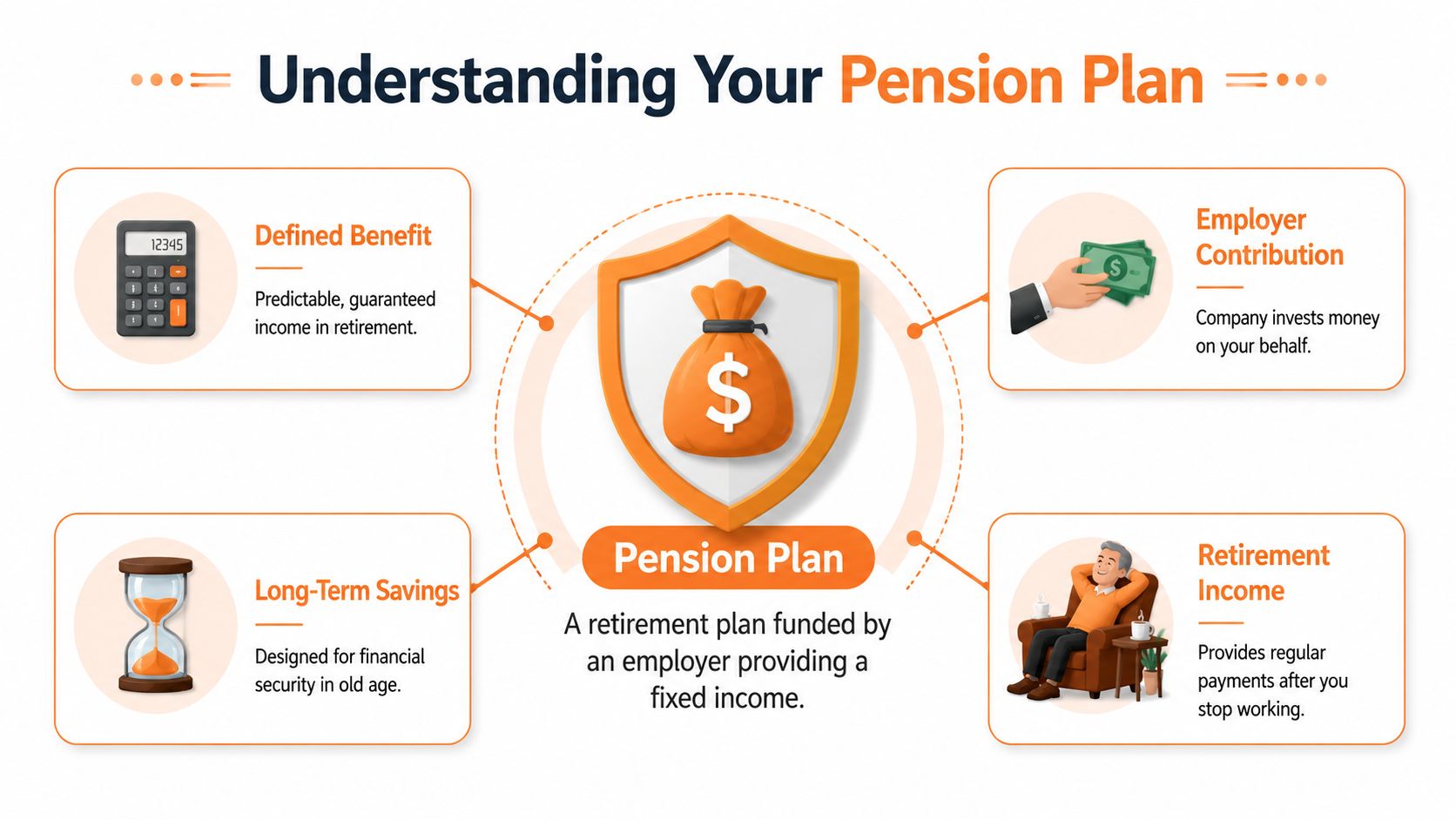
The simplest answer to what is a pension plan is this: it's a retirement arrangement where an employer promises a future benefit.
A pension functions as a pre-arranged retirement paycheque. Instead of building a bucket of money that you manage yourself, a traditional pension is designed to pay you income later based on a formula.
The core idea behind a pension
The classic pension is usually a defined benefit plan. “Defined benefit” means the benefit is set by plan rules, not by whatever your account happens to earn in the market.
The US Department of Labor explains that defined benefit plans often use a formula based on things like salary and years of service, such as 1% of average salary for the last 5 years of employment per year of service in its explanation of types of retirement plans. That means your future retirement income is linked to your work history, not just to investment returns.
Who carries the risk
Many people often get mixed up here.
With a pension, the employer typically carries the investment risk and the longevity risk. Investment risk means the plan sponsor has to manage assets well enough to support future payments. Longevity risk means the plan still owes benefits even if retirees live a very long time.
That's different from a retirement account where your own balance rises and falls with market performance.
Practical rule: If the plan promises a formula-based benefit later, you're usually looking at a pension. If it promises only contributions now, you're usually looking at a different kind of retirement plan.
For readers who work in government roles or want to maximize your federal pension, it helps to learn the same core logic from a benefits-specific angle. The labels may vary by employer, but the basic structure is similar.
If you've heard that pensions can involve tax advantages, this explainer on tax deferral helps clarify why retirement money is often treated differently from regular income while it stays inside a plan.
The Two Main Types of Retirement Plans
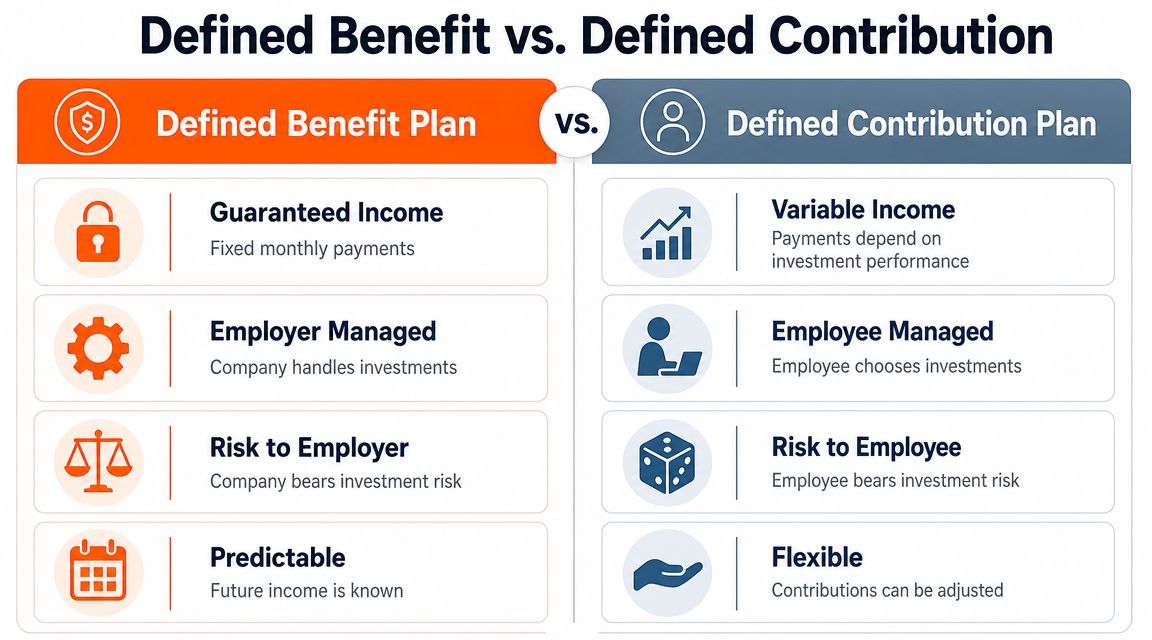
Most workplace retirement plans fall into two broad buckets. One is the defined benefit plan, which is the traditional pension. The other is the defined contribution plan, which includes accounts like a 401(k).
The easiest way to separate them is to ask one question: who bears the risk if investments underperform?
Side-by-side comparison
| Feature | Defined benefit plan | Defined contribution plan |
|---|---|---|
| Main promise | Future retirement income | Contributions into an account |
| Typical example | Traditional pension | 401(k) |
| Who manages investments | Employer or plan sponsor | Employee usually chooses among plan options |
| Who bears investment risk | Employer | Employee |
| Retirement income | Often a lifetime payment stream | Depends on account balance and withdrawals |
| Portability | Often more limited | Often easier to move when changing jobs |
The biggest emotional difference is predictability.
Pension benefits are usually paid as a guaranteed stream of income for life, while a 401(k) payout depends on contributions plus investment gains or losses. That difference matters because a pension can reduce retirement cash-flow volatility, while a 401(k) leaves you managing market risk and withdrawal choices yourself, as explained in this overview of the difference between a pension and a retirement plan.
Why people often confuse them
Both plans are meant for retirement. Both may come through an employer. Both may show up in your benefits package.
But they answer different questions:
Pension answer
“How much income is the employer promising me later?”401(k) answer
“How much money has gone into my account, and how has it performed?”Planning answer
One gives you more built-in income structure. The other gives you more direct control, but also more responsibility.
A useful comparison is healthcare benefits. A pension is closer to getting a promised service later. A 401(k) is closer to getting a funded account and choosing how to use it. If you've ever compared benefit structures in other areas, this piece on what an HSA account is shows a similar pattern of “same broad category, very different mechanics.”
If you know whether your plan promises a benefit or just a contribution, you've already cleared up most pension confusion.
How Your Pension Payout Is Calculated
Once the basic definition clicks, the next question is obvious. How much will it pay?
The answer usually comes down to a formula. You don't need to be an actuary to understand the moving parts. You just need to know what inputs your plan uses.
The pieces that drive your benefit
Many pensions use some version of these ingredients:
Years of service
The longer you work under the plan, the more benefit you may build.A multiplier
This is the percentage factor in the formula.Final average salary
Many plans look at your pay over a set period near the end of your career.
A simplified example might look like this in plain language: your pension could be based on a percentage of your average salary, multiplied by how many years you worked there. The exact formula depends on the plan.
Why vesting matters so much
A pension isn't always fully yours on day one.
Vesting is the point where you've earned a non-forfeitable right to your benefit under the plan's rules. If you leave before you're vested, you may walk away with less than you expected, or in some cases no pension benefit at all.
That's why job changes can have a bigger impact than people realise.
- Leaving early can reduce value if you haven't vested yet.
- Retiring early can shrink the monthly amount because plans often reduce benefits when payments start sooner.
- Choosing a survivor option can affect your payment because the plan may adjust the amount to cover a spouse or other beneficiary.
A pension statement is only the starting point. The real value depends on when you leave, when you claim, and which payout option you choose.
Monthly income or lump sum
Some plans offer a choice between a lifetime monthly payment and a lump sum. Others don't.
That choice isn't just about preference. It changes who carries the risk going forward. A monthly pension keeps the built-in income structure. A lump sum gives you more control, but then you have to manage the money, the investing, and the risk of outliving it.
Because these choices can materially change the benefit's value, it helps to review plan details carefully, especially if you're comparing “steady income later” versus “more flexibility now.” If you want a better feel for how growth assumptions influence long-term decisions, this guide to rate of return can help you think through the trade-offs.
Pensions, Taxes, and Your Overall Financial Plan
You retire, your first pension payment arrives, and then the practical questions start. How much of this is taxable? Should you still draw from your 401(k)? If you change jobs before retirement, does that affect the pension income you were counting on years from now?
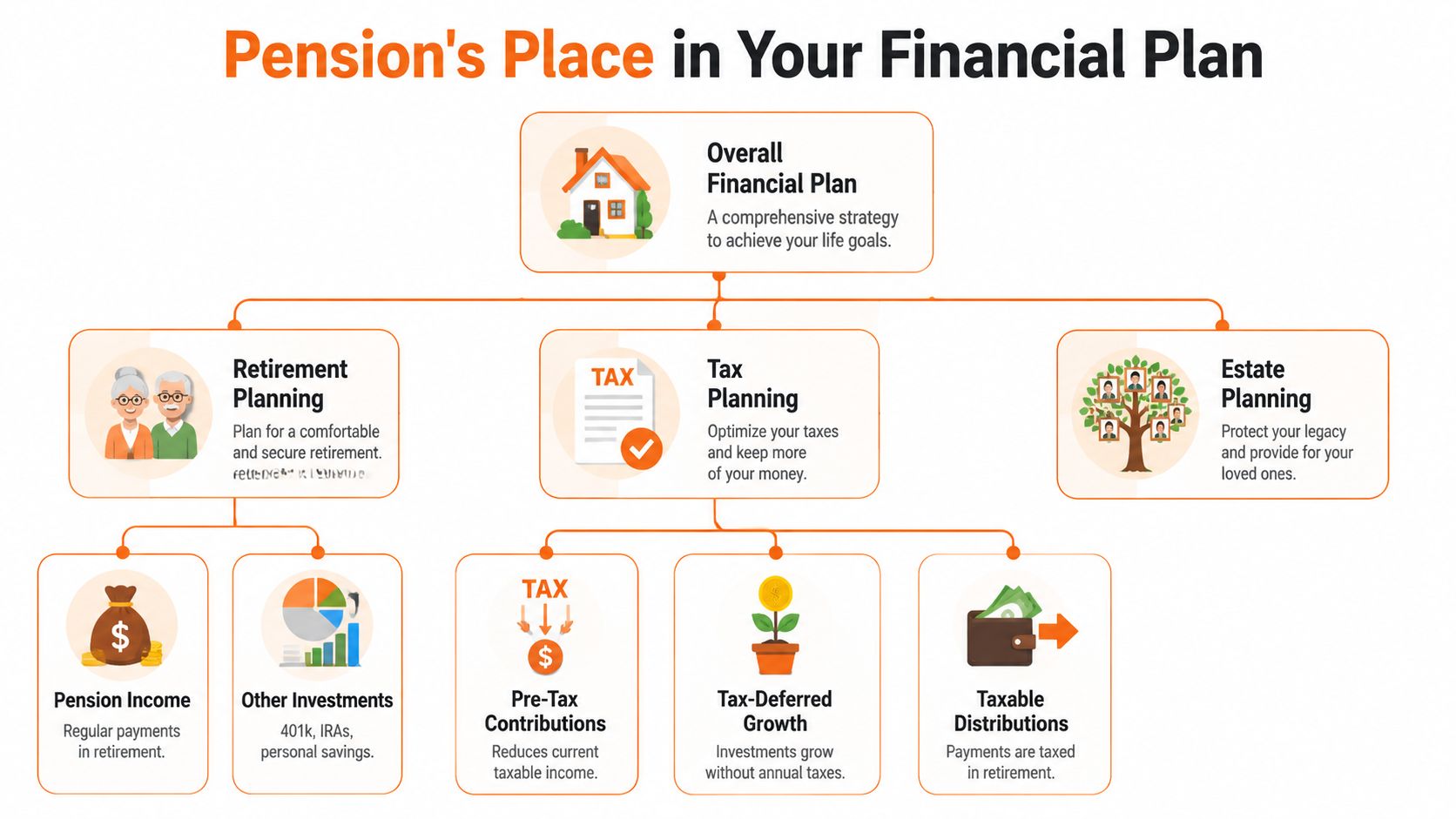
A pension works best when you see it as one income stream in a larger retirement picture. It can provide steady monthly cash flow, but your day-to-day flexibility often comes from other accounts, government benefits, and the choices you make about when to take money from each source.
Where pensions fit
A pension often works like the paycheck substitute in retirement. If it covers part of your housing, food, utilities, or insurance, your savings may not need to carry the full load every month.
That matters because a household with pension income may invest and withdraw differently from a household relying only on a 401(k) or IRA. The pension can handle some of the predictable bills. Personal savings can then do the jobs pensions are less suited for, like large one-time expenses, travel, helping family, or covering a surprise repair.
Retirement plans are common, but access and actual use are different things. The US Bureau of Labor Statistics reports that many private-sector workers had access to a retirement plan in 2023, while a smaller share participated, in its employee benefits summary. That gap is a good reminder that having a benefit available is not the same as building enough income for retirement.
A pension is one tool, not the whole strategy
A simple way to frame it is to give each resource a job.
Pension income
Often helps cover regular monthly expenses.401(k), IRA, or other savings
Can provide flexibility, growth potential, and money for uneven spending.Tax planning
Withdrawals from different accounts may be taxed differently, so timing matters.Life events
Marriage, divorce, survivor choices, and estate decisions can affect who receives benefits and how they are divided. For a legal example in a family-law context, this article on Florida law enforcement pension and divorce shows why pension benefits sometimes need careful review beyond retirement planning alone.
Taxes are where many people get tripped up. In many cases, pension payments are taxable as ordinary income when you receive them. That does not automatically make a pension bad or less valuable. It just means the monthly amount on your statement may not match what lands in your bank account after withholding and other income are factored in.
This is also why pensions and 401(k)s should be planned together. If your pension already covers a meaningful share of your basic expenses, you may choose to be more selective about when to draw from tax-deferred savings. If your pension is smaller, your personal accounts may need to do more of the heavy lifting.
If your employer also offers matching in a separate retirement account, it helps to understand how that benefit fits beside a pension. A guide to how RRSP matching works can be useful if you want to compare structured employer benefits with personal retirement savings incentives.
A pension can give you steady income. Your full retirement plan still needs to account for taxes, spending flexibility, and the fact that life rarely follows a straight line.
If you want to see retirement goals alongside your monthly cash flow, tools like Fintrack can help you organise the bigger picture by combining everyday budgeting with goal tracking and a financial overview in one place. That's often more useful than looking at a pension statement in isolation.
Common Questions About Modern Pension Plans
A lot of people get the basic definition of a pension, then immediately ask the questions that directly affect their life. If I leave this job in three years, what do I keep? If I already have a 401(k), am I doubling up or building a better plan? And when people say a pension is guaranteed, how guaranteed is it really?
What if I change jobs
Changing jobs does not automatically mean your pension disappears. The key issue is vesting, which is the point where you have earned the right to keep some or all of the employer-funded benefit.
A pension works a bit like earning ownership in slow steps. Before you are vested, leaving early can mean walking away from part or all of the employer benefit. After you are vested, you usually keep a claim to a future payment, but the final amount may be smaller than it would have been if you had stayed longer, because many formulas reward years of service.
This is why job changes and pension statements should be looked at together, not separately.
Can I have both a pension and a 401k
Often, yes.
These plans usually play different roles. A pension is built to provide a monthly income stream later. A 401(k) is your personal savings bucket, with more control over contributions, investing, and withdrawals. One is closer to a paycheck in retirement. The other is closer to a pool of money you manage over time.
Having both can reduce pressure on each one. If your pension covers part of your fixed bills, your 401(k) can give you more flexibility for travel, healthcare, home repairs, or retiring earlier than planned.
Is a pension really guaranteed
“Guaranteed” is helpful shorthand, but it is not a reason to skip the fine print.
Private pensions are shaped by federal rules. The modern pension system was influenced by the Social Security Act of 1935 and ERISA of 1974, as described in EH.net's history of retirement in the United States. That same source notes that in 2024 about one-third of older adults received income from a pension source (EH.net, retirement in the United States) and that the median state or local government pension benefit was $24,930 per year, compared with $11,440 for private pensions and annuities (EH.net, retirement in the United States).
Those numbers are useful because they show two things at once. Pensions are a real part of retirement income for many households. The amount can also vary widely depending on where the pension comes from and how the plan was structured.
So yes, a pension can be very dependable. It is still smart to ask who is responsible for paying it, what happens if the plan changes, and whether survivor or early-retirement choices reduce the monthly amount.
What should I do next
Start with your plan documents and your latest benefit statement. Then review these points:
- Whether you're vested
- How the formula works
- What happens if you leave before retirement
- Whether early retirement reduces the payment
- Whether survivor options change the amount
If any of that feels fuzzy, ask your benefits department for the summary plan description and have them walk you through it in plain language.
A good next step is to put your pension beside your other retirement income and monthly spending so you can see what it means in real life. Fintrack can help you review your broader money picture, set retirement goals, and understand how future income fits with the budget decisions you're making now.