
A lot of people in Ontario land on this topic after a bad week.
Maybe your car starts making a brutal noise on the 401 and you need it for work on Monday. Maybe your landlord gives notice of a rent increase and your next paycheque is already spoken for. Maybe your hours get cut, your fridge dies, or a child needs something now, not next month.
That's where emergency funds Ontario becomes more than a search term. It becomes a question about how to stay steady when life gets expensive fast.
An emergency fund isn't about being perfect with money. It's about giving yourself a buffer between a hard moment and a full financial spiral. In a province where housing, transportation, and everyday basics can stretch a budget thin, that buffer matters.
If you already have savings, the goal is to make sure those savings are built for real emergencies. If you don't have savings yet, you still have options, including Ontario's emergency assistance system for people in immediate crisis. Both matter. One helps you prepare. The other can help when you're already under pressure.
For a broader foundation on getting organised with money before emergencies hit, it helps to review the basics of planning your personal finances.
Introduction A Financial Safety Net for Life in Ontario
Think about two Ontarians facing the same surprise bill.
One has a small cash cushion set aside. The other doesn't. The bill is equally annoying for both of them, but the second person may need to use a credit card, miss another payment, borrow from family, or choose which essential expense gets delayed.
That difference is why an emergency fund matters. It's not just a pile of money. It's a financial safety net that gives you room to react without panic.
Why this hits differently in Ontario
Ontario isn't one-size-fits-all. A renter in Toronto, a commuter in Durham, a family in London, and a worker in Northern Ontario all face different day-to-day costs. But the pattern is similar. When fixed expenses are already high, even a modest surprise can knock your budget off balance.
Common examples include:
- Transportation shocks like a car repair, towing bill, or urgent transit costs after a vehicle breaks down
- Housing pressure such as a rent shortfall, utility arrears, or moving costs after a sudden change
- Income disruptions when hours are cut, contract work dries up, or a job ends unexpectedly
- Household emergencies like replacing food after a power issue or handling immediate basic needs
Practical rule: An emergency fund should protect your essentials first. Food. Housing. Utilities. Transportation you need to earn income.
People often think of savings as something you do later, after life gets easier. In reality, a small emergency fund can make life easier sooner because it reduces the damage from the next surprise.
What this safety net really gives you
The biggest benefit isn't just money. It's breathing room.
When you have even a modest buffer, you can make calmer decisions. You're less likely to reach for expensive debt, drain money meant for rent, or abandon longer-term goals every time something goes wrong. That's a big shift, especially if your budget already feels tight.
What Exactly Is an Emergency Fund
An emergency fund is money set aside for urgent, unexpected, necessary expenses.
A simple way to think about it is this. It's your financial fire extinguisher. You hope you won't need it often, but when something catches fire in your financial life, you want it close by and ready to use.
That “emergency only” part matters. If the money gets mixed in with everyday spending, it stops doing its job.
What counts as a real emergency
A real emergency usually has three traits. It's unexpected, important, and time-sensitive.
Examples include:
- Job or income interruption when you need to cover basics while money is temporarily reduced
- Urgent home or car repairs if the problem affects safety or your ability to work
- Essential travel or temporary costs tied to a family emergency or sudden housing issue
- Immediate basic needs when cash flow has dropped and groceries or shelter are at risk
A sale on a new phone isn't an emergency. Holiday shopping isn't an emergency. A weekend getaway after a stressful month isn't an emergency either.
What it is not
People get confused because “savings” can mean a lot of things. An emergency fund is only one type of savings.
Here's the clean distinction:
| Savings type | Main job |
|---|---|
| Emergency fund | Covers sudden, necessary costs |
| General savings | Holds money without a specific urgent purpose |
| Retirement savings | Supports your future, not today's crisis |
| Sinking fund | Pays for planned expenses you know are coming |
If you're saving for car insurance, school supplies, a move, or holiday gifts, that's usually better treated as a sinking fund. This breakdown becomes much easier once you understand what a sinking fund is.
Keep your emergency money boring and separate. The less tempting it feels, the more useful it becomes.
That separation helps you avoid a common mistake. People think they “have savings,” but all of it is already assigned to predictable expenses. When an actual emergency arrives, they still have no true buffer.
How Much to Save for an Emergency in Ontario
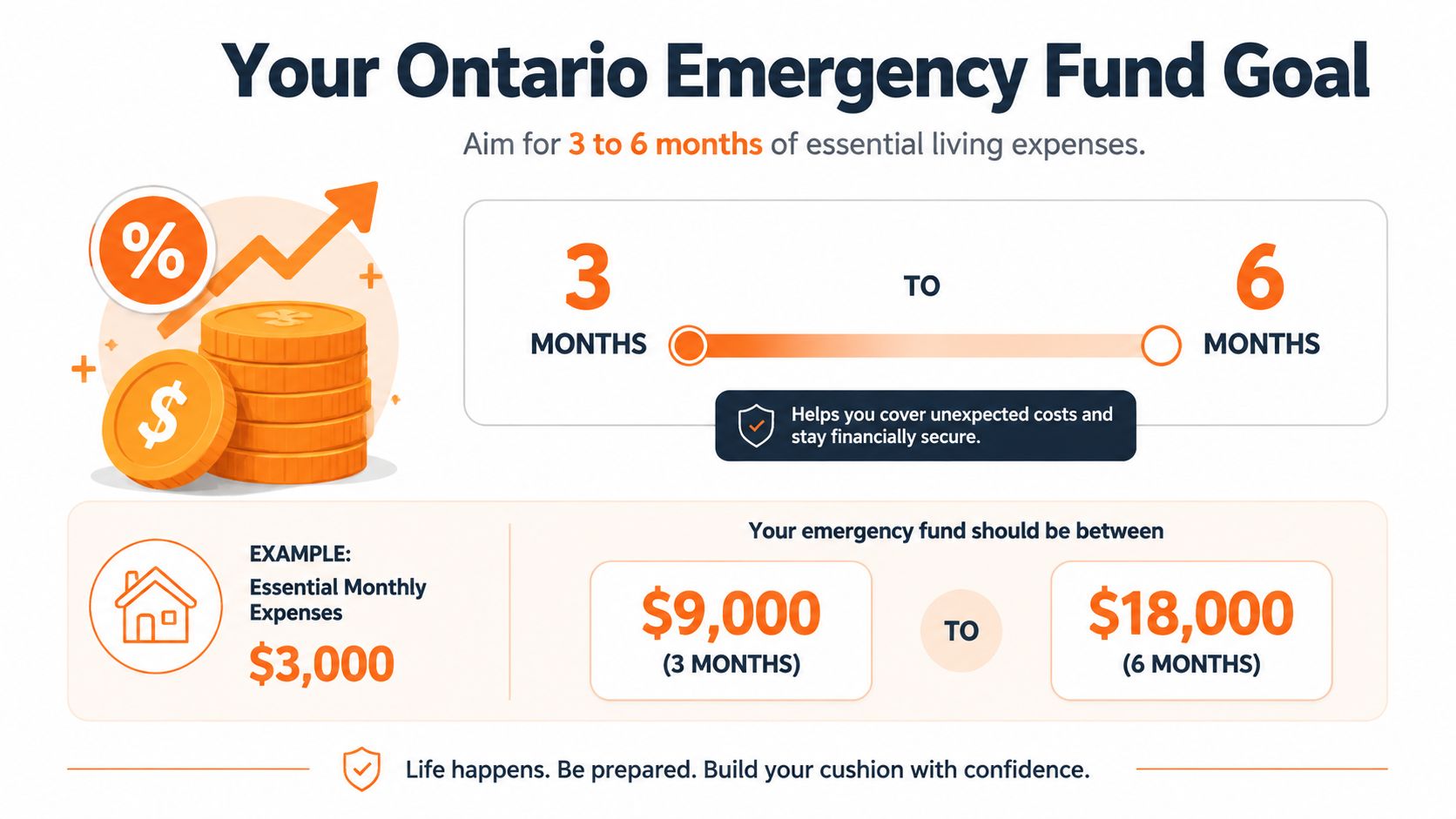
The usual rule of thumb is to save three to six months of essential living expenses.
That's a useful starting point because it focuses on survival, not your full lifestyle. The target isn't “everything you spend in a month.” It's the amount needed to keep the lights on, stay housed, eat, and get to work.
Start with essentials, not your full spending
Your number should include the costs you'd still have to pay if income dropped. For most Ontarians, that means some version of:
- Housing including rent or mortgage
- Utilities such as heat, hydro, water, and phone
- Groceries for basic meals at home
- Transportation that lets you keep working or manage family duties
- Minimum required payments on core obligations
What you usually leave out are flexible extras like dining out, entertainment, impulse shopping, and non-urgent upgrades.
If your emergency fund target feels huge, shrink the timeline in your mind, not the importance of the goal. One month of essentials is still protection.
Ontario costs change the target
Emergency funds Ontario needs a local lens.
Someone in the GTA may need a much larger fund than someone in a smaller community because housing and commuting can take up more of the monthly budget. A household with one income earner, contract work, or children may also want a stronger buffer than someone with stable employment and lower fixed costs.
A few practical examples:
- Toronto renter. Higher rent can push the target upward even if the person lives frugally in other areas.
- Suburban commuter. Car dependence means a breakdown can hit both transportation and income at once.
- Smaller-city household. Housing may be lower, but limited local transit or seasonal work can still make a larger cushion wise.
If a sudden move is part of the risk you're trying to plan around, this guide for homeowners moving quickly can help you think through the practical costs and decisions that often pile up under pressure.
A simple way to calculate your number
Use this quick method:
- List your essential monthly expenses.
- Add them together.
- Multiply by three for a starting target.
- Multiply by six for a stronger buffer.
You don't need perfect math on day one. You need a realistic estimate. If you want context for broader savings milestones, this article on how much you should have saved by 30 can help frame the bigger picture without turning your emergency fund into a comparison exercise.
Where to Get Help Now Ontario's Emergency Assistance
A missed paycheque can turn into a housing problem fast in Ontario. Rent, groceries, transit, and child care do not pause while you figure out a plan. If your emergency fund is not there yet, the next best move is to find out what short-term help exists right now.
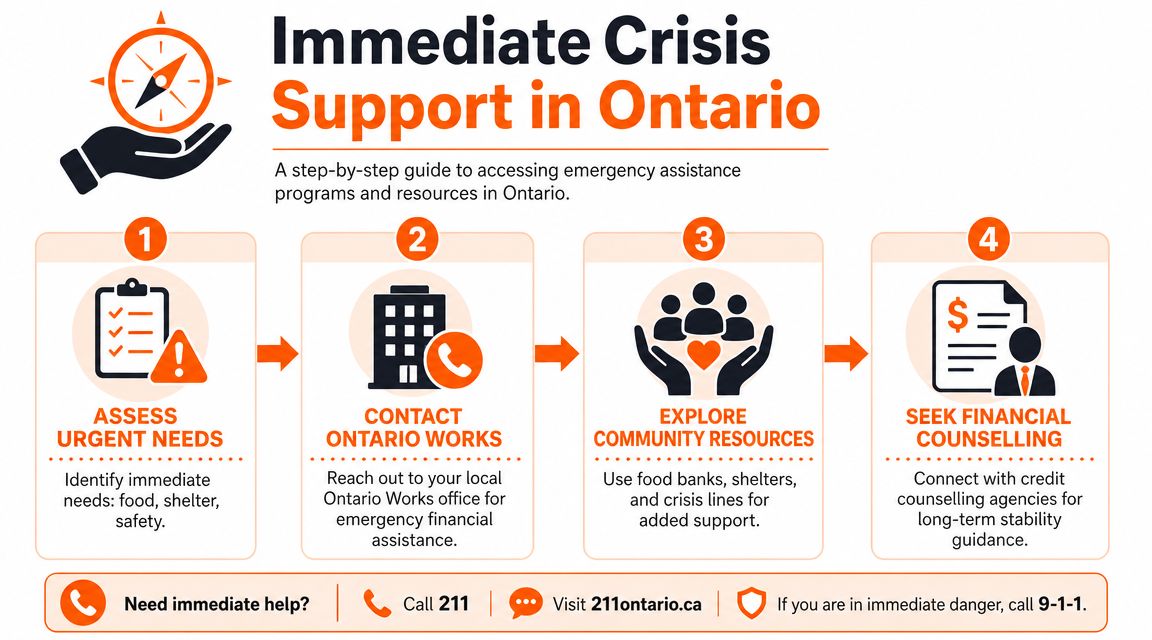
Ontario offers Emergency Assistance for people in an immediate financial crisis who do not have enough money for basics such as food and shelter. The province explains eligibility, benefit details, and application options on Ontario's Emergency Assistance application page. For a single person, support may cover basic food and housing needs for a short period, and households with children or different living costs may qualify for more.
Who this program is for
Emergency Assistance works like a temporary bridge. It is meant to help someone get through a sudden gap, not replace a long-term income plan.
Ontario says applicants generally need to:
- Live in Ontario
- Not be visitors or tourists
- Be facing an emergency or crisis
- Lack enough money for basic needs, including food and housing
That last point matters. This program is aimed at immediate need. If your cash flow has broken down and basic bills cannot be covered, it is worth checking the rules rather than assuming you do not qualify.
Who may not qualify
Some readers get confused here because Ontario has several income-support programs that can sound similar.
People already receiving Ontario Works or ODSP are usually not the main group for this specific stream of aid. Emergency Assistance is generally used as a short-term support option for people who are not already on ongoing social assistance. Local Ontario Works offices also play a practical role in delivery. A municipal overview from Renfrew County's emergency funding overview notes that support can include more than food and shelter, such as transportation, clothing, and cleaning supplies, depending on the situation.
How to apply without getting overwhelmed
Treat the application like triage in an emergency room. Start with the most urgent problem first.
Name the immediate need
Write down what has to be solved first. Rent, food, transportation to work, or another basic need.Pull together the basics
Gather identification, contact information, and any details that show your current financial situation.Pick the application route
If you have a SIN, email address, and phone number, you may be able to apply online. If not, contact your local Ontario Works office for help.Ask about local options at the same time
Ontario programs are often delivered through municipalities, so available help can look a little different from one community to another.
For readers who want the bigger picture beyond Ontario, this guide to emergency fund basics across Canada gives useful national context.
Ontario help also exists at the community level
Individual aid is one layer of protection. Community preparedness is another.
In 2024, the province announced funding through a community emergency preparedness grant program, according to Ontario's local emergency preparedness announcement. That funding supports supplies, equipment, and training for local emergency response.
Why mention that in a guide about personal emergency funds? Because life in Ontario often works in layers. Your own savings are the first buffer. Provincial emergency aid can help in a personal crisis. Community funding helps local systems respond when larger disruptions hit. When housing costs are high and many households have little room in the monthly budget, knowing all three layers can make a hard week feel more manageable.
Your 5-Step Plan to Build an Emergency Fund
Building an emergency fund can feel impossible when money is already tight. The trick is to stop treating it like one giant task. It works better as a short series of small moves.
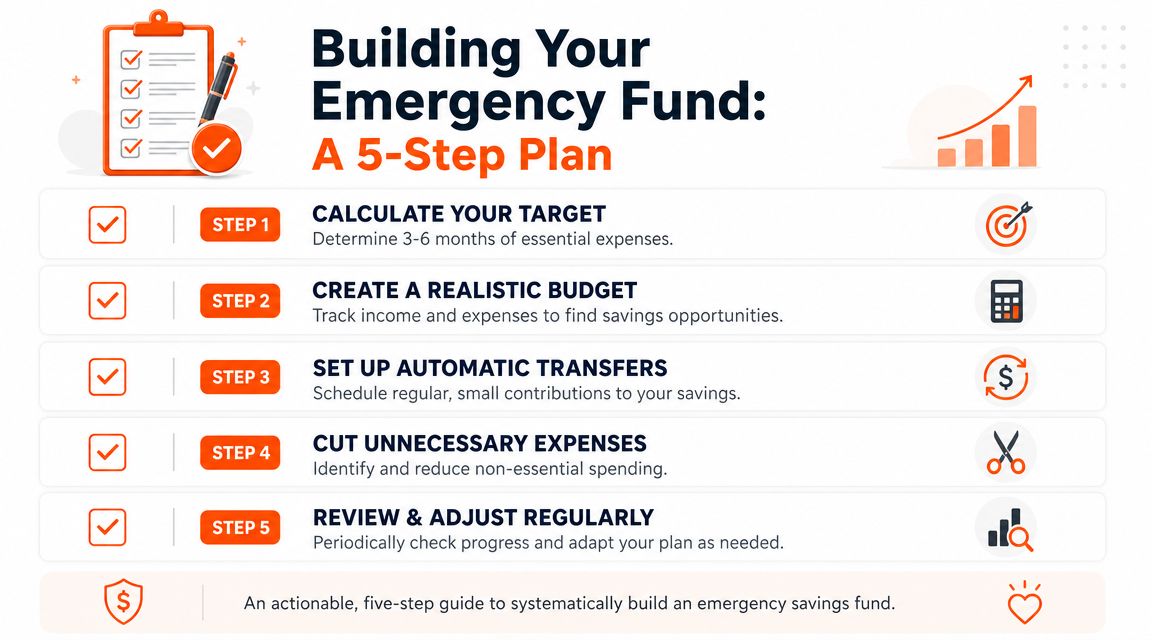
Step 1 Pick your first target
Don't begin with the final number if that number makes you freeze.
Use the emergency-fund range you calculated earlier, then choose a first milestone that feels reachable. For some people, that might be enough to cover one urgent bill. For others, it might be one full month of essentials.
Small targets work because they turn a vague hope into a clear job.
Step 2 Keep the money separate
Open a savings account that isn't mixed in with your daily spending.
If your emergency cash sits beside debit purchases and bill payments, it becomes too easy to dip into it for something that feels urgent in the moment but isn't a true emergency. You want access, but not temptation.
Good boundary: Your emergency fund should be easy to reach in a real crisis and slightly annoying to touch on an ordinary Tuesday.
Step 3 Automate before you negotiate with yourself
This step does more work than people expect.
Set up an automatic transfer on pay day or the day after. The amount doesn't have to be dramatic. What matters most is consistency. If you wait until the end of the month to “see what's left,” there often won't be much left.
A simple rhythm might look like this:
- Start tiny if your budget is tight
- Increase slowly after rent changes, debt payoffs, or income bumps
- Keep the transfer recurring so it happens without a monthly decision
Step 4 Find money already hiding in your budget
Individuals don't build an emergency fund by becoming perfect. They build it by redirecting money they were leaking.
Look for:
- Recurring expenses you don't value much anymore
- Spending patterns that rose gradually over time
- Convenience purchases that became routine
- Seasonal costs that can be planned better next time
This doesn't mean cutting everything enjoyable. It means choosing a few trade-offs on purpose. Cancelling one unused subscription, reducing takeout for a while, or lowering impulse spending can create room for your safety net.
Step 5 Review progress and protect the habit
Your emergency fund isn't “set and forget.” It needs check-ins.
A change in rent, a move, a new baby, a job shift, or a paid-off debt can all change the right target. Review your essentials from time to time and adjust the transfer amount when your life changes.
Here's a simple maintenance checklist:
| Check | What to ask |
|---|---|
| Target check | Does my current goal still match my real essential costs? |
| Habit check | Is the automatic transfer still active and realistic? |
| Usage check | Did I dip into the fund for a true emergency or a convenience expense? |
| Refill check | If I used some of it, what's my plan to rebuild it? |
People often think progress only counts when the fund looks “big enough.” That's not true. Progress starts the moment you create separation, automate the habit, and protect the money for real emergencies.
The Best Accounts for Your Emergency Fund
Where you keep your emergency fund matters almost as much as building it.
The best account has three jobs. It should keep your money safe, let you access it quickly, and earn at least some return while it sits there. For most Canadians, the usual comparison is between a high-interest savings account and a TFSA used for savings.
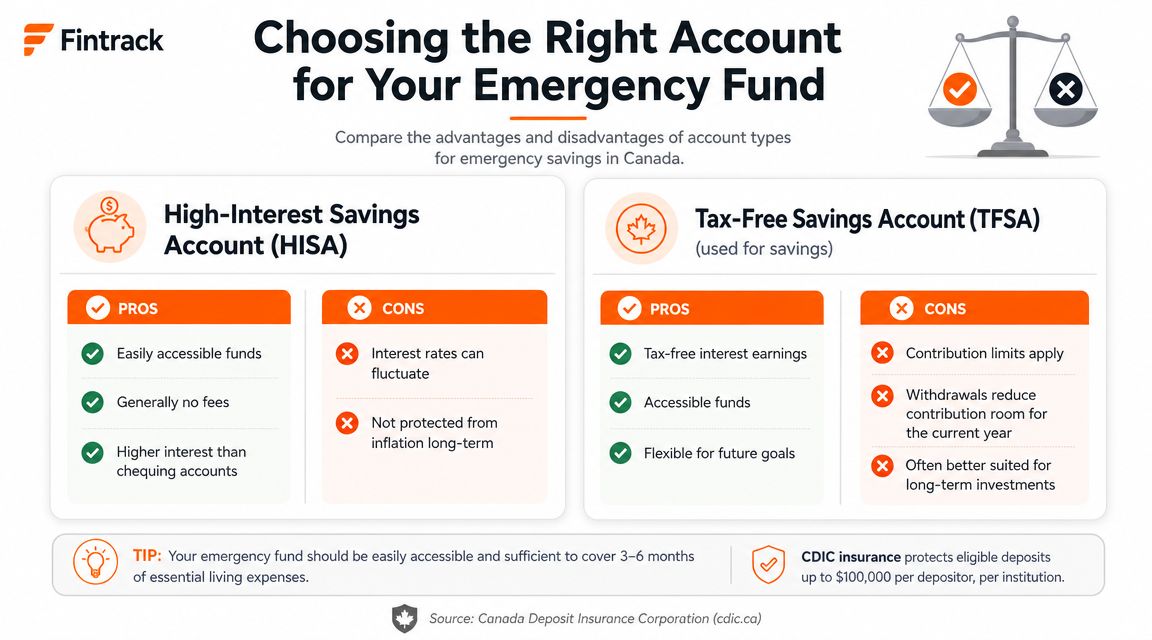
HISA versus TFSA for emergency money
| Account type | Best feature | Main caution |
|---|---|---|
| High-interest savings account | Straightforward access to cash | Interest rates can change |
| TFSA used for savings | Tax-free growth on the savings inside | Contribution rules need attention |
A high-interest savings account is often the simplest fit. It's easy to understand, usually easy to access, and keeps the money clearly in “cash reserve” mode rather than “investment” mode.
A TFSA can also work well if you use it carefully for savings rather than tying emergency money up in assets that may fluctuate or take time to sell.
How to choose without overthinking it
Choose the account that best matches your behaviour.
- Pick a HISA if you want clean separation, simple access, and very little decision-making.
- Pick a TFSA savings setup if you have available contribution room and want any growth to stay tax-free.
- Avoid complexity if complexity makes you delay starting.
If you want a closer look at one savings option, this review of the Renaissance High Interest Savings Account can help you think through what to compare.
The best emergency fund account is usually the one that keeps your money safe, reachable, and untouched until you actually need it.
Building Your Financial Resilience for Tomorrow
A flat tire on the 401, a missed week of work, or a furnace problem in the middle of an Ontario winter can turn a normal month into a stressful one fast. An emergency fund gives you a buffer between the problem and the panic.
That buffer matters in Ontario because everyday life is expensive. Rent, groceries, transit, childcare, and housing costs can leave very little room for surprises. With money set aside, an urgent bill stays a problem to solve, not a chain reaction that spills into missed payments, high-interest debt, or choices you regret later.
Financial resilience works like shock absorbers on a car. You still feel the bump. You are just less likely to lose control.
Over time, that is what this fund really does. It gives your budget room to bend without breaking. It also gives you time, which is often the most useful thing in an emergency. Time to compare repair quotes, time to wait for the next paycheque, or time to apply for short-term help if you qualify.
Ontario households sometimes need both kinds of support. Provincial Emergency Assistance can help during immediate hardship. Your own savings can help with the next surprise that does not qualify for public support, or happens after that short-term help ends.
Homeowners have an added layer to plan for because housing costs can jump suddenly. A roof leak or urgent plumbing repair rarely arrives at a convenient time, and mortgage pressure can make the whole budget feel tighter. This guidance for homeowners facing financial distress can help if your emergency fund planning overlaps with repair costs or housing strain.
You do not need a perfect plan.
You need a plan you can repeat. Save a small amount consistently. Protect it from everyday spending. Refill it after you use it. That is how an emergency fund becomes more than a savings goal. It becomes part of how you stay steady through Ontario's higher-cost reality.
If you want a simple way to put this into action, Fintrack can help you see your spending clearly, set an emergency fund goal, and build a saving habit around your real monthly costs.