Your spreadsheet says you're fine, but your bank balance tells a different story by the third week. That's usually a timing problem, not a discipline problem. A good family budget planning template shows money by paycheque, so you can see a shortfall before it arrives.
Build the Template Layout in Six Steps
Say a Calgary couple with two kids checks their balance on the 20th and finds it dropping fast. Their monthly totals balanced, yet rent, childcare, and two car payments all landed before the second paycheque. The sheet had no timing view, so it couldn't warn them.
Build the layout before you enter numbers. You'll avoid reshaping the sheet every time a new bill shows up.
Set Up Six Blocks First
Use these headers in row one: Category | Planned | Actual | Variance | Due date | Update rhythm. Then create blocks for income after tax, fixed expenses, variable essentials, debt payments, sinking funds, and discretionary spending, with savings and reserve at the bottom.
Template blocks, line items and update rhythm
| Block | Line items | What to enter | Update rhythm |
|---|---|---|---|
| Income | Paycheques, benefits, side income | Take-home pay on the date received | Each pay period |
| Fixed expenses | Rent or mortgage, insurance, phone, internet, loan payments | Exact amount and due date | Monthly, check once a year |
| Variable essentials | Groceries, fuel, transit, childcare, medication | Three-month average per category | Weekly |
| Debt payments | Credit cards, lines of credit, car or student loans | Balance, rate, minimum payment, due date | Monthly |
| Sinking funds | Car repairs, gifts, school costs, annual premiums | Annual cost divided by 12 | Monthly |
| Discretionary | Dining out, entertainment, shopping, subscriptions | Monthly limit per category | Weekly |
| Savings and reserve | Emergency fund, goal savings | Amount moved after essentials are covered | Monthly |
These headers work in Excel or Google Sheets. Manual entry is enough to start, so you don't need a bank connection on day one.
Fill It In Paycheque by Paycheque
- Enter take-home pay by date: Record each paycheque on the date it lands, not as one gross monthly total. This shows which bills each paycheque has to cover.
- List every bill with its due date: Include annual renewals and subscriptions, not just rent and utilities. A renewal you forgot is the one that breaks a calm month.
- Split variable spending: Give groceries, fuel, transit, childcare, and personal items separate lines. Lumped together, you can't tell which one moved.
- Divide annual costs by 12: Turn premiums, repairs, and school costs into monthly sinking funds. The money builds gradually instead of arriving as a crisis.
- Set limits from real statements: Use your last three months, not what you hope to spend. A hopeful limit fails in week three, and that's when many people quit.
- Add totals and variance: Add a total row and a planned-minus-actual variance column for every category.
Practical rule: Planned outflows must sit below income in every pay period, not just in the monthly total.
If housing is your biggest fixed line and you're weighing a move from renting to owning, it helps to understand closing and carrying costs before you rewrite that block, which is where a guide to first-time home buying in BC can be a useful reference. Bring those costs back as sinking fund lines rather than guessing.
Create the six blocks now, even if the numbers are rough. A rough sheet you maintain beats a polished one you abandon.
Category Benchmarks for Canadian Households
National averages describe what households spend. They don't tell you what you should spend. Treat them as a comparison point, then judge the gap on your own circumstances.
Statistics Canada household spending data reported average Canadian household spending on shelter reached $24,671 in 2023, compared with $12,046 on food and $12,090 on transportation. Converted to monthly planning amounts, that's about $2,056, $1,004, and $1,008.
National household spending benchmarks, 2023
| Category | Annual average (2023) | Approximate monthly | How to use it |
|---|---|---|---|
| Shelter | $24,671 | $2,056 | Compare with rent or mortgage plus utilities and property costs |
| Food | $12,046 | $1,004 | Compare with groceries and restaurant meals together |
| Transportation | $12,090 | $1,008 | Compare with payments, fuel, transit, insurance and repairs |
How to Read a Gap
If one category sits far above its benchmark, flag it for a separate review rather than cutting automatically. Housing well above the shelter average may need a different plan entirely, while high transportation may point to a commute problem. For a fuller list of lines to compare, see these household budget categories.
Keep subcategories visible, including rent or mortgage, property costs, utilities, groceries, restaurant meals, vehicle costs, transit, fuel, insurance, and maintenance. The same habit helps with new costs you haven't carried before, for example when you budget for your puppy's first year and need food, vet visits, and supplies as separate lines.
If your income is irregular, plan categories on the lowest typical month of the last year. Treat anything above that as surplus for reserves or debt.
US readers can run the same comparison with their own national figures, since the six blocks stay the same. These benchmarks are a reference for Canadian households only.
Write down your three largest monthly categories now and compare each with its benchmark row. One clear gap is enough to investigate first.
Weekly Expense Logging and Reconciliation
A monthly catch-up is where most family budgets fail. Memory fades, small charges pile up, and reconstructing four weeks feels so unpleasant that people stop. Fifteen minutes weekly is easier to keep.

A Weekly Routine You Can Keep
- Pick one fixed day: Sunday evening works for many households. Keep the same day so it becomes routine rather than a decision.
- Enter transactions: Type them by hand or import a CSV download from your bank. You don't need a live bank connection for this to work.
- Categorise every line: Use the exact category names in your template so totals match. Similar names create duplicate categories and split your totals.
- Reconcile against the balance: Compare total spent with your bank balance and note any gap. Our guide to account reconciliation walks through finding a gap step by step.
- Record the variance: Note each category that moved more than planned, while you still remember why.
- Mark one-off costs: Flag them clearly so a single large purchase doesn't inflate next month's limit.
Two habits prevent most errors:
- Record cash weekly: Enter cash spending at week's end while receipts are still at hand, because cash is the first thing you'll forget.
- Check pending charges: Confirm a charge has settled before entering it, or you'll count the same purchase twice.
Subscriptions renew automatically, so scan them on the same day. Complete your first weekly reconciliation before the end of this week, even if it's imperfect.
Automate Tracking and Find Hidden Money
Automation cuts retyping. It doesn't replace your weekly check, because a rule can file a charge neatly into the wrong category for months. Keep both.
- Set category rules for repeat merchants: Grocery stores, transit passes, and daycare can sort themselves, which leaves you only the unusual charges to judge.
- Import or enter, then compare: Use a CSV download or manual entry, then match the total against your bank balance. Reading about the benefits of spend analysis helps you turn those sorted totals into decisions.
- Add due date reminders: Tie each reminder to the sinking funds and debt block so bills aren't missed between paycheques.
- Flag overruns early: Use an AI assistant to highlight any category running over plan before the monthly review, while there's still time to adjust.
- Audit subscriptions quarterly: List every recurring charge, cancel what you no longer use, and move the savings into the matching sinking fund or debt payment.
- Check benefits and reimbursements: Review employer benefits, health spending accounts, and unused reimbursements, then add anything found to your reserve line.
These checks surface money you already have. They don't guarantee a savings amount, and any figure you find belongs in the template as a one-time entry, not new monthly income.
Reserves and Debt Payoff Order
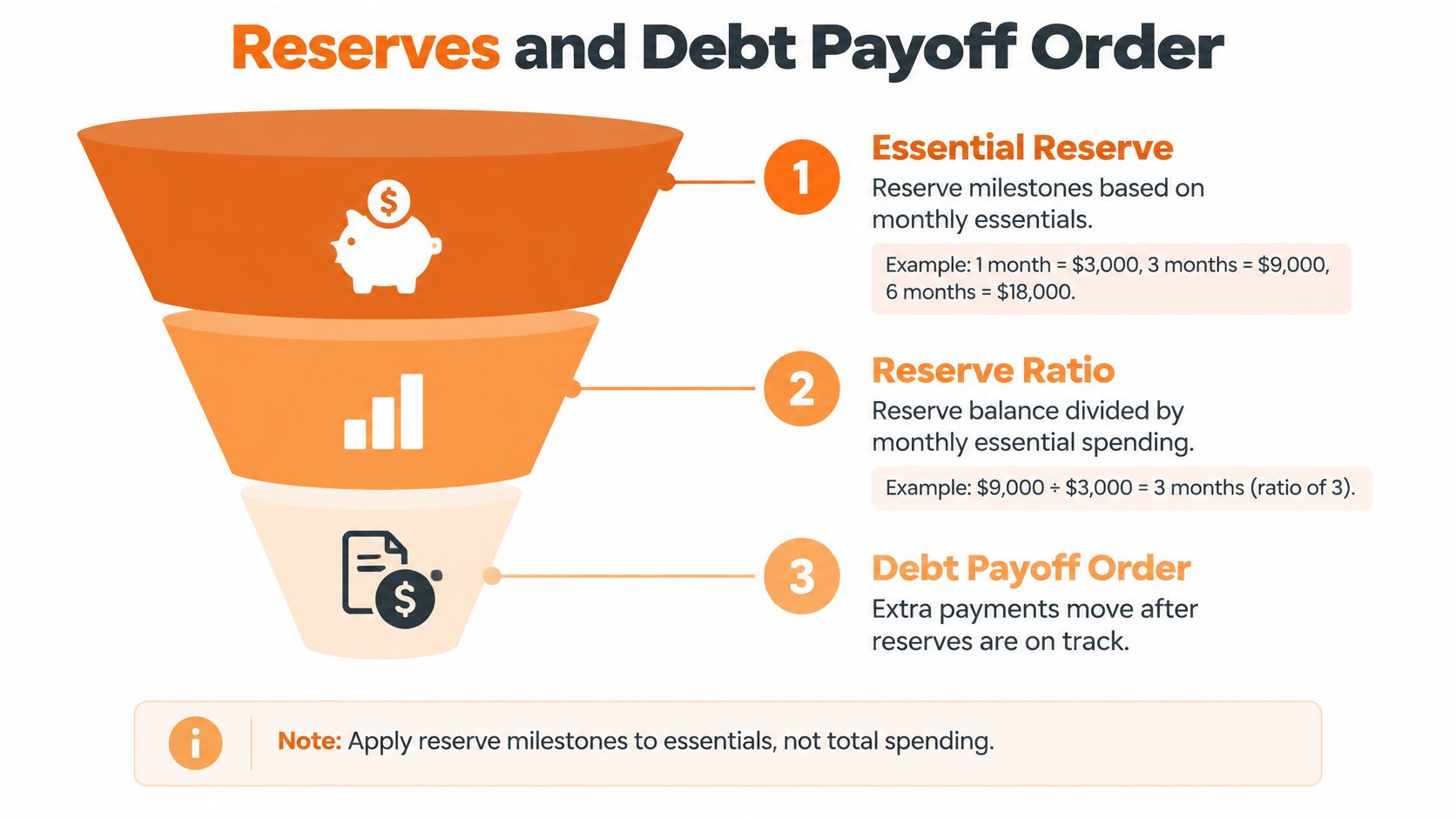
Apply reserve targets to essentials, not total spending. Your template should show coverage at a glance using one calculation: reserve balance divided by monthly essential costs.
Build Coverage in Stages
The Financial Consumer Agency of Canada budget guidance recommends building an emergency fund large enough to cover three to six months of living expenses. If essential costs equal $4,000 per month, a three-month reserve would be $12,000 and a six-month reserve would be $24,000.
Work through the milestones in order:
- One month of essentials: Your first target, covering housing, utilities, basic food, insurance, work transportation, minimum payments, and necessary healthcare.
- Three months: The point where a job loss becomes manageable rather than immediate.
- Six months: A later goal, not a starting requirement. A fixed monthly contribution toward the next milestone is enough to begin.
Keep sinking funds separate from the emergency fund. Using reserve money for predictable annual bills makes the reserve look bigger than it is, and you'll discover the gap during a real emergency.
Order Your Debt Payments
List each balance, rate, minimum payment, and due date. Then follow one plain rule: pay every minimum on time, and put surplus toward the highest-interest debt first. If you're weighing that against paying smallest balances first, the comparison of avalanche vs snowball method lays out the trade-off.
Choose your next milestone today, set the monthly amount, and write it into the savings and reserve line.
Sample Budgets for Single, Dual and Family Households
The same template flexes very differently depending on who earns and who depends on that income. Household size, number of earners, and childcare move the numbers more than any fixed percentage split.
Three household setups compared
| Household | Income pattern | Lines to add or emphasise | Test or first target |
|---|---|---|---|
| Single earner with one child | One paycheque on a fixed date | Childcare and fixed expenses carry the most weight | First reserve target, one month of essentials |
| Dual-income couple, no children | Two paycheques on different dates | Bills split by due date; shared sinking fund for holidays and travel | Check the timing gap in every pay period |
| Dual-income family with children | Two paycheques plus child costs | Separate sinking funds for school, activities and medical costs; larger groceries and childcare lines | Test, which blocks stay covered if one income stops |
A single earner with one child has one paycheque setting every date. Childcare and fixed expenses carry the most weight, and the reserve usually grows slowly, so one month of essentials is a fair first target. Review monthly and protect that reserve line fiercely.
A dual-income couple without children faces a timing gap instead. Two paycheques land on different dates, so split bills by due date rather than by who pays them. Add a shared sinking fund for holidays and travel, and review together weekly.
A dual-income family with children needs separate sinking funds for school costs, activities, and medical expenses, plus a larger variable essentials line for groceries and childcare. Housing and commute choices drive much of this, as RentReboot's Bay Area rent budgeting guide shows when weighing rent against travel costs.
Run one simple test on your own sheet. If one income stopped, which blocks would still be covered?
Run Your First Monthly Review This Month
The monthly review is where your family budget planning template earns its keep. Work through it in order and keep it short.
- Compare planned and actual: Use the variance column for each category. Our walkthrough of budget variance analysis shows how to read the bigger gaps.
- Question each overrun: Ask whether the limit was wrong or the spending was a one-off. A wrong limit needs adjusting, not willpower.
- Update bills and funds: Refresh fixed bills, due dates, and sinking funds for renewals or new premiums.
- Check reserve coverage: Note coverage in months, then decide how much surplus goes to the next milestone or the highest-interest debt.
- Reset next month: Adjust limits and write one sentence on what changed, so future you understands the decision.
Keep planned and actual columns side by side in one place, whether that's your sheet or a planner such as the Budget Planning page on Fintrack. Household Plans let users invite family members to share the same accounts, transactions, budgets, and goals, and the Free plan includes manual expense tracking, CSV imports, and basic AI chat. It's free forever and requires no credit card, so you can run this review there without commitment.
Set up your six blocks in Fintrack, enter take-home pay by paycheque date, and run your first weekly reconciliation this week. You'll see planned and actual spending side by side, with shared household budgets and goals in one place. Start with the free plan and build the habit before you add anything fancy.