
A lot of first-time buyers hit the same moment of confusion. A parent, grandparent, or another family member offers to help with the down payment, and it feels like a huge relief. Then the lender asks for a gift letter mortgage document, plus extra records about where the money came from and where it went.
That request can sound more serious than it is. In plain language, a mortgage gift letter is just a signed note confirming the money is a true gift, not a private loan that would change your mortgage application.
The part that catches people off guard isn't usually the letter itself. It's the paper trail behind it. If you can show the money clearly moving from the donor to you, with matching documents, this process is usually manageable and routine.
Your Down Payment Gift and the Letter That Makes It Official
Your offer is accepted. You are already picturing the keys in your hand. Then your lender asks for a gift letter because part of your down payment is coming from family.
For many first-time buyers, that request sounds bigger than it is.
A gift letter is the document that turns a kind family promise into mortgage-ready paperwork. It tells the lender who gave the money, who received it, how much was given, and that the money does not have to be paid back. You can picture it as the label on a file folder. The letter names what the money is, and the rest of your documents prove the money moved exactly the way the letter says it did.
That last part matters more than many buyers expect. The letter is only one piece of the process. Lenders also want the money trail to make sense on paper, from the donor's account to yours or to the closing table, without gaps or confusing transfers. A clear paper trail helps your file move with fewer questions and fewer last-minute requests.
This is why buyers often feel surprised. Writing the letter is usually simple. Gathering the matching evidence is what takes care and timing.
A gift letter makes the gift official. A clean paper trail helps the lender approve it without avoidable delays.
If you like keeping important money details in one place, a personal finance dashboard can help you track incoming funds, saved documents, and next steps during the homebuying process.
For readers comparing rules in different markets, this guide on how gifted deposits work for UK buyers shows how similar the basic concern is. Lenders want clear proof that family support is genuine and properly documented.
Why Lenders Need Proof Your Down Payment Is a Gift
A lender approves a mortgage based on what you earn, what you owe, and whether the monthly payment fits your financial picture. If someone gives you money for the down payment, the lender needs to know whether that money came with strings attached.
If it's a real gift, fine. If it's a side loan from a relative, that changes things because loans usually create a repayment obligation.
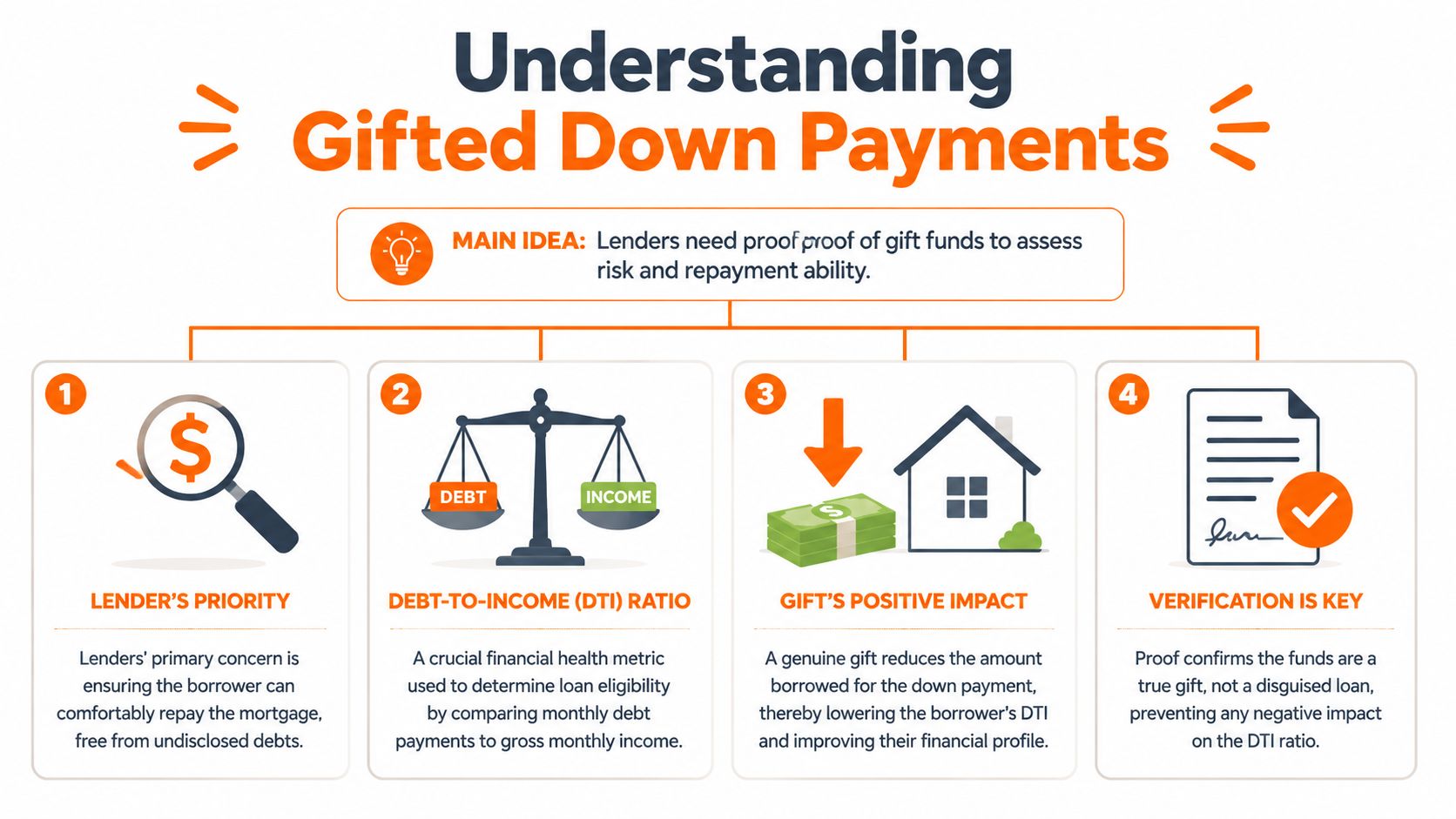
The DTI issue in simple terms
Lenders look closely at your debt-to-income ratio, often shortened to DTI. Think of DTI like a monthly balancing test. The lender compares your regular debt payments against your income to judge whether the mortgage payment is realistic.
If your down payment money is secretly borrowed, then your monthly debt is higher than it appears on paper. That means the lender could approve a mortgage based on incomplete information.
A gift letter works like a receipt plus a declaration. It tells the lender, in writing, that the donor gave the money freely and repayment is not required.
If you want a simple refresher on income basics before you review mortgage paperwork, this guide on what annual gross income means can help.
What conventional lenders often require
Fannie Mae's rules are a useful reference point for conventional loans. According to the Fannie Mae Selling Guide on personal gifts, the gift letter must be signed and include the gift amount, donor identity and contact information, the relationship to the borrower, and a statement that no repayment is required. Fannie Mae allows gift funds for a principal residence or second home, but not for an investment property.
That same guidance also helps explain why the letter alone may not be enough. Lenders can ask for proof of transfer and source-of-funds records as part of their review.
Think of it like proving ownership
If you bought a laptop with your own money, a receipt helps prove the purchase was yours. Mortgage gift documentation works in a similar way. The lender wants a written record showing what the money is, who sent it, and why it won't create a hidden bill later.
Practical rule: If a lender can't tell whether gifted funds are a gift or a loan, they'll keep asking questions until the file makes sense.
That's why the cleanest mortgage files are usually the ones where the borrower and donor prepare the letter early, then match it with a clear transfer trail.
The Rules of Gifting Who Can Give and How Much
A common first-time buyer scenario goes like this: your parents offer to help with the down payment, you feel relieved for about ten minutes, and then a new question shows up. Is your lender allowed to accept that money?
The answer depends on the loan program and on who the donor is. The basic rule is simple. Lenders want the gift to come from an acceptable source, and they want the amount and transfer to fit the loan guidelines.

The big rules to know
According to Experian's overview of mortgage gift letters, lenders often have documentation thresholds based on the loan type and the size of the gift. Experian also explains that funds left in your account long enough may be treated as seasoned funds, which can reduce the need for separate gift documentation in some cases.
Experian notes another point that often causes confusion. The annual federal gift-tax exclusion applies to the donor's tax reporting situation. It does not automatically set the maximum amount you can receive for a home purchase.
That distinction matters.
Mortgage approval is usually less about a tax headline and more about whether the lender can verify three things clearly: who gave the money, whether that person is permitted under the loan rules, and whether the transfer created any hidden debt.
Who can usually give the money
In many cases, lenders are most comfortable with gifts from family members or another clearly permitted source under the loan program. The exact list can vary, so your lender will tell you whether a parent, sibling, fiancé, domestic partner, employer, or charitable program is acceptable for your file.
A useful way to look at it is this: lenders are checking whether the money came from a source they can identify and explain. The closer and clearer the relationship, the easier that review usually is.
If the donor is allowed, the next step is documenting the transfer in a way that leaves no gaps.
How much can be gifted
There is no single dollar cap that applies to every mortgage. The practical limit comes from your loan guidelines, your occupancy type, and the lender's documentation standards.
For borrowers, the safer question is not “What is the maximum gift I can receive?” It is “How much gift money can my loan program accept, and what records will my lender ask for?”
That shift helps you avoid a common mistake. Buyers sometimes focus on the amount and forget the paper trail. Underwriting often cares just as much about the evidence as the gift itself. A large gift with clear bank records is often easier to approve than a smaller gift that moved through several accounts with no clear explanation.
What usually causes delays
The money trail needs to read like a short, believable story. The donor had the funds. The donor sent the funds. You received the funds. The amounts match at each step.
Problems tend to show up when money is transferred in cash, split across multiple apps, or deposited without a matching record. Those are the moments that lead to extra questions, extra documents, and delays close to closing.
If you know family help is coming, tell your lender early and ask what transfer method they prefer. One clean transfer with matching statements is usually much easier to document than several small transfers from different places.
A broader guide on planning your personal finance for big life goals can also help if you are balancing your own savings with support from family.
How to Write a Perfect Gift Letter With a Sample
You are a week away from final loan approval. Your parent has already sent the down payment help. Then your lender asks for one more item: a signed gift letter. That request can feel bigger than it is.
A gift letter is the written version of a basic fact. Someone gave you money for the home purchase, and you do not have to pay it back. The letter matters because it connects the people, the amount, and the purpose in one place. It is the label on the file folder. The bank records are the papers inside.
The good news is that the letter itself is short. What matters is accuracy. Names should match your loan application. The dollar amount should match the transfer record. The date should make sense with when the money moved.
A simple sample you can adapt
Use your lender's form if they provide one. If not, this format covers the details underwriters usually want to see:
Gift Letter Sample
Date: [Insert date]
To whom it may concern,
I, [Donor Full Name], currently residing at [Donor Address], am giving [Borrower Full Name] a gift in the amount of [Gift Amount] to be used toward the purchase of a home.
My relationship to the borrower is [Relationship].
These funds are a gift, not a loan, and no repayment is expected or implied.
The source of these funds is [Name of bank or account description].
Donor phone number: [Phone Number]
Donor email: [Email Address]Signed, [Donor Signature]
Borrower acknowledgement:
I, [Borrower Full Name], confirm receipt of these gift funds for my home purchase.Signed, [Borrower Signature]
What each line is doing
Each sentence has a job.
The donor's full name and address identify who gave the money. The relationship explains why the gift is allowed under your loan rules. The amount gives underwriting a number to match against the transfer. The no-repayment statement tells the lender this money is not hidden debt. The source of funds gives the underwriter a starting point for the document trail.
That last part is where buyers often get tripped up.
If the letter says the gift came from a checking account, but the transfer record shows a payment app with no matching statement, your lender may ask follow-up questions. If the donor sends three smaller transfers instead of one stated amount, the file can slow down. A clean letter and a clean transfer method work together. If you are deciding how to send the money, compare a few money transfer apps for large documented payments before anyone hits send.
Lender-Ready Gift Letter Checklist
| Element | What to Include |
|---|---|
| Donor identity | Full legal name and current address |
| Donor contact details | Phone number and, if requested, email |
| Borrower identity | Full legal name of the person receiving the gift |
| Relationship | Parent, grandparent, sibling, or other allowed relationship |
| Gift amount | The exact dollar amount being gifted |
| Purpose | A statement that the funds are for the home purchase |
| Non-repayment statement | Clear wording that no repayment is required |
| Source of funds | Where the money is coming from, such as the donor's bank account |
| Signatures | Donor signature and, if requested, borrower signature |
| Date | The date the letter is signed |
Keep the letter consistent with your documents
Gift letter problems usually come from mismatches, not poor writing. A nickname on the letter, a rounded gift amount, or a date that does not line up with the deposit can all trigger questions.
Do one final comparison before you upload anything. Check the names, amount, account source, and timing against the records you plan to send with it. Loan officers and processors often use the same verification logic they apply to deposit reviews, and training on essential VOD skills for MLOs shows how closely those details are examined.
If your lender has its own template, use it. Their version is usually the fastest option because it already matches the checklist your underwriter will review.
Creating a Clean Paper Trail for Your Gifted Funds
Mortgage files often get delayed at this stage of the process. The letter says the money is a gift, but the lender also wants to see the money move clearly from one account to another.
In high-cost markets like California, where the median home value was about $906,500 in early 2026, large down-payment gifts are more common and often draw more scrutiny, according to Bankrate's guide to mortgage gift letters. The same source notes that lenders often want the donor's bank statements and a clear transfer trail, not just a signed letter.
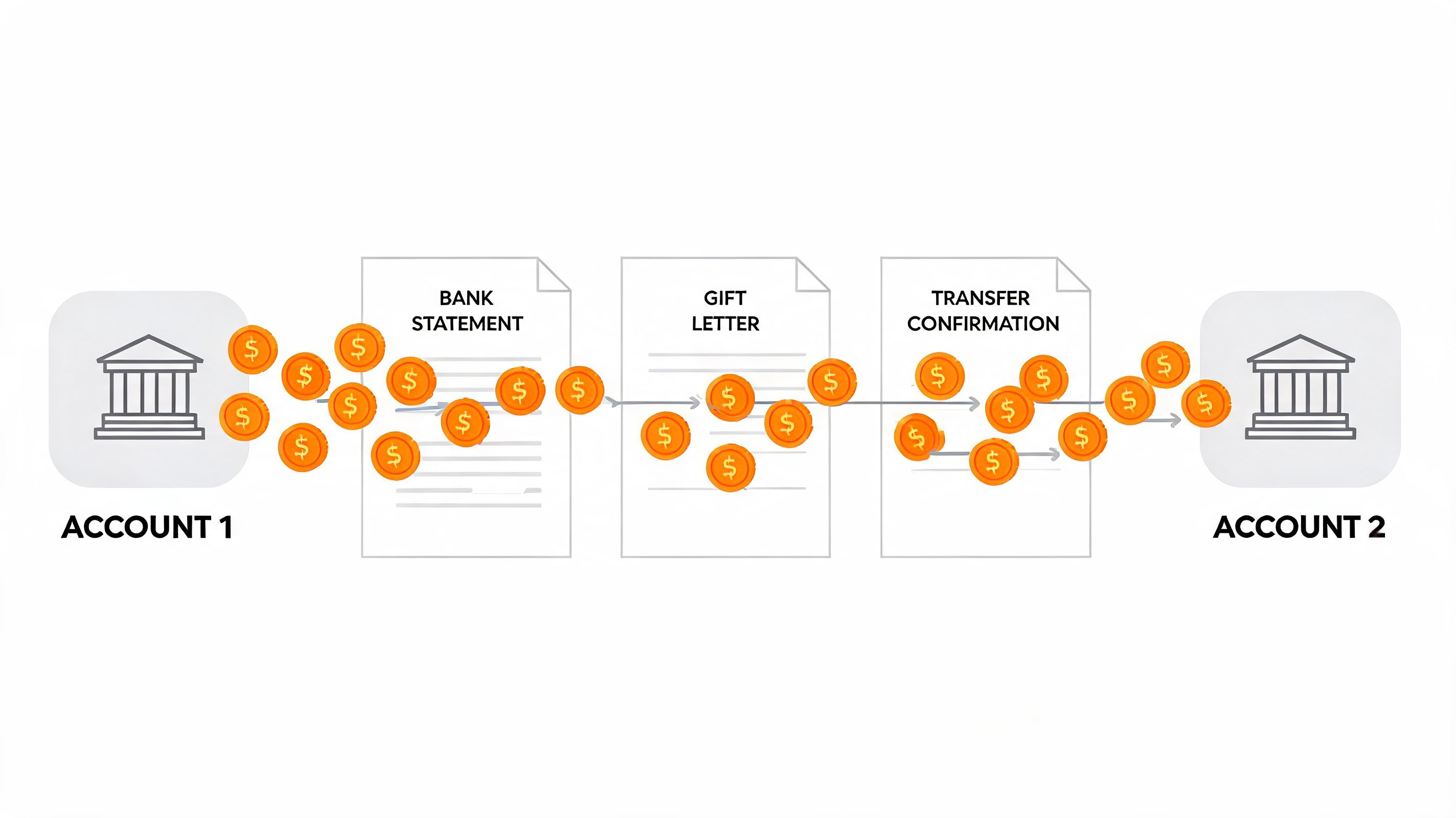
The three-part trail lenders want
A clean paper trail usually includes these records:
Proof the donor had the funds
A bank statement or equivalent record showing the money was available before the transfer.Proof the transfer happened
This could be a wire confirmation, cashier's cheque record, or another formal transfer document.Proof you received the funds
Your bank statement should show the deposit matching the gifted amount.
This is why cash causes problems. Once money is handed over without a bank record, it becomes harder to prove where it came from.
How to stay organised
Keep every document in one folder from the start. Save PDFs, screenshots, and confirmations with obvious file names so you're not searching your inbox the night before underwriting asks.
If you want to understand why lenders care so much about account verification, this explainer on essential VOD skills for MLOs gives useful background on how deposit verification works behind the scenes.
A practical guide on choosing the best money transferring app can also help if your family is deciding how to move funds in a traceable way.
The easiest mortgage gift to document is the one that moves once, clearly, through accounts that can produce records on demand.
Common Gift Letter Mistakes to Avoid
Most gift-related delays come from a small set of avoidable mistakes. If you keep these in mind, the process usually feels much less stressful.
- Using cash: Cash is hard to trace. Use a method that creates a formal record, such as a bank transfer or other documented movement of funds.
- Sending the money too late: Last-minute transfers leave no room for questions. Move the funds early enough for your lender to review everything calmly.
- Letting the letter and records disagree: The names, amount, and timing should all match across the gift letter, transfer confirmation, and bank statements.
- Forgetting the donor's documents: Some buyers think the signed letter is enough. Often, the lender also wants proof of the donor's ability to give the funds.
- Changing the transfer method midway: A switch from cheque to wire, or from one donor account to another, can create extra questions if the paperwork no longer matches.
- Waiting to tell the lender: Early disclosure gives your loan officer time to confirm what specific records your file will need.
- Treating family support like informal household money: If multiple relatives move money around before one person sends the final amount, the trail can get messy. Simpler is better.
If you're balancing homebuying with broader savings goals, keeping your regular finances stable still matters. This guide on building an emergency fund in Canada is a helpful reminder that homeownership works best when your wider cash flow is organised too.
If you're getting ready for a home purchase, Fintrack can help you keep the process tidy. Use it to organise account activity, monitor incoming deposits, and keep your broader budget clear while you prepare for closing.