
You open your banking app to check one thing. Then you see the credit card balance, the subscription you forgot to cancel, the grocery total, the rent withdrawal coming next week. You close the app and tell yourself you'll deal with it on Sunday.
Sunday comes, and you don't.
That isn't laziness. It's what money stress does. It turns a simple task into a heavy one, and after enough heavy moments, even people who care about their finances stop tracking, stop reviewing, and stop trusting themselves. If you've been searching for how to stay motivated and every answer sounds like “just be more disciplined,” you're not the problem. The system you're using is.
When Money Stress Quietly Steals Your Motivation
A lot of people hit this wall the same way. They start with good intentions. They make a budget, set a savings goal, maybe even track spending for a week or two. Then life gets expensive, work gets busy, and the numbers start feeling personal. Not informative. Personal.

The problem usually isn't that you stopped caring. It's that looking at your money started to feel like walking into bad news. That's why so many people end up in a cycle of avoidance, guilt, panic, then a short burst of effort, then avoidance again. If that sounds familiar, you're not unusual. You're reacting to pressure.
Canadian data makes that pressure hard to ignore. Money was the top source of stress for 42% of Canadians, 43% said they procrastinate because of stress or anxiety, 52% feared making the wrong financial decision, and 68% said the high cost of living was a barrier to taking control of their finances, according to FP Canada's 2025 Financial Stress Index. If you're trying to fix your finances while also trying to survive high costs and decision fatigue, motivation won't feel steady.
What this looks like in real life
You might recognise yourself in one of these patterns:
- App avoidance: You know your transactions are there, but you don't want to look.
- All-or-nothing budgeting: If you overspend once, you treat the whole month as ruined.
- Future-number paralysis: Retirement, debt payoff, and emergency savings all blur into one giant impossible target.
- Shame-based tracking: Every review session feels like self-criticism instead of useful feedback.
Practical rule: If checking your money feels emotionally expensive, your first job is to lower the friction, not raise the pressure.
That's why I'm skeptical of generic advice like “just set a goal and track your spending.” Plenty of people know they should do that. Knowing isn't the issue. Starting, repeating, and recovering are the issue.
If you're feeling stuck, read this first: how living paycheck to paycheck can drain your financial energy. It helps name the pressure before you try to fix the behaviour.
The four-part system that works better
What helps is simpler and more mechanical than most motivation advice:
- Reduce friction so the next money action feels small enough to do.
- Turn vague goals into if-then actions so you don't have to decide from scratch.
- Review weekly with a closed loop so tracking changes behaviour.
- Treat bad weeks as feedback so one slip doesn't become a lost month.
That's how you stay motivated when money feels heavy. Not by trying harder. By making the next action easier than avoidance.
Why Willpower Advice Stops Working
Willpower-first advice sounds good because it flatters people. It tells you that if you just cared enough, focused enough, or “wanted it” enough, you'd finally stick to the plan. That's tidy. It's also wrong for most real financial situations.
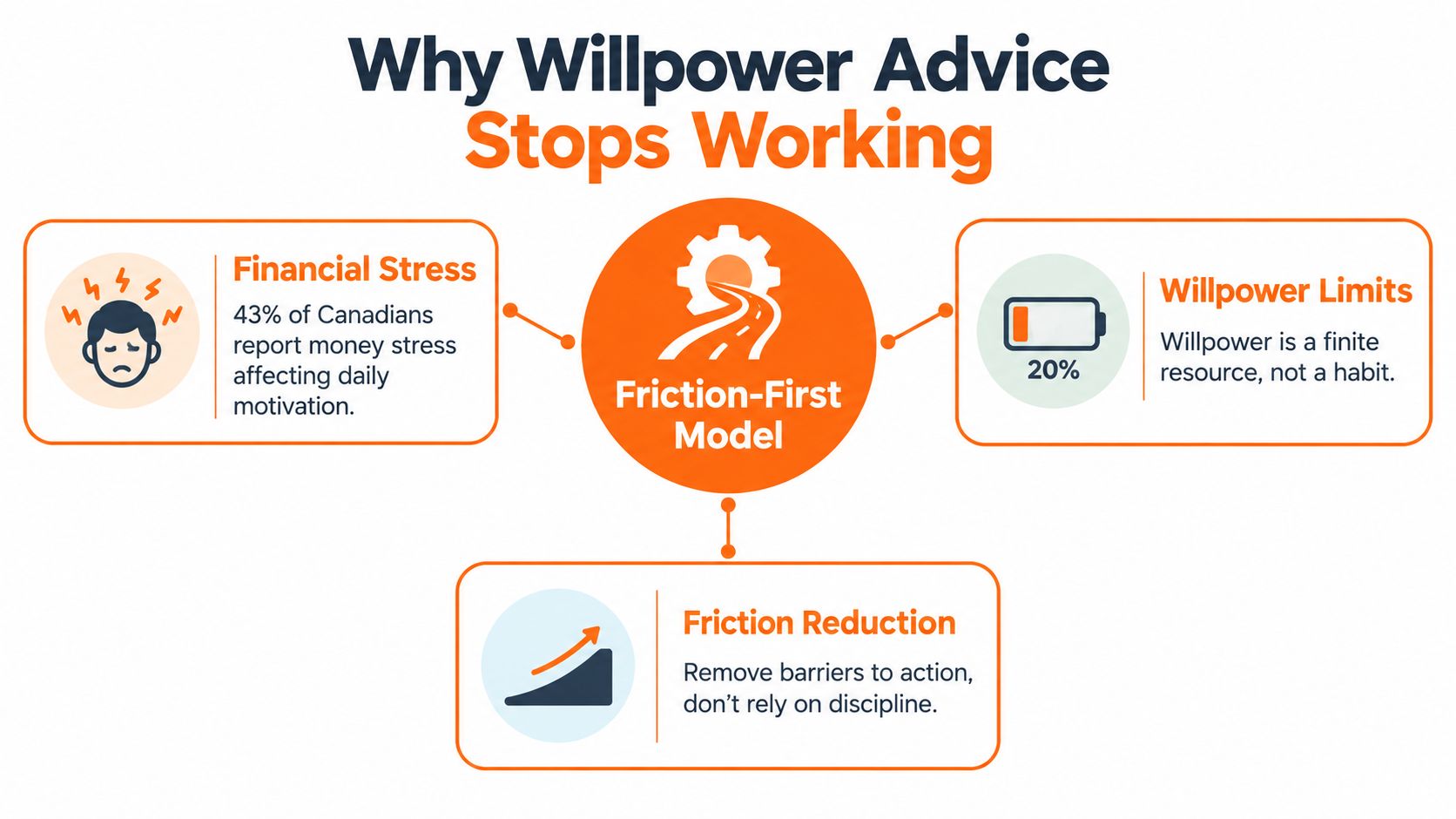
When motivation drops, people often assume discipline disappeared first. I think the opposite is usually true. Progress became invisible, the effort started to feel emotionally costly, and every money decision began asking too much of a tired brain.
The three drains on motivation
The pattern usually comes from three forces working together.
Overwhelm beats intention
A budget doesn't fail because you forgot how maths works. It fails because there are too many moving parts, too many categories, and too many decisions arriving when you're already stretched thin. That's why good systems reduce choices at the moment of action.
If decision fatigue is part of the problem, this plain-language piece on decision fatigue from The Sleep Consultant is worth your time. It explains why repeated choices wear people down, even when the choices are small.
Invisible progress kills effort
Motivation rarely survives staring at a distant goal with no proof that today's behaviour matters. Saving, debt payoff, and spending control all feel better when progress is visible in small increments. If progress is hidden, your brain reads the effort as pointless.
Looking at the numbers can feel punishing
This is the one many money articles ignore. For a lot of people, opening the app, spreadsheet, or statement doesn't feel neutral. It feels like exposure. If the review process feels shaming, you'll avoid it, even if you know avoidance makes things worse.
The system has to do part of the motivational work. If it doesn't, you'll keep trying to force yourself through friction.
What works better than more effort
The better model is friction first. Don't ask, “How can I become more disciplined?” Ask, “What makes the next money action hard to start?”
Then fix that.
Two tools matter more than almost anything else:
- Implementation intentions, which turn goals into trigger-based actions.
- Closed-loop monitoring, which turns raw tracking into decisions and course correction.
There's strong evidence behind the first one. A review of 94 studies covering about 8,155 participants found that implementation intentions improved goal attainment with an average effect size of d = 0.65 and roughly doubled the odds of achieving goals across health, academic, and workplace settings. That matters because it confirms something coaches see every day. Vague goals drain motivation. Specific trigger-linked actions protect it.
So stop telling yourself to “be better with money.” That's not a plan. It's a guilt sentence.
Use a design that tells you exactly what to do when the moment arrives.
Turn Vague Goals Into If-Then Actions
“Save more” isn't a goal you can follow. It's a wish. The same goes for “stop overspending” or “get my finances together.” These phrases feel productive because they sound responsible, but they give you nothing to do at 8:12 a.m. on payday or 9:30 p.m. when you're about to order takeout.
If you want to learn how to stay motivated, start here. Replace vague goals with if-then actions.
The four-part protocol
Use this sequence every time:
- Pick one measurable target. Not five. One.
- Identify the trigger or obstacle. Payday, grocery shopping, Friday fatigue, a low chequing balance.
- Write the if-then action. “If X happens, then I do Y.”
- Rehearse it in the actual setting. Same app, same day, same context.
The point isn't to sound clever. The point is to remove hesitation.
Here's a clean example for an emergency fund:
If it is payday, then I will move a fixed amount to my emergency buffer before any discretionary spending.
That wording works because it's specific, timed, and actionable. Compare it with “I need to stop being bad with money.” One gives you a behaviour. The other gives you a personality problem.
Avoid the trap of negative-only goals
A lot of people write money goals like this:
- Don't overspend
- Stop wasting money
- Quit impulse buying
Those are incomplete. Your brain needs a replacement behaviour, not just a warning.
Try this instead:
- If I want takeout on a weekday, then I will check my dining category first and choose a cheaper option if I'm close to the limit.
- If I go over my shopping category, then I will pause non-essential purchases until the weekly review.
- If I receive extra income, then I will send part of it to my buffer the same day.
A helpful companion read is this piece on motivation and reward systems from Kohru, especially if you respond better when a system includes visible reinforcement instead of pure restraint.
If-Then Templates You Can Use This Week
| Trigger (If...) | Action (Then...) | Goal It Feeds |
|---|---|---|
| If it is payday | Then I will transfer money to savings before discretionary spending | Emergency buffer |
| If I open a food delivery app | Then I will check my dining category first | Spending control |
| If I feel anxious and want to avoid my numbers | Then I will review just one transaction | Rebuilding consistency |
| If a recurring charge posts | Then I will decide whether it still earns its place in my budget | Cash-flow improvement |
| If I miss a planned contribution | Then I will reschedule the next one during my weekly review | Goal recovery |
Use a real goal, not a moral aspiration
People stay engaged when the target means something to them. That's why short, concrete goals work so well. A first emergency buffer. One category under control. One recurring charge removed. One month with a clean weekly review habit.
If you want ideas for goals that are concrete enough to follow through on, this guide to short-term financial goals that actually feel achievable is a good place to start.
One practical way to set this up is with Fintrack's savings goals, where you can name a target, set an amount and optional date, track contributions, and use progress alerts so the prompt shows up near the moment the action should happen. That matters because motivation is rarely missing in the abstract. It disappears in the moment of decision.
Build a Weekly Review That Actually Changes Behaviour
Tracking alone doesn't fix much. It just produces data. I've seen plenty of people record transactions faithfully and still feel out of control because nothing in their system tells them what to do next.
That's why a weekly review matters. Not a vague promise to “check in sometime.” A fixed, repeatable review that turns information into one adjustment.
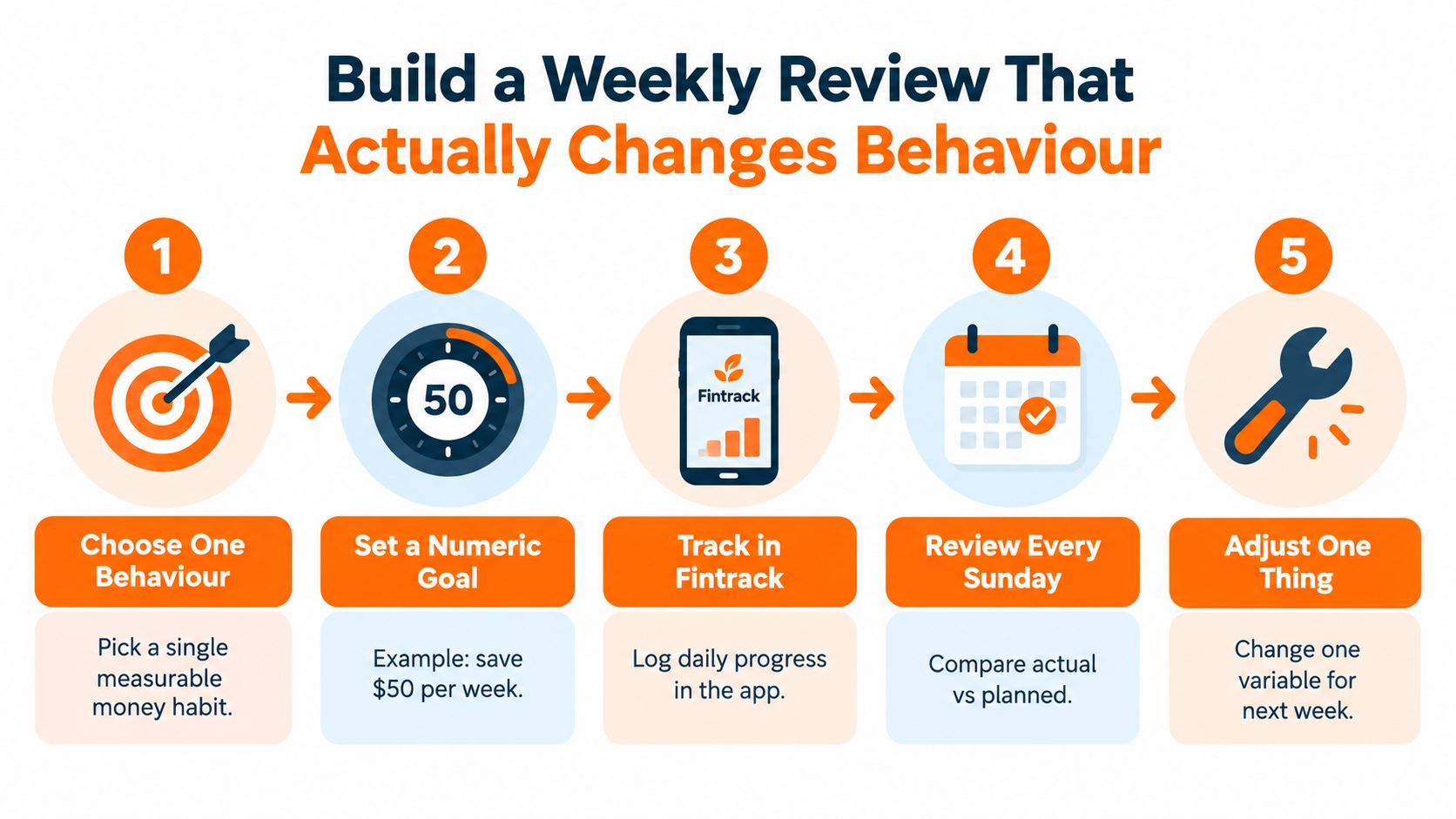
There's solid support for this approach. A meta-analysis involving more than 19,000 participants found that monitoring goal progress significantly increased goal attainment. The useful twist is the closed-loop part. Good tracking shows the target, the current result, the gap, the trend, and the next action. That's what turns a dashboard into behaviour change.
The five-step review
1. Choose one behaviour
Pick one thing that matters right now. Not your whole financial life.
Examples:
- Dining spending
- Weekly savings contribution
- Impulse purchases
- Recurring charges to review
2. Attach a number
If the behaviour has no benchmark, your review will drift into feelings.
Use something like:
- Dining category limit
- Contribution amount per payday
- Maximum number of unplanned purchases
- Number of subscriptions to review this month
3. Record consistently
This doesn't need to be perfect. It needs to be current enough that the review reflects reality.
If you're checking multiple categories, a dashboard that compares plan versus actual is more useful than a transaction list by itself. This breakdown of a budget vs actual dashboard shows why the gap matters more than the raw total.
4. Review at the same time every week
Sunday works well for a lot of people because it gives you a clean reset before the next spending week starts. The key is consistency. The review should happen whether the week was good, bad, or messy.
5. Adjust one thing
People often go wrong here. They review the numbers and then judge themselves. Don't. Change one variable.
What a useful review should show
A helpful weekly money view should answer five questions fast:
Target
What was I trying to do?Current value
What happened?Variance
How far off am I?Trend
Am I improving, flat, or drifting?Next action
What single adjustment do I make now?
Weekly rule: Don't end a money review with guilt. End it with a smaller next move.
A practical readout might look like this in plain language:
Dining spend is near the category limit. The pace suggests you'll run over if nothing changes. Reduce one restaurant meal this week or switch one planned purchase to groceries.
That kind of prompt works because it doesn't ask you to become a new person. It tells you what to do next.
A copy-paste Sunday ritual
Use these three prompts every week:
- What one money behaviour went off track, and what triggered it?
- What one adjustment will I make before next Sunday?
- What progress did I make that still counts, even if the week wasn't perfect?
That last question matters. People abandon good systems because they only notice failure. A closed loop keeps the signal without the shame.
Recovering After a Bad Week Without Quitting
A bad week usually doesn't start with recklessness. It starts with one tired decision. Dinner gets ordered twice. A bill lands earlier than expected. A subscription renews. A grocery trip runs high. Then you look at the account, feel that drop in your stomach, and decide you've blown it.
That's the dangerous moment. Not the overspending itself. The story you tell after it.
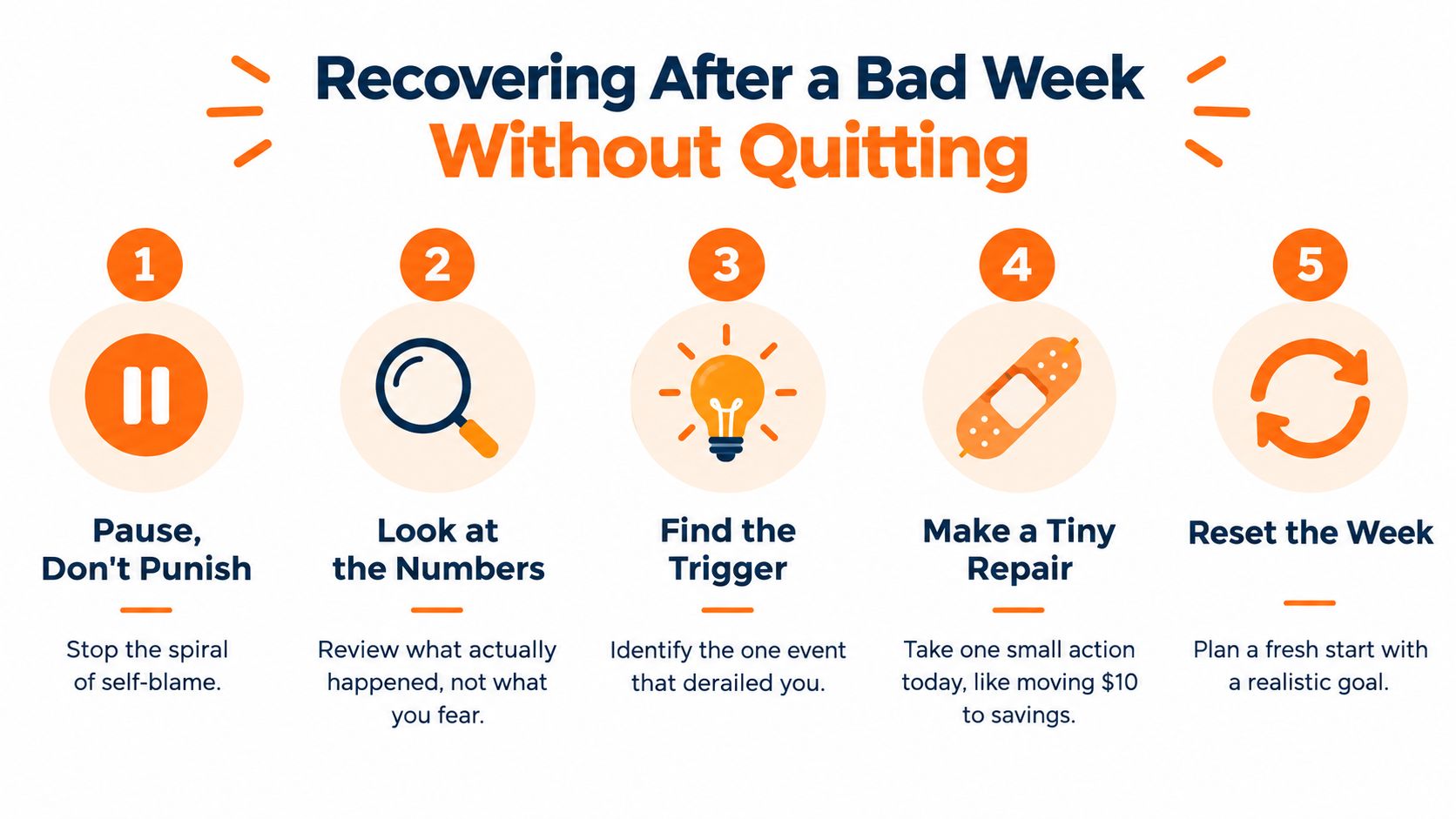
When people quit mid-month, they usually aren't responding to the numbers. They're responding to shame. And shame is lousy at producing useful adjustments.
Ask three diagnostic questions
When a week goes sideways, don't make a character judgment. Run a diagnosis.
Was the goal too aggressive?
A target that looks good on paper can still be unrealistic in your actual life. If your category limit or savings contribution keeps breaking under normal conditions, the problem may be the setup, not your effort.
Did the trigger mismatch the week I actually had?
A good if-then plan fits your real routines. If the action was supposed to happen at a time when you're always rushed, distracted, or depleted, rewrite the trigger.
Did a hidden expense eat the buffer?
This one gets missed constantly. Forgotten subscriptions, duplicate charges, annual renewals, expiring credits you never used, and small recurring costs can wreck a tight month.
Reclaim cash before demanding more discipline
Here people need practicality, not a pep talk. The Financial Consumer Agency of Canada found that only 47% of Canadians saved often or very often for unexpected expenses, and about one in seven often used credit to buy necessities such as food after running short. When money is that tight, reclaiming existing value matters more than trying to summon fresh willpower.
So after a bad week, look for money you can recover:
- Recurring charges you no longer use
- Unused credits or perks already available to you
- Expiring offers or loyalty value you forgot about
- Duplicate or unusual transactions that need attention
That's also why cleaning up spending leaks matters so much. If you need help spotting the patterns, this guide on how to stop overspending without relying on guilt gives a more practical approach.
A setback is data. Use it to adjust the system that produced the week.
One of the smartest recovery moves is surprisingly boring. Don't try to “make up” for a bad week with an extreme reset. Remove one drag, lower one category, reclaim one piece of lost value, and restart the loop. That's how people keep going long enough to see progress.
Your 14-Day Starter Plan and What to Do Next
Motivation gets stronger when the actions are small, visible, and repeatable. That's the whole game. Not intensity. Not perfect budgeting. Repetition with less friction.
A good sign you're on the right path is that your plan feels almost too simple. That's fine. Simple beats abandoned.
Your 14-day reset
Use this for the next two weeks.
Daily non-negotiables
- Review one money item. One transaction, one category, or one upcoming bill.
- Do one tiny planned action. A transfer, a category check, a subscription note, or a saved receipt.
- Name tomorrow's trigger. Decide in advance when the next money action will happen.
Each should take under two minutes.
Two weekly rituals
Sunday review
Use the three prompts from the weekly review section. Keep it short. Keep it factual.
Wednesday reset
Mid-week, check whether your if-then action fired. If not, rewrite the trigger while the week is still salvageable.
One monthly check-in
At month-end, ask:
- Which goal still feels meaningful?
- Which category needs a more honest benchmark?
- What hidden value did I miss?
That “meaningful” part matters. A 2024 BMO/Ipsos survey of 3,404 Canadian adults found that 69% had already set financial goals, with retirement at 58%, saving for a vacation at 47%, and paying down debt at 40%. Concrete goals hold attention better than abstract instructions.
If the heaviness around money is tied to something deeper than budgeting, it's worth getting support that deals with the emotional layer too. This overview of depression treatment options in Vernon from Interactive Counselling is a useful reminder that avoidance and exhaustion aren't always just “bad habits.”
If you want a practical next read, this article on choosing a savings goal tracker app that keeps progress visible fits well with the system above.
Reduce friction. Install if-then actions. Review weekly. Treat slips as feedback. That's a much more reliable answer to how to stay motivated than waiting to feel inspired.
If you want one place to put this into practice, Fintrack gives you goal tracking, transaction visibility, alerts for unusual activity and recurring charges, a Benefits Wallet for unused credits and perks, and an AI assistant that helps you review your money without digging through everything yourself. Start with one simple goal, one trigger, and one weekly review, then let the system carry more of the load than your willpower does.